The teal-blue roofs first appeared in the 1930s, a promise of rest and sweetness along the long, hot roads of the American South. At its peak in the late 1960s and early 1970s, Stuckies operated roughly 368 stores across more than thirty states. For a generation of families packed into station wagons, heading south toward Florida or simply crossing the countryside, the sight of that roof meant clean restrooms, a hot meal, gasoline, and aisles of irresistible souvenirs. Most importantly, it meant the Stuckies Pecan Log Roll—vanilla nougat wrapped in caramel and rolled in Georgia pecans, the perfect treat for a long car trip.
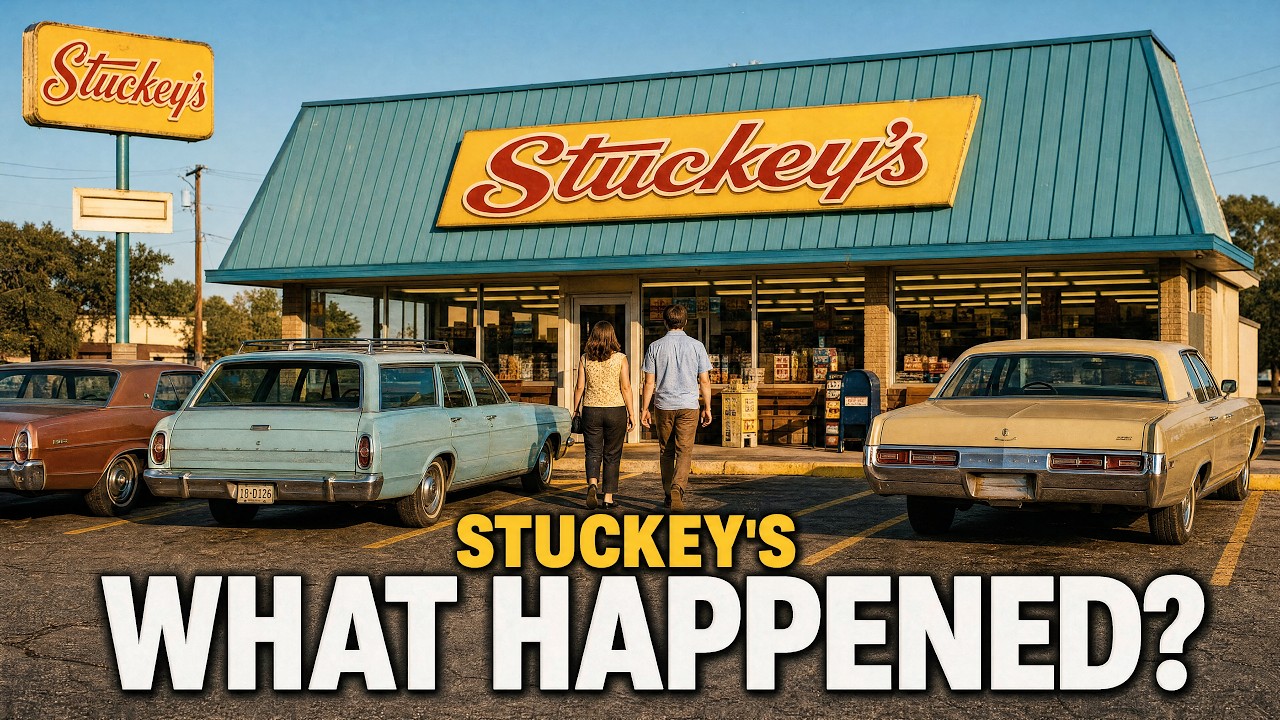
Miles of billboards counted down the distance to the next store, building anticipation until the teal roof appeared on the horizon and a tired, cranky carload felt a jolt of joy. Stuckies was not just a rest stop; it was a destination in itself, a small event in the middle of a long drive. Today, only a small handful of the original standalone stores remain. The billboards are gone, the roofs are gone, and a whole generation has grown up driving the same highways their grandparents drove with no idea they are passing the ghosts of a vanished empire.
The story of how that happened is one of the most poetic tragedies in American business, because Stuckies was killed by the very thing that created it: the road itself. The story begins in Eastman, Georgia, in the depths of the Great Depression, with a young man named Williamson Sylvester Stucky, known to everyone as W. S. or Sylvester.
After one especially bountiful pecan harvest, he had more nuts than he knew what to do with. Watching the steady stream of travelers on Georgia Route 23—many of them snowbirds heading to Florida for the winter—he had a simple, brilliant idea. He set up a humble roadside stand beside the highway and began selling his surplus pecans to passing cars. The travelers bought them faster than he could stock them.
Without fully realizing it, Stucky had discovered the single most important insight of his career: a traveler on a long drive is a captive, restless, slightly hungry customer, and a well-placed stop beside the road offering something good is nearly irresistible. In 1937, with a $35 loan borrowed from his grandmother, W. S. Stucky turned the pecan stand into a real business.
Then his wife, Ethel, added the ingredient that would make it legendary. Using the pecans the business already had in abundance, she began making old-fashioned homemade Southern candy. Her signature creation, developed from a secret family recipe, was a rolled confection of nougat, caramel, and roasted pecans that would become one of the most famous road-trip treats in American history: the Stuckies Pecan Log Roll. It traveled well, lasted for miles, was easy to eat in a car, and was the kind of treat a family would buy several of—one for now, a few for the road ahead.
The business grew. Stucky moved out of the lean-to into a real store, then began building more. In 1941, the company opened its first out-of-state location in Hillyard, Florida—a hugely symbolic step, since Florida was the promised land at the end of all those long Southern drives. With each new store, Stucky understood better that he was not really in the pecan business or even the candy business.
He was in the business of serving the traveler. The stores grew to offer everything a road-weary family could want: clean restrooms, a genuine luxury in that era; gasoline; hot meals at a lunch counter; and, above all, the souvenirs. Rubber snakes, skin caps, back scratchers, snow globes, shot glasses, Elvis memorabilia—it was a paradise for a bored child in the back seat, and it was brilliant business, because these little novelties carried enormous profit margins and turned a quick pit stop into an extended shopping experience. The whole thing was wrapped in unforgettable branding: the teal-blue roof, chosen to be instantly recognizable from a distance at highway speed, and hundreds of billboards lining the highways for miles in every direction, building anticipation with folksy messages promising pecan log rolls and clean restrooms ahead.
Stuckies understood the psychology of the road as well as anyone ever has—the boredom, the restlessness, the near-magnetic pull of a promised treat. Then came the thing that turned Stuckies from a successful Southern chain into a national empire: the interstate highway system. In 1956, the Eisenhower administration passed the Federal Aid Highway Act, launching construction of a vast network of high-speed roads that would transform American travel forever. In the early years, this was the greatest gift Stuckies could have received.
Suddenly there were enormous new volumes of traffic, more Americans driving more miles than ever before. Stuckies expanded aggressively, planting its teal-roofed stores along the new interstates, spreading from dozens of stores to hundreds across more than thirty states, from Connecticut to Oregon. By the late 1960s and early 1970s, it had reached its peak of around 368 stores and become one of the true icons of American roadside culture. But hidden inside that triumph was the seed of its destruction.
The interstate system that gave Stuckies its golden age was, in the 1950s and early 1960s, still a young and incomplete thing. As it matured, its very design turned against the roadside stop. In the era when Stuckies rose, much of American highway travel was still on older two-lane roads that ran directly through the heart of every town and past countless roadside businesses. A traveler was intimately connected to the roadside; pulling in required nothing more than easing off the gas and turning the wheel.
But the interstate was built for the opposite purpose: speed, efficiency, non-stop travel. It was a limited-access road, where cars could only get on and off at designated interchanges, often miles apart, and it was designed to bypass towns entirely, routing traffic around them so a driver could travel for hundreds of miles without ever slowing down or passing a single storefront. That design was a quiet catastrophe for Stuckies. In the old world, traffic passed right by the door.
In the new interstate world, the traveler had to be actively persuaded to leave the highway. Every year, as the interstate system was completed and perfected, it got easier to just stay on the highway and blow right past. The old way, stopping was the default; driving past took effort. The new way, driving past was the default; stopping took effort.
That complete inversion flipped the roadside business model permanently against Stuckies. Worse, the maturing interstate created a brutal new competitor: the exit-ramp cluster of national fast-food chains, gas stations, and convenience stores. When a driver took an exit, they were greeted by the golden arches and familiar gas brands, all clustered right at the interchange, offering faster, cheaper, more predictable service. Stuckies, with its sprawling stops and sit-down food, suddenly looked slow and old-fashioned.
Right at that vulnerable moment, when the company most needed sharp, committed leadership, Stuckies fell into the hands of owners who did not care about it. Back in 1964, near the height of its success, the company had merged with Pet Milk Company, a large dairy corporation, in a deal worth around $12 million, to gain capital for expansion. For a while it worked. But the real disaster came in 1977, when two things happened at once: W.
S. Stucky Senior, the founder, died, and Pet Milk itself was bought by a large conglomerate called Illinois Central Industries. Now Stuckies was buried three layers deep inside a giant industrial conglomerate, whose leadership had no attachment to teal roofs or pecan log rolls. To that distant corporate ownership, Stuckies was just an underperforming asset, a collection of aging roadside stores struggling as the interstate changed the travel landscape.
So the conglomerate did what distant corporate owners do: it began to close them. Through the late 1970s and into the 1980s, stores were closed by the hundreds, the billboards came down, and the brand faded from the highways where it had once reigned. There were other blows in these years. The oil crises of the 1970s, with gas shortages and spiking fuel prices, struck directly at a business that depended on Americans taking long, leisurely road trips.
As air travel became more affordable, more families flew to their destinations instead of driving. Every trend pointed the same direction: fewer people making the kind of long, unhurried highway trip that Stuckies was built to serve. Then, in 1984, the founding family came back to fight for it. W.
S. “Billy” Stucky Jr. , the son of the founder and a five-term United States congressman from Georgia, bought the company back from the conglomerate. He understood that the era of the big standalone teal-roofed destination stop was probably over, so he pioneered a new concept: Stuckies Express, a store within a store.
Rather than operating its own huge stops, Stuckies placed its brand, its pecan log rolls, and its candy inside existing gas stations, convenience stores, and travel centers that already had the traffic. Under this model, the brand rebuilt its presence to over 160 locations across seventeen states. But the deeper wound never fully healed. The soul of the thing—the standalone destination, the experience, the teal-roofed event in the middle of a long drive—had been a casualty of the interstate, and no clever store-within-a-store concept could resurrect it.
The Great Recession struck in 2008 and 2009, and in 2009 it forced the closure of the original Stuckies Candy Plant in Eastman, Georgia, the factory dating back to 1948 where the company had made its famous candy for generations. After that, the pecan log rolls were produced by outside vendors. In recent years, the founder’s granddaughter, Stephanie Stucky, bought the struggling company back into family hands once again, working with passion to revive the brand, selling the candy online and through surviving stores. The pecan log roll is still made, and a modest number of stores remain, most of them express locations inside other businesses, with only around a dozen or two of the classic standalone stores still standing.
So what killed Stuckies? The answer is unusually elegant and unusually sad. Stuckies was killed by the highway, by the very thing that had created it. The whole empire was a creature of the road, perfectly adapted to a particular way of traveling.
Then the road itself changed, evolving into a limited-access, town-bypassing, high-speed network designed specifically to keep travelers moving and separate them from the roadside. The exact same force that built the empire in one era destroyed it in the next, simply by maturing into its intended final shape. Stuckies did not do anything wrong. The road it was built beside was rebuilt into a road that flew over and around everything the company was.
The empire of the open road lived and died with a particular American dream—the dream of the family road trip, the romance of the journey. The road built Stuckies, and in the end, a faster, colder, more efficient road left it behind.
