High in the Bavarian Alps above the town of Berchtesgaden, Adolf Hitler built a mountain complex that became the center of Nazi power outside Berlin. The Berghof was never merely a vacation home. By the mid-1930s, Hitler had transformed a modest retreat into a sprawling headquarters where he hosted foreign dignitaries, conducted wartime planning, and governed the Third Reich as its secondary capital. In 1938, British Prime Minister Neville Chamberlain traveled there for talks just before the Munich Agreement.
Hitler spent much of his time at the Berghof after 1941, entertaining his inner circle, screening films in a private cinema, and meeting with the men who would carry out the war and the Holocaust. His companion Eva Braun lived there as mistress of the house, her presence hidden from the German public. The compound grew into a network of buildings that included quarters for SS guards, administrative offices, underground bunkers, and a tea house perched on a neighboring peak. Nearby, Hermann Göring built his own lavish home, and Hitler’s powerful secretary Martin Bormann constructed an extensive complex of his own.
The entire area was designated a restricted zone, guarded and closed to ordinary Germans. Hitler left the Berghof for the last time in mid-July 1944, shortly after the failed assassination attempt against him. He retreated to Berlin, where he would spend his final months in the underground bunker beneath the Reich Chancellery. He never returned to the mountains.
On April 30, 1945, with Soviet forces closing in, he committed suicide. Five days before his death, on April 25, the Royal Air Force sent more than 300 Lancaster bombers to strike the Obersalzberg. They dropped over 1,300 tons of bombs, aiming to eliminate any possibility that Nazi leadership could establish a final redoubt in the Alps. The raid was devastating.
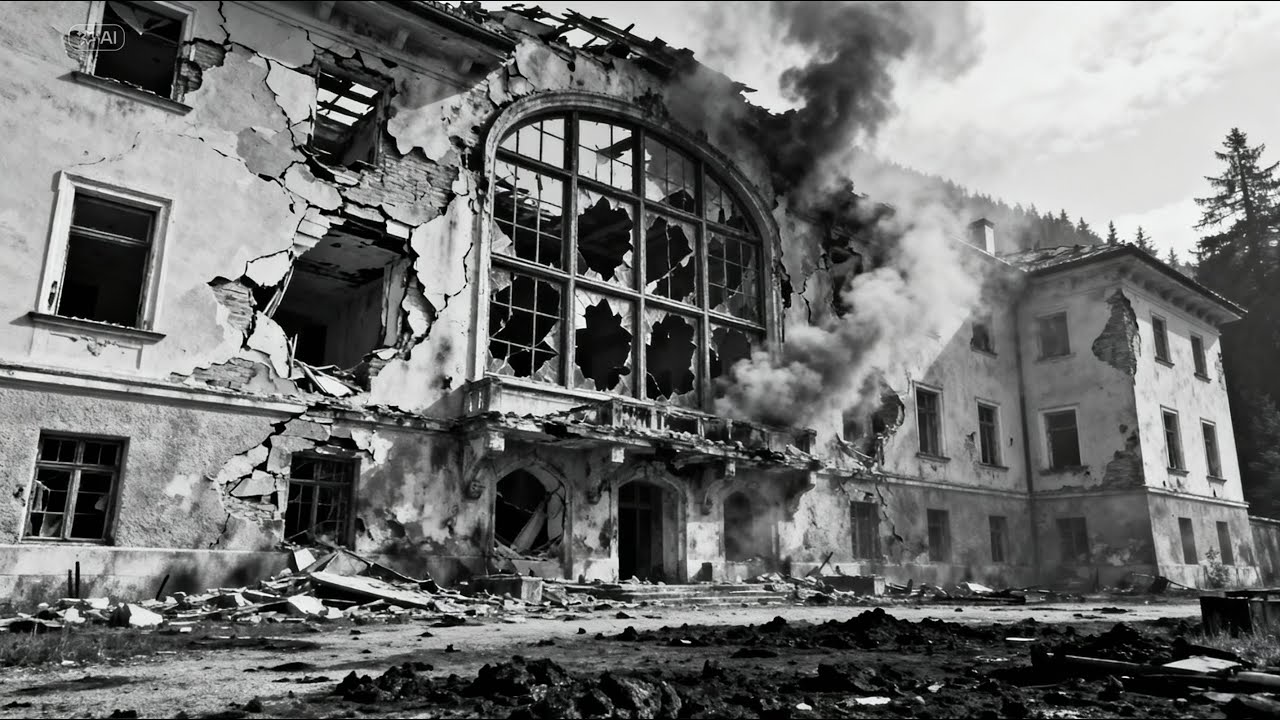
The Berghof was hit repeatedly, its great hall’s vast window blown out, walls collapsed, and fires consumed much of the structure. The complex was left a smoking ruin, though the main building still stood as a shattered shell. On May 4, 1945, four days after Hitler’s suicide, units of the U. S.
Third Infantry Division reached the Obersalzberg. Most SS guards had fled, though scattered exchanges of gunfire occurred before remaining defenders were overcome or slipped into the mountains. What the American soldiers found inside the damaged Berghof astonished them. Despite the bombs and fires, furniture, artwork, personal belongings, and official documents lay scattered among the wreckage.
Almost immediately, looting began. It was not an organized confiscation by military authorities. Soldiers from privates to officers seized whatever they could carry: silverware stamped with Hitler’s initials, paintings, books from his library, furniture, chunks of marble, and fragments of the famous window frame. They took Eva Braun’s clothing, Hitler’s stationery, and bottles of wine from his cellar.
One American officer described complete chaos, with soldiers trying on SS uniforms, passing around champagne from Hitler’s personal stock, and taking axes to furniture too large to haul away so pieces could fit into duffel bags. The globe from Hitler’s study was smashed and its fragments distributed among the men. Photo albums belonging to Eva Braun were torn apart as soldiers claimed individual pictures. Military authorities posted guards and declared the area off limits, but thousands of items had already vanished, destined for attics and basements across America.
Locals from Berchtesgaden soon joined the scavenging. Many had been displaced from their homes to make room for Hitler’s expansion of the area and had lived for years under the shadow of SS guards and party officials. Now they climbed the mountain to claim souvenirs of their own or simply to see the ruins of what had dominated their lives. In the years after the war, American military authorities faced a difficult question: what to do with what remained.
Some proposed preserving the Berghof as a museum or memorial to Nazi tyranny and its defeat. Others argued forcefully for destruction, warning that even ruins could become a shrine for neo-Nazis and Hitler sympathizers. Practical concerns also pressed on the decision. The area was badly needed for housing in a country suffering a severe shortage.
Parts of the less damaged complex were used for American military recreation, and displaced persons from Eastern Europe were housed in some of the remaining buildings. People driven from their homes by Nazi aggression were now living in the ruins of Hitler’s house. The debate dragged on for years. In 1952, seven years after the war’s end, Bavaria’s government made the final decision.
The remaining structures were to be demolished. The demolition proceeded in stages. The Berghof’s remains were blown up and bulldozed, its rubble used as fill or buried. Göring’s house was destroyed, and Bormann’s complex was leveled.
One by one, the buildings of Hitler’s mountain compound were erased from the landscape. The erasure was thorough but not absolute. The underground bunker systems were too extensive and too deeply buried to be removed entirely. Some were filled and sealed; others were abandoned, their entrances blocked or hidden.
The demolition was not complete until the late 1950s. Trees were planted over the site, grass concealed the scars, and roads were removed. The goal was to make it appear nothing had ever stood there. For decades, the policy of erasure largely succeeded.
Visitors to Berchtesgaden were unlikely to know they were near the site of Hitler’s retreat unless they deliberately sought it out. But complete erasure proved impossible. Historians came, curious tourists came, and so did neo-Nazis and Hitler admirers. Bavarian authorities posted no-trespassing signs and occasionally arrested people found on the site, yet interest never died.
By erasing the complex entirely, the authorities had made it more mysterious. With no historical context and no education about what had happened there, the empty hillside required local knowledge even to identify. Some historians began arguing that ignoring the site did not prevent neo-Nazism; it made it easier for misinformation and mythology to take root. In the 1990s, attitudes shifted as Germany confronted how to remember and teach its Nazi past.
In 1999, the Bavarian government opened the Documentation Center Obersalzberg, a museum built near the former Berghof site. The museum does not glorify Hitler. It provides historical context through photographs, documents, and artifacts, showing what the Obersalzberg was, how it functioned as a center of power, and what crimes were planned and ordered from this Alpine retreat. It also addresses the postwar looting, the demolition, and the decades of trying to forget.
Visitors can access parts of the remaining bunker system, descending into the cold, damp tunnels that once housed guards and communications equipment. The site where the Berghof stood is marked but not reconstructed. Visitors stand on a hillside where terrible decisions were made, with the history presented as a warning rather than an inspiration. The Kehlsteinhaus, the tea house that Americans called the Eagle’s Nest, survived both the war and the demolitions because it was remote and relatively undamaged.
It now operates as a restaurant and tourist attraction, with information about its history displayed inside. The thousands of items looted from the Berghof have their own complicated legacy. Many ended up in American homes as family heirlooms. Some have surfaced at auctions and command high prices from collectors, despite the moral questions surrounding Nazi memorabilia.
Others found their way into museums as artifacts of the Nazi period. That debate continues without resolution. One unexpected consequence of the destruction is that the site now holds little symbolic power for neo-Nazis. Without a physical structure Hitler inhabited, there is nothing to rally around, and visitors today are confronted with documentation of Nazi crimes rather than monuments to Nazi authority.
The story of the Berghof after the war reflects how Germany evolved in confronting its history. The initial impulse was to destroy and forget. Concentration camps were torn down or left to collapse, and Nazi sites were abandoned. Over time, that approach changed.
Camps were restored as memorials and museums, and sites were marked and explained rather than hidden. The Berghof site represents that evolution. For five decades it was essentially erased. Now it is a place of education and remembrance, one that says this is where decisions leading to war and genocide were made, and it must be remembered so it is never repeated.
The physical Berghof is gone, demolished and buried, its grand hall and private quarters existing only in photographs. The mountain has been partially reclaimed by nature, though traces of foundations and retaining walls remain for those who know where to look. The history of what happened there, both during the Nazi period and afterward, is now available to anyone who visits the Documentation Center.
The building may be gone, but its history remains, serving as a lesson about power, tyranny, and the importance of remembering even when remembering is painful.
