The torn envelope landed flat on the kitchen table, open side up, empty. The tall man who had done the talking let it fall from his fingers the way a man drops something he believes is already his. Ten thousand dollars, he said. Protection fee.
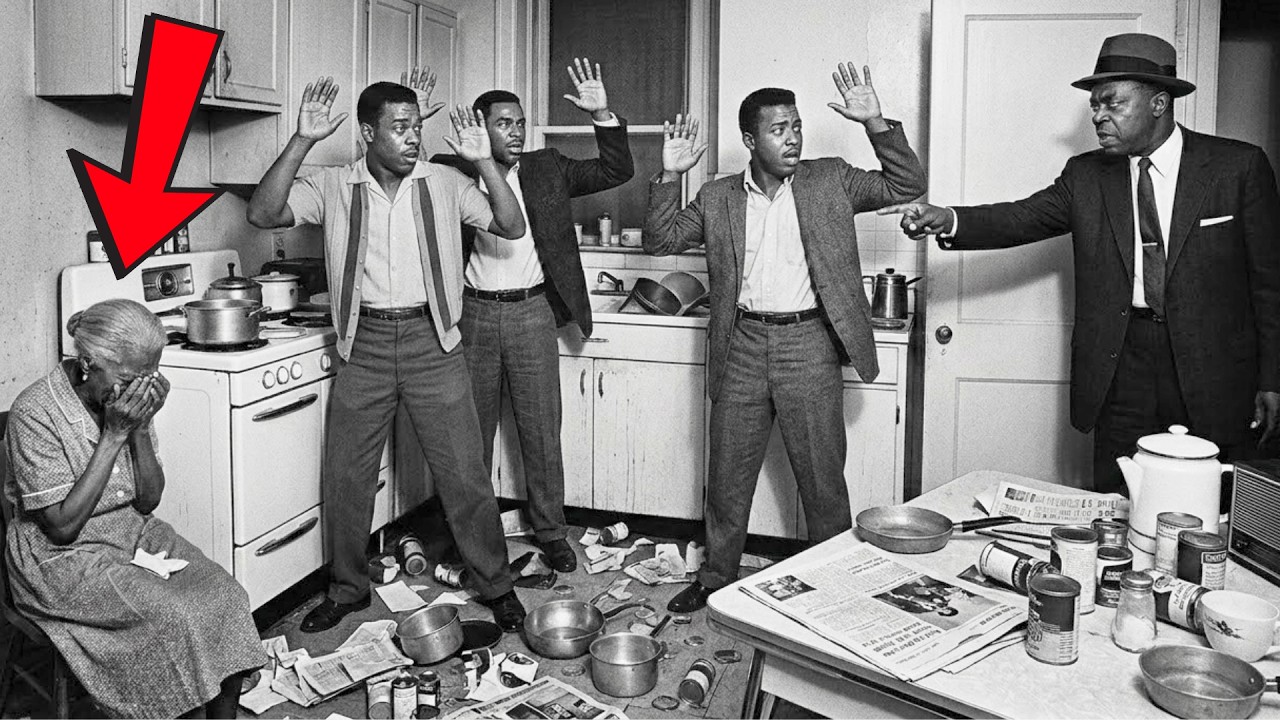
Harlem pays like everywhere else now. The woman across from him did not reach for the envelope. She did not scream. She looked at him the way old Harlem women look at things that disgust them, straight through, as if he were not worth the full focus of her eyes.
You don’t know whose house you’re standing in, she said. The man smiled. It was the smile of someone who had done this a hundred times and never once been wrong about the outcome. We know exactly whose house this is, he said.
That’s why we’re here. The date was October 14th, 1937. The address was on 135th Street in Harlem. The woman was Ella Johnson, sixty-one years old, a widow who had lived in that neighborhood since 1919 and raised her children in rooms that smelled like cast iron, hair grease, and Sunday prayer.
She was not a woman who scared easily. She had buried a husband, survived the Depression, and watched her neighborhood change hands a dozen times without flinching. But when three large men filled her kitchen doorway without warning, she went still. Eight minutes was all the men needed.
They found her savings hidden the way poor people hide money, in places that seem invisible until someone knows to look. A coffee tin above the stove. A folded cloth behind the sugar jar. A small envelope taped beneath the second drawer of the kitchen dresser.
Ten thousand dollars, a lifetime of careful, quiet accumulation, gone in eight minutes. They left the torn envelope on the table. A message. A calling card.
We were here, it said. We took what we wanted, and there is nothing you can do about it. The door closed behind them. Ella Johnson stood in her kitchen for a long moment.
The cast iron pan was still warm on the stove. The radio in the next room played something slow and far away. The coffee tin above the stove sat open and empty like a wound. She picked up the telephone.
The call reached her son at 22:31, fourteen minutes after the men left. Bumpy Johnson was at a card table on Lennox Avenue, three blocks north, in a back room that smelled like cigarette smoke, hair oil, and the particular tension that lives in rooms where serious men make serious decisions. He answered on the second ring. He listened without speaking.
The people in the room later said they watched his face for a reaction and found nothing. No jaw tightening. No eyes going hard. No hand gripping the receiver tighter.
Just stillness, the kind that comes not from calm, but from a man who has learned to keep his interior completely separate from his exterior. When his mother finished speaking, Bumpy asked one question. Who sent them? Not “Are you hurt?
” Not “How much did they take? ” Not “I’m going to kill them. ” Just: who sent them? Because Bumpy Johnson understood something the three men in Italian leather shoes did not.
This was not a robbery. A robbery is random. A robbery is opportunity. This was deliberate, calculated.
Someone had chosen that address on purpose, chosen that woman on purpose, chosen that specific night on purpose. This was a test. Someone powerful wanted to know if Harlem would absorb the hit and stay quiet. Bumpy set the receiver down.
He did not explain to the men at the card table. He did not raise his voice. He did not reach for the pistol that was never more than eighteen inches from his right hand. He sat still for eleven seconds.
The men in the room counted later. Eleven full seconds of absolute silence while Bumpy Johnson processed what had been done and began quietly to decide what came next. Then he stood, buttoned his jacket, and walked out into the Harlem night. The bar was called Sal’s, though nobody who drank there regularly called it that.
They called it the Corner, because it sat at the corner of 132nd and 7th, and because names that stick in Harlem are always the names that tell you exactly what a place is without dressing it up. It kept its front windows painted halfway up, enough light to look open, not enough to see inside clearly from the street. The jukebox played loud enough to cover conversation, but not loud enough to cover trouble. At 23:19, the crew that had visited Ella Johnson’s kitchen was inside.
Four of them now, the original three plus a fourth who had been waiting at the corner during the job. They were drinking, not celebrating exactly, but loose, comfortable, the particular ease of men who have done something and gotten away with it cleanly. The tall one, the talker, had ordered a second bourbon. He was explaining to the fourth man what Ella Johnson had said when they walked in, doing the voice.
The table was laughing. At 23:21, the front door opened. The jukebox was playing Billie Holiday, something slow and aching, the kind of song that makes a room feel smaller than it is. The room did not go silent all at once.
It went silent the way a fire goes out from the edges first, then the center. The men closest to the door stopped talking. Then the men at the bar. Then the men in the back booths.
Then the jukebox seemed quieter, though nobody touched it. Bumpy Johnson stood in the doorway. He was alone. No bodyguards.
No backup waiting outside. No visible weapon. He wore a dark suit, jacket buttoned, hat level. He looked like a man who had simply decided to have a drink.
Except for his eyes. His eyes moved across the room with the slow, complete attention of a man taking inventory. Not scanning for threats. Not checking exits.
Counting, cataloging, filing every face, every position, every glass on every table into some internal record that would not be forgotten. He found the crew’s table in four seconds. He walked toward it. The crowd at the bar did not part dramatically.
They simply adjusted, shifted, created space without being asked, the way water moves around something that has decided to pass through it. The tall one looked up when Bumpy reached the table. His bourbon glass was halfway to his mouth. He set it down.
Bumpy Johnson, he said, the way men say names when they want to sound like the name doesn’t mean anything to them. Bumpy pulled out the empty chair across from him and sat down. He did not ask permission. He placed both hands flat on the table, fingers spread, and looked at the man directly.
You went to my mother’s house tonight, Bumpy said. It was not a question. His voice was low, conversational, the volume of a man discussing weather or baseball. The men at the nearest tables strained to hear without appearing to strain.
The tall one leaned back. He was doing the math. Four of his men. One of Bumpy.
Public location. Lots of witnesses. The math said he was in a strong position. The math said the smart play was confidence, business.
Harlem’s expanding its obligations, the tall one said. Nothing personal. You took $10,000 from a sixty-one-year-old woman in her kitchen, Bumpy said. You left a torn envelope on her table.
Like I said, business. Bumpy nodded slowly. He looked down at his own hands on the table for a moment, then back up. I’m going to ask you something, he said.
I want you to think carefully before you answer, because the answer matters more than you understand right now. The tall one said nothing. Something in the air of the room had shifted. He could feel it without being able to name it.
Who told you to go to that address? Bumpy asked. The tall one smiled, slow and deliberate, the smile of a man who thinks he holds cards. Above my pay grade to say, he said.
Bumpy looked at him for a long moment. Then he stood, buttoned his jacket, straightened his hat. All right, he said quietly. He walked back through the bar.
The crowd adjusted again. The door opened and closed. The jukebox kept playing. Billie Holiday, still aching, still slow.
The tall one picked up his bourbon and finished it. He said something to the table that made two of the four men laugh. He was performing confidence now, louder than before, a little too loose. But the bartender, who had been behind that bar for eleven years and had seen things he would never repeat to anyone, said later that the room never went fully warm again that night.
It stayed cold from the moment the door closed. A fool reaches for a gun first. A dangerous man reaches for information. Bumpy Johnson had just left that bar with everything he came for, and the crew at that table didn’t know he’d taken a single thing.
By midnight, Bumpy was in a room on the third floor of a building on 131st Street that did not appear on any lease or city record. The room had one window painted shut, one bare bulb hanging from a cord in the center of the ceiling, a wooden table, four chairs, and a telephone with a line that ran through the building’s walls in a way no city inspector had ever traced. Three men were already there. These were not soldiers.
They were not muscle. They were the kind of middle men who never appear in newspapers and whose names never come up in police reports. Men who knew how money moved, who was connected to whom, which captains talked to which commissioners, and where the seams in the city’s official story didn’t quite line up. Bumpy sat down and laid it out flat.
Three men went to my mother’s house tonight. Italian, well-dressed. They knew the address. They knew the hiding places.
They had a number, $10,000, before they walked in. This wasn’t improvised. The man to his left, a thin, quiet man who had spent fifteen years moving information between Harlem and Lower Manhattan, nodded slowly. That number is specific, he said.
They didn’t guess it. No, Bumpy said. They didn’t. The silence in the room settled like weight.
A crew acting alone doesn’t walk into Bumpy Johnson’s mother’s house. A crew acting alone doesn’t know her address, doesn’t know the amount, doesn’t choose that specific woman on that specific street, unless someone above them has decided this particular move is worth the particular risk it carries. This was not a robbery. This was reconnaissance, a probe.
Someone at a much higher level of the city’s criminal infrastructure had decided to test Harlem, to see how much pressure it would absorb before it bent. And they had chosen the most personal possible target to make the test as sharp as possible. Touch a king’s money and he gets angry. Touch a king’s mother and you find out what he’s made of.
The thin man pulled a folded piece of paper from his jacket and placed it on the table. There’s a capo operating out of Red Hook, he said. Name’s Carmine Falcone. He’s been making moves uptown for eight months.
Small things. A numbers runner here. A supplier agreement there. Testing the edges.
He’s the one who sent them. Bumpy asked, He’s the one who approved it, the thin man said. There’s a difference. Bumpy understood immediately.
Falcone didn’t send the crew because he wanted $10,000. Ten thousand meant nothing to a capo with Red Hook’s operation behind him. Falcone sent the crew because he wanted to know if Bumpy Johnson would respond, and how. He wanted to map the reaction, study it, use it to decide how far he could push before pushing became a problem.
The test wasn’t the robbery. The test was what happened after the robbery. Bumpy stood and walked to the painted-shut window. He looked at the dark glass, his own reflection looking back at him, the bare bulb behind his head like a halo made of low light.
He wants to see what I do, Bumpy said. Yes, the thin man said. Then we’re going to show him something he’s not expecting to see. What Bumpy did next was not what anyone in that room anticipated.
He did not send men to Red Hook. He did not reach out to Falcone directly. He did not make a move that could be observed, reported, and analyzed. Instead, he started lying carefully, deliberately, the way a surgeon cuts with precision and a clear understanding of anatomy.
He put three separate stories into three separate mouths. Each story slightly different. Each designed to travel through a specific channel. One moved through the numbers runners on the west side.
One moved through a contact at the 32nd precinct. One moved through a Sicilian-connected supplier who maintained relationships with both sides of the color line in Harlem. Each story described a different version of Bumpy’s response to the robbery. In the first, Bumpy was furious and planning immediate retaliation, a reckless, emotional response that would be easy to predict and prepare for.
In the second, Bumpy was negotiating quietly, willing to accept the new arrangement in exchange for certain guarantees, the response of a man who could be managed. In the third, Bumpy had already moved his mother out of Harlem entirely and was preparing to go to ground himself, the response of a man who was afraid. Three stories. Three channels.
Three different pictures of Bumpy Johnson, all of them false. The real Bumpy sat in that room on 131st Street and waited to see which story Falcone believed. Because whichever one Falcone acted on would tell Bumpy exactly which channel was compromised, exactly who was feeding information downtown, and exactly how deep Falcone’s reach into Harlem actually went. By Wednesday, two of the three stories had made it back to Bumpy through sources he trusted.
The third had gone quiet, disappeared. Which meant the third channel was clean, and the other two were not. One of Harlem’s police contacts. One of the numbers runners on the west side.
Bumpy had names now. Not Falcone’s name, not yet, but the names of the channels Falcone was using, the seams in the network, the places where information was leaking from Harlem’s interior into Italian hands. The men in that room later said Bumpy did not react visibly when the picture became clear. He just sat with it, let it settle, let the full shape of what he was dealing with come into focus without rushing toward the conclusion.
Then he said something none of them forgot. He thinks he’s watching me, Bumpy said quietly. He doesn’t know I’ve been watching him. Real power doesn’t announce itself.
Real power begins the moment your enemy has no idea what game you’re playing. The name came on a Thursday morning. Not from a detective. Not from a rival crew.
From a fourteen-year-old boy who ran numbers on the west side of 131st Street and who had, without understanding what he was carrying, delivered a message to the wrong address three weeks before the robbery. The thin man brought the information to Bumpy at seven in the morning. Bumpy was eating breakfast, eggs, black coffee, toast with no butter. The thin man sat down across from him and placed a single folded piece of paper on the table next to the coffee cup.
Bumpy looked at the paper, then at the thin man. Say it. The address came from inside, the thin man said. Someone in your network sold it.
The amount, the hiding places, the timing, all of it. Whoever went into your mother’s kitchen knew exactly where to look, because someone who had been inside that kitchen told them. Bumpy set down his fork. The kitchen they were sitting in smelled like coffee and cast iron in the particular staleness of a Harlem morning that hasn’t fully woken up yet.
A radio somewhere in the building above them was playing the news, the announcer’s voice thin and distant through the ceiling, like something coming from another world. Bumpy did not speak for four minutes. The people who were in that room later swore to it. Four full minutes of silence while Bumpy Johnson sat with both hands flat on the table, his breakfast going cold in front of him, his eyes fixed on a point somewhere between the paper and the wall that nobody else in the room could locate.
Four minutes is a long time to sit in silence with a man who has just learned that someone he trusted sold his mother’s kitchen to the Italian mob. The thin man did not fill the silence. He had known Bumpy long enough to understand that filling that particular silence would be the wrong thing to do. When Bumpy finally spoke, his voice was exactly the same volume and temperature it had been before the silence.
That was the thing that stayed with the thin man for the rest of his life. Not the silence. But the fact that Bumpy’s voice came back out of it completely unchanged. Who is it?
Bumpy asked. The thin man told him. The name belonged to a man who had been in Bumpy’s organization for six years. A man who had eaten at Bumpy’s table, who had been trusted with routes and addresses and the kind of operational detail that only people at a certain level of trust ever learn.
A man who had a gambling problem that had quietly grown over the past eighteen months into something that required outside money to manage. That outside money had come with conditions. He’s been feeding Falcone’s people for four months, the thin man said. The address was the biggest thing he gave them.
Before that, it was smaller things. Routes, schedules, a few supplier contacts. Bumpy picked up his coffee cup. He took a slow sip, set it back down.
Does he know we know? Bumpy asked. No, the thin man said. Good, Bumpy said.
Keep it that way. The thin man said later that something shifted in the room when Bumpy said that word. Something that felt less like relief and more like a door closing on a particular version of what was about to happen. The version where the traitor died quickly was gone now.
Bumpy had just replaced it with something else, something slower and more deliberate. The thin man understood without being told that the man who had sold Ella Johnson’s address was not going to be killed today, or tomorrow, or any day soon. A dead traitor gives you nothing. A living traitor who doesn’t know he’s been discovered is the most valuable asset in any war.
Bumpy pushed his plate aside. The eggs were cold. He didn’t care. I want to know every piece of information he’s passed downtown in the last four months, Bumpy said.
Every route he knew, every name he could have given. I want to know exactly how much of my operation Falcone thinks he understands. That’ll take a few days, the thin man said. Take three, Bumpy said.
And I want him watched. Every move, every meeting, every telephone call, if you can get close enough. He is not to be touched. He is not to be spooked.
As far as he is concerned, nothing has changed. The thin man nodded. There’s something else, he said. He hesitated, not from fear exactly, but from the particular discomfort of delivering a second piece of bad news inside the same conversation as the first.
The west side numbers runner, the channel that went quiet when you ran the three stories. We found out why it went quiet. Bumpy looked at him. Falcone didn’t use it, the thin man said, because he already knew it was being tested.
Someone told him you were running a bait operation. The room went very still. The traitor hadn’t just sold an address. He had sold the counter-intelligence operation too.
He had watched Bumpy set the trap, and then quietly told Falcone a trap was being set. Bumpy was quiet for a long moment. Then something happened that the thin man had seen only twice before in six years of working with Bumpy Johnson. The corner of Bumpy’s mouth moved.
Not a smile, exactly. Something smaller, colder, the expression of a man who has just realized the situation is worse than he thought, and has decided this fact makes it more interesting rather than less. Good, Bumpy said again. That means Falcone thinks he’s ahead.
He stood up from the table. Let him think that for three more days. An outside enemy can be fought, managed, turned back at the border of your territory. But a traitor has already been inside the walls.
He has already eaten your food and learned your rooms and memorized the places where the locks are weakest. An outside enemy threatens your empire. A traitor has already started destroying it from the inside. And the most dangerous part is that he does it quietly, in the dark, wearing your trust like a coat.
By Sunday, Bumpy knew everything. Every route the traitor had sold. Every supplier name. Every schedule adjustment.
Every piece of operational information that had leaked from Harlem’s interior into Falcone’s hands over four months of careful, quiet betrayal. The traitor, whose name was Marcus, though in everything that followed nobody who told this story used his name with anything resembling respect, had been methodical. He had not sold everything at once. He had rationed the information, parceling it out in pieces small enough that no single leak would trigger an investigation.
Smart enough to be dangerous. Not smart enough to understand who he was stealing from. Bumpy sat with the full picture Sunday evening and made the decision that surprised everyone in the room except himself. He was not going to kill Marcus.
Not yet. Possibly not ever, depending on how the next week played out, but definitely not now. The reasoning was precise and cold and completely without sentiment. Marcus was the only living bridge between Bumpy Johnson’s organization and Carmine Falcone’s operation in Red Hook.
As long as Marcus believed his cover was intact, that bridge stayed open. And an open bridge, properly managed, could carry traffic in both directions. Falcone had been using Marcus to move information out of Harlem. Bumpy was going to use Marcus to move something back in.
The room on 131st Street smelled like cigarette smoke and cold coffee when Bumpy laid out the plan. Three men listened. None of them spoke until he finished. The plan was this.
Marcus would be allowed to make his next scheduled contact with Falcone’s people. He would deliver a piece of information real enough to be credible, specific enough to be actionable, about a cash transfer happening on Wednesday night. A large one. The kind of transfer worth sending a crew to intercept.
The transfer would be real. The cash would be real. The route would be real. The crew that showed up to take it would walk into something very much not what they expected.
Harlem that week went quiet in a way people on the street felt before they understood. The numbers runners pulled back slightly. The card games on Lennox Avenue moved indoors. The usual noise of the neighborhood, the arguments, the music spilling from windows, the street-corner debates that ran until two in the morning, damped down to a low hum.
People who lived through that week said later that the silence had texture, that it felt intentional, that Harlem that week felt like a room where everyone was pretending not to notice something that everyone had already noticed. The streetcar on 130th ran on schedule. From three blocks away, in the hushed streets, you could hear its metal wheels on the track like a slow clock counting down. On Monday, Bumpy had a brief, ordinary-seeming conversation with Marcus.
He discussed a numbers route on the west side. He mentioned casually that a cash consolidation was being moved Wednesday night. Too much sitting in too many places. Time to bring it together.
He gave Marcus the route, the time, the amount. He watched Marcus’s eyes while he talked. Marcus’s eyes were steady, practiced, the eyes of a man who had been lying successfully for four months and had begun to believe in his own competence. He nodded at the right moments.
Asked one clarifying question, natural, not suspicious. Said he understood. He understood. All right.
Forty minutes later, through a channel Bumpy’s people were now monitoring completely, the information moved south toward Red Hook. Falcone took the bait Tuesday evening. His response came back through the same channel, not in words but in movement. Two of his regular crew members, tracked by Bumpy’s people, relocated from their usual positions in lower Manhattan and moved toward Harlem.
They took rooms on the west side, paid cash, gave false names that were almost good enough. Almost. Wednesday arrived cold and clear, the kind of October night where the sky above Harlem was hard and black and the stars, when you could see them between the buildings, looked like they had been put there by someone who didn’t care how cold it got down below. The transfer route ran north on 8th Avenue, turned east on 134th, and was supposed to end at a building on the corner of 134th and Lennox.
Three men carrying the cash. A fourth walking a block ahead as a scout. Falcone’s crew positioned themselves at two points along the route, six men total. They had been told it was a straightforward interception.
A disorganized transfer. Lightly protected. Easy money. What they found instead was a route that was empty from the moment they took their positions.
No transfer. No cash. No three men walking north on 8th Avenue. Just Harlem, quiet, watching.
And by the time Falcone’s six men understood the route was a ghost, Bumpy’s people had photographed all six of them, documented their positions, traced two of them back to specific addresses in Red Hook, and connected one of them directly to a meeting with a corrupt officer at the 28th precinct that had happened nine days earlier. Bumpy now had faces, addresses, and a direct line from Falcone’s operation to a specific dirty cop in a specific precinct house. He had gone from knowing Falcone existed to holding the structural map of Falcone’s entire uptown operation in four days. Without firing a shot.
Without tipping his hand. And without Marcus having any idea that he had been used rather than trusted. Marcus was still alive, still in place, still believing his cover was intact. That was precisely the point.
Mercy in this world is rarely about forgiveness. Sometimes keeping a man breathing is the most ruthless decision available, because a man who is alive can keep being useful. And a man who is useful is a man you are not finished with yet. Letting someone live is not always kindness.
Sometimes it is the cruelest possible move on the board. The meeting took eleven days to arrange. Not because either man was difficult to reach, but because a meeting between Bumpy Johnson and Carmine Falcone required the kind of careful, invisible architecture that takes time to build correctly. The wrong intermediary, the wrong location, the wrong sequence of approach.
Any of those could turn a negotiation into an incident before the two men ever sat down together. The location was chosen by Bumpy. A room on the second floor of a building on 133rd Street that had once been a tailor’s shop and was now nothing in particular, a space that existed in the gap between what it used to be and what it hadn’t yet become. No windows.
One door. A table. Two chairs. A single light fixture overhead that threw everything into the flat, honest illumination of a place where there was nowhere to hide your face.
Falcone arrived first. This was deliberate on Bumpy’s part, an invitation structured so that Falcone would naturally arrive before him, sit in that room alone for several minutes, have time to feel the walls and understand that he was on Harlem’s ground. Bumpy arrived at 9:14 in the evening. He was alone.
So was Falcone, or appeared to be. Both men understood that the street outside held people whose job was to make sure the meeting ended with both principles walking out alive. Neither man acknowledged this. Falcone was fifty-three years old.
He had a broad face, heavy around the jaw, and the particular stillness of a man who had spent decades learning to be unreadable in rooms exactly like this one. He wore a gray suit, no tie. His hands were on the table when Bumpy walked in, visible, relaxed, the posture of a man communicating that he had come to talk. Bumpy sat down.
He did not extend his hand. Neither did Falcone. They looked at each other across the table with the careful, assessing attention of two people who have spent considerable time learning about each other without ever being in the same room. Mr.
Johnson, Falcone said. Mr. Falcone, Bumpy said. The room smelled like old wood and dust and the faint chemical ghost of whatever solvents the tailor had used in his work years ago.
Outside, faintly, the sound of Harlem. A car passing. A distant voice. The low pulse of a city that never fully slept.
I appreciate you agreeing to sit down, Falcone said. His voice was measured, courteous, the voice of a man conducting business, not issuing threats. I don’t agree to things that aren’t worth agreeing to, Bumpy said. Falcone allowed himself a small, brief acknowledgment of that.
Not quite a smile, but the movement around his eyes that a smile would make if he permitted himself one. Fair enough, he said. Then I’ll be direct. Harlem is growing.
The numbers, the supply lines, the street-level operation, all of it is larger than it was five years ago. That growth creates adjacency with operations that extend from downtown. Those adjacencies create friction. The visit to your mother’s home was, he paused, chose his word carefully, an overstep by men who acted with more confidence than was warranted.
Bumpy said nothing. He let the almost-apology sit in the air without reaching for it. What I’m proposing, Falcone continued, is a structure. A formal understanding.
Harlem operates as it operates. We don’t cross into your territory without prior arrangement. In exchange, certain supply channels that currently run through Harlem are treated as shared infrastructure. A percentage.
Reasonable. Nothing that changes the fundamentals of how you run your operation. He sat back slightly, the posture of a man who has made what he considers a fair offer and is waiting for the other party to recognize its fairness. Bumpy looked at him for a long moment.
You sent men into my mother’s kitchen, Bumpy said. You used someone inside my organization to get her address. You sent six men to intercept a cash transfer that you thought I didn’t know you were coming for. Falcone’s face did not change, but something behind his eyes shifted.
A micro-recalibration. A rapid internal reassessment of exactly how much Bumpy Johnson knew, and how he knew it. And now, Bumpy continued, you’re sitting in a room in Harlem telling me that the arrangement you’re proposing is peace. It is peace, Falcone said.
His voice was still measured, but the temperature had dropped slightly. Sustainable peace. The alternative creates problems for both of us. Bumpy leaned forward, just slightly, enough to close the distance across the table by a few inches.
Mr. Falcone, he said quietly. I know the name of the officer at the 28th precinct who meets with your people on the second Tuesday of every month. I know the two addresses in Red Hook where you house your uptown crew.
I know the name of every man who stood on a Harlem street corner last Wednesday night waiting for a transfer that was never going to happen. Falcone was very still. I know all of this, Bumpy said. And I haven’t done anything with it yet.
That’s not weakness. That’s me giving you the opportunity to understand the actual situation before you make a decision that becomes difficult to walk back. The room was silent except for the faint sounds of Harlem outside and the almost imperceptible hum of the light fixture overhead. Falcone looked at Bumpy Johnson across the table of that windowless room on 133rd Street, and something moved across his face that was not quite fear and not quite respect, but existed in the territory between them, the place where powerful men go when they realize they have underestimated something significant.
What do you want? Falcone asked. My mother’s $10,000 returned, Bumpy said. By Friday.
No percentage arrangements. No shared infrastructure. No formal understanding. Harlem is not adjacent to your operation, Mr.
Falcone. Harlem is its own country. He stood up. And the next man who knocks on her door without an invitation will be the last mistake anyone in your organization makes uptown.
He buttoned his jacket, settled his hat, walked to the door. Nobody outside that room ever confirmed the meeting happened. No record was ever filed. No intermediary ever spoke publicly about the architecture it took to arrange it.
But Harlem knew, the way Harlem always knows things. Not from newspapers or police reports, but from the particular quality of the silence that follows when something important has been decided behind a closed door. In the world of organized crime, peace between two powers is almost never what it appears to be. It is almost never an agreement between equals who have decided to respect each other.
It is almost always one man telling another man, in the most polite possible language and the most controlled possible voice, exactly how close he came to a decision that would have ended very differently. Peace in this world is usually just surrender with better manners. The morning after the meeting on 133rd Street, Bumpy made three telephone calls. He did not send men.
He did not hold a meeting. He did not issue a formal order. He picked up a telephone and spoke to three people in the quiet, unhurried voice of a man discussing ordinary business on an ordinary morning. By noon, Harlem had changed.
Not visibly. Not in any way a stranger walking up from Midtown would have noticed. The streets looked the same. The storefronts were open.
The numbers runners were still on their corners. The card games were still running in the back rooms on Lennox Avenue. But the money had stopped moving. Not all of it.
Not the money that belonged to Harlem, which kept flowing exactly as it always had through channels Bumpy’s organization had spent years building and maintaining and protecting. What stopped was the money that touched Falcone’s crew. The money that passed through bars and suppliers and street-level operators who had, in the past several months, begun doing small amounts of business with the Italian operation pushing uptown from Red Hook. That money went still, completely, overnight.
The first bar to feel it was Sal’s, the Corner on 132nd and 7th, the bar where the tall one had been drinking bourbon the night Bumpy walked in alone. By Tuesday evening, the bar’s regular crowd had thinned by half. By Wednesday, the suppliers who stocked its back room had quietly delayed their deliveries, pending what they described without elaboration as a scheduling adjustment. The scheduling adjustment did not resolve itself.
The bartender, the same man who said the room never went warm again after Bumpy left that first night, later described what happened that week with the precision of someone who had watched it unfold in real time and understood exactly what he was seeing. It was like a tap, he said. Someone just turned a tap, and the water stopped. Not a flood, not a fire, just off.
And when the water stops, you find out very quickly which parts of the operation actually needed it to run. The answer, it turned out, was all of them. The numbers operation Falcone’s crew had been quietly absorbing on the west side of Harlem over the previous eight months began to seize up within seventy-two hours. The runners who had been working that territory, men who owed their positions to relationships that ran through Bumpy’s network, not Falcone’s, began receiving their collections late, or not at all.
Bets placed on Monday were not confirmed by Tuesday. Winnings owed from the previous week were suddenly subject to delays nobody could explain clearly. Word moved through the street the way bad news always moves in Harlem, fast, and without needing to be spoken directly. The debt books Falcone’s people had been maintaining on the west side disappeared Thursday.
Not stolen. Not destroyed. Simply unavailable. The men who kept them developed sudden and comprehensive memory problems regarding where the books were located.
One of them, a heavyset man who ran a small loan operation out of a barbershop on 134th, told the collector who came asking that the books had been sent to be audited. When the collector asked by whom, the heavyset man looked at him with the patient, unreadable expression of a Harlem man who has been asked a question he has no intention of answering. Audited, he said again. I’ll let you know when they come back.
They did not come back. By Friday, one week after the meeting in the windowless room on 133rd Street, Falcone’s uptown operation was running at roughly thirty percent of its previous capacity. Not because anyone had attacked it. Not because anyone had threatened the men running it.
Simply because Harlem had decided, with complete collective coordination and zero visible organization, that it was no longer available for that particular business. The numbers men who told this story later said they had never seen the neighborhood move like that. Not during the Depression. Not during the war years.
Not during any of the periodic crackdowns the NYPD ran through the community every few years when the newspapers started paying attention. It was like the whole street decided at the same time, one of them said. Nobody told me not to do business with those people. I just knew.
We all just knew. That was the part people outside Harlem never fully understood about how Bumpy Johnson operated. Open commands, visible enforcement, those were for situations that required spectacle. The real power was quieter.
It lived in the thousand small daily decisions the people of Harlem made about who they would do business with, who they would give information to, whose presence they would accommodate, and whose they would make unwelcome without ever saying a word directly. Bumpy did not control Harlem through fear alone. He controlled it because Harlem understood, at a bone-deep level, that his interests and the neighborhood’s interests were the same thing. When he protected himself, he was protecting 135th Street.
When he drew a line, the line protected everyone behind it. So when Bumpy’s three telephone calls quietly communicated that Falcone’s crew was no longer to be accommodated, Harlem did not need to be told twice. It did not need to be told once. It simply adjusted, the way a body adjusts to reject something that doesn’t belong inside it.
The tall one, the man who had drunk bourbon at the Corner and smiled when Bumpy walked away, came back to Sal’s on Saturday night. He sat at his usual table. He ordered his usual drink. He waited for the room to feel the way it used to feel.
It didn’t. The bar was half empty. The men who were there did not look at him. The bartender served him without conversation.
The jukebox played something slow, and the sound of it in the thin crowd felt different from the way it had sounded a week ago. Larger, somehow. Colder. The tall one sat with his bourbon for forty minutes.
Then he paid his tab and left. He did not come back. When money stops moving, it takes everything with it. Confidence.
The casual cruelty. The easy assumption that the territory belongs to whoever has claimed it most recently. Power without economic foundation is just posture, and posture in Harlem in October of 1937 was not something Falcone’s crew could afford to be caught wearing. When the money stops, the power stops breathing.
And something that cannot breathe cannot survive. Of the three men who had entered Ella Johnson’s kitchen on the night of October 14th, Bumpy had identified all of them within forty-eight hours of the robbery. He knew their names, their usual locations, their connections to Falcone’s Red Hook operation. In the case of the tall one, he knew the specific gambling debt that had made him available for uptown work in the first place.
He had not moved against any of them immediately. The economic freeze on Falcone’s operation had been the first move. The meeting in the windowless room had been the second. What came next required a different kind of precision.
The kind that leaves a mark not just on the specific target, but on every person who hears about it afterward. Bumpy did not want violence. Not because he was incapable of it, but because violence in this situation was the wrong instrument. Violence against Falcone’s men would bring the kind of attention that disrupted operations, invited police involvement, and gave Falcone a legitimate grievance to take to his own superiors, a narrative of a Harlem operator who had responded to a business dispute with bloodshed.
What Bumpy wanted was not blood. He wanted an example. And the most durable examples, the ones that last in a community’s memory for decades, are not the ones written in violence. They are the ones written in consequences so precise and so inevitable that everyone who sees them understands immediately that they were not accidental.
The tall one’s name was Vincent Caruso. He was thirty-four years old. He had been working for Falcone’s organization for seven years, starting as a driver and moving up through a series of small promotions that had given him enough authority to lead a crew on a job, but not enough to know the full strategic picture of what that job was intended to accomplish. He owed money.
Significant money. Spread across three separate debts to three separate parties. A private loan arranged eighteen months ago to cover a run of bad luck at cards. A second loan taken out to service the first.
A third obligation that had accumulated quietly while Caruso told himself he was managing the situation. He was not managing the situation. Bumpy’s people had known about the debts for several days. What they did in the week following the meeting on 133rd Street was make certain that the people Caruso owed money to became aware, simultaneously and through channels that could not be traced back to any single source, that Caruso’s earning capacity had recently and significantly diminished.
The economic freeze on Falcone’s uptown operation had consequences for the men who ran it. Jobs that had been available were no longer available. Collections that had been reliable were no longer reliable. The income stream Caruso had been counting on to manage his debt situation dried up at precisely the moment his creditors began to recalibrate their patience.
By the second week of November, Caruso was in a position that was professionally, financially, and personally untenable. He began making mistakes. Small ones at first. A conversation held in a location less private than he believed.
A telephone call made from a number being monitored. A meeting with a creditor that took place on a corner Bumpy’s people had been watching for unrelated reasons, and that turned out to be extremely relevant. The arrest came on a Tuesday morning. Not by Bumpy’s people.
Bumpy’s people didn’t make arrests. It came from a detective at the 32nd precinct who had received, through an intermediary he trusted, a set of information about Vincent Caruso’s activities that was specific, documented, and impossible to ignore without risking the kind of professional exposure that even cooperative officers preferred to avoid. The charges were financial fraud primarily, with additional counts related to his debt-collection activities and a specific transaction that had been conducted in a manner that left a paper trail clear enough to follow without difficulty. Caruso did not fight the charges.
He did not have the resources to fight them, and the people who might previously have provided those resources were no longer in a position to do so. He accepted an arrangement that took him out of circulation for a period that, in the street vernacular of Harlem at the time, was described as long enough. No shots fired. No bodies.
No dramatic confrontation in an alley or a bar or a back room. Just a man who had walked into the wrong kitchen on the wrong night, and who had subsequently found that every support structure he depended on had quietly been removed, one piece at a time, until the weight of his own decisions had nothing left to rest on, and came down on him completely. The people on 135th Street did not need to be told what had happened or why. The message did not require explanation.
It was written in the specific and visible nature of Caruso’s disappearance from the streets he had walked with confidence three weeks earlier. Everyone who needed to understand it understood it. The most powerful strike is not the one that makes the most noise. It is the one that lands so precisely, so cleanly, and with such obvious intentionality that everyone who witnesses it immediately understands what it means without a single word being spoken to explain it.
That understanding, passing from person to person through the streets of a neighborhood, is more durable than any threat. It does not fade. It does not require maintenance. It simply remains.
The envelope arrived on a Friday morning. Not to Bumpy’s address. Not through any channel that could be directly traced or documented or used as evidence of anything by anyone inclined to look for such things. It arrived through the particular informal infrastructure of Harlem’s street-level communication, passed from hand to hand through people who understood their role in its delivery without being told explicitly what they were carrying or why.
By the time it reached the right table, everyone involved in its transmission had already forgotten the details of how it got there. The envelope was sealed. Inside was $10,000 in cash. The bills were used, non-sequential, the kind of money that moves easily and leaves no clear record of its origin.
There was no note. No name. No signature. Just the money returned, complete to the dollar.
The thin man brought it to Bumpy on a Saturday morning. He set it on the table without ceremony. Bumpy looked at it for a moment, then looked at the thin man. All of it?
Bumpy asked. Every dollar, the thin man said. Bumpy nodded once. He did not smile.
He did not express satisfaction or relief or vindication. He simply received the information the way he received all information, as data to be processed and filed and used to update his understanding of the situation. What the envelope communicated was more important than the money inside it. The money itself, $10,000, was not significant at the level where Carmine Falcone operated.
He spent more than that in a week on the ordinary overhead of running an organization that stretched from Red Hook to portions of Brooklyn and had fingers reaching uptown toward Harlem. The money was not the point. The return was the point. Returning the money was an acknowledgment.
It said, without words and without the vulnerability of having words attributed to it, that the move against Ella Johnson’s kitchen had been wrong. Not morally wrong, because neither Bumpy Johnson nor Carmine Falcone operated in a framework where moral wrong was the relevant category. Wrong strategically. Wrong in terms of the actual balance of power.
Wrong in the specific sense that it had been based on a miscalculation about what Harlem was, and what Bumpy Johnson was capable of. The return of the money said: we understand now what we did not understand before. It was the closest thing to an apology that the world these men inhabited was capable of producing. Bumpy had the money sent to his mother’s house by Saturday afternoon.
The same address. The same kitchen. The same table where the torn envelope had been left three weeks earlier. Ella Johnson received it.
She counted it, all of it, carefully, the way a woman counts money she has worked to accumulate. Then she put it back in the places it had come from. The coffee tin above the stove. The folded cloth behind the sugar jar.
The small envelope behind the second drawer of the kitchen dresser. She did not call her son to tell him she had received it. She did not need to. The fact of its return had already been communicated through channels that moved faster than telephone lines in Harlem.
She simply put the money back and continued with her morning on 135th Street. The news moved the way the best news in Harlem always moved. Not loudly. Not dramatically.
But with the particular quality of information that everyone receives and nobody needs to discuss at length, because its meaning is completely clear without elaboration. The old men on the stoops understood it. The numbers runners understood it. The women with their windows cracked just enough to hear understood it.
The bartender at Sal’s, pouring drinks for a crowd that had slowly begun returning to something closer to its normal size, understood it. Falcone’s crew had tested Harlem. Harlem had responded. And the response had been so precise, so controlled, so devastatingly effective, conducted without a single shot fired, without a single body left anywhere that could be pointed to as evidence of anything, that the only possible conclusion available to anyone paying attention was that Bumpy Johnson had not simply won this particular exchange.
He had demonstrated something permanent. He had demonstrated that Harlem had a floor, a level below which it would not be pushed, and that the man who maintained that floor was capable of enforcing it through means that were more sophisticated, more patient, and ultimately more damaging than anything a conventional show of force could achieve. From that Friday forward, the block where Ella Johnson lived on 135th Street was, in the informal but absolutely real geography of Harlem’s street-level power map, untouchable. Not because of a formal agreement.
Not because of a written rule or a spoken prohibition that could be cited or negotiated around. Simply because everyone who might have considered testing it knew with complete certainty what the result of that test would look like. Nobody knocked on that door without an invitation again. Not in 1937.
Not in the years that followed. Not while Bumpy Johnson was alive, and for a long time after. The thin man asked Bumpy once, several months later, whether he considered the matter closed. Bumpy thought about it for a moment.
A matter like that doesn’t close, he said. It just stops needing to be opened. Real power does not announce itself after the fact. It does not hold celebrations or demand recognition.
It does not need to explain what it has done, or why, or what it is capable of doing again. Real power is visible only in what doesn’t happen. In the door that nobody tries. In the test that nobody runs.
In the silence where a challenge used to be. That silence on 135th Street in Harlem lasted for the rest of Bumpy Johnson’s life. And that, more than the money returned, more than the crew dismantled, more than any single move made in any of the twenty-three days between a torn envelope on a kitchen table and a sealed envelope on a Saturday morning, was the measure of what he had built. Not what he had taken.
What nobody dared take from him. Harlem went back to normal. The bars reopened. The streetcars ran.
The numbers books filled again. But something had permanently changed. Outsiders learned what Harlem already knew. This neighborhood had a floor nobody could push through.
One torn envelope on an old woman’s kitchen table became the most expensive mistake Falcone’s organization ever made north of 110th Street. No gun settled it. No blood on the pavement. Just twenty-three days of patience, precision, and a man who never needed to prove his power twice.
Bumpy Johnson never spoke publicly about what happened that October. He didn’t need to.
