Vincent “Vinnie Ocean” Palermo lived two lives that never should have overlapped. By day he was a suburban family man, the kind of neighbor who kept his lawn trimmed and his voice low. By night he sat at the center of the DeCavalcante crime family, the quiet authority who held New Jersey’s underworld together without ever raising his voice. He was the man the FBI would later describe as the real Tony Soprano, and the resemblance to the fictional boss was not a coincidence of casting.
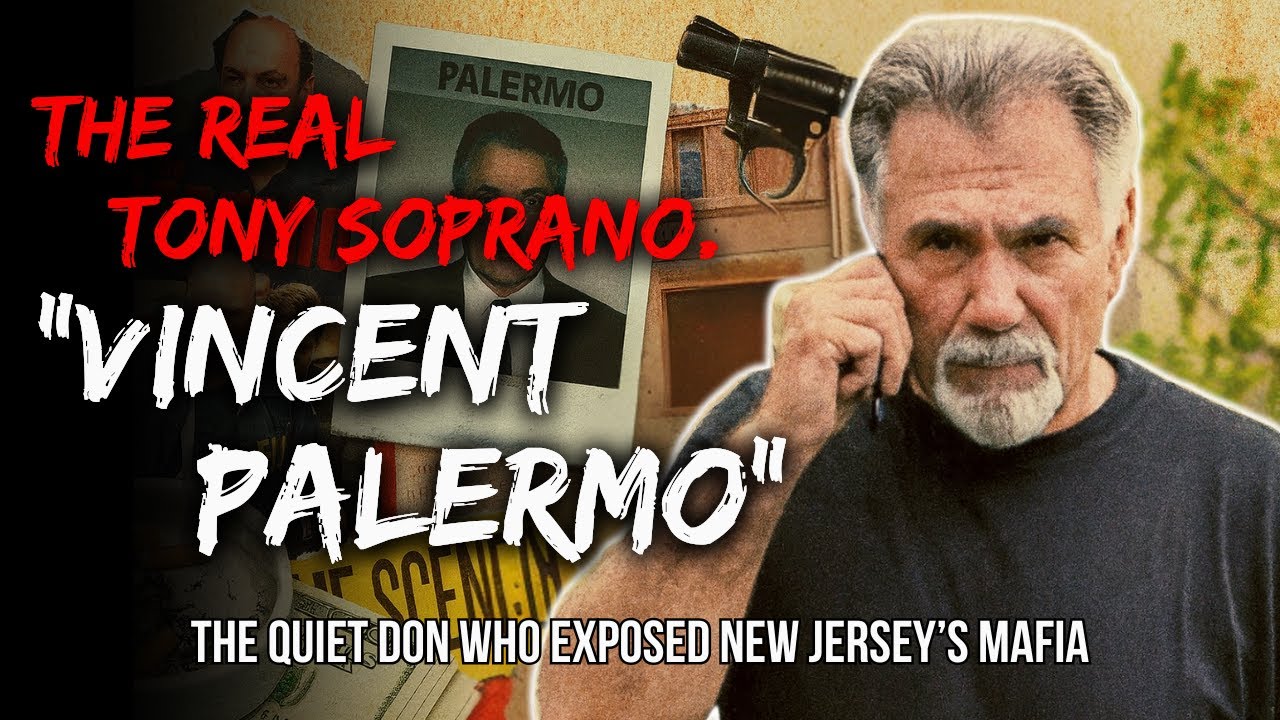
It was a reflection of a life lived so carefully in the shadows that when the light finally found him, it destroyed everything he had built. Palermo was born into the noise and tension of postwar Brooklyn, where survival meant learning to read a room before anyone spoke. He watched men count money at kitchen tables and guard conversations that stopped the moment a stranger passed. When his family moved across the river to Elizabeth, New Jersey, he carried that education with him.
Elizabeth was quieter than Brooklyn, but beneath its neighborly surface ran the same hidden currents. Social clubs stood on certain streets like unmarked churches, their doors never locked but never open to the curious. Young Vincent did not chase that world. He absorbed it.
He watched the way certain men moved through life, unhurried, unworried, always above the tide that drowned everyone else. He noticed how gamblers walked differently depending on whether they owed money or expected to collect. He learned that silence was not shyness. It was armor.
His entry into that world came not through ambition but through marriage. When he wed Anna, he married into the family of Sam “The Plumber” DeCavalcante, the man who had transformed a struggling crew into a structured, disciplined organization that operated beneath the radar of New York’s five families. Sam was a new kind of mob boss. He did not roar.
He fixed problems quietly and efficiently, weaving networks of politicians, businessmen, and union leaders into a web so complex that even federal investigators struggled to map it. He rewarded intelligence over toughness and loyalty over ego. That philosophy shaped the culture of the family, and it created an environment built for a man like Vincent, who had spent his life mastering the art of listening. Palermo did not climb through violence.
He rose through reliability. He collected debts without cruelty, managed card games without chaos, and took over a failing strip club and transformed it into one of the family’s most stable revenue streams. He never wore expensive suits or drove flashy cars. He remained forgettable, and that forgettability became his greatest weapon.
When the federal government began dismantling mafia families across the country in the 1980s, the DeCavalcantes survived because they never exposed their throat. And Vincent survived because he never exposed himself. The turning point came in 1989 with the murder of Fred Weiss. Weiss had done business with the family and then come under federal investigation, and the bosses feared he was cooperating.
With a man suspected of talking to the government, there was only one solution. The order filtered down through the ranks until it reached Palermo, a man who had proven he could be trusted with serious tasks. The hit was carried out with cold precision. Weiss died in the dim morning light without warning, and the killers disappeared before the echo of the shots faded.
Palermo went home, washed his hands, and carried on as if nothing had happened. But that act changed everything. He was no longer just an earner. He had proven his commitment in the purest form the mafia understands, and the hierarchy began to see him differently.
By the early 1990s, the family was in crisis. The boss, John “The Eagle” Riggi, had been arrested, and the organization entered a dangerous vacuum. Younger members schemed for power. Older members clung to outdated methods.
Federal pressure tightened around every conversation. In that chaos, Palermo’s calm became gravity. He resolved disputes without dominating, offered guidance without demanding authority, and slowly, without ceremony, the family came to trust him as its acting boss. He held the organization together through a period of arrests, betrayals, and shifting alliances, always operating with the same quiet discipline Sam DeCavalcante had taught decades earlier.
He kept the temperature of the room cool enough that no one boiled over, but warm enough that no one froze. He lived in two worlds that collided constantly. A meeting with capos in a dimly lit club followed by helping his children with homework at the kitchen table. A construction shakedown in Newark at noon followed by a quiet dinner with his wife at seven.
The FBI would later call him the quiet dawn, a leader so understated that he seemed almost untouchable. But invisibility attracts its own kind of attention. Federal agents had begun studying him, recognizing that true power rarely shouts. The investigation that would destroy him began with wires.
The FBI installed listening devices in the places he believed were safe, a dusty room above a storefront, a back office in a club, a basement under a union hall. The agents were patient. They collected every whispered instruction, every subtle acknowledgement of a crime, every pause between words that revealed more than speech. They mapped the hierarchy with breathtaking precision.
And they waited for someone to break. Someone did. In 1999, as the television show The Sopranos was making New Jersey mobsters a national obsession, the DeCavalcante family was already crumbling from within. The show had created its own kind of paranoia, as men saw their lives reflected on screen and began whispering that someone must have talked.
But the real threat was not a Hollywood writer. It was informants. One by one, soldiers, associates, and ranking members agreed to cooperate with the FBI, some out of fear, some out of spite, some because they saw the walls closing in. A trusted capo wore a wire into meetings.
Betrayal spread like poison through a bloodstream, and Vincent sensed it in every room he entered. He saw the trembling hands, the darting eyes, the men who avoided his gaze. He knew what was coming, but he could not stop it. On the morning of the raid, just before dawn, the stillness of suburban New Jersey shattered.
The operation was called Operation Heat, and it hit forty-seven homes within minutes. CT agents crashed through doors across the state, dragging men out of bed in front of screaming wives and crying children. When they reached Palermo’s house, he was already awake. He opened the door without resistance and asked only for one mercy, that they let him walk out on his own, without handcuffs, so his children would not see.
They granted him that small kindness. It was the last control he would ever hold. In the interrogation room, he sat in silence while agents laid out the evidence against him. Transcripts, recordings, analysis of his every gesture.
They told him the family he had protected was blaming him for its collapse. They told him he was being set up to take the fall. And then they asked the question that would decide everything. After a lifetime of quiet loyalty, Vincent Palermo looked up and asked, who else is talking?
That question signaled his decision. He did not break suddenly. He moved through his cooperation slowly, carefully, the same way he had moved through every other part of his life. He named names, explained structures, confirmed suspicions, and provided the testimony that would become the backbone of one of the most devastating mafia cases New Jersey had ever seen.
He did not brag. He did not justify. He simply recounted the events like a man reading from an old ledger. By 2003, the DeCavalcante family of old was gone.
Men who once walked with swagger now shuffled into courtrooms in shackles. Some screamed betrayal. Some stared blankly at the floor. The structure that had held New Jersey’s underworld together for decades had evaporated, and Vincent Palermo, the quiet man who once guided it, had done what no one expected.
He walked away alive. The government moved him into witness protection and relocated him to Texas, where he was given a new name, a new history, and a new life he never asked for. He tried to start over. He became involved in managing clubs in Houston, applying the same skills that had made him invaluable in New Jersey, organization, discretion, and an understanding of how cash flows through any city’s shadows.
He found a strange sense of purpose in it, not criminal purpose, just competence. But success attracts scrutiny. A wrongful death lawsuit involving one of the clubs peeled back the layers of his new identity, and someone eventually made the connection. The story broke.
Newspapers ran headlines about the strip club operator who was secretly the former boss of the New Jersey Mafia. Federal agents intervened, moved him again, tightened the restrictions, but the damage was done. He was no longer anonymous. He was no longer safe.
He was no longer invisible. In his final years, he lived quietly, more quietly than ever. Neighbors described him as polite, almost fragile, a retired man who kept to himself. He never gave interviews.
He never tried to reclaim his legacy. He understood that men like him do not get redemption arcs. Their stories do not end with forgiveness. Their pasts do not dissolve because they outlived them.
Every time The Sopranos found a new audience, every time a documentary explored the real roots of New Jersey’s underworld, his name resurfaced like a shadow rising through fog. He had become a symbol of the mafia’s transformation, the end of an old world and the beginning of something colder and more distant. He faded not because he was defeated, but because time swallows even the loudest legends. And Vincent Palermo, the man who ruled New Jersey with silence, eventually became exactly what he always claimed to be.
Invisible. But the story of the real Tony Soprano endured, a reminder that the strongest men are often the quietest, that loyalty and betrayal run in the same vein, and that silence can build an empire and destroy it just as easily.
