On a damp Tuesday morning in March, curator Sarah Mitchell removed a cardboard frame from a paper envelope and found herself staring at a secret that had waited nearly 140 years to be told. The photograph showed a Black woman in her forties, seated on an ornate studio chair, her hand resting on the shoulder of a young boy standing beside her. Both wore their finest clothes—she in a dark dress with a white collar, he in a pressed suit that seemed slightly too large for his thin frame. The envelope had arrived from an estate sale in Charleston, containing a handwritten note: “My great-grandmother Clara and her son Thomas, taken in 1885 in Richmond.
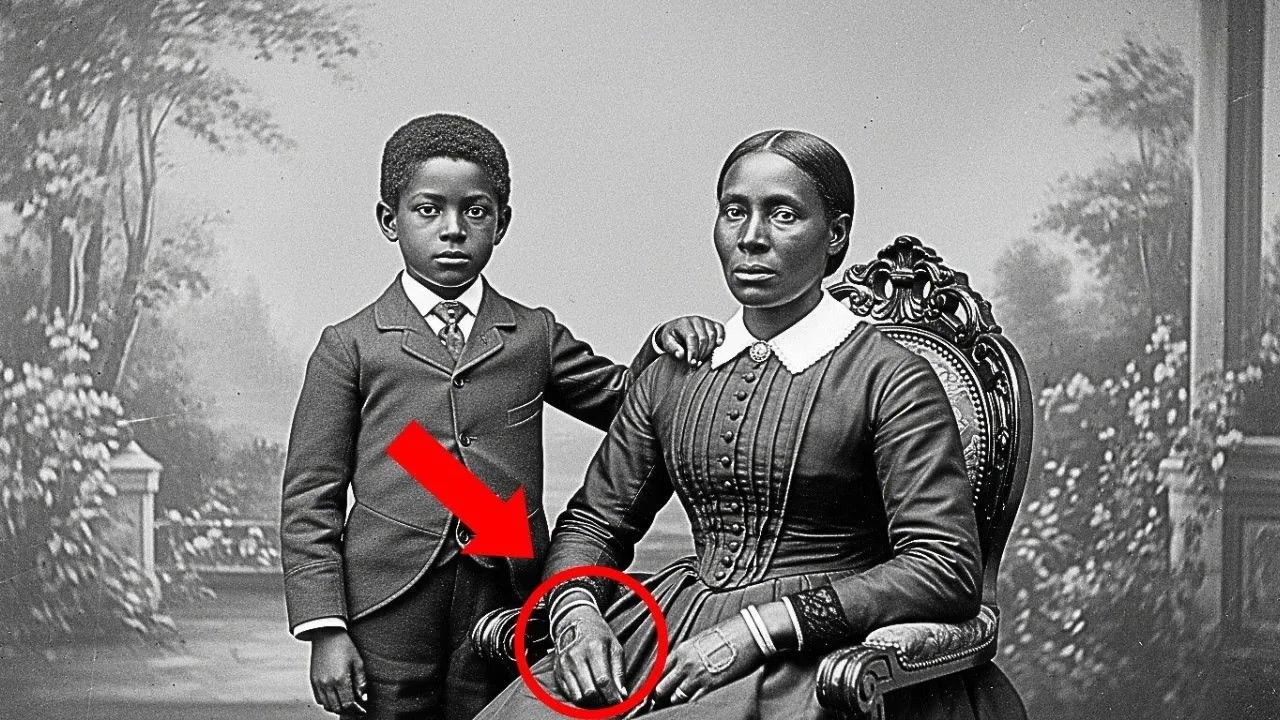
This is the only photo we have of her. ” The sender, a woman named Patricia Coleman, had included her phone number and asked the Historical Preservation Society in Richmond for help preserving and documenting the image. Sarah specialized in post-Civil War American photography and had examined hundreds of similar portraits from the 1880s. Studio photographs had become more accessible to formerly enslaved people during Reconstruction, and families treasured them as symbols of their hard-won freedom.
But something in this particular image held her attention longer than usual. The woman’s eyes carried a weight that seemed to span the decades. The boy, no older than ten, stood with a stillness that suggested training in remaining perfectly composed. Sarah adjusted her desk lamp and studied the studio background—a painted garden scene, common for the era.
The photographer had captured remarkable detail: the texture of the fabric, the slight blur of the boy’s left hand where he had moved during the long exposure, the precise arrangement of Clara’s skirts. Professional work, likely from one of Richmond’s best studios that had begun serving Black clients after the war. She reached for her magnifying lens, a habit developed over years of examining historical photographs for details. Photographers of that era often left subtle signatures in their work—specific props, background patterns, even the way they positioned subjects’ hands.
As Sarah slowly moved the lens across the image, studying its composition, she paused at Clara’s hands. The right hand rested steadily on Thomas’s shoulder, but it was the left hand, folded in her lap, that caught her attention. Even in the sepia tones of the old photograph, she could see something unusual. The skin of Clara’s wrists looked different—rough, marked.
Sarah leaned closer, her breath catching slightly as she adjusted the magnification. There were unmistakable lines around both wrists—bands of scarred tissue that stood out even in the soft focus of nineteenth-century photography. Sarah sat back in her chair, her heart beating faster. She had seen similar marks before in documented photographs of formerly enslaved people.
These were not ordinary scars. They were the permanent traces of shackles, worn by Clara for so long they had left their eternal imprint on her skin. She spent the rest of that morning photographing the image with high-resolution equipment, creating digital files that allowed her to examine every millimeter without risking damage to the fragile original. The photograph was in good condition for its age, carefully preserved by the Coleman family across generations.
As the files loaded on her computer screen, Sarah enlarged the image of Clara’s wrists, and the evidence became even clearer. The scars formed distinct bands approximately two inches wide on each wrist. The tissue appeared raised, discolored, permanent. In the enlarged image, Sarah could see how Clara had deliberately positioned her hands, perhaps trying to hide the marks in the folds of her dress.
But the photographer’s lighting had caught them anyway, preserving evidence that Clara herself might have preferred to conceal. Sarah reviewed her database of Civil War-era records and began searching for documentation. It was 1885—twenty years after emancipation, seventeen years after the ratification of the Fourteenth Amendment. Many freed people were building new lives, starting families, working for wages, exercising their right to vote.
Yet the physical and psychological traces of slavery remained. The marks on Clara’s wrists told a story that transcended the formal portrait. That afternoon, Sarah called Patricia Coleman. The phone rang four times before a woman with a tremulous voice answered.
Sarah identified herself and explained she was calling about the photograph. Patricia expressed surprise that anyone would care about an old family picture, explaining it was the only image they had of Clara and she hoped they might learn more about her life. Sarah chose her words carefully. She told Patricia the photograph was historically significant and the Society would like to add it to their collection, but first she needed to ask some questions about Clara’s life before the photograph was taken.
A silence hung on the other end of the line. Patricia admitted she knew very little. Family stories said Clara was born into slavery somewhere in South Carolina, came to Richmond after the war, worked as a seamstress, and raised Thomas alone—he was Patricia’s great-grandfather. But Clara herself rarely spoke of her past, according to what Thomas had told his children.
Sarah asked if Patricia knew which part of South Carolina Clara came from, which plantation, which family had held her. No specific names had ever been mentioned. Thomas said his mother wanted to forget all of it. She once told him the past was meant to stay buried, and they should look forward, not back.
Sarah understood this impulse. Many survivors of slavery made the same choice, trying to protect their children from the horrors they had endured. But sometimes the past refuses to stay buried. Sometimes it leaves marks that cannot be hidden—evidence that demands acknowledgment.
She told Patricia about the scars visible on Clara’s wrists, consistent with prolonged physical restraint, marks carried by many enslaved people. The photograph might document not only Clara’s freedom but also the permanent proof of her enslavement. The silence on the phone stretched longer this time. When Patricia finally spoke, her voice trembled with emotion.
She had never told them. Thomas never knew. All these years, the photograph had been in the family, and no one had ever truly seen what they were looking at. Sarah spent the following week immersed in research.
The Historical Preservation Society’s archives contained extensive records from the Civil War and Reconstruction era, including slave narratives, plantation records, bills of sale, and freedom documents. She began with South Carolina, knowing Clara had come from somewhere in that state. The research was grueling and often painful. Plantation ledgers recorded human beings as property, listed alongside livestock and equipment.
Names were frequently incomplete, enslaved people identified only by first name, sometimes only by age and gender. Clara was a common name in the records, appearing dozens of times in various documents. Sarah contacted colleagues at universities and historical societies across South Carolina, sending them high-resolution images of the photograph, wondering if anyone recognized details that might indicate a specific region or photographer. Studio photography during the Victorian era had regional variations; certain background styles, props, and lighting techniques were associated with particular photographers or cities.
A response came from Dr. Marcus Webb, a professor of African American history at Charleston College. He had studied Reconstruction-era photography extensively and noted elements in Clara’s portrait suggesting the work of Jonathan Blake, a Richmond photographer who operated a studio on Broad Street from 1880 to 1895. Blake was exceptional for his time—a white photographer who actively sought Black clients and treated them with dignity, producing formal portraits that rivaled those made for wealthy white families.
Webb wrote that if this was Blake’s work, they could narrow down the location and perhaps find studio records. Blake kept meticulous records of his clients. If Clara had sat for this photograph, there might be a record of it. Sarah felt a surge of hope.
She contacted the Virginia Historical Society, which held Blake’s surviving papers. Within two days, she was sitting in their reading room with three leather-bound ledgers open before her. Blake’s handwriting was precise and elegant. He recorded not only names and dates but often brief notes about the people he photographed: first portrait after emancipation, celebrating a new home, family reunion after years of separation.
Sarah found the entry on a Thursday afternoon, May 15, 1885. “Clara, portrait with her son Thomas. The lady is quiet but possesses great pride. The boy is about 10 years old.
Amount paid: $2. 50, paid in full. ” Sarah stared at the entry, her fingers trembling slightly as she copied it into her notebook. Two dollars and fifty cents—a significant sum for someone working as a seamstress in 1885.
Clara had saved the money and chosen to have this photograph taken, to leave evidence of her existence and her son’s, evidence that they were free, that they were a family. The decision to sit for this portrait was deliberate and meaningful. But Blake’s notes said nothing about the scars, nothing about Clara’s past. Sarah needed to dig deeper.
The discovery came from an unexpected source. Sarah posted inquiries on several genealogy forums used by researchers tracing African American family histories. These communities were invaluable resources, filled with people who had spent years tracking ancestors through fragmented records, oral histories, and DNA analysis. A woman named Dorothy Harrison responded to Sarah’s post.
Her message was detailed and carefully written. She had been researching the Ashford plantation in Beaufort County, South Carolina, where her great-great-grandfather had been enslaved until 1865. She had copies of the plantation records, and there was a Clara listed among the field workers in the 1850s and 1860s. The records indicated she had given birth to a son in 1875, which would have made him about ten years old in 1885.
Could this be the Clara Sarah was looking for? Sarah’s pulse quickened as she read the message. She replied immediately, asking Dorothy to send copies of any records she had. The documents arrived by email that evening—scanned pages of plantation ledgers written in faded ink.
Ashford was one of the largest rice plantations in the Lowcountry, operating with more than two hundred enslaved workers at its pre-war peak. The records were meticulously detailed. Every enslaved person was listed with an estimated value, work assignment, any punishments inflicted, births, deaths. The handwriting was elegant, the script beautiful, documenting atrocities with precise care.
Sarah found Clara’s name on a page dated 1863. “Clara, female, approximately 20 years old, field worker, valued at $800. ” Her hands trembled as she continued reading. The next entry, dated three months later, included a note: “Clara, punished for attempting to escape, confined to quarters for two weeks, shackled.
”
There it was—the first direct evidence. Clara had tried to escape. She was caught, punished, shackled. Suddenly, the scars in the photograph took on deeper meaning.
They were not merely the traces of work restraints but evidence of punishment, of resistance, of a young woman who refused to accept her enslavement without a fight. Sarah called Dorothy immediately, and they agreed to speak by phone the next morning. Dorothy’s voice was warm but carried the weariness of someone who had spent years confronting painful truths. She explained she had been working on this research for five years.
Most of her mother’s family descended from Ashford plantation. It was not easy reading these records and seeing her ancestors reduced to property values and punishment logs. Sarah asked if the records showed when Clara left the plantation. Dorothy’s voice grew somber.
The records ended abruptly in early 1865, around the same time Sherman’s troops passed through the region. Many enslaved people fled when they heard the Union army was approaching. The plantation owner, Richard Ashford, had tried to move some of them inland to avoid losing them, but according to family accounts, many escaped when the opportunity arose. Clara might have been among them.
Sarah revisited her conversations with Patricia Coleman, this time with more questions about Thomas. If Clara had been born around 1843 and enslaved at Ashford until 1865, she would have been about twenty-two when she gained her freedom. Thomas was born in 1875, ten years later. What happened in that decade?
Patricia invited Sarah to visit her home in Alexandria, Virginia. She lived in a modest house filled with family photographs spanning five generations. The walls told a visual history of the Coleman family: graduations, weddings, military service, family reunions. But the oldest photograph—Clara and Thomas—held a place of honor in the living room, framed and carefully preserved.
Patricia was a woman in her sixties, a retired teacher with kind eyes and the bearing of her great-grandmother. She brought out a cardboard box filled with family documents—birth certificates, marriage licenses, obituaries, a family Bible with names inscribed in the front pages. Patricia explained that Thomas had lived until 1952, dying at age seventy-seven. She showed Sarah his obituary from the Richmond Times-Dispatch.
It said he worked for the railroad for forty years, served as a deacon at First African Baptist Church, and had four sons and twelve grandchildren. He was highly respected in the community. Sarah read the obituary carefully. It mentioned Thomas’s birth in Richmond in 1875 and his long career, but said nothing about his mother Clara.
Sarah asked if Patricia had any letters or documents in Thomas’s handwriting, anything that might shed light on his mother’s life. Patricia nodded and produced a small leather journal. These were Thomas’s memoirs. He had begun writing them in 1920 at age forty-five.
Her grandfather said Thomas became more reflective as he aged and started recording memories and family stories. There were several entries about Clara. Sarah opened the journal with trembling hands. The pages were fragile, the ink faded but still legible.
Thomas’s handwriting was precise and deliberate—the writing of a man who had received an education but practiced writing later in life. She found the first entry about Clara dated September 1923. “My mother would have turned eighty this year had she still been with us. I think of her often lately, wondering about the stories she never told me.
She passed when I was only thirty, and I regret now that I never pressed her to speak of her life before my birth. She worked herself to exhaustion, taking in sewing and mending to give me opportunities she never had. She was the strongest person I ever knew. ”
Sarah turned the pages carefully, finding another entry from 1925.
“Today I discovered something that troubles me greatly. While sorting through my mother’s belongings, things she kept in a box for years, I found a small bundle wrapped in cloth. Inside were iron shackles—the kind used to restrain slaves. They were rusty and broken but unmistakable.
Why did my mother keep them? What did they mean to her? I remember as a child noticing scars on her wrists. But when I asked her about them, she would only say she had injured herself long ago, then change the subject.
Now I understand what I was too young to grasp then. ”
With Dorothy Harrison’s help, Sarah began assembling the threads of Clara’s journey from South Carolina to Virginia. The post-war years were turbulent—millions of formerly enslaved people moved across the South, searching for family members, seeking work, trying to build new lives. Many records from that period were lost or never created, but Sarah found fragments.
A researcher in the records of the Freedmen’s Bureau in Washington, D. C. , found Clara listed in a food ration distribution register in Charleston in 1866. The entry read: “Clara, no surname, approximately 23 years old, in need of assistance, from Beaufort County.
” The Bureau had been established to help freed people transition to freedom by providing food, medical care, assistance with labor contracts, and education. Sarah also found Clara’s name in marriage records at Richmond’s city hall. In 1874, Clara married a man named Samuel Thompson. The marriage certificate identified both parties as colored and noted that Clara had signed with an X because she could not write her name.
Samuel’s occupation was listed as laborer. Thomas’s birth certificate, dated March 1875, named both parents—Clara Thompson and Samuel Thompson. But no record of Samuel could be found after that. Sarah searched death certificates, census records, and city directories.
Samuel Thompson seemed to have vanished from the historical record after Thomas’s birth. Patricia had heard family stories suggesting Samuel died when Thomas was an infant, but no specific details about what happened. Thomas wrote in his journal in 1927: “My mother never spoke of my father. I do not remember him, no stories about him, nothing but his name.
My mother raised me alone, and when I was old enough to ask questions, she would only tell me that he was gone and we had to carry on without him. I learned not to press her on subjects that brought deep sorrow to her eyes. ”
Sarah contacted Dr. Webb in Charleston again, telling him everything she had discovered.
He suggested she examine church records. Many Black churches kept detailed membership records and community registers during Reconstruction. These congregations served as centers of community life, providing not only spiritual guidance but also practical assistance, education, and social networks. Dr.
Webb searched church records in Richmond’s Jackson Ward neighborhood, where many Black families had settled in the 1870s and 1880s. He found Clara listed as a member of Ebenezer Baptist Church since 1876. Beside her name was written: “Widow, one child, seamstress. ”
So Samuel had died, probably within a year or two of Thomas’s birth, leaving Clara alone with an infant son in a city where she had no family and no acquaintances—in a nation that had been free from the institution that had enslaved her for more than twenty years for barely a decade.
The photograph taken in 1885 took on new dimensions of meaning. Clara, about forty-two years old, had survived slavery, escape, widowhood, and a decade of raising her child alone. She worked as a seamstress, saved her money, and chose to have a formal portrait taken with her son. This was not merely an ordinary studio photograph.
It was a declaration of survival, a reclamation of dignity, a mother’s determination to document her love for her child. Sarah contacted Dr. Jennifer Martinez, a medical historian who specialized in studying the physical evidence of slavery’s brutality. Dr.
Martinez had examined dozens of photographs similar to Clara’s, documenting the ways shackles left permanent marks on survivors’ bodies. She agreed to analyze the high-resolution images of Clara’s wrists. Her report arrived after three days, detailed and affecting. Dr.
Martinez explained that the type of scarring visible in Clara’s photograph was consistent with iron shackles worn for extended periods—possibly weeks or months of continuous wear. These marks indicated not merely restraint during work but punitive confinement—the kind of restraint used to prevent escape or punish resistance. The pattern of scarring suggested the shackles had been extremely tight, causing repeated tearing of the skin. Over time, they had caused not only surface wounds but deep tissue damage, resulting in permanent scarring as seen in the photograph.
The clarity of these marks twenty years after emancipation testified to the severity of the original trauma. Dr. Martinez’s report noted something else. Examining the photograph closely, she observed that Clara had positioned her hands in a way that partially hid the scars.
Her right hand rested prominently on her son’s shoulder, while her left hand was folded inward with her wrist turned away from the camera. This suggested Clara was conscious of these marks, perhaps reluctant about their visibility. Yet the photographer’s lighting had captured them anyway. Whether this was intentional on the photographer’s part or simply the result of professional lighting techniques could not be determined.
But the result was that the photograph preserved evidence Clara might have preferred to hide. Sarah thought about Jonathan Blake, the photographer who had taken this image. Had he noticed the scars? Had Clara mentioned them?
Or were they simply there—part of her physical reality, impossible to completely conceal even in a polished studio portrait? Sarah returned to Blake’s records at the Virginia Historical Society, searching for any additional notes about the sitting. Blake was known for his respect for his Black clients, but he was also a businessman working in a deeply segregated society. What did he see when Clara sat before his lens?
There were no additional notes, but Sarah found something else. Blake had printed two copies of Clara’s portrait, not just one. The usual procedure was to print a single copy for the client unless additional copies were specifically ordered and paid for. Yet Blake’s records showed two copies listed beside Clara’s portrait.
Sarah wondered whether Blake had kept a copy for himself. Many photographers kept sample books displaying examples of their work, and some had begun collecting photographs documenting the lives of formerly enslaved people, recognizing their historical significance even then. Sarah contacted the Virginia Museum of History and Culture, which held Blake’s surviving sample books. A curator named James Patterson agreed to search their collection.
Two weeks later, he called Sarah with news. They had found it. Blake had kept a copy of Clara’s photograph in a leather-bound album titled “Portraits of Dignity 1880-1890. ” The collection contained about forty photographs, all of Black clients, all formal portraits.
Blake appeared to have regarded these images as historically significant. There was a handwritten note on the page opposite Clara’s photograph. Did Sarah want to know what it said? Her heart pounding, she said yes.
James read Blake’s words aloud: “Clara came to my studio with her young son in May 1885. She spoke little, but her bearing commanded respect. I noticed marks on her wrists—unmistakable evidence of slavery. When I asked her gently, she told me she wished the photograph to show her and her son as they were—a free woman and her free child.
She said she did not want to hide the past, but she did not want it to entirely define her either. I photographed her as she requested, with her son, both in their finest clothes, with dignity and freedom. Yet the camera captured what words might fail to convey—that freedom does not erase the marks of slavery, but only enables us to live despite them. ”
Sarah’s research into Thomas’s life revealed how Clara invested everything in her son’s future.
Despite her limited income as a seamstress, Clara enrolled Thomas in the Richmond Colored Teachers School, one of the first institutions dedicated to educating Black children in Virginia after the war. Surviving school records showed Thomas’s attendance from 1883 to 1889, from age eight to fourteen. Patricia showed Sarah another document from the family collection—a certificate of completion dated June 1889 bearing Thomas’s name and signed by the principal, a man named Nathaniel Freeman. The certificate confirmed Thomas had completed his full course of study in reading, writing, arithmetic, history, and moral philosophy.
Thomas wrote in his journal in 1928: “My mother believed that education was everything. She would take on extra work, sewing late into the night by lamplight, to ensure I could attend school instead of working. Other boys my age were learning trades or working in tobacco warehouses, but my mother insisted that I learn to read and write, because this knowledge was the only inheritance she could give me that could never be taken away. ” Sarah found enrollment records showing the school fee was three dollars per term, with three terms per year.
For a widowed seamstress supporting herself and her child, paying nine dollars annually for education was a significant sacrifice. Yet Clara paid this amount year after year, ensuring Thomas had opportunities that slavery had denied her. The records also revealed something else. In 1887, when Thomas was twelve, Clara herself enrolled in the school’s evening adult literacy program.
The notation in the register was brief: “Clara Thompson, age 44, wishes to learn to write her name and read the Bible. ”
Patricia had not been aware of this detail. She stared at the record, her eyes welling with tears. Clara had learned to read after everything she had endured—after years of slavery when it was illegal to teach enslaved people to read.
She went to school with her son. She was in her forties and decided it was not too late. Sarah found attendance records showing Clara attended the adult literacy program for two terms before her name disappeared from the rolls. No note explained why she stopped.
Perhaps work demands made it impossible to continue. Perhaps learning to read was too difficult after a lifetime without formal education. Or perhaps, as Thomas suggested in his journal, Clara had already learned what she most wanted to know. Thomas wrote in 1930: “I remember the evening my mother first read from the Bible.
I was about fourteen. We were sitting at our small table after dinner, and my mother brought out the family Bible she had purchased years before. She opened it to the Gospel of Luke and read slowly, haltingly, the words of Mary’s song: ‘He has brought down rulers from their thrones but has lifted up the humble. ‘ Her voice trembled with emotion, and when she finished, she closed the book and sat silent for a long time.
Then she looked at me and said: ‘Now I understand what these words mean. Now I can read them myself. ‘ That was the only time I ever saw my mother cry. ”
As Sarah’s research continued, the photograph of Clara and Thomas began to circulate in academic and historical circles.
Dr. Webb published an article about the image in the Journal of Southern History, analyzing it as evidence of how formerly enslaved people used photography to assert their dignity and document their freedom. The article included high-resolution details of Clara’s scarred wrists along with the historical context Sarah had uncovered. The response was overwhelming.
Descendants of other formerly enslaved people came forward, sharing their own family photographs, seeking help researching the stories behind them. Historians recognized that Clara’s photograph was part of a broader visual archive documenting the transition from slavery to freedom—images that embodied both the trauma of the past and the resilience of survivors. The Historical Preservation Society organized an exhibition titled “Portraits of Freedom: Photography and Black Life in Reconstruction America. ” Clara’s photograph was displayed prominently, alongside Jonathan Blake’s handwritten note and excerpts from Thomas’s journal.
The exhibition also included historical context: maps showing the rice plantations of the South Carolina Lowcountry, documents from the Freedmen’s Bureau, statistics on Black education and economic progress during Reconstruction, and photographs of other formerly enslaved people who had left similar visual testimonies. Patricia Coleman attended the opening in Richmond, standing before her great-grandmother’s photograph, enlarged and dramatically lit. Clara’s scarred wrists were visible to everyone who looked. Visitors moved slowly through the exhibition, reading the interpretive panels, contemplating the photographs, confronting the legacy of slavery and the determination of those who survived it.
Patricia said quietly to Sarah as they stood together before the photograph: “I never knew. All these years, this photograph hung in our family’s homes, passed down from generation to generation, and we never truly saw what it held. We saw a beautiful portrait of our ancestors in their finest clothes. We never saw the scars.
We never asked the hard questions about what Clara endured. ” Sarah nodded. “Sometimes we see what we are ready to see. Your family preserved this photograph, honored Clara’s memory, carried forward her legacy.
Now we are able to understand the full story—to recognize not only her dignity in this portrait but her survival, her strength, her sacrifice. ”
The exhibition included a timeline of Thomas’s life drawn from census records, city directories, and newspaper archives. After completing his education, Thomas worked for the Chesapeake and Ohio Railway for forty years, advancing from track maintenance to a supervisory position. He married a woman named Ruth in 1898, and they had four children.
He was active in his church, serving as deacon and Sunday school teacher. He lived to see his grandchildren attend integrated schools after Brown v. Board of Education, though he died before the passage of the Civil Rights Act of 1964. Patricia said: “He built a good life because of Clara’s sacrifices—she gave him that education, those opportunities.
The legacy was not just a photograph, but everything she did to ensure he had a future she never had. ”
Six months after the exhibition opened, Sarah received an unexpected email from a woman named Catherine Ashford in Charleston. The name made her pause. Ashford—the same surname as the plantation owner who had enslaved Clara.
She opened the message cautiously. It began: “Dear Dr. Mitchell, I am writing regarding your research into a woman named Clara, who was enslaved at my family’s plantation in Beaufort County. I am the great-granddaughter of Richard Ashford.
I recently discovered documents in my family’s estate that I believe may be relevant to your work, and I would like to share them with you. I recognize that my family’s history is difficult and painful, but I believe the truth must be known. ”
Sarah called Catherine that evening. The woman’s voice was calm, educated, carrying the accent of old Charleston families.
Catherine explained she had found a box in her grandmother’s attic containing plantation records, correspondence, and personal papers belonging to Richard Ashford. Most of it was painful to read—the casual documentation of buying and selling human beings, the punishment logs, the complete absence of recognition that enslaved people were human beings with families and feelings. But there were also documents Catherine believed Sarah should see. She sent scanned copies of two letters Richard Ashford had written to his brother in 1863, complaining about the disturbances caused by unruly slaves attempting to escape.
One letter mentioned Clara specifically: “Clara, who has worked in the fields since childhood, attempted to flee last week. She was captured three miles from the plantation and placed in shackles as an example to the others. These people do not understand the benevolence we show them by providing food and shelter. They are ungrateful and require strict discipline.
”
Sarah felt nauseated reading the words, though she had seen similar statements in countless historical documents. The letter confirmed what the plantation records had indicated: Clara had been shackled as punishment for attempting to claim her freedom two years before emancipation became law. But Catherine had found something else—a letter dated April 1865, written hastily in a different hand: “The Yankees have come. All the slaves have fled.
The plantation is destroyed. We have lost everything. ” It was signed Margaret, Richard Ashford’s wife. Catherine said quietly: “My family lost the plantation.
They lost their wealth, their social standing, everything they had built on the labor of enslaved people. For generations, we convinced ourselves that we were victims of the war, of Northern aggression, of the betrayal of people we loved. It took me years to understand the depth of that delusion, to recognize the truth of what my ancestors did. ”
Sarah appreciated Catherine’s candor but understood that acknowledgment alone did not change history.
She asked what Catherine planned to do with the documents. Catherine replied that she would donate them all to the South Carolina Historical Society—the records, the letters, everything. They belonged in a public archive where researchers and descendants could access them. People like Clara’s family deserved to know their ancestors’ stories, even the painful parts.
Especially the painful parts. And people like herself needed to confront what their families had done, not run from it. Sarah thought of Clara standing in Jonathan Blake’s studio in 1885, her son beside her, having chosen to be photographed with her scars visible. Clara had hidden nothing.
Her past, though she rarely spoke of it, was written on her body. She had lived with the marks of what she had endured, and she had chosen to document herself not as a victim but as a survivor—a free woman, a mother, a person who had reclaimed her dignity despite everything that had tried to strip it away. The exhibition remained open for six months, attracting thousands of visitors. Teachers brought school groups to view the photographs and discuss the legacy of slavery.
Descendants of enslaved people came to honor the resilience of their ancestors. The photograph of Clara and Thomas became one of the most widely circulated historical images of that year, appearing in documentaries, textbooks, and museum collections across the country. Patricia Coleman donated the original photograph to the Historical Preservation Society, ensuring its preservation and accessibility for future generations. She kept a high-quality copy in her home, but she wanted the original to serve a broader purpose.
On the day she signed the donation papers, Patricia stood with Sarah in the conservation laboratory, where Clara’s photograph would be kept in a climate-controlled, light-protected vault. Patricia said softly, looking at her great-grandmother’s face: “She wanted to be seen. That’s why she asked for this photograph, why she didn’t hide her scars, why she wore her finest clothes and brought her son to that studio. She wanted to be seen, to be remembered, to be honored—not as a slave, but as a human being who survived slavery and built a life despite it.
” Sarah nodded. “And now she is. Clara’s story has become part of the historical record. Her strength, her sacrifice, her love for her son—all documented and preserved.
She left us evidence, and we are finally learning how to read it. ”
The photograph remained in its vault, carefully preserved, but copies of it spread widely through exhibitions, publications, classrooms, and homes. Clara’s face looked out from the frame across nearly 140 years. Her scarred wrists were clear evidence of what she had endured.
Her dignified bearing was testimony to what she had overcome. The photograph that had at first seemed like an ordinary nineteenth-century portrait revealed itself to be something deeper—a document of resilience, a declaration of freedom, a mother’s love embodied in silver and light. Thomas made his last entry about his mother in his journal in 1946, six years before his death: “I am an old man now, and my mother has been gone for forty years, but I carry her with me every day. The sacrifices she made, the strength she showed, the love she gave—this is my inheritance, more precious than any material wealth.
When I look at that photograph of us, taken when I was a small boy, I do not see merely a picture. I see a promise kept. My mother promised herself that I would be free in ways she never was, that I would have opportunities denied to her, that I would know my worth as a human being. She kept her promise, and in keeping it, she showed me the true meaning of love.
“
