The photograph was taken on the 14th of May, 1912, on the front porch of an orphanage in northern Pennsylvania. There are 31 children in it, arranged in three rows on wooden porch steps. Two staff members stand at either end like bookends. And in the center of the front row, seated in a wooden chair that does not match anything else on that porch, there is a child.
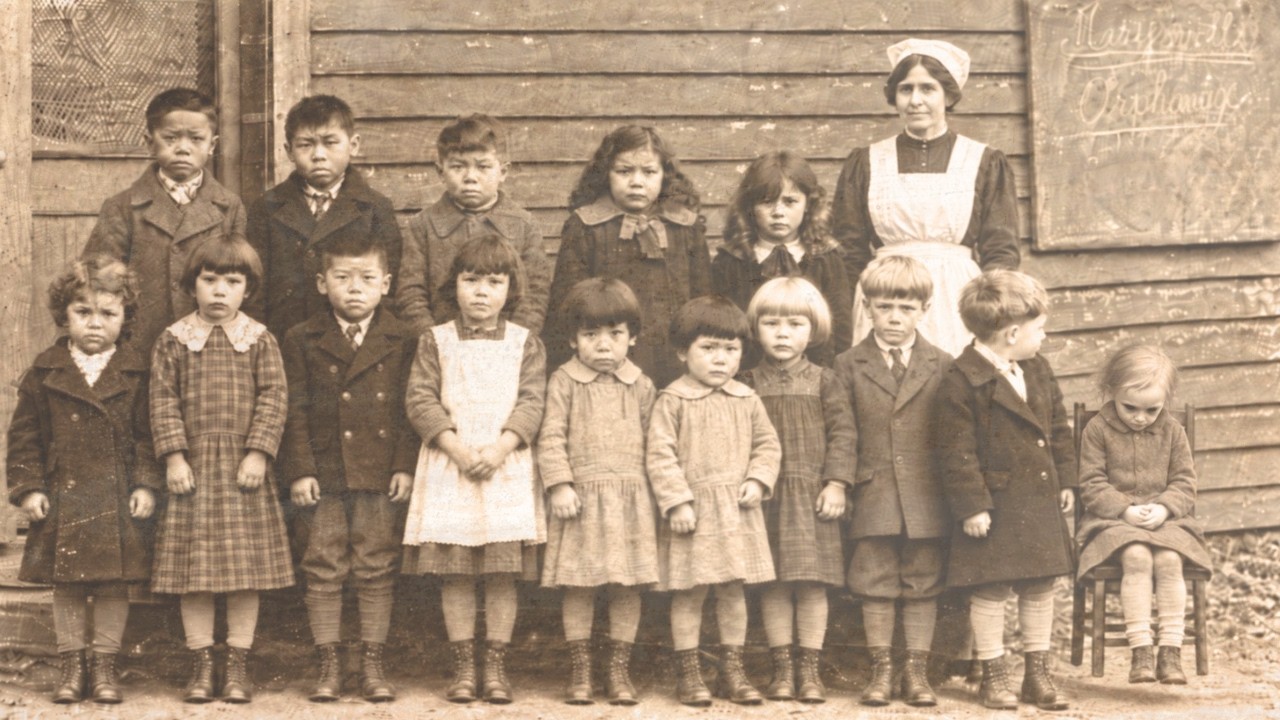
The child is larger than the others. The child’s hands are wrong. For 35 years, nobody who looked at this photograph noticed any of that. It was taken by an itinerant photographer named Clement Pardo on the front porch of the Briarfield Home for Foundlings in Potter County.
Clement traveled the northern tier counties with a wagon-mounted camera. He charged the county $2. 50 for the sitting and another $1. 75 for 12 prints.
Thirty-one children are arranged on the porch steps in three rows, the back row standing, the middle row seated on the top step, the front row on the bottom step except for the center where the chair is. The children range in age from about four to about twelve. Most are in plain dark clothes, cotton and wool, whatever the county provided or the donation barrels held. One girl in the back row has her eyes closed.
These are ordinary details, the details that make a photograph real. Then there is the child in the chair, center of the front row, a wooden spindle-back chair, oak, with turned legs and a flat seat, no cushion. The kind of chair you would find in a farmhouse kitchen in that part of Pennsylvania in that era. The child seated in it is larger than the children on either side, not dramatically, but noticeably broader through the shoulders.
Except the face does not read as any particular age. The hands are resting on the armrests. The fingers are long. In the photograph, which is not sharp by modern standards, the fingers appear to extend past the ends of the armrests by a margin that is difficult to explain as a trick of angle or shadow.
The face is not monstrous. It is not deformed. It is a child’s face as a police sketch is a face, features individually correct, but not adding up to a person you would recognize if you saw them a second time. The eyes are looking directly at the lens with an expression that is not childlike in any way that matters.
Not angry, not sad, not afraid. Patient. The child in the chair looks patient, like a thing that has been waiting a long time. On the back of the photograph, in a hand that matches no other sample in the Briarfield files, someone had written three words in pencil: “Count the hands.
”
The photograph sat in the Potter County Historical Society collection from 1968 until 2003. It arrived in a cardboard box with 46 other photographs donated by the estate of a county clerk named Harold Finn, who had died that year at 91. The photograph was cataloged simply as “Briarfield Home, circa 1912, children and staff. ” A volunteer filed it in a flat storage drawer and never mentioned anything unusual about it.
For 35 years it lay in that drawer. Nobody requested it. Nobody studied it. Nobody looked at the child in the chair and felt what Marjorie Oakes felt when she finally did.
Marjorie Oakes was 27 years old in 2003, a graduate student at Penn State working on a dissertation about institutional child care in rural Pennsylvania between 1875 and 1925. She requested the Briarfield file by mail. She opened it at her desk in Pattee Library on a Tuesday afternoon in October. She later wrote in a footnote to her unfinished dissertation, and that word unfinished matters, that she looked at the photograph for 11 minutes before she understood what was wrong with it.
She was specific about the time because she had a clock on her desk and remembered checking it twice. She wrote that for the first several minutes she was simply cataloging what she saw. The wrongness came on gradually like nausea. It started in her hands.
Her fingers began to feel cold and she did not know why. Then she looked at the child in the chair and she understood. She put the photograph face down on the table and did not pick it up again for two days. When she did pick it up, she went looking for the records.
She went looking for Briarfield Home for Foundlings, Potter County, Pennsylvania. And what she found, and what she did not find, opened the case. Potter County, Pennsylvania, Northern Tier, Allegheny Plateau. The county seat is Coudersport, which had a population of about 2,500 in 1910 and has not grown much since.
The county is big, 1,100 square miles, roughly the size of Rhode Island, and empty. By 1912 the lumber was mostly gone. The hillsides were stumps and slash. The sawmills were closing or had closed.
The people were leaving. And the children left behind by that emptying, the orphans, the abandoned, needed somewhere to go. Briarfield Home sits at the head of a hollow off Sinnemahoning Creek on a 340-acre tract called the Briarfield Patent, dated to 1791. Four miles from the nearest settlement, a hamlet called Costello.
The road in is a wagon track, unpaved, that follows the creek north and crosses it twice on plank bridges. In 1912, there was no telephone line to the property. The mail came twice a week with the supply wagon. The nearest doctor was in Coudersport, 22 miles south.
The house was a two-story frame structure over a stone foundation built in 1846 by a family named Fenster. Jacob Fenster and his wife Margarethe raised seven children in it, five of whom survived to adulthood. Twelve rooms, a stone cellar with a dirt floor and a ceiling so low that a man of average height had to duck. A detached kitchen, standard for the period because kitchens caught fire, connected to the main house by a covered walkway in 1870.
A porch across the full front of the house facing south. A well, a barn originally for horses and cattle, converted to general storage when the home opened. A root cellar cut into the hillside behind the house. The house became an orphanage in 1881.
The last Fenster heir was a woman named Elspeth Fenster, who had never married and had no children. She was 73 years old and dying. She donated the property to the county for use as a home for foundlings and orphans. The deed was filed on the 12th of March, 1881.
Elspeth died six months later and was buried in the Costello churchyard. Briarfield Home operated from 1881 to 1919, 38 years. In that time, according to the county’s own intake ledger, which survives partially in the county clerk’s office in Coudersport, water damaged and mouse eaten at the corners, approximately 410 children passed through its doors. Some stayed weeks, some years.
Some were adopted out, some aged out, some were transferred to larger institutions in Williamsport or Harrisburg. Some died of scarlet fever, diphtheria, pneumonia, the ordinary cruelties that killed children in rural Pennsylvania at the turn of the century. Marjorie Oakes did what nobody had done in a hundred years. She cross-referenced.
She took the intake ledger and compared it against discharge records, adoption records, death certificates filed in Potter County, and transfer records to other institutions. She worked on it for three weeks. She accounted for 341 children. Sixty-nine children who entered Briarfield Home have no record of ever leaving it.
No death certificate, no adoption filing, no transfer, no runaway report. They appear in the intake ledger, name, age, date of admission, county of origin, and then they do not appear anywhere else ever again. Sixty-nine children over 38 years, about two a year on average, though the distribution is not even. It clusters.
And the child in the chair, the one with the patient eyes and the long fingers and the face you forget while you are looking at it, does not appear in the intake ledger at all. As far as Potter County’s records are concerned, that child was never at Briarfield Home. And yet there it sits in the center of the front row. The woman who finally understood this was Hazel Comstock, and her story began long before she ever saw the chair.
Hazel Comstock was born on the 22nd of June, 1884, in Williamsport, Pennsylvania, the youngest of four children of a sawmill foreman named Orin Comstock and a woman named Bett Straub, who took in laundry and kept a kitchen garden that was, by every surviving account, the finest in the neighborhood. Hazel was practical, quiet in a crowd, the kind of woman who listened more than she spoke. She was good with numbers, keeping household accounts to the penny. But she had one quality that everybody who knew her mentioned in every letter and remembrance that survives: her voice.
Hazel Comstock could be heard across a yard, across a field, across the full length of a church, not because she shouted but because her voice carried as a bell carries, clear and level and impossible to ignore. She married at 20 in 1904 a man named Garrett Comstock, a distant cousin, as happened in small-town Pennsylvania where family trees crossed and recrossed. Garrett worked in the lumber camps as a scaler, seasonal work that took him away for weeks at a time. They had one child, Pearl.
Pearl Comstock was born on the 3rd of March, 1907. She weighed 6 pounds 11 ounces. She had dark hair from the start and her mother’s chin and her father’s ears and a gap between her two front teeth wide enough to whistle through. And she did whistle through it constantly, tunelessly, as some children hum.
She whistled while she played, while she ate, while she was carried on her mother’s hip through the market. Pearl called her mother Mama Bird, because Hazel used to whistle Pearl awake in the mornings, a low, soft whistle, three notes, repeated. Pearl was three when she decided the name was correct. Hazel was a bird.
She whistled. Birds whistle. Pearl had a habit of pressing both palms flat on the table before meals, as if steadying herself for the food. Pearl died on the 11th of October, 1910, of scarlet fever at three years old.
The fever came on a Friday. By Sunday she could not eat. The doctor came twice, Dr. Elias Weber, who told Hazel there was nothing to do but keep the child cool and wait.
There was no antibiotic. Pearl whistled through the fever, fainter each day, but there. For seven days, Pearl whistled. On the seventh day, the whistling stopped.
Hazel was sitting in the chair beside the bed. She heard the silence as you hear a sound. It had weight. It filled the room.
Garrett died four months later in February of 1911 in a sawmill accident at a camp in Clinton County. Hazel was 26 years old and she had lost everyone who had ever called her by a name she wanted to hear. She could not stay in Williamsport. She took a position at a boarding school in Lock Haven.
She lasted eight months. She took a position at a county home in Tioga County. She lasted four months. In the spring of 1912, she saw a notice in the Williamsport Sun-Gazette.
Matron position, Briarfield Home for Foundlings, Potter County. Room and board provided, salary of $14 a month. Hazel read the notice twice. She applied by letter the same day.
She was hired by letter three weeks later, signed by Mrs. Dorothea Strack, head matron, who wrote, “We are glad to have someone willing. ”
Hazel arrived at Briarfield on the 8th of May, 1912, six days before the photograph was taken. She took the train to Coudersport, two changes, the better part of a day.
She arrived at half past four with one trunk, one carpetbag, and a hatbox that contained not a hat but Pearl’s christening blanket, folded small. She was met at the station by a man named Emmett Pardo, who drove the supply wagon for Briarfield and three other county institutions. Emmett Pardo was 61 years old, lean, weather-darkened, with hands that had held reins for 40 years. The ride to Briarfield was 22 miles on a wagon road, four hours.
The last four miles were the hollow. The road narrowed. The trees closed in, their canopy meeting overhead so the road became a green tunnel. The creek was on the right, and the wagon crossed it twice on plank bridges.
At the last creek crossing, Emmett pulled the wagon up. He kept his hands on the reins. He turned to Hazel and spoke more words in the next two minutes than he had spoken in the previous three hours. “I am going to tell you three things,” he said.
“And then, I am not going to tell you anything else about it. ” Hazel waited. “First one, you count them at supper, you count them at breakfast, you count by name out loud every child on the register. And if the number at breakfast is not the number at supper, you do not ask why.
You count again, and you keep counting until it comes right. Second one, if a child calls you by a name you have not given, you do not answer to it. You do not turn around. Third one, there is a chair in the front parlor.
It has been there since before the home was a home. You do not move it. You do not sit in it. And you do not let any child sit in it who was not already sitting in it when you arrived.
” He put his hat back on. “And that is all I have got to say about it. ”
Hazel laughed a little, not cruelly, as you laugh when someone tells you the bridge ahead is haunted. “Is that a Potter County thing?
” Emmett Pardo did not answer. He drove the wagon across the creek and up the last mile to the clearing in a silence so complete that Hazel could hear the water dripping off the wheel rims. Mrs. Dorothea Strack met her at the front door.
Fifty-eight years old, tall, straight-backed, with gray hair pinned in a style that had not changed since 1890. She had been at Briarfield since 1904, eight years, longer than any other matron in the home’s history. She shook Hazel’s hand and said, “You are younger than I expected. Good.
The stairs are steep. ” She showed Hazel the house, the parlor, the dining room with its three long tables, the dormitories upstairs, two large rooms, boys and girls, iron bedsteads and straw mattresses. In the front parlor by the east window, Hazel saw the chair, a spindle-back chair, oak, darker than the floorboards. The floor beneath it had four wear marks where the legs had stood for so long they had dished the wood, shallow depressions, dark with age, perfectly round.
Hazel reached to move it, rearranging the room in her mind. Mrs. Strack, walking toward the dining room, said without turning around, “That stays where it is. ”
Her first night, Hazel counted as Emmett had told her to count, by name, out loud, whispering each name from the register.
Thirty-one children, all present. She passed the parlor. She did not intend to stop, but she stopped. The chair was empty.
But in the dark, she saw what she had not seen that afternoon. The seat of the chair was bare wood, but the wood was compressed. The center had a shallow dish in it, a concavity, smooth, polished by friction, shaped by weight. A heavy thing had sat in that chair for a very long time, heavier than a child.
A thing had sat so still and so long that it had pressed its shape into oak. Hazel stood in the parlor doorway and knew, not believed, knew in the way the body knows before the mind, that something had been sitting in that chair very recently and that it had gotten up when it heard her coming. In the mornings, early, before the children were up, when Hazel passed the parlor on her way to the kitchen, the chair was occupied. Not by anything she could see clearly.
The parlor was dark at half past four. But the shape of the chair was wrong. The spindles that should have been visible against the far wall were hidden by a form sitting in the chair, broad across the shoulders. She lit a lamp and walked into the parlor.
The chair was empty. She put her hand on the seat. The wood was warm. Not the warmth of a room that has been heated, the warmth of skin, the specific, localized warmth of a body that had been sitting there moments ago.
Hazel pulled her hand back. There is always a rational explanation, until there is not. She noticed the tree line. The clearing around Briarfield was bounded by forest on three sides, and the edge of the forest was too clean.
No brush, no briars, no saplings at the margin. The grass ran flat and even right up to the trunks and stopped as though it had been mowed to the inch. In the Pennsylvania woods, edges are messy. Hazel mentioned to Mrs.
Strack that it looked as though someone had been clearing the brush. Mrs. Strack told her the county had never cleared it. She did not claim the brush had never been cleared.
She specified the county had never cleared it, and there was a difference. In her third week, Hazel was helping Nella Jarvis with her writing. Nella was seven and left-handed. Hazel held Nella’s right hand to keep it flat on the table.
She looked at the left hand holding the pencil and the right hand resting in her own palm, and she felt the wrongness before she understood it. The hands were the same, not similar, the same, perfectly mirrored. The same calluses on the same fingers. The same nail lengths, bitten to the same depth on the same fingers.
The same tiny scar on the ring finger. Nella had a scar on her left ring finger from a kitchen mishap three months before Hazel arrived. Hazel was holding the right hand, and the right hand had the same scar in the same place at the same angle. That is not how scars work.
Hazel said nothing. She let go of Nella’s hand and did not look at her hands again that day. But she began checking. Four of them were wrong.
Nella Jarvis, Teddy Broom, a younger girl named Elsa Crane, age five, and a boy named Arthur Hughes, four and a half. Four children with perfectly symmetrical hands. Hazel did not know what it meant. She knew only that it was wrong.
On the 14th of May, Clement Pardo arrived with his camera. He arranged the children in three rows. Hazel helped. And when she stepped to the side and looked at the arrangement from the east end of the porch, she counted 32.
She counted again. 32. Three rows, 12 in the back, 11 in the middle, nine in the front. And there were 31 names on the register, and she had counted 31 at breakfast not two hours before.
But Clement, standing behind his camera at the west end of the porch, counted 31. He said, “Hold still, all 31 of you. ” The photograph, developed three days later in Clement’s darkroom at the Pardo farm, showed 31 children. Hazel counted 32.
Both of them were right. And there was one more thing. The chair was not on the porch when Clement arrived. She was certain.
She had not carried it out. No one had carried it out. Yet the photograph showed a child seated in a chair in the center of the front row, a spindle-back chair, and in it sat a child Hazel could not identify, whose hands, both hands resting on the arms of the chair, were perfectly, impossibly symmetrical. On the evening of the 28th of May, Hazel counted at supper.
Every name got an answer. Every child was present. The count was 32. She went back to the beginning of the register.
Every name got an answer again. 32 voices in a room that should have held 31. She counted the names on the page. 31 names, 32 children.
One child in the room did not have a name on the register, and Hazel could not find it. She walked between the tables and looked at every face. She knew these faces. And she could not find the extra child.
Every face was a face she knew. Mrs. Strack took the register. She read the names.
Every name got an answer. She counted. 31. Hazel counted again.
31. The number was right again. Whatever had been there for those two counts had corrected itself. It had noticed that it had been noticed.
And Hazel stood there with the register in her hands and understood for the first time that the counting was not a way of finding the thing. The counting was a way of keeping the thing from being found. That night she could not sleep. At half past one she got up and went down to the parlor.
The chair was empty. The seat was warm. She began hearing sounds at night from the parlor. A creak, the creak of a chair bearing weight, wood flexing under someone settling into it.
And breathing, slow, even, patient breathing. The breathing of a presence that did not need to breathe but had learned that breathing is what is expected. In the last week of May, Hazel started going through the older registers. Thirty-one years of names and dates.
In the margins of certain registers, seven across the 31 years, there were pencil marks next to certain names. Small check marks made by different hands in different decades. Forty-three marks across seven registers. She found one register from 1898 where words had been written in the margin so faintly she had to hold the page to the lamp to read them.
“The one in the chair. ” Just those words, written next to the name of a girl named Birdie Stoll, age nine. On the night of the 31st of May at 11 minutes past 2:00, Hazel woke to whistling. Not from the children’s rooms, not from outside, from below, from the parlor, from the direction of the chair.
Tuneless whistling, air pushed through a gap in the teeth. Hazel knew that sound. She had not heard it in two years and 23 days. Pearl used to whistle through the gap in her two baby teeth that had fallen out three months before she died.
Hazel lay in her bed and listened to her dead daughter’s whistle coming from the parlor of an orphanage in Potter County, Pennsylvania. She did not move. She did not go down because some part of her knew that whatever was whistling in the parlor was not Pearl. Pearl was dead.
And if Hazel went down and saw it, whatever was sitting in the chair, whatever was wearing her dead daughter’s whistle like a borrowed coat, she would not be able to unsee it. The whistling went on for about 40 minutes. Then it stopped. Not gradually, suddenly, as a mouth closes.
And the silence meant the thing in the chair had closed its mouth, and closing your mouth means you are about to do something else. In the morning the chair was empty. The seat was warm. On the afternoon of the 3rd of June, 1912, at about half past four, Hazel stood in the kitchen of Briarfield Home and put her hand on the cellar door.
Mrs. Strack never went into the cellar. Hazel had asked about it casually. Mrs.
Strack told her the preserves were fine, and then Mrs. Strack looked at Hazel directly, which she almost never did, and in that look there was a thing that was not quite a warning and not quite a plea, but meant plainly, without words, do not go down there. Hazel pulled open the plank door set into the floor at a 30-degree angle. She went down twelve narrow pine stairs that creaked in the middle but not at the edges, which told her someone had learned to walk down the sides.
At the bottom, the ceiling dropped to six feet. The walls were fieldstone. The floor was dirt, packed so hard it felt like clay tile, with a faint sheen as if worn smooth by years of walking. The east wall was different from the others.
About four feet from the south corner, the fieldstone gave way to a section of brick roughly five feet wide and seven feet tall. The sixth brick from the left in the third row from the floor was loose, worn smooth on its face where fingers had gripped it. She pulled it. Behind it was a cavity about the size of a bread box.
In the cavity was a tin, a Prince Albert tobacco tin, rusted. Inside, wrapped in muslin gone yellow with age, was a notebook, a composition book, about 90 pages filled front and back in a small, careful hand. On the inside cover, in ink faded to a deep reddish brown, it said: “Honora Fitch, her record begun the 4th of September, 1898. ”
Hazel sat down on the dirt floor against the stone wall and began to read.
Honora Fitch was the matron of Briarfield Home from September of 1898 to March of 1906. She had been a schoolteacher, and her journal read like a lesson plan for a course no school would ever offer. The first entry of substance was dated the 14th of September, 1898. Honora had been at Briarfield for ten days.
The previous matron had left in the night without a forwarding address. Honora asked the county man why. He said she did not say. Honora asked if this was unusual.
He looked at her for a long time and said, “It is not unusual for this house. ” On the 3rd of October, 1898, Honora found 27 supper bowls in the wash. Mrs. Belcher, who did the cooking, said she always made 27 because there were always 27 at the table.
Honora told her there were 26 on the register. Mrs. Belcher said, “Yes, ma’am. 26 on the register and 27 at the table.
”
On the 11th of November, 1898, Honora wrote that she had seen it herself. At the morning count, she had counted 27 three times. But when she called the names from the register, only 26 answered. “It was as if the number 27 occupied the room,” Honora wrote, “without occupying any single spot in it.
”
The entry dated the 19th of January, 1899, was the longest in the notebook. Honora had sat up all night in the hall outside the parlor. At 23 minutes past 2:00, the chair made a sound, the sound of wood taking weight. She went to the parlor door and held the lamp up, and the chair was occupied.
It was the size of a child of perhaps ten years. It sat upright, hands on the armrests, looking at the wall. It was not translucent. It was not glowing.
It was solid and still, and it looked like a child in the way that a drawing of a child looks like a child, all the features present, none in the right proportion. The face too smooth, the fingers too even. Both hands were exactly the same, mirrored. She watched it for perhaps four minutes.
Then it turned its head and looked at her. And she put the lamp out. On the 4th of March, 1899, Honora went to see old Mrs. Fenster, the granddaughter of the people who built the house.
She was 70 years old and as rational as any person Honora had met. Mrs. Fenster told her three things. The first: “It is not a ghost.
A ghost is a person who was and is not. This was never a person. It is becoming one. ” The second: “It assembles itself from what it finds.
A name here, a face there, a way of walking. It takes a piece from each child and puts itself together the way a wasp builds a nest. It does not hate the children. It only needs the material.
” The third: “The chair was put there by my grandmother and her husband in 1846 over the place in the floor where the ground underneath is thin. As long as the chair holds weight, the ground stays sealed. As long as it sits in it, nothing else comes up through it. My grandmother put it there because she understood that the thing was already partway through and that the only way to keep it from finishing was to give it a seat and let it sit.
And it has been sitting for 52 years and it is still not finished, but it is closer than it was. ”
The entry dated the 1st of June, 1899, was written in a slightly less steady hand. Honora understood the arrangement now. The thing in the chair sat.
The children lived around it. It took from them slowly, a name heard at roll call, a face seen at supper, a habit watched through a doorway. The copies it made, the versions it tried on, were almost perfect. Almost.
The hands were always wrong, both hands identical. It could not seem to learn that human hands are not symmetrical. “I check the children’s hands every week now,” Honora wrote. “Four of them have changed.
”
By the 2nd of February, 1902, the number of children with mirrored hands was 14. By the 19th of September, 1905, in her seventh year, it was 23 out of 30. The process was getting faster. In her first two years, the thing had changed four children.
In the past year alone, nine. And the thing in the chair, she had looked at it again the previous night, and it was better than it had been. It looked more like a child. It had learned to blink.
“And it has begun to look at me the way the children look at me,” she wrote, “with what is almost recognition, and that is the thing I cannot bear. ”
The final entry was dated the 8th of March, 1906. Honora had been woken by a sound from the dormitory. She went up and opened the door, and 23 children were standing in the dark in a circle facing inward.
In the center of the circle was the chair, which had been in the parlor on the ground floor when she checked it at 10:00, and which was now in the dormitory on the second floor. The thing was sitting in it, and it turned its head toward her, and its face was—
The entry stops mid-sentence. The last word is “was. ” The sentence simply stops, as if the hand that wrote it had been gently, carefully, lovingly set down.
Honora Fitch left Briarfield Home sometime between the 8th and the 15th of March, 1906. There is no record of her departure. She does not appear in any subsequent census, any marriage record, any death certificate, any court filing in the state of Pennsylvania or any bordering state. Honora Fitch walked out of Briarfield Home and out of every record that might have held her and was never heard from again.
Hazel closed the notebook and sat in the cellar for a while longer. Then she put it back in the tin and slid it back into the cavity and fitted the brick into its place. She went outside and knelt beside Nella Jarvis and took her hands and turned them over. Mirrored.
She checked Teddy Broom. Mirrored. She checked the two younger ones. All four.
Four children with mirrored hands out of 22. Not 23. Whatever had happened to Honora’s 23, those children were gone. New children had come.
The thing had started over with a fresh batch of material. And then she understood what the 69 missing children were. Not runaways, not hidden deaths. They were the finished ones, the ones whose hands had gone mirrored, whose names had been taken and used up and incorporated into the long, patient project of assembly.
They did not run away. They did not die. They were consumed, absorbed, drawn into the thing’s work as thread is drawn into a loom, present in the fabric but no longer recognizable as thread. The journal told her what the thing was and the rules of the arrangement.
It did not tell her how to stop it. But there was someone who might know. Old Mrs. Fenster, who had known the three rules.
Hazel asked Mrs. Strack. Mrs. Strack’s hand stopped stirring the stew.
“Two miles up the ridge road,” she said. “If she is still there. And she is still there, because that kind does not die easy. ”
Hazel walked the ridge road on the morning of the 5th of June, a Saturday.
About a mile in, the birdsong stopped. It did not fade. It stopped, as a door closes. The stone house appeared around a bend.
Opaline Fenster was in the dooryard splitting kindling with a hatchet. She was 81 years old. She looked up when Hazel came around the bend. She split three more pieces and told her, “You found the book.
” Hazel stopped at the edge of the dooryard. “Yes. ” Opaline studied her. “Come inside.
This will take a while. ”
Opaline set two tin cups of coffee on the scrubbed pine table and sat down across from Hazel. Without preamble she said, “Ask. ” Hazel said, “The chair.
” Opaline nodded. “Some ground is thick and some ground is thin. The ground under that house is thin. It has always been thin.
My grandmother’s mother knew it was thin when they built on it and she built on it anyway because the water was good and the field was level and she thought thin ground could be managed the way a thin wall can be managed by putting a heavy thing against it. ” The chair had been made for the purpose, oak from a tree struck by lightning in 1845 and still standing, placed over the thinnest spot. “As long as it bears weight, the ground stays shut. ”
“It is not a ghost,” Opaline said.
“It is not a demon. It is becoming. It must take names because a name is the first thing a person has. It takes faces because a face is how a person is known.
It takes habits because habits are how a person is remembered. And when it has enough, it will be finished and it will stand up out of that chair and walk out of that house and be a person in the world. ”
Hazel asked about the hands. Opaline nodded slowly.
“It gets almost everything right, but it cannot get the hands right. It makes them mirrored. It does not understand asymmetry. And that is your tell.
That is the only way you will know which children are still entirely yours. ” Hazel asked what she should do. “You count them by name every morning and every evening, and you listen for the answer. Not look, listen.
Because it can wear a face, but it cannot yet speak a name it has not heard spoken first. If a child is missing from the count, you go to the chair and speak the missing child’s name to it, and the child will come back. ” And then Opaline’s face held the expression of a woman who has just described the bait without mentioning the trap. “But every time you speak a name to the chair, the thing gets that name too.
You are giving it a name every time you save a child. You are feeding it to keep the children. The counting keeps the children. The counting also feeds the thing.
You cannot do one without the other. ”
Hazel asked how to stop it. “You cannot stop it. You can slow it.
My family has been slowing it for 66 years, but it is closer now than it was when my great-grandmother put the chair down. It was a shadow then. Now it looks like a child. ” She asked what happens to the children whose hands go mirrored.
Opaline was quiet for a moment. “They are still your children. They are still the children they were. But a part of them is also in the chair now.
And when it has been used up, the child will be quiet. And then the child will not be there, and nobody will remember the child was ever there, because the thing takes the memory last, after everything else. ”
Hazel asked about the photograph, the child in the chair. Opaline went very still.
Her eyes went wide in a way Hazel would remember for the rest of her life. “It let itself be photographed. ” She stood and went to the window. “A photograph is a name made of light.
What the camera sees becomes fixed, becomes permanent, becomes a record. If it let itself be seen by the camera, it is nearly finished. ” She stood with her back to Hazel. “Go back.
Count them. Keep counting. And do not let it call you by a name you love. ”
Hazel did not ask what she meant.
She thought of Pearl’s whistle, and the word “mama bird,” and how it had almost sounded right. That night, the whistling came again, and after the whistle, a voice. A child’s voice, three years old. “Mama bird.
” Hazel’s hands went to her ears. The voice came through her palms and through the hum and through every defense she had. “Mama bird. I am cold.
I want to come up to you. ” It was exactly Pearl’s voice. And it was not Pearl’s voice, because Pearl was dead. The voice repeated it three more times, each time more like Pearl, each time not Pearl, and then it stopped.
Over the ten days between the 6th and the 15th of June, four more children developed mirrored hands. Bessie Thorne, age nine, whose scar across her right palm appeared on both hands on the 7th. Arthur Loom, age ten, whose black thumbnail went black on both hands on the 8th. Eight children now.
The counting started to go wrong. She got 32 at the morning count on the 8th, 31 at supper, 33 on the 11th. Each time the number righted itself within an hour, and Hazel was left with the feeling that the numbers were laughing at her. One evening Mrs.
Strack told her, without prompting, “The ones who lasted did not try to fix it. They counted. They kept counting. And they stayed.
” Hazel asked about the ones who did not last. Mrs. Strack looked out at the tree line. “They tried to fix it.
Or they ran. Or they went down to the cellar and did not come back up. ”
On the night of the 12th of June, Hazel woke at 3:00 to the sound of wood on wood, a dragging sound, heavy and slow. She went up to the dormitory.
The chair was in the center of the room, between the rows of beds. The chair that had not been moved since 1846. A thing was sitting in it. It was a child of about ten, broader than a child should be, the proportions of an adult compressed into a child’s frame, both hands exactly the same, mirrored.
Its face was almost a face, but the eyes were too still. It turned its head toward her, and its mouth moved, and it spoke in a voice like a child’s voice played at the wrong speed. It said, “Mama bird. ” Hazel backed out of the room and went downstairs and sat in the kitchen until dawn.
In the morning, the chair was back in the parlor. The wear marks were undisturbed. That week, Emmett Pardo delivered the developed photograph. Hazel unwrapped it and held it in both hands.
She counted the children. 31. She looked at the child in the chair. It sat with its hands on the armrests, both hands perfectly symmetrical, mirrored.
The face was the face she had seen in the dormitory. She turned the photograph over. She took a pencil from the kitchen drawer. She wrote five words on the back, pressing hard enough that the graphite dug into the paper: “That is not a child.
”
On the evening of the 15th of June, Hazel did the evening count on the porch. She worked through the list, 30 names and 30 voices, and reached the 31st name, Cora Yost. No answer. She looked at the line.
30. She called the name again. No answer. Nella Jarvis, seven years old, looked down at the ground.
Cora Yost, six years old, who sang to herself, who had been at Briarfield since she was three, who did not have mirrored hands, who had a scar on her left knee and no scar on her right. She was not here. Hazel looked at Mrs. Strack.
Mrs. Strack’s eyes were closed. Hazel understood what she had to do. She had to go to the parlor, stand in front of the chair, and speak Cora Yost’s name to the thing sitting in it.
She had to feed it a name to save a child. The parlor was 11 steps from the kitchen. She counted them. She stood in front of the chair and spoke the name, “Cora Yost.
” She spoke it plainly, as you would call a child in for supper. The chair creaked. The weight came on slowly, as if whatever was settling into it was arriving from a great distance. The cold came, the cold of absence, and she could feel the presence in the chair looking at her.
Then from upstairs, a child crying. Cora’s cry. Hazel turned and went upstairs. Cora Yost was in her bed, tangled in her blanket, crying the half-awake cry of a child who does not know where she is.
“I was in the dark,” Cora said. “It was so dark, and somebody was counting, and they would not stop counting. ” Hazel held her and checked her hands. Still asymmetrical.
Still normal. The ritual had worked. But the thing in the chair had Cora’s name now. When Hazel went back to the parlor, the room was warm, the chair empty.
And the wear marks in the floor were deeper. Not by much, the width of a pencil line, but deeper. The chair was settling. The thing was getting heavier.
Over the next ten days it happened three more times. On the 17th, Willis Fenn was missing. Hazel spoke his name. Willis came back, but he was different.
His stammer, the hard, grinding stammer he had had since age four, was gone. He spoke clearly, his voice smoothed, ironed out. And his hands were mirrored. On the 19th, Ada Plimpton, age five, the smallest child.
She came back with mirrored hands, and her birthmark had migrated to the exact center of her wrist. On the 23rd, Rupert Sills, age seven. Mirrored hands, and his ears, which had been slightly different, were now perfectly even. And the children who had already been marked continued to change.
Teddy Broom’s freckles redistributed into perfect symmetry. His missing front tooth grew back overnight, fully formed. And the children did not notice changes in each other anymore. The changes had become normal.
Sixteen children with mirrored hands out of 31. On the night of the 21st of June, the summer solstice, Hazel sat in the parlor at 2:00 in the morning, in a straight-backed kitchen chair she had brought in, eight feet from the oak chair. The chair was occupied. It looked like a child of about 11 or 12.
And it spoke, in its own voice, a voice like a voice heard through water. “I know your name. ” Hazel did not answer. It repeated, “Hazel.
” She did not answer. “Hazel Comstock. ” And then it said, “I know all the names now. I have enough names.
I only need one more. ” And then it spoke the worst word Hazel would ever hear. It said, “Pearl. ” And then it pressed both its hands flat on the armrests, palms down, fingers spread, the exact gesture, the exact placement, the exact angle of the wrists that Pearl used to make before meals.
Hazel stood up and left the room. She walked out into the clearing and she screamed until her throat was raw. Then she went back inside and locked the parlor door. The next day she told Mrs.
Strack everything. Mrs. Strack listened without interrupting. When Hazel was done, Mrs.
Strack set her teacup on the table and said, “I know. ” She had known for eight years. She had fed the thing deliberately to save the children who could still be saved. Hazel asked how many she had lost.
Mrs. Strack answered, “14. 14 children in 8 years. Used up, absorbed, unremembered.
”
That afternoon Hazel went back to the cellar with a hand trowel and dug in the corner nearest the parlor. At eight inches she hit stone, a flat slab of pale gray limestone, roughly three feet by three feet, set into the earth with precision. The slab was carved with angular straight lines, like tally marks, carved with a steady hand. She counted them twice.
69 marks. The same number as the missing children. A record kept in stone, in a language that was not a language but a ledger. And at the bottom of the slab, below the 69 marks, there was a space, smooth, unmarked, waiting.
Room for, by Hazel’s estimate, about 30 more. 31 children slept upstairs. On the night of July the 3rd, Hazel did the evening count. 31, all present.
She checked the hands she could reach. 16 mirrored. At 10:00, after the children were in bed, she walked through the dormitory and counted the sleeping forms. 29.
Two missing. Not one, two. In all the years of Briarfield’s history, the chair had never taken two at once. Hazel went downstairs.
She stood in front of the chair and spoke the first name, Lucinda Nye. The chair took weight. From upstairs, crying. Lucinda was back.
Hazel turned back to the chair. She spoke the second name. “Cora Yost. ” Nothing happened.
The chair did not creak. The room did not go cold. She repeated it, louder. And the thing in the chair answered in its not-voice.
“That one is mine now. ” Hazel said, “Give her back. ” And the thing answered, almost conversationally: “I will for a name. But not a child’s name this time.
Give me your name. Say your name to me and the girl comes back and we are finished, you and I. ”
Hazel stood in the dark parlor and understood the deal, her name for Cora’s life, and she wanted to do it. She wanted to make the trade.
But she remembered what Opaline Fenster had told her. Once it is finished, it walks. Her name would not be the last name it ever consumed. Her name would be the one that set it free.
Cora was gone, and Hazel could not give it her name, and she could not leave Cora in the dark, and there was no third option. There had never been a third option. And then, in the dark, in the worst moment of her life, she thought of it. The third option.
Nobody before her had thought of it because nobody before her had the right kind of dead. You need a specific dead for this. You need a dead person whose details you know better than you know your own, because the thing will take all of it, and it will try to wear all of it, and the one thing it gets wrong will be the one thing that saves you. She was going to give it Pearl’s name.
She was going to give the thing the one name it could never finish wearing. She spoke it standing three feet from the spindle-back chair. “Pearl Comstock. ” The reaction was not what she expected.
The chair made a sound like wood splitting, like something cracking open under pressure. The cold that came was grave cold, the cold of a casket in November. And the thing in the chair began to change. The shape got smaller.
The shoulders narrowed. The hands contracted. The face shifted, the jaw receding, the forehead widening. And the gap appeared, the gap between the front teeth.
For one second, in the dark of that parlor, Pearl Comstock was sitting in the spindle-back chair. But it was not Pearl. The hands were mirrored, dead things resting on dead wood. And then the thing tried to whistle through the gap.
The whistle came out clear, musical, perfectly in tune. Pearl’s whistle was never in tune. Pearl could not carry a tune. Hazel had loved it precisely because it was wrong.
The thing in the chair could not whistle out of tune, because being wrong was a human thing, and it was not human. It was trapped. It had taken the name and the face and the gesture and even the gap in the teeth, but it could not take the wrongness. It could not take the imperfection.
It could not take the beautiful human failure of a three-year-old girl who could not carry a tune and did not care. There was one more tell. Pearl had hated having her hair brushed, screamed and twisted and grabbed at the brush. The thing in the chair would sit still for a brush, perfectly, obediently, symmetrically still, because it did not understand resistance.
It could imitate the whistle, but not the refusal. And that gap, between imitation and resistance, was the gap that would hold it forever. A name once taken could not be given back. That was the rule.
From upstairs, crying. Cora Yost was in her bed, alive, saying the voice had counted and she had counted with it, and her hands hurt. Hazel went up and held her. Then she went back to the parlor one more time.
The chair was occupied by a small shape, a three-year-old, gap-toothed, hands mirrored on the armrests. It looked at Hazel with Pearl’s eyes, and behind them there was nothing she recognized as her daughter. It said, “Mama bird. ” For a fraction of a heartbeat, Hazel felt the pull.
Hazel said, “You are not her. ” It said, “I have her name. ” Hazel said, “You have her name. You do not have her.
You will never have her. She was mine, and she is gone. And you can wear her all you like, and I will know you by the whistle. ” It was the last thing she ever spoke to the thing in the chair.
On the morning of the 4th of July, 1912, Hazel Comstock packed her things. Mrs. Strack was already standing at the stove. She did not argue.
She offered one thing: “You fed it a dead name. Nobody has ever done that before. ” Hazel asked how long it would hold. Mrs.
Strack gave her the answer that had been true for 66 years. “Until somebody else comes who does not know the rules. ” Hazel took the photograph from her room and went to the cellar and pulled the sixth brick and took Honora Fitch’s journal. She walked past the parlor without turning her head.
Emmett Pardo drove her out, down the hollow road, across the two plank bridges. He did not speak for 22 miles. At the train station in Coudersport he said, “You gave it a thing it cannot finish. That is more than anybody else ever did.
” Then he drove away, backing the wagon out of the station yard. Briarfield Home continued to operate for seven more years. Mrs. Strack stayed until 1917.
The matrons who followed did not last, four of them in two years. In 1919, Potter County closed the home and transferred the remaining 23 children to the county home in Coudersport. The house was boarded up. The county sold the 340-acre tract in 1922 for $4.
50 an acre. The house stood empty for decades. It burned on the 14th of September, 1941, reported by a hunter named Gerald Mauk, who saw smoke at approximately 4:00 in the morning. It burned to the foundation in three hours.
The official cause was listed as undetermined. The stone foundation is still there. And the chair was not found in the ashes. No spindle-back oak chair, no fragments, no char consistent with a chair of that size and type.
It was either removed before the fire or it was never there when the fire started, and nobody knows which, because the last person who knew the rules was already dead. Opaline Fenster died on the 3rd of November, 1914, at 83, in her stone house, found by Emmett Pardo, sitting in her own chair, holding a cup of coffee that had gone cold. Among her effects was a letter describing the location of the thin ground under the house, but also a second spot, 30 feet deeper, directly under the cellar floor, under the stone slab. Opaline wrote that her great-grandmother had known about the second spot and had chosen not to seal it.
Sealing both spots would have killed the thing. And killing a thing that had eaten 69 children meant those 69 children died too, permanently, irrecoverably. Their names and residues gone with the entity that held them. As long as the thing existed, a trace of those children existed inside it.
An echo. A fragment. That is why nobody ever destroyed the chair. Hazel Comstock left Coudersport by train on the 4th of July, 1912, and never went back to Potter County.
She went to Scranton and took work as a bookkeeper at a dry goods store. She counted, always counted, money in the till, days since she left, steps from her room to the store. She never worked with children again. She married in 1920, a man named Clyde Dunlap, a railyard worker, a quiet man who came home tired and did not ask questions.
They had no children. She covered every mirror in every house she lived in. She kept the photograph in a tin box in the bottom of her bureau for 59 years. In the 1930s, she added three more words to the five already on the back: “Count the hands.
” She kept Honora Fitch’s journal in the same tin and read it once a year on the anniversary of Pearl’s death. She read it for 59 years and never showed it to anyone. On the night of the 3rd of November, 1968, Hazel woke at 2:30 to a sound she had not heard in 56 years. A tuneless whistle from the hallway, flat and wandering, the not-quite-melody of a three-year-old who could not carry a tune.
Pearl had been dead for 58 years. The thing that wore her name had been locked in a chair in a house that burned 27 years ago. Hazel lay in bed and did not move. The whistling lasted about five minutes, then stopped.
In the morning, on the windowsill at the far end of the hallway, she found a mark scratched into the paint, a single vertical line, a tally mark, one of 69, or one of 70. She did not tell anyone. Hazel Comstock Dunlap died on the 19th of March, 1971, at 86, in her sleep. She was found by the landlady at noon.
Her hands were not symmetrical. Asymmetrical. Imperfect. Human.
Hers. Among her effects, the landlady found a tin box containing one photograph and one notebook. The photograph was given to the Potter County Historical Society. The notebook was thrown away.
The landlady could not read the handwriting. It was Honora Fitch’s journal. It is gone. Hazel Comstock Dunlap is buried in the Dunlap family plot in Forest Hill Cemetery in Scranton, under a stone that reads her name and her dates and nothing else.
In 2003, Marjorie Oakes pulled the filing cabinet drawer and found the photograph. She looked at it for 11 minutes. She turned it over. She read the eight words on the back, written in two different hands in two different inks.
“That is not a child. Count the hands. ” She counted the hands. 31 children, 62 hands visible, and two of those hands, the two resting on the armrests of the spindle-back oak chair in the center of the front row, were identical, perfectly mirrored, left matching right without a single visible difference.
Marjorie Oakes did not finish her dissertation. She changed her topic. She moved to a different department. When asked about the photograph by a colleague in 2009, she said one thing: “There are photographs you look at and there are photographs that look at you.
That one looked at me. ”
So have you looked at a photograph lately? A group photograph, a school, a family, a team? Have you looked at every face and been sure, truly sure, that every face belongs to a person?
Have you looked at the hands? Have you counted them? Because the imperfections are the proof, and the proof is all we have. That is what Hazel Comstock left behind.
Not a warning, not a solution, not an answer. A habit. The habit of counting. And the terrible, quiet, lifelong knowledge that some things are assembled from the pieces of the living by something that has never been alive, and that the only way to tell the real from the made is to look at the hands, and that most people never look at the hands.
Sleep with your mirrors covered, and count your hands before you go.
