For most of American history, ordinary people had no way to simply buy the stock market. From the founding of the Republic until the nation’s bicentennial, the financial tools we now take for granted—the S&P 500 fund, the total market fund, the target-date retirement fund—simply did not exist. The index fund was not invented until 1976. Before that, every generation of Americans faced a financial system that was not designed to help them build wealth.
It was designed to extract from them. In the early days of the American Republic, investing was the province of the wealthy, the well-connected, and the reckless. The New York Stock Exchange was founded in 1792 when 24 stockbrokers signed the Buttonwood Agreement beneath a tree on Wall Street, but for the average citizen, that world was as distant and exclusive as a royal court. A farmer in Virginia or a shopkeeper in Massachusetts had their wealth tied up in land, tools, livestock, and whatever coins they kept buried in a jar.
There was no such thing as a risk-free investment. The government did not issue Treasury bills as we know them. Bank deposits were not federally insured. If a bank collapsed, and many did, savings vanished with it.
By the middle of the 1800s, corporate stocks and bonds were appearing more frequently in the portfolios of wealthier Americans. Research into estate records from the period shows that by around 1850, roughly 15% of total investor wealth at death was tied up in corporate securities, up from less than 4% a few decades earlier. But these were landowners, merchants, and industrialists, not ordinary people. When Charles Dow began publishing a daily index of prominent stocks around 1885, the precursor to the Dow Jones Industrial Average, stock ownership remained overwhelmingly concentrated among the elite.
The mechanics of buying a share were cumbersome and intimidating. Ownership was evidenced by paper certificates that were difficult to transfer and easy to lose, steal, or destroy. There were no regulations to speak of. Insiders manipulated prices freely.
Panics and crashes erupted with terrifying regularity, wiping out fortunes overnight. For most Americans, the stock market was not an opportunity. It was a casino run by people who had no interest in their well-being. Around the turn of the 20th century, the American economy had become the largest on Earth, and a new class of investment banking firms, names like J.
P. Morgan, Goldman Sachs, and Lehman Brothers, was rising to prominence. The appetite for speculation grew along with the economy. Historians estimate that the number of individual stockholders grew from roughly 4.
4 million in 1900 to around 18 million by 1928. Two forces drove this expansion. The first was industrial momentum: railroads, steel, oil, electricity, and automobiles were minting fortunes. The second was war.
When the United States entered World War I in 1917, the federal government needed money fast. Treasury Secretary William McAdoo devised a plan that would reshape the relationship between ordinary Americans and the financial system. He sold government bonds directly to the public in small denominations, calling them Liberty Bonds. The Liberty Bond drives were one of the largest campaigns to introduce ordinary households to financial investment in American history.
Bonds were sold in denominations as low as $50 and could be purchased through installment plans. The government launched a massive marketing blitz with celebrity endorsements, dramatic posters, parades, and rallies. Movie stars like Charlie Chaplin and Douglas Fairbanks urged Americans to buy bonds. The message was simple and emotionally powerful: invest, or the enemy wins.
It worked. Across the four major Liberty Bond drives, over 22 million Americans subscribed, encompassing roughly a third of the entire adult population. For tens of millions of people, this was their first experience owning a financial instrument. But there was a bitter lesson hidden inside the patriotic act.
Many small investors who bought Liberty Bonds at face value were forced by personal financial hardship to sell them before maturity. Because these were marketable securities subject to fluctuations in the bond market, many sold at a loss. The very people the government had urged to invest for the first time were burned by market forces they did not understand. Still, the experience created a class of people who now understood that financial markets existed and that they could participate.
When the Roaring Twenties arrived, that seed of awareness blossomed into something far more dangerous. The economy was booming, and millions of Americans turned their attention to the stock market for the first time. A new ecosystem of brokerage houses, investment trusts, and margin accounts emerged. You could buy stocks with borrowed money, putting down as little as 10% of the purchase price.
Investment trusts, the precursor to the modern mutual fund, proliferated at a breathtaking pace. In 1924, there were just 49 such trusts. By March of 1927, that number had jumped to 179. In the first eight months of 1929 alone, more than a billion dollars flowed into them.
These trusts promised ordinary investors diversification and professional management, but many were leveraged to the hilt, amplifying gains on the way up and devastating losses on the way down. Also in 1924, something quieter but ultimately far more consequential happened in Boston. A man named Edward Leffler created the Massachusetts Investors Trust, widely recognized as the first open-end mutual fund in the United States. Unlike the closed-end trusts that dominated the market, this fund allowed investors to redeem their shares at current net asset value at the end of every business day.
It was a revolutionary distinction. Your money was not locked up, and the fund had to be transparent about what it was worth. But the timing was brutally unfortunate. The fund launched into a market careening toward the most catastrophic crash in history.
On October 29, 1929, Black Tuesday, the stock market collapsed. The Dow lost roughly 89% of its value between its 1929 peak and its trough in 1932. Highly leveraged investment trusts were obliterated. Millions of Americans who had borrowed money to buy stocks were wiped out.
Banks that had lent money for margin purchases failed, and those failures destroyed the savings of millions more who had never bought a single share. The Great Depression was not just an economic catastrophe. It was a psychological one. An entire generation learned the hardest possible lesson about financial markets: stocks are not safe, banks can fail, and your money can simply vanish.
For decades, this trauma shaped how ordinary Americans thought about investing. Many wanted nothing to do with the stock market ever again. In the aftermath of the crash, the federal government created a new framework for financial regulation. The Securities Act of 1933 and the Securities Exchange Act of 1934 established the Securities and Exchange Commission.
The Investment Company Act of 1940 created the regulatory framework for mutual funds that persists to this day. And the Glass-Steagall Act separated commercial banking from investment banking, a firewall designed to prevent the kind of reckless speculation that had contributed to the crash. One of the most important innovations to emerge from this period was the United States savings bond, introduced in 1935 by Treasury Secretary Henry Morgenthau Jr. Unlike Liberty Bonds, savings bonds were non-marketable, meaning they could not be traded on the open market.
If you needed your money, you could redeem the bond directly with the government at a guaranteed value. You would not be at the mercy of fluctuating market prices. This was a direct response to the painful experience of Liberty bond holders forced to sell at a loss. When World War II arrived, the savings bond became the centerpiece of another massive campaign.
War bonds were marketed with the same patriotic fervor as Liberty Bonds. The government sold roughly $185 billion worth of bonds across eight separate war loan drives. More than 85 million Americans purchased them. By the end of the war, these bonds represented a huge portion of household savings.
But even with savings bonds and the new mutual fund regulations, the financial options available to ordinary Americans in the 1940s and 1950s were remarkably limited. For a typical middle-class American, the wealth-building toolkit looked something like this. First, a savings account, insured by the FDIC but with interest rates that often barely kept pace with inflation. Second, a home, fueled by the GI Bill and the expansion of the Federal Housing Administration.
For millions of families, the house was their single largest investment and often their only one. Third, a pension. The defined benefit pension was the dominant form of retirement savings in mid-century America. Your employer promised a fixed monthly income based on salary and years of service, and you did not have to make investment decisions.
It was, in many ways, the golden age of retirement security, but it only worked if your company stayed solvent and honored its promises. Fourth, whole life insurance, which provided a death benefit and accumulated a cash value that functioned as forced savings. Fifth, and this is where things get interesting, individual stocks. After the war, the New York Stock Exchange, brokerage firms, and the mutual fund industry made a concerted effort to bring more Americans into the market.
The NYSE launched campaigns with slogans like “Own Your Share of American Business. ” Merrill Lynch pioneered retail brokerage, running full-page newspaper advertisements and opening offices across the country. By the mid-1950s, attitudes were shifting. The number of individual shareholders rose to 8.
6 million by the end of 1956, a 33% increase over just four years, and the median income of new shareholders was falling. But even in this era of expanding access, there was a structural problem. The game was rigged, not conspiratorially, but structurally. For most of Wall Street’s history, the New York Stock Exchange required member brokers to charge customers a minimum commission rate, typically a percentage of the par value of the shares traded.
It was a cartel arrangement that shielded brokers from competition. For the average investor buying a small number of shares, these commissions were punishing, averaging around 4% but climbing as high as 6% on very small investments. And then there were mutual funds. By the early 1960s, 95% of mutual funds charged front-end sales loads averaging about 8.
5%. If you put $1,000 into a mutual fund, $85 went straight to the salesman. You started out nearly 9% in the hole. In the background, a quiet revolution was brewing in academic economics.
In the 1950s and 1960s, a series of landmark studies began to demolish the idea that professional stock pickers could consistently beat the market. Harry Markowitz’s modern portfolio theory, published in 1952, demonstrated the mathematical basis for diversification. Eugene Fama’s efficient market hypothesis, developed in the early 1960s, argued that stock prices already reflected all available information. And then came the damning empirical evidence.
Study after study showed that the vast majority of actively managed mutual funds underperformed simple market benchmarks after fees. The expensive professionals were, on average, doing worse than a strategy of simply buying and holding every stock in the market. In 1960, a young student at Princeton University named John Clifton Bogle wrote a senior thesis arguing that most mutual funds did not outperform broad market indices. It was a prescient insight, but it would take more than a decade before anyone had the courage and institutional platform to act on it.
The first practical step came in 1971 when William Fouse and John McQuown at Wells Fargo established what is considered the first index fund, but it was designed exclusively for institutional investors. Ordinary people could not access it. A firm called Battery March Financial Management in Boston independently pursued the idea and found no takers. The idea was considered so absurd that it was literally a punchline.
In the summer of 1976, the Nobel Prize-winning economist Paul Samuelson wrote an article in Newsweek explicitly lamenting the fact that retail investors had no access to index funds. He challenged someone, anyone, to create one. That someone was John Bogle. Bogle had spent his career at Wellington Management Company, rising through the ranks until he was essentially running the firm.
But a series of bad decisions, including a disastrous merger, led to his firing in January of 1974. He appealed to the boards of Wellington’s mutual funds and convinced them to let him create a new company to handle the administrative functions of the funds. On May 1, 1975, Vanguard was born with a team of just 28 people. Bogle designed the company around a radical structural principle: it would be owned by its own mutual funds, meaning it was effectively owned by the fund shareholders themselves.
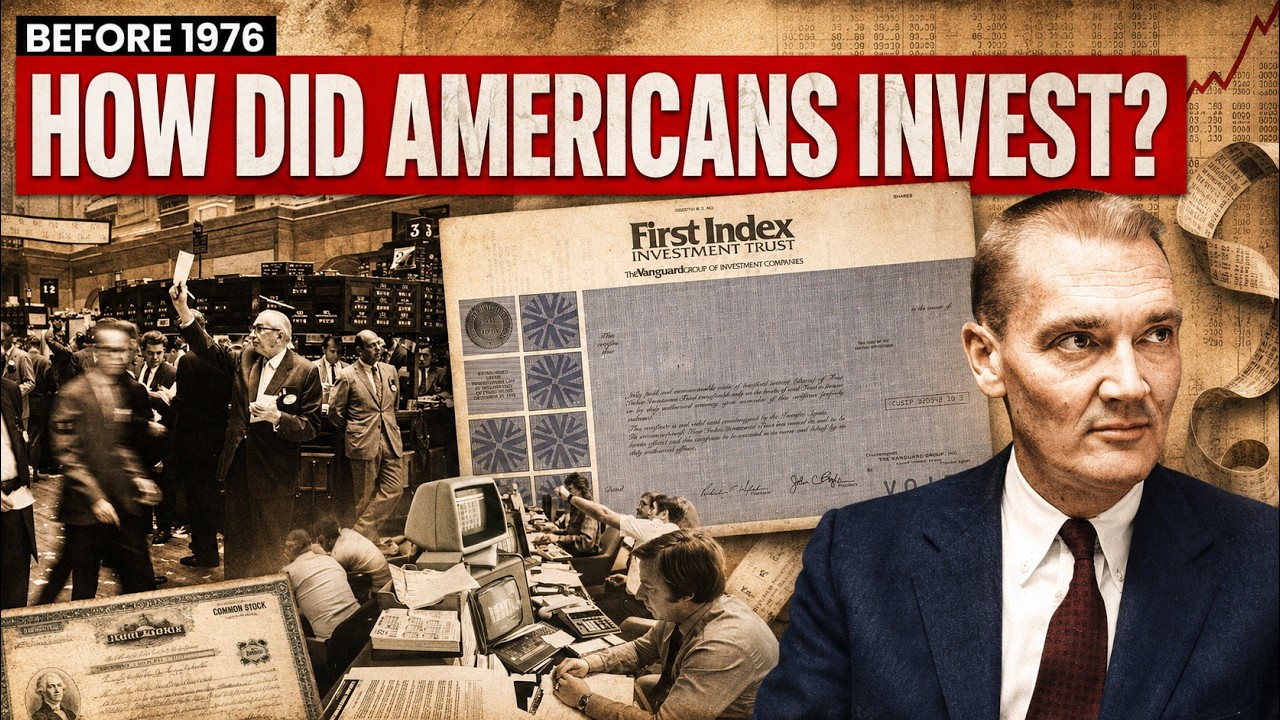
The company would operate at cost. Every dollar saved on fees would stay in the pockets of the people who invested. On August 31, 1976, Vanguard launched the first index investment trust, the world’s first index mutual fund available to individual investors. It tracked the S&P 500, and Wall Street hated it.
The fund was mocked relentlessly. They called it un-American. They called it a guarantee of mediocrity. One competitor distributed posters showing Uncle Sam with a clenched fist and the slogan “Index funds are un-American.
” The industry called it Bogle’s folly. At first, it looked like they might be right. Bogle hoped to raise $150 million in the fund’s initial public offering. He raised just $11.
3 million. The fund did not even have enough money to buy all 500 stocks in the index; it could only afford 280 of them. By the end of 1976, the First Index Investment Trust had accumulated just $14 million in assets, ranking 152nd in size among 211 equity funds. Bogle himself described it as an artistic, if not commercial, success.
It took nearly a decade before a second index fund entered the market. Competitors saw no reason to launch one. But Bogle kept going. The evidence kept piling up.
Active managers kept underperforming. Fees kept eating into returns, and the index fund, charging a fraction of what active funds charged, kept doing exactly what it promised. It matched the market. It did not try to beat it.
It simply owned a piece of everything and let the long-term growth of the American economy do the work. By 1982, the fund had crossed the $100 million mark, although only because it merged with another fund worth $58 million. By 1988, it hit $1 billion. The idea that Wall Street had called un-American was slowly, relentlessly, inevitably beginning to win.
Today, index mutual funds and exchange-traded funds comprise well over half of all stock fund assets in the United States. Vanguard now manages trillions of dollars for tens of millions of investors worldwide. A $10,000 investment in the Vanguard 500 Index Fund back in 1976 would have grown to over $2. 1 million by 2025.
John Bogle died in January of 2019 at the age of 89. By that point, the company he founded was managing nearly $5 trillion in assets. He never became a billionaire himself. He could have easily, if he had structured Vanguard as a conventional company rather than as a mutual organization owned by its shareholders.
But that was the whole point. He built a company designed to serve investors, not to extract from them. For most of American history, the financial system existed to enrich the people who ran it. The index fund was one small, stubborn, revolutionary attempt to change that answer.
And against the mockery and the resistance and the entrenched power of the financial establishment, it worked.
