The explosion came not as a sound but as a physical blow. One moment the boat was there, a small wooden fishing vessel riding the calm Atlantic waters beyond the harbor wall at Mullaghmore. The next, there was only a towering column of grey smoke, a fountain of water, and a rain of splintered timber falling from the sky. Witnesses on the shore would later struggle to describe it.
A boat had simply ceased to exist. On board, Lord Mountbatten had been at the tiller, steering toward the lobster pots that had been the morning’s purpose. The blast had been planted in the engine block directly beneath him. The last Viceroy of India, the man who had drawn the borders of India and Pakistan, died instantly, his legs severed by the force of fifty pounds of gelignite.
His fourteen-year-old grandson Nicholas was killed at the same moment. The local boy who had been hired as a summer boat hand, fifteen-year-old Paul Maxwell, died too. A mile away, in the stone walls of Classiebawn Castle, Amanda Knatchbull heard the thunder roll across the cliffs. She had stayed behind that morning.
The accounts of why vary: she wanted to read, she was tired, she wanted a few hours away from the noisy energy of the twins. Whatever the small reason, the decision carried monstrous consequences. As she watched the cars depart through the castle gates, raising dust on the country road, she was watching her life as she had known it drive away. It would never return.
The survivors were left struggling in water slick with oil and strewn with wreckage. Amanda’s mother, Lady Patricia, had been thrown clear of the boat, conscious but horrifically wounded, her face torn by shrapnel, both legs broken, her lungs filling with water and smoke. Her husband John floated nearby, his legs shattered. Their other twin, Timothy, was screaming, blinded by the blast, his body covered in burns.
The elderly Lady Brabourne, John’s mother, was still alive, barely staying afloat amid the debris. Local fishermen, overcoming their shock, raced their boats toward the smoke. They pulled the living and the dead from the water, laying the bodies on the deck of the same craft that usually carried crab and lobster, and hurried back to the harbor. The Irish Republican Army claimed responsibility days later, describing the killing as an execution.
They said Mountbatten was a legitimate target, chosen to draw attention to the British occupation of Northern Ireland. For Amanda, reading those words, the message was unmistakable. Close proximity to the crown was a death sentence. —
The road that led to that August morning in 1979 had been carefully paved by the man whose life had just ended.
Louis Mountbatten, the first Earl Mountbatten of Burma, had been known to the royal family as Uncle Dickie. To the world, he was a giant: the last Viceroy of India, the Supreme Allied Commander in Southeast Asia during World War II, a man of such commanding charisma and towering vanity that he dominated any room he entered. He was not merely a member of the royal circle; he was its director. Obsessed with lineage, with legacy, and above all with the name Mountbatten, he had already engineered his greatest victory in 1947 when he helped his exiled, penniless Greek nephew Philip marry the woman who would become Queen Elizabeth II.
He had planted his dynasty in the House of Windsor. But for a man like Mountbatten, one victory was never enough. He wanted the line of succession secured for generations. He turned his intense focus toward the next heir: the sensitive, awkward, deeply impressionable Prince Charles.
Charles grew up in the cold, emotionally distant nurseries of Buckingham Palace, where the Queen was often occupied with the red state boxes and Prince Philip was a harsh, demanding figure. Mountbatten became his surrogate grandfather, a safe harbor. He was warm, loving, attentive. He wrote Charles countless letters advising him on everything from naval tactics to leadership, and most importantly, on love.
His advice on women was notorious for its cold Edwardian pragmatism. He urged the prince to enjoy his youth, to have adventures and relationships, but to choose a wife with the calculations of a horse breeder. In a famous letter, he urged Charles to find a suitable, attractive, sweet-charactered girl before she fell in love with someone else. The future Queen, he believed, should be young, adaptable, and of proper lineage.
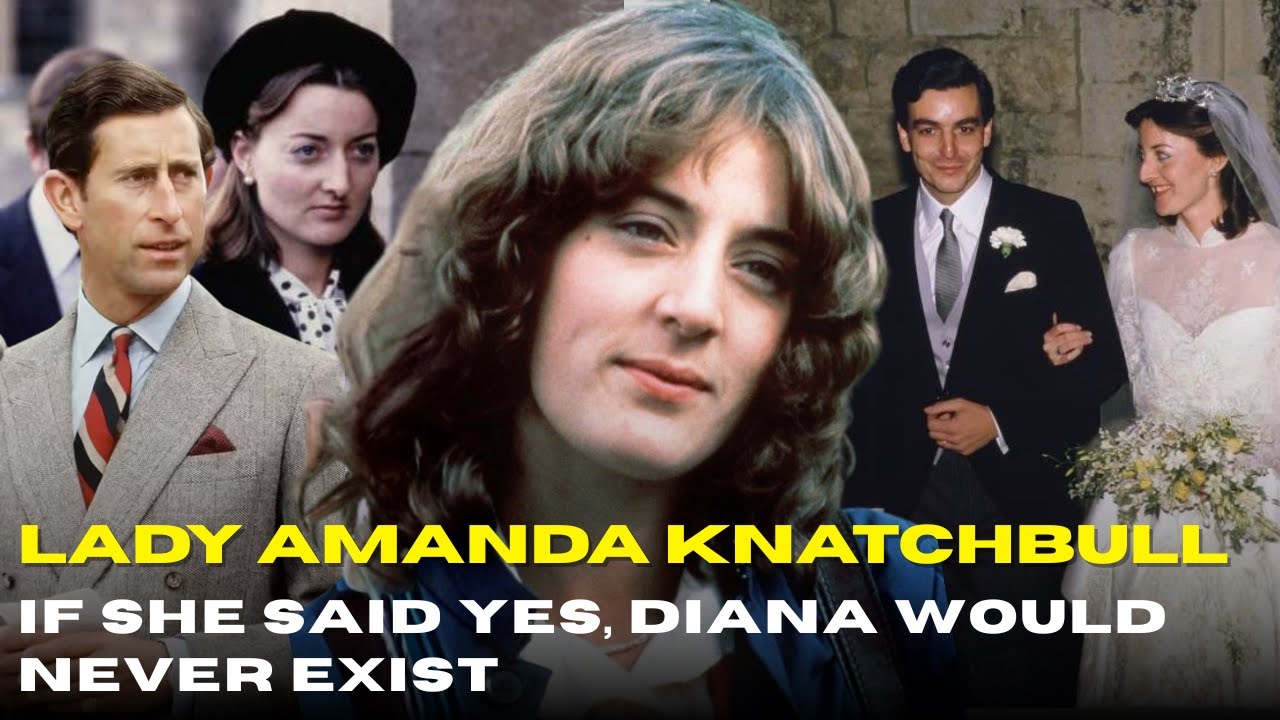
In his view, there was no better lineage than his own. Amanda Knatchbull was born on 26 June 1957, the daughter of Patricia, Mountbatten’s eldest daughter, and John Knatchbull, the seventh Baron Brabourne. From birth, she was woven into the fabric of the royal family. She grew up running through the corridors of Broadlands, Mountbatten’s Palladian mansion in Hampshire, the very house where the Queen and Prince Philip had spent their honeymoon.
She moved in the same privileged circles, in constant contact with the wider royal family. Unlike the aristocratic girls who would later scramble for Charles’s attention, drawn by titles and crowns and fame, Amanda was different. She was intelligent, perhaps one of the sharpest women in the royal orbit. Educated at Benenden, she then took a gap year to travel, displaying a curiosity about the world beyond high society.
She was composed, with a dry wit and a strong sense of self. She was also beautiful, not in the flashy cinematic way of Diana, but in a quiet, classic English manner. She had a calm demeanor that promised stability, something the anxious, neurotic Prince Charles desperately needed. Mountbatten began his campaign early.
In 1974, when Amanda was seventeen and Charles was twenty-five, he wrote to Charles, subtly planting the idea. He noted that Amanda was growing up, turning into a wonderful young woman. He suggested she would be the perfect choice. “I think you will find her a very loving and supportive friend,” he wrote, carefully avoiding the word “wife” while implying it in every syllable.
She was young, but she was one of them. Charles, who idolized his great-uncle, was not put off. He was lonely, exhausted by the London dating scene of the 1970s, by the constant photographers, the girls who sold stories to the tabloids, the pressure to find a virgin bride. Amanda represented safety.
She was one of them. She knew the rules. She would not run to the press or be shocked by protocol. He genuinely liked her.
They were related, but distantly enough to avoid genetic problems, and close enough to share a particular language of understanding. They laughed at the same jokes, shared a love of the outdoors, painting, and the quiet rural life Charles craved away from London. The courtship developed slowly, orchestrated by Mountbatten. He arranged for them to be together at family gatherings, seated them next to each other at dinner parties, encouraged Charles to visit the family home.
It was not a story of fireworks and passion. It was a story of inevitability, a merger of two great houses. By the late 1970s, Mountbatten’s plan was an open secret within the inner circle. The Queen and Prince Philip were aware and reportedly approved.
Philip, after all, was also Amanda’s cousin. It would keep the throne firmly within the family. The court liked that Amanda was sensible. She would not cause trouble.
In 1979, the timeline accelerated. Charles was thirty-one. The press was demanding a royal wedding. Mountbatten urged him to get on with it.
That year, a fateful trip was arranged. Charles and Amanda accompanied Lord Mountbatten to Eleuthera, a long, thin island in the Bahamas, a place of white sand and absolute privacy. Under the Caribbean sun, the prince and the lady tested the possibility of their future together. They swam, water-skied, and picnicked on deserted beaches.
During the trip, it was said, Charles raised the subject of marriage. Amanda did not say yes. She did not say no, either. Not yet.
She was twenty-one, ten years younger than Charles. Despite her maturity, she had a modern sensibility that clashed with her grandfather’s Edwardian expectations. She did not see the proposal as a fairy tale but as a job, and a terrifying one. She valued her independence.
She had watched the press hound Charles’s previous girlfriends. She knew that becoming Princess of Wales meant the death of her private life. She was also astute enough to see the ghost in the machine: Camilla Parker Bowles. Perhaps she sensed that while Charles loved her as a friend and partner, his deeper passion was directed elsewhere.
So on that beach in Eleuthera, she asked for time. She told Charles she was still too young, not ready for a lifetime commitment to the institution. Charles, to his credit, was patient. He did not pressure her.
Her hesitation made him respect her more. It proved she understood the weight of the role. He agreed to wait. The understanding was that the door remained open.
The wedding was postponed, not cancelled. Mountbatten was frustrated but not discouraged. He wrote to Charles with reassurance. She admires you greatly, he insisted.
She just needs to get used to the idea. Uncle Dickie was confident. He had spent his life manipulating the chess pieces of Europe. He would not let a twenty-one-year-old girl’s hesitation ruin his masterwork.
—
The summer of 1979 passed. It was strange and fevered in Britain. Margaret Thatcher had just been elected prime minister. The economy was struggling.
As August approached, the Mountbatten family prepared for their annual pilgrimage to Classiebawn Castle, a fairytale fortress on a cliff edge in County Sligo on Ireland’s western coast, a place of wild beauty overlooking the Atlantic. It was a sanctuary, but also a place of danger. Ireland in 1979 was a war zone in the north, and the shadows of the Troubles stretched across the border. The Provisional IRA was active and lethal, seeking high-profile targets.
Lord Mountbatten, as a former Chief of the Defence Staff and a relative of the Queen, was a valuable target. Security services in London and Dublin were anxious. They warned Mountbatten repeatedly that Classiebawn was unsafe. The castle was isolated.
The roads were easily mined. The harbor where his boat moored was impossible to defend. They begged him not to go. Mountbatten ignored them.
He was an old sailor, a warrior who had survived torpedo attacks in World War II. “Who would want to kill an old man like me? ” he famously asked. He refused to let a few terrorists dictate how he spent his holiday.
He believed his popularity in Ireland, where he was generally loved by the locals of Mullaghmore village, would protect him. So in August 1979, the family gathered at Classiebawn: Lord Mountbatten; his daughter Patricia, Amanda’s mother; her husband John; their fourteen-year-old twins Nicholas and Timothy; and the formidable elderly Lady Brabourne. Amanda was there too. It was a happy, boisterous family holiday.
They played games in the castle, walked along the cliffs, and went fishing. Mountbatten had a small thirty-foot wooden boat called the Shadow V. It was not luxurious, just a simple vessel for lobster and mackerel fishing. It was his pride and joy.
The days before 27 August were filled with simple summer pleasures. Charles, serving in the Royal Navy, was in constant contact. He was planning to visit later in the holiday. The plan was for Charles to come to Ireland, spend time with his grandfather, and, most importantly, spend time with Amanda.
The pressure to formalize the engagement was mounting. The family whispered that this Irish holiday might be the moment Amanda finally said yes. It was perfect: romantic, isolated, family-oriented. But as the sun set on the evening of 26 August, unseen eyes watched the harbor at Mullaghmore.
Men moved in the darkness, driven by a hatred the aristocratic Mountbattens could not comprehend. They crept to the water’s edge. They did not see the Shadow V as a grandfather’s fishing boat. They saw it as a symbol of British imperialism.
They saw a floating coffin. —
The morning of the bank holiday in County Sligo seemed impossibly peaceful. The Atlantic, often boiling with grey fury on this stretch of coast, was glassy and calm. Inside the castle, the mood was light.
The gloom of the security warnings felt distant. Lord Mountbatten was in high spirits. At seventy-nine, he lived on a near-military schedule even on holiday. The plan for the day was simple: go to the harbor, board the Shadow V, sail toward the lobster pots, catch some fish for tea, enjoy the sea air.
It was a routine of deliberate normalcy, a defiant statement that he would not yield to terrorists on his own doorstep. The group assembled in the castle courtyard. There was Mountbatten, in old comfortable fishing clothes. There were Patricia and John Knatchbull, Amanda’s parents.
There were the twins, Nicholas and Timothy, bursting with teenage energy. There was the widowed Lady Brabourne, John’s eighty-three-year-old mother, a formidable woman of the old school. One person was missing from the procession: Amanda. At the harbor, the scene was beautiful.
The Shadow V, a twenty-nine-foot wooden boat painted green and white, bobbed gently at the dock. A local teenager, fifteen-year-old Paul Maxwell, was already on board, hired as the boat boy for the summer, a dream job for a local lad. The family boarded with practiced ease. Mountbatten took the tiller.
He loved this boat. It was not a fancy yacht; it was a working boat, modest and sturdy. He started the engine. The twins rushed to the bow.
The adults settled in the stern. The lines were cast off. Late that morning, the Shadow V motored out of the harbor, leaving a clean white wake in the blue water. The device was detonated remotely from the shore.
The bombers were members of the Provisional IRA. They had a clear line of sight and a radio transmitter. The boat was about two hundred yards from the harbor wall, just passing the final breakwater. Mountbatten was at the helm, looking toward the lobster pots.
Then the world ended. —
The blast targeted the engine block where Mountbatten stood. Nicholas was killed instantly. Paul Maxwell was killed.
The survivors were pulled by local fishermen into their boats. Amanda rushed to Sligo General Hospital, stepping into a living nightmare. She saw her elegant mother, unrecognizable behind a mask of blood and bandages. She saw her father broken and drugged.
She saw her surviving brother, Timothy, in shock and pain. She saw the bodies, and she was the one who had to identify them. The man who had engineered her future, who had guided her hand toward the crown, was now a shattered husk. The brother she had played with hours ago was gone.
In the days that followed, Amanda displayed a composure that was frightening in its determination. With her parents incapacitated in intensive care, she became the pillar of the family. She handled the press. She communicated with the police.
She drew strength for her surviving brother. She was a Mountbatten woman, as her grandfather had raised her to be: strong, capable, unyielding. But something inside her had changed fundamentally. The romantic haze of the Caribbean holiday, the mutual fondness with Prince Charles, the glitter of palaces, all turned to ash.
Prince Charles received the news while fishing in Iceland. He was devastated. He wrote in his diary that life would never be the same again. He had lost his mentor, the man who had been more of a father to him than Prince Philip.
He was distraught, weeping openly, consumed by grief and a helpless, raging anger. He hurried back to Britain. He wanted to see Amanda. He wanted to comfort her.
Perhaps he thought this shared tragedy would bring them closer together. Shared grief, after all, is a powerful bond. He imagined they would cling to each other in the storm. He was wrong.
When they finally met in the aftermath, Charles found a different woman. The carefree girl of Eleuthera was gone. In her place was a survivor with haunted eyes. Amanda was compassionate, yes, kind, but there was a barrier.
She had seen the price of the game he was asking her to play. At Mountbatten’s funeral in Westminster Abbey, surrounded by kings and queens from across Europe, Amanda walked with her family, a mask of solemn grief on her face. But she was thinking of the empty seats. The place where Nicholas should have been.
The place where Paul Maxwell should have been. She saw the soldiers lining the streets not as a guard of honor but as a security necessity. She saw the bulletproof glass and the snipers on the rooftops. She understood that if she married Charles, this would be her life forever.
Every car ride, every holiday, every public appearance would be a search for a gunman. She would be checking under her car for bombs, wondering if her children would become the next victims. The bomb on the Shadow V had not just killed a Viceroy. It had shattered the illusion of royal immunity.
It had proven that the castle walls were not high enough. —
In the quiet, painful months that followed, Charles pressed her again. He was desperate, lonely, needing her more than ever. He believed that marrying her would be the highest tribute to Mountbatten’s memory, completing the plan, a victory of love over terror.
He formally asked her to be his wife, to be Princess of Wales, to help him bear the burdens of the monarchy. Amanda looked at the man she loved as a cousin and friend. She looked at the institution that had just cost her half her family. She made the decision that would change the course of history.
Sometime in late 1979 or early 1980, the moment of truth came. The exact date and place remain a secret, buried in the memory of the two people who were there. But the outcome is a matter of historical record. Charles asked her to marry him.
He offered her the world: the title of Princess of Wales, the future title of Queen, the palaces, the jewels, the adoration of millions. Amanda looked at him. She loved him as a cousin, as a friend, as a suffering child in a cruel world. But she did not love the cage.
She said no. It was not an equivocal no. It was not a “not yet” or an “ask me later. ” It was a final, absolute refusal.
She explained her reasons with the brutal candor Charles had always admired. She told him that the self-surrender the monarchy required was absolute, and she was not prepared to make that sacrifice. She told him that the shadow of the bomb was too long, that the fear of being a target would poison their lives. She told him, in essence, that she chose freedom over duty.
Charles was stunned. He was the most eligible bachelor in the world. The idea that the one woman he truly wanted, the perfect woman for the role, would refuse him was inconceivable. He tried to argue, to persuade.
Amanda was immovable. She had seen the beast up close and refused to feed upon it. The refusal broke something in Charles. It was not just grief at losing her; it was panic.
Mountbatten’s plan was dead. The pressure from his father and the press became unbearable. “Charles the Cad,” the papers called him, wondering why he could not find a bride. The palace entered a state of emergency.
They needed a replacement, and they needed one fast. But the criteria had changed. They could no longer look for a woman equal to him. Amanda had proven that an equal woman would refuse.
They needed someone younger, more naive, someone who did not understand the price. They needed a blank canvas. Enter Lady Diana Spencer. The contrast with Amanda Knatchbull could not have been starker.
Amanda was twenty-two, educated, realistic, cynical about royal life. Diana was nineteen, a nursery assistant who had dropped out of school, romantic and utterly dazzled by the idea of the prince. Where Amanda saw a target, Diana saw a fairy tale. Where Amanda saw a cage, Diana saw a castle.
The engagement was swift, almost predatory in its speed. Charles met her in the summer of 1980, months after Amanda’s final refusal. He did not love her, not the way he loved the idea of Amanda or the way he burned for Camilla Parker Bowles. He saw her as a solution.
She was an aristocrat from the Spencer family. She was a virgin, a non-negotiable condition at the time. She was good-natured, as Mountbatten had advised. Most importantly, she was willing.
When Charles proposed to Diana in the nursery at Windsor Castle in February 1981, he was not looking for a soulmate. He was making a business deal because the preferred candidate had withdrawn. Diana, young and deceived by the romance novels she loved, said yes immediately. She did not know she was the second choice.
She did not know she was filling a void left by a woman who had fled the scene of the crime. The wedding on 29 July 1981 was the wedding of the century. But for those who knew the truth, it was a tragedy in a fancy dress. Amanda Knatchbull was present.
She sat in St. Paul’s Cathedral and watched the spectacle unfold. It must have been a surreal, out-of-body experience. As Diana stumbled over Charles’s names during her vows, Amanda knew the truth.
Diana was not marrying a man. She was marrying an institution that devoured people. Amanda had escaped the line of fire. Diana had walked into it, unaware.
—
The years that followed were a confirmation of Amanda’s fears. The fairy-tale marriage of Charles and Diana unraveled with a speed and violence that shocked the world. The press intrusion was relentless. Every outfit, every glance, every tear was analyzed, commodified, and sold.
In later accounts, Diana described her severe psychological distress and the overwhelming impact of press intrusion. Amanda watched it all from a distance, in the quiet countryside. She did not retreat entirely from the royal orbit. Instead, she went to work.
She later worked in social welfare and charitable roles, largely away from the spotlight. It was a poignant choice. The woman who could not save her brother from violence devoted her career to saving other children from harm. In 1987, eight years after the bomb, Amanda married.
She did not marry a duke or a prince. She married Charles Ellingworth, a writer and property developer. The wedding was private, respectful, traditional but not a state occasion. There were no television cameras, no miles of cheering crowds, just family and friends.
They had three sons: Luke, Joseph, and Louis. They lived in a comfortable house in the country. They had dinner parties. They went on holidays without bodyguards.
They argued about ordinary things, not constitutional crises or mistresses. Amanda achieved the one thing Diana never could: a normal life. Yet she remained close to Charles. The bond created by the bomb was stronger than the refusal.
Charles respected her choice even as he regretted it. They remained friends, keepers of secrets, sharing a history no one else could understand. When Charles was attacked by the press in the 1990s, vilified for his relationship with Camilla and his treatment of Diana, Amanda was one of the few who did not judge him. She knew the pressures he was under.
She understood he was a man trapped in a role he did not choose, just as she was a woman who had escaped a role she did not want. Then came 31 August 1997. A Mercedes, a tunnel in Paris, a crash. Princess Diana was dead.
For Amanda, Diana’s death must have been a horrifying moment of déjà vu. It was an echo of Sligo. The crown had claimed another victim. The royal curse was real.
Had Amanda said yes in 1980, would she have been the one in that car in Paris? Probably not. She would not have dated Dodi Fayed. She would not have leaked stories to the press.
But she would have been the target. And in a different way, the system might have destroyed her too. Diana’s death was the final, bloody proof that Amanda Knatchbull was one of the smartest women in royal history. She had looked into a crystal ball in 1979 and seen the accident coming.
She had gotten off the train before it derailed. —
The story, however, did not end with her escape. It had one final chapter: reconciliation between the past and the present. For decades, the shadow of August 1979 hung over the Mountbatten family like a radioactive cloud.
The name “Sligo” was synonymous with death. The family never returned. The castle stood empty. The political situation in Northern Ireland remained tense.
Amanda’s surviving brother, Timothy, the boy who had been blinded and battered on the boat while his twin died, began a public journey of healing. He wrote a book, From a Clear Sky, confronting the horror of that day. Amanda supported him from the shadows, advocating the idea that the family needed to process the grief, not just suppress it with stiff-upper-lip stoicism. It was a radical departure from the old royal approach of silence.
Then, in 2015, the geopolitical earthquake that brought the story full circle. Prince Charles announced he would do the unthinkable: he would visit Mullaghmore. It was a delicate act requiring immense diplomatic and personal courage. On 19 May 2015, under a grey Irish sky, the Prince of Wales walked along the harbor wall at Mullaghmore.
There were no bombs this time, though there were snipers, protecting him. The local people of Sligo came out in thousands. They did not jeer; they cheered. They reached out their hands to shake his.
In a speech that was widely praised, Charles spoke directly about the pain of loss and acknowledged the broader suffering across these islands. “At that time,” he said, “I never imagined how we would come to terms with the pain of that deep loss. ” Then he did something extraordinary. He connected his loss to the loss of the Irish people.
“Through this terrible experience,” he said, “I now understand in a profound way the suffering that so many people in these islands have carried, regardless of their faith, their tradition, or their political persuasion. ” It was a masterful gesture of empathy. Amanda, back in England, must have felt a heavy weight lift. The Mountbatten fate had finally evolved.
It was no longer about ruling an empire. It was about healing a division. Charles had finally become the man Mountbatten had wanted him to be, not through marrying the perfect bride, but through showing perfect humanity. The visit proved Amanda’s refusal right in a new way.
Had she married Charles in 1980, she would have been the public face of the British establishment during the worst years of the Troubles, a direct target of hatred. By stepping aside, she allowed Charles to make this journey as a man seeking peace, rather than a husband defending a dynasty. Her absence allowed the focus to remain on the victims and on reconciliation. Amanda’s lesson also began to manifest in the next generation.
As Prince William courted Catherine Middleton, the lessons of Amanda and Diana were clearly being applied. William did not rush. He waited ten years. He made Kate see the cage before asking her to enter it.
He subjected her to the photographers, the pressure, the protocol. He effectively put her through the Amanda test. Could you handle this? Do you want this?
Catherine Middleton was the “Amanda” who said yes, but she said yes with her eyes open, fully prepared. The stability of the Wales family today is a direct result of the lessons learned from the refusal of 1980. —
On 8 September 2022, the news flashed across screens worldwide. Queen Elizabeth II had died.
The Elizabethan era was over. As Charles ascended the throne, visible as an older, greyer man, the ghosts of his past walked with him. Camilla, now Queen Consort, was at his side. But for those with a sense of history, there was another figure hovering at the margins of that historic moment.
Somewhere in the quiet English countryside, Lady Amanda Ellingworth watched the accession ceremony on television, just like the rest of us. It was the moment for which she had been prepared since birth. It was the moment Mountbatten had planned for, and died for. Had she said yes forty-two years earlier, she would have been the one standing on the balcony of Buckingham Palace.
She would have been Queen Amanda. Her face would have been printed on the new banknotes. Her children would have been the heirs to the throne. The contrast between that alternate reality and the actual one is the ultimate justification for her life’s choices.
Look at the reality Charles faced upon his accession. He inherited a kingdom in crisis, a family torn apart by the exile of Prince Harry and Meghan Markle, a public skeptical of the monarchy’s relevance. The media scrutiny was ferocious. The story of Harry and Meghan was a re-run of the 1980s nightmare, a royal couple tearing each other apart in the public eye, driven by trauma and intrusive journalism.
Amanda had predicted this. She had spared her children that fate by refusing to feed herself or them to the machine. Her sons do not sell secrets to Netflix or write scandalous memoirs. They are ordinary citizens living private lives.
That ordinary life is an invaluable legacy that no amount of royal dukedoms could purchase. Furthermore, Amanda’s survival is a quiet triumph over the terrorism of 1979. The IRA bomb was meant to destroy the British establishment, to break the spirit of the ruling class. In a way, it left scars on them.
But it failed to destroy Amanda. She did not let the trauma define her as a victim. She chose the most radical response to terrorism possible. She chose to live a happy, productive life.
She founded a family. She served her community. She endured. In the final analysis, the story of Lady Amanda Knatchbull is a mirror reflecting our obsession with the royal family.
We consume their lives as entertainment. We project our fantasies onto them. We assume the crown is the ultimate prize. Amanda shattered that mirror.
She showed us that the crown is in fact a burden, a heavy golden hat that comes with a lifetime sentence of scrutiny. She is the winner who was never crowned. She won the game by leaving the match. Her relationship with King Charles today remains a testament to what might have been.
They are friends, survivors. When they meet, perhaps they do not discuss “what if. ” Perhaps they talk about their grandchildren, about the gardens at Highgrove or Broadlands, about the changing seasons. They share a silence louder than words.
The silence of the bomb that exploded, and the silence of the life that continued after the smoke cleared. As we watch the reign of King Charles III unfold, we might spare a thought for the woman who is not there. The Lady Amanda Knatchbull lived to see her hair go grey. She lived to see her children grow up.
She lived to turn off the television when the royal drama became too loud, and to walk out into her garden, into the quiet beauty of a life she chose for herself, away from the lights. In the history books, she will be a mere footnote: the girl who said no. But in the reality of human existence, she is the headline. She is the proof that sometimes the bravest thing you can do is walk away from the fairy tale.
The tragedy of the Shadow V in 1979 tore a hole in history. It took the life of a great man and shattered the innocence of a royal dynasty. But from that wreckage emerged two distinct paths. One led to St.
Paul’s Cathedral, to Diana, to worldwide fame, and ultimately to a pillar in a Paris tunnel. The other led to a quiet country church in 1987, to social work, to privacy, and to life. Lady Amanda Knatchbull stood at the crossroads of the twentieth century. On one side was the crown, glittering and deadly.
On the other was obscurity, quiet and safe. She looked at the blood in the water and made her choice. She refused the crown to save her soul.
And in doing so, she became the only royal woman of her generation who got a truly happy ending.
