On the morning of September the 20th, 1941, in a region under Hungarian military occupation, a young Jewish woman was seized by the Hungarian military police. Her name was Lily Burm, and the charge was simple and stark: she was carrying a weapon. In wartime, possession of a firearm was often enough to end a life. But for Lily, the arrest was only the beginning of a slow, public, and deliberately terrifying ordeal that would end with her suspended from a three-meter pole, her body left on display for hundreds of people to see.
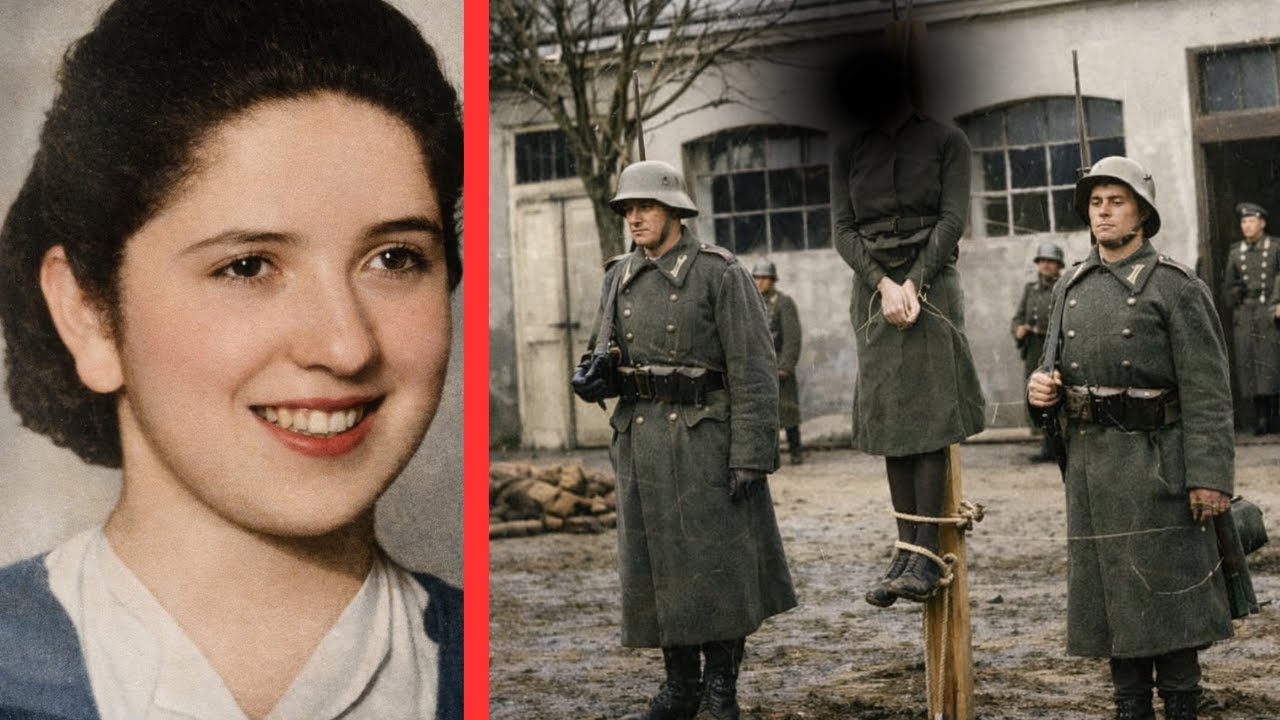
The weapon itself was never described in detail. A gun, presumably. But the military court that tried her was not interested in the particulars of the arrest. They deemed her dangerous.
They judged her to be involved with the resistance. And on that basis, they sentenced her to death. The method chosen was Hungarian pole hanging, a form of execution that had been practiced across the lands of the former Austro-Hungarian Empire and one that the Hungarians had refined into a tool of psychological warfare. It was not designed merely to kill.
It was designed to demonstrate. To understand how a young woman came to face such a fate, one has to look at the world she grew up in. Lily Burm was a young Jewish woman raised in Yugoslavia. Her surname suggests a possible German ancestry, perhaps an ethnic German family with roots that stretched back into the old empires of Central Europe.
But in the eyes of the Nazi regime and its allies, that heritage meant nothing next to her Jewish identity. She was marked for persecution from the moment the war began. She was a member of a Jewish youth organization known as the Young Guards, active in the region of Novi Sad, a city on the banks of the Danube in what was then Yugoslavia. This was a youth group built on the ideals of Jewish self-defense, community, and resistance-awareness.
In peacetime, it might have remained a social and cultural organization. But this was not peacetime. In 1941, the Axis powers invaded Yugoslavia, and the country was carved up among the conquerors. The region around Novi Sad fell under Hungarian control.
The Hungarian authorities were tasked with occupying the area, maintaining order, and crushing any sign of defiance. For Lily, the choice was clear. She became involved in resistance activities against the Hungarian authorities. She was linked with sabotage groups operating in the region, groups that caused constant problems for the occupiers.
This was not a passive existence. These were people who damaged infrastructure, disrupted supply lines, and made the occupation as costly and as uncomfortable as possible. The occupiers responded with collective punishment, mass arrests, and executions. It was the standard currency of occupation in the Second World War.
Rule by fear was the strategy, and public executions were the means. When Lily was arrested on that September day in 1941, she was caught carrying a weapon. It is not known whether she was betrayed by an informer or whether the Hungarian police simply stumbled upon her. The record is silent on that point.
But the outcome was never really in doubt. A military court heard her case. In their eyes, a young Jewish woman carrying a weapon in a region seething with resistance activity was a threat that had to be eliminated. The sentence was death.
The method they chose was deliberate. Hungarian pole hanging was not a quick, private affair. It was a spectacle. The apparatus consisted of a three-meter pole or post, set upright in the ground.
The condemned person was secured to it with a chest sling. A system of ropes was passed around the top and bottom of the post, connected by pulleys. The executioner stood behind the post. When the chest sling was released, the condemned person dropped a short distance, and at that same moment, the executioner tried to force the head to one side, attempting to snap or dislocate the neck.
In theory, death would come within seconds. The executioners of the time considered it relatively quick and even humane, more humane than a traditional gallows with a trap door. But the theory did not always match the reality. When the neck was not broken cleanly, the condemned person would not die quickly.
They would slowly strangle on the post, struggling for some time, gasping, choking, their body wracked with convulsions as the crowd watched. And because these executions were deliberately held in public, hundreds of people would witness this struggle. It was meant to horrify. It was meant to terrify.
It was meant to send a message to anyone who might be tempted to join the resistance: this is what happens to those who defy the occupation. Lily Burm spent two months on death row. Then, on the 25th of November 1941, she was brought out to a military barracks and forced onto the post. Hundreds of people had been gathered to watch.
The exact details of her final moments are not recorded. Whether the executioner managed to break her neck cleanly or whether she strangled slowly on the pole before the crowd is not known. Either way, her body was left hanging there after the execution had ended. The pole was not taken down quickly.
It was left in place, with her suspended on it, as a warning to the local population. The sight of a young woman, a teenager or barely older, hanging dead in public view was the message the occupiers wanted to imprint on the minds of everyone in the region. Why pole hanging specifically? The answer lies in history.
The lands that had once fallen under the influence of the Austro-Hungarian Empire had long used this method of execution. It was part of the legal and punitive culture of that empire, passed down to the successor states that emerged after its collapse. The Hungarians, who had controlled these territories and who now occupied them again in the chaos of the Second World War, were experts in its use. They employed it not just to kill, but to communicate.
Every execution was a performance, a piece of theater designed to cow the population into submission. The image of a body swaying on a post, visible to all, was a permanent reminder of the cost of defiance. In the end, the story of Lily Burm is simple in its tragedy. She was a young woman who wanted to do her bit to rid her country of its occupiers.
She joined a resistance group. She was caught carrying a weapon. She was sentenced to death by a military tribunal. And she was executed in a way that was designed not just to end her life, but to use her death as a weapon against the people she had tried to help.
The public hanging of a young Jewish woman was meant to deter others from following her path. It was a lesson carved in the flesh of one person and displayed for all to see. Whether the occupiers got the response they wanted is impossible to say with certainty. But the act itself stands as one of the darkest examples of what occupation meant in the Second World War.
Behind the methodical language of military courts and the clinical descriptions of execution techniques was a simple and brutal reality: a young woman, persecuted for her identity, condemned for her resistance, and killed in a way designed to maximize terror. Her body was left on the pole as a warning, but her name survived the warning. And it is her name that remains attached to the story, a reminder of the human cost of an occupation that ruled through fear.
