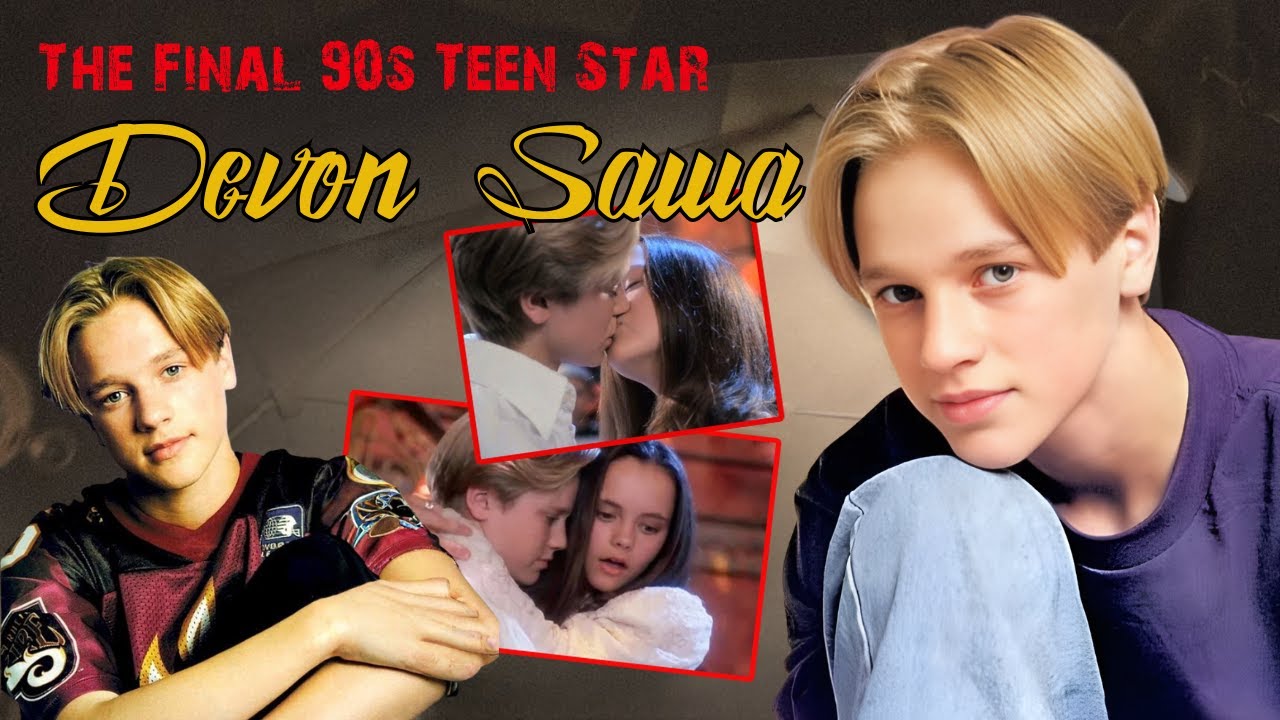
In 1995, a seventeen-year-old from Vancouver stepped onto a movie screen for barely six minutes and became the romantic fantasy of a generation. Devon Sawa had been cast as the human version of Casper, the friendly ghost, appearing only at the film’s climax to take the heroine’s hand and ask, “Can I keep you? ” The effect was immediate. Casper grossed over 287 million dollars worldwide, and the teen magazine machine that had quietly noted Sawa in the 1994 family comedy Little Giants kicked into overdrive.
He was no longer an actor. He was a product. He was born on September 7th, 1978, in Vancouver, British Columbia, the youngest of three children. His father was a refrigeration mechanic, his mother a homemaker, and his upbringing was deliberately ordinary in a blue-collar Canadian household.
His interests were hockey and football, not Hollywood. But Vancouver in the 1980s and 90s operated as “Hollywood North,” a production hub for American film and television drawn by tax incentives and versatile locations. For a local kid with talent, acting was less a pipe dream than a local industry. A teacher encouraged him to pursue school theater, and at fourteen he began his professional career not with a dramatic role but with a commercial for Kenner’s Starting Lineup sports action figures, selling toys to kids his own age.
From there came small television guest spots and then Little Giants, which put his face on posters and his name on casting desks. When Universal and Steven Spielberg’s Amblin Entertainment began casting Casper, they faced a specific problem. The ghost was a digital effect voiced by another actor, and the emotional weight of the entire film rested on a single scene in which Casper becomes human for one night. The actor chosen had to embody everything audiences had come to love about an invisible character.
They chose Sawa. His entrance down a grand staircase at the Halloween dance was a star-making moment that launched a thousand crushes, and the machine that built teen idols went into full production. The following year he appeared in Now and Then, playing the town bully and object of the girls’ confused affections, a slight pivot from the angelic ghost. His status was cemented in 1997 with Wild America, co-starring Jonathan Taylor Thomas, the undisputed king of the teen magazines.
Sawa was by all accounts a polite, grounded kid watching his life explode into something unrecognizable. But he was also watching the graveyard around him. The 1990s were littered with teen heartthrobs who had been chewed up and discarded. Jonathan Taylor Thomas had walked away at the height of his fame.
Edward Furlong’s career had been derailed by addiction. Brad Renfro had battled drugs his entire career and would die of an overdose at twenty-five. Sawa could see the wall coming, and he made a conscious decision to break the machine before it broke him. His rebellion did not take the form of public meltdowns or scandalous interviews.
It was internal, strategic, and professional. He actively tried to dismantle the Casper persona by pivoting into darker, grittier projects. In 1998, at the absolute peak of his teen idol fame, he took a role in SLC Punk, a raw independent film about the punk scene in conservative Salt Lake City. His character, Shawn, was a punk from an affluent family who ingests acid at a party and suffers a complete psychotic break, ending the film reduced to a childlike state in his parents’ home.
It was the anti-Casper, a grenade thrown directly at his pin-up image. The film became a cult hit on video, and for Sawa it was a declaration of intent: I am not who you think I am. He doubled down in 1999 with Idle Hands, taking his first top-billed role in a major studio film. He played Anton Tobias, a lazy stoner teenager whose right hand becomes possessed by a demon and goes on a killing spree.
It was a gory, slapstick horror comedy, the anti-romance designed to bury the ghost for good. The film was released on April 30th, 1999, just ten days after the Columbine High School massacre, and it bombed at the box office. But like SLC Punk, it found a massive audience on video and became a beloved cult classic. For Sawa, it was an image victory.
He had proven he could lead a studio film and that he was not the boy on the staircase. The year 2000 brought the role that should have been his final graduation. Final Destination was a high-concept horror film in which a group of teenagers cheat death after one of them has a premonition of a plane explosion. Death, an invisible, implacable force, hunts them down one by one in an elaborate series of accidents.
Sawa played Alex Browning, the tortured prophet nobody believes. His performance was a controlled, paranoid intensity that made the unbelievable premise feel real. The film grossed over 112 million dollars on a modest budget and spawned one of the most durable horror franchises of the century. That same year, Dr.
Dre cast Sawa in the music video for Eminem’s Stan, a dark, eight-minute cinematic short film about an obsessed, mentally unstable fan who descends into madness. Sawa played Stan, a man who bleaches his hair to look like his idol, grows increasingly enraged as his letters go unanswered, and finally drives his car off a bridge with his pregnant girlfriend bound in the trunk. The video was a cultural landmark, permanently cementing the song’s narrative in the public’s mind. At twenty-two, Sawa had done the impossible.
He had survived the teen idol curse, led a blockbuster, and been anointed with cultural cool by the biggest names in music. And then nothing. The momentum that seemed unstoppable shattered in two crushing failures. Slackers, a 2002 college comedy, was reviled by critics and audiences alike.
Roger Ebert gave it zero stars. Extreme Ops, released the same year, was a big-budget action film meant to be Top Gun on snowboards. It grossed 13 million dollars worldwide against a reported 40 million budget. In the ruthless calculus of Hollywood, Sawa had followed two career-defining successes with two career-killing bombs.
In twenty-four months, he had gone from the next big thing to box office poison. The scripts dried up. The phone went quiet. He was profoundly burned out.
Around 2003 or 2004, at the age of twenty-five, he made a move that was almost unthinkable for a star of his magnitude. He left. He returned to Vancouver, disappearing from the public eye almost completely. During what he later called his wilderness years, roughly 2004 to 2009, he drifted.
He drank heavily. He took work in a string of independent, often direct-to-video films that most of his fans never knew existed. He was a jobbing actor in exile, grappling with the bottle and the existential dread of his own irrelevance. Then he met Donnie, a Canadian film producer who was not connected to his past fame.
Meeting her was the catalyst for his second transformation. He got sober. He found a reason to build a life rather than mourn a career. He married Donnie in 2013, had a son in 2014, and a daughter in 2016.
He found something more important than fame: an ordinary, grounded adult existence. The first brick of his rebuilding was laid in 2010, when he was cast in the CW’s action series Nikita. He played Owen Elliot, a former government assassin, a rugged, haunted, physically imposing man. It was a shocking contrast to every image the public held of him, and it proved to casting directors and audiences that he was back.
From that foundation he worked constantly, finding his true home in horror and thrillers. His breakthrough came in 2020 with Hunter Hunter, a brutal survival thriller in which he played a fur trapper living off the grid in the Canadian wilderness, a performance of almost pure physicality and stoicism that earned rave reviews from genre critics. Then Don Mancini, the creator of the Child’s Play franchise, came calling. Mancini cast Sawa in the television series Chucky, and what began as a dual role as identical twin brothers evolved into a beloved running gag.
Each season, Sawa returned as a new character, each time killed off in spectacularly gory fashion. By season three, he was playing the President of the United States in a White House stalked by the killer doll. In a single franchise, he has played comedy, drama, domestic pathos, and full-bore horror, all while winking at the audience. The man who starred in Final Destination, the ultimate final guy who cheats death, has become the ultimate recurring victim, the guy who always dies and comes back stronger.
Today, Sawa engages with his 1990s past with warmth and humor, joking freely about “Can I keep you? ” and his magazine rivalry with Jonathan Taylor Thomas. He is no longer haunted by the ghost. He won a Saturn Award in 2001 for Final Destination, but his gritty work in Hunter Hunter and his multi-character tour de force in Chucky show a depth and confident craftsmanship that was only hinted at two decades ago.
He has transformed himself from heartthrob to craftsman. His story is not one of explosive tabloid drama but of quiet, grinding perseverance. He was a boy who became a product, a product that became a burnout, and a burnout who became a man. He did not flame out.
He did not fade into a nostalgic punchline. He retreated, rebuilt, and returned entirely on his own terms. He proved that the ultimate final destination is not what a studio or a teen magazine hands you.
It is the life you build for yourself, brick by brick, long after the cameras have stopped flashing and the screaming has stopped.
