The Mighty Dump came out in 1965, and it became the best-selling toy truck of the twentieth century. It was nineteen inches long, with rubber tires nearly five inches across, a steel cab with a windshield, and a dump bed that tilted back on a heavy hinge. It was made of 20-gauge cold-rolled automotive steel, the same metal used for car body panels, with riveted joints, welded seams, and baked enamel paint fired in an oven so the yellow would not chip when a boy scraped it across a concrete driveway at full speed. You could stand on it.
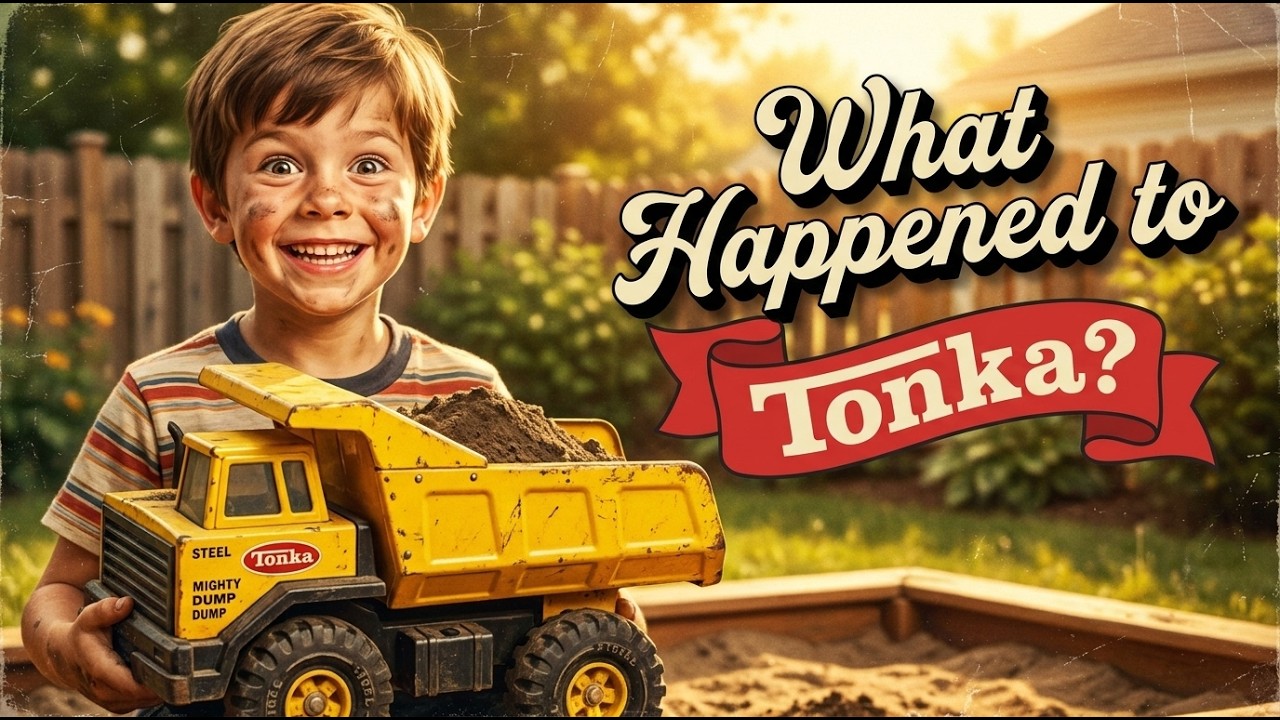
Boys rode them down hills like go-karts, feet dragging on the grass, mothers yelling from the porch, and the trucks did not bend. The weight was the first thing anyone noticed. You picked it up and it pulled your arm down. It felt like it belonged to the real world, not a toy world.
A boy could back a station wagon over one in the driveway and lose some paint and bend the bed slightly, but the wheels still turned and the bed still went up and down. You played with it the next morning like nothing had happened, because nothing had happened. The sandbox in the backyard was not a sandbox. It was a quarry, a highway project, a city being built from nothing.
Four landscape timers filled with fifty-pound bags of sand from the hardware store became a construction site where the yellow dump truck hauled loads to the other side and tilted its bed back to pour them out, the bulldozer pushed sand into piles, and the front loader scooped it up and dropped it into the bed. A boy could do this for hours without getting bored, without a screen, without instructions. Steel trucks, sand, and an afternoon that stretched until dinner. The trucks stayed out in the rain overnight and were still working Monday morning, still yellow, still ready.
Nobody had one Tonka truck. You had a fleet. Around the Mighty Dump you built an empire: the bulldozer with a blade that went up and down, the front loader with a scoop that curled under and lifted, the crane with a boom that swung and a cable that wound on a spool, the grader that smoothed roads between the sandbox and the flower bed. The cement mixer was the crown jewel.
It had a barrel that turned when you cranked the handle on the back and a discharge chute that swiveled. You filled the barrel with mud and small rocks, turned the crank, and the mud poured out the chute like real concrete. You poured foundations for buildings that did not exist in a city only a child could see. A boy would ask his mother for a glass of water.
She asked if he was going to use it to make mud. He said no, and then used it to make mud. In 1974, Tonka made a commercial that every boy in America remembered. They put a real African elephant on top of a Tonka truck.
The elephant stood with its full weight. The truck did not break. The tagline was Tonka built to last, but any boy who had run his trucks off the porch, into walls, through puddles, and under car tires already knew. The elephant just confirmed what the sandbox had already proven.
Steel on sand made sounds plastic could not make: the low scraping rumble of a dump truck dragging through wet sand, the metallic clank of two trucks colliding at an intersection, the rattle of the dump bed hitting the frame, the click of the crane cable locking, the crunch of the bulldozer blade pushing through packed dirt. These were the sounds of metal working, and under all of it was the sound of a boy’s own voice making engine noises, because the trucks did not have motors. He was the motor, the engine, the driver, the foreman, the city planner, and the construction crew. The company began in 1946, when three men, Baker, Crowns, and Tesche, started Mound Metalcraft in an old schoolhouse in Mound, Minnesota, on the shores of Lake Minnetonka.
The schoolhouse had been used during the war to make ammunition boxes. One of the men found toy designs abandoned by a previous tenant who had no interest in the toy business. They looked at the designs, made toy trucks out of 20-gauge automotive steel, and sold 37,000 steam shovels and cranes in their first year with six employees. Baker said a youngster really had to use his imagination with the toys on the market, so they decided to make scale model miniatures that looked just like the trucks a little boy might see passing his house every day.
They named the company Tonka after the Dakota Sioux word for great. By 1974, they had 2,000 employees, facilities in eight countries, and were producing 13 to 16 million trucks a year with $102 million in annual sales. From a schoolhouse in Minnesota to the biggest toy truck company in the world in less than thirty years. Every boy wanted the Mighty Dump.
Every boy got one eventually, for Christmas or a birthday, or as a hand-me-down from an older brother or cousin. That is how Tonka trucks move through families. An older brother played with his until he was nine or ten, then it went to the younger brother. When he was done, the truck went into the garage or basement and sat for twenty years.
Then a nephew or a son came along, and the truck came back out and worked the same way it had worked decades earlier. There are families with Tonka trucks from the 1960s that have carried three generations of boys. Sixty years, three childhoods, same truck, same yellow paint worn down to bare metal where small hands gripped it ten thousand times. That was what they meant by built to last.
Not until the warranty expired, but until your grandson was done with it. Part of the appeal was that you could see the real thing, the dump truck on the construction site down the street, the bulldozer pushing dirt on the lot where a new house was going up, the cement mixer turning its barrel on the way to the job. You stood at the chain link fence and watched real machines work, then went home and did the same thing in the sandbox. The gap between real and toy was smaller than with any other toy.
The Tonka dump truck looked like a dump truck, worked like a dump truck, and was made of the same metal as a dump truck. It was the first toy that did not ask you to pretend it was something else. It already was the thing, scaled down and painted yellow. The fire truck was the one that made a boy the hero of the neighborhood.
It was red enamel steel with a chrome bumper and a ladder on top that extended, swiveled, and locked at different heights. Some models had a hand pump and a rubber hose that shot real water. You filled the tank from the garden hose, pumped the handle, and a stream of water arced out of the tiny nozzle at an imaginary fire in an imaginary building. The fire truck was the one you did not leave in the sandbox.
It came inside and sat on the shelf in the bedroom next to the baseball glove and the model airplane. A five-year-old pushing a steel fire truck across the kitchen floor, ladder extended, making siren sounds with his mouth, was not pretending to be a fireman. He was a fireman. Tonka trucks arrived in a boy’s life on a birthday or Christmas.
The box was heavy, heavier than any other toy box, and when a mother handed it from under the tree, the boy felt the weight and knew. He tore off the paper, saw the yellow truck in the clear window on the front, pulled it out, and felt the weight settle into his hands. He turned it over, ran his fingers along the rivets, spun the wheels, tilted the bed, and the room disappeared. Christmas morning lasted all day, but he was in the backyard by 9:30 with the new truck in the dirt and the old trucks lined up beside it.
Then they changed it. In 1983, Tonka closed the factory in Mound, Minnesota, costing 2,000 jobs. Manufacturing moved to El Paso, Texas, and Juarez, Mexico, where labor was cheaper. In 1987, Tonka borrowed $555 million to buy a competitor and nearly collapsed under the debt.
In 1991, Hasbro bought the company for $500 and moved the headquarters to Rhode Island. In 1998, Hasbro stopped making Tonka trucks entirely and licensed the name to another company. The steel got thinner, then replaced by plastic. The rivets became snaps.
The welded seams became glued joints. The baked enamel became spray paint. The weight disappeared. The name survived.
The truck did not. The old Tonka is still in the garage, on a shelf behind the paint cans or in a box with Hot Wheels and Lincoln Logs. The yellow has faded, scratches mark the cab, the dump bed has a dent from driving it off the porch in 1972, one tire is cracked from age. But the bed still tilts and the wheels still turn, and it would work in a sandbox exactly the way it worked fifty years ago.
Twenty-gauge automotive steel does not forget what it was made to do. It was made by three men in a schoolhouse in Minnesota who believed a toy should be built like the real thing. It was.
