He was a man who rarely showed his feelings, and this moment was no different. He grew quiet, and Julia, expecting him to share her excitement, saw instead a flicker of distress cross his face. When she asked what was wrong, Ulysses looked at her and said, “Did I not see you and fall in love with you with these same eyes? I have seen them in every phase of life and have never seen them otherwise.
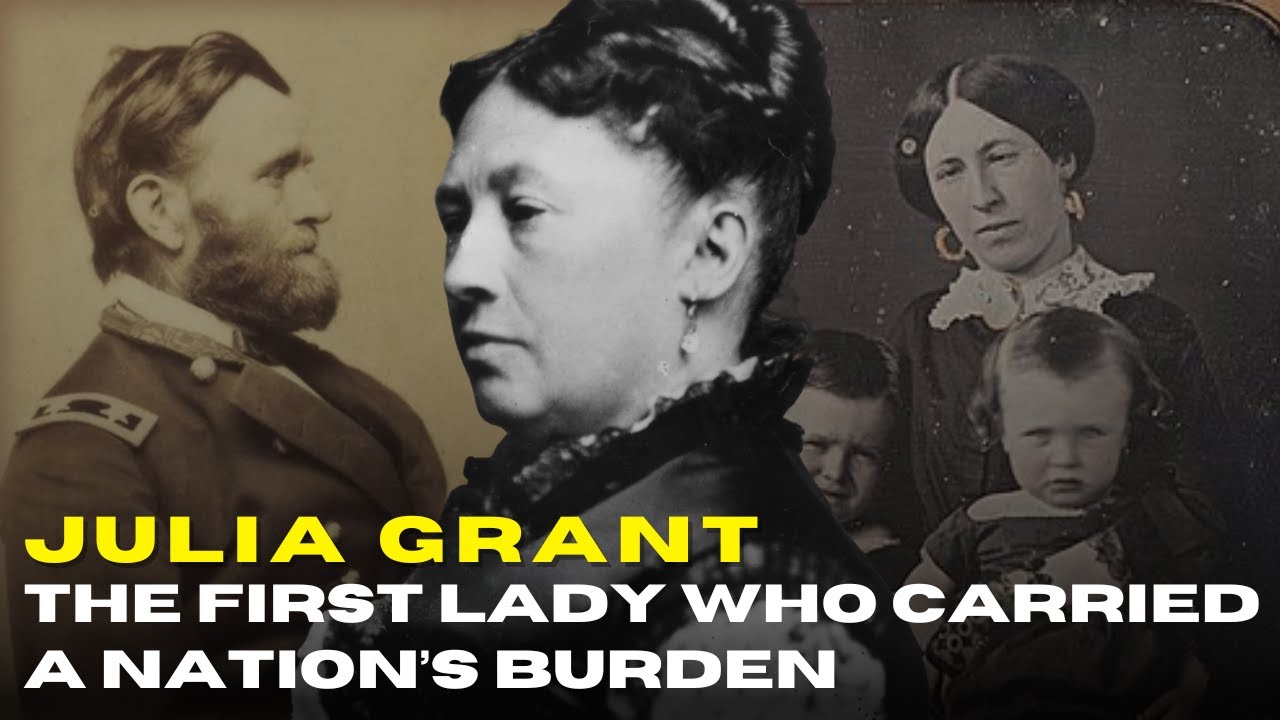
I would not have them changed for the world. ” He had fallen in love with her just as she was, he told her, and if she had the surgery, she might not be the same Julia he had known and loved for all those years. She cancelled the operation. In that single intimate moment, the truth of their bond was laid bare.
In a world that was constantly judging her, Ulysses Grant was her safe harbor. He did not merely tolerate what she saw as a flaw; he cherished it as part of the woman he loved. The story reveals a profound tenderness at the heart of a man the world knew as a hardened general, and it shows us Julia, a woman who drew her ultimate confidence not from public approval, but from the unwavering love of her husband. No story of Julia Grant can be told honestly without confronting her relationship with the institution of slavery.
This is not a simple footnote to her life, but a central, uncomfortable paradox. Julia grew up on a slave plantation. She was a slave owner herself. This is a historical fact.
When she married Ulysses S. Grant, she brought with her into the marriage at least one enslaved man named William Jones. Throughout their hardscrabble years in Missouri, the Grant household included enslaved people who were owned by Julia and her father. The most well-known of these was a young woman named Julia or Jule.
As the Civil War raged, with her husband leading the Union armies in a fight that would ultimately destroy the institution of slavery, his own wife remained a slaveholder. While Abraham Lincoln was preparing the Emancipation Proclamation, Julia Grant was traveling to visit her husband’s headquarters in the South, sometimes accompanied by her enslaved servant, Jule. One perspective is that Julia was simply a product of her time and place. She was raised to believe that slavery was a natural part of the social order.
Her entire family’s wealth and way of life depended on it. To her, enslaved people were not part of a vast, cruel system, but individuals who were part of her domestic world, a responsibility she had inherited. There is no evidence that she was a particularly cruel mistress, but that does nothing to excuse the fundamental injustice of ownership. Another perspective is that it reveals a significant moral blind spot.
Even as the war forced the nation to confront the sin of slavery, Julia seemed unable or unwilling to apply that moral lesson to her own life. She famously claimed that she let her enslaved people go free whenever they wanted, but this is contradicted by the fact that they remained with her. Jule, her servant, did in fact run away to freedom while traveling with Julia in 1864. She did not wait to be freed; she seized her own liberty.
The most damning piece of evidence is that Julia continued to hold four enslaved people until January 1865, when they were freed not by her choice but by the provisional emancipation ordinance in Missouri. The war was nearly over, and the wife of General Grant was among the very last slaveholders in the state. The end of the Civil War in 1865 catapulted Ulysses S. Grant to a level of fame second only to Abraham Lincoln.
He was the savior of the Union. For Julia, this meant a sudden and dramatic change in their fortunes. The years of poverty and obscurity were over. In 1868, her husband was elected the 18th president of the United States, and Julia Dent Grant, the girl from a Missouri plantation, became the first lady.
Unlike many of her predecessors who found the role to be a burdensome duty, Julia embraced it with undisguised delight. After decades of hardship, she reveled in her position as the nation’s hostess. She oversaw a complete and often lavish redecoration of the White House. Her receptions and state dinners were magnificent, known for their abundant food, fine wines, and guest lists that included writers, scientists, and artists, not just politicians.
She brought a sense of joy and glamour back to a capital that was still recovering from the trauma of war and the somberness of the Lincoln years. She saw herself as the nation’s representative, and she played the part beautifully. The public, for the most part, adored her. While some of Washington’s elite society whispered about her slightly provincial Missouri manners and her crossed eyes, most saw a woman who was warm, unpretentious, and genuinely happy.
The eight years she spent in the White House were, she later wrote, the happiest of her life. When Grant’s second term ended in 1877, the couple embarked on a journey that few Americans had ever experienced: a two-and-a-half-year tour of the world. It was a diplomatic triumph. They were treated like royalty, meeting with Queen Victoria in England, the Pope in Rome, and the Emperor of Japan.
For Julia, the girl who grew up on a remote farm, it was the adventure of a lifetime. She was no longer just the general’s wife; she was a global celebrity, a respected figure in her own right. They returned to America as heroes and settled in New York City. The future seemed bright and secure.
And then, in 1884, their world collapsed. Grant had invested his entire life savings in a Wall Street brokerage firm with his son and a brilliant young financier named Ferdinand Ward. But Ward was a con artist. He had been running a massive Ponzi scheme, and when it imploded, the Grant family was left utterly destitute, their fortune gone and their name disgraced by association.
Just as this financial catastrophe struck, an even more terrifying blow landed. Grant was diagnosed with incurable throat cancer. He was in constant pain, bankrupt, and facing a slow, agonizing death. The hero of the Civil War was facing his final, most difficult battle.
He had one last mission: to provide for his family. He decided to write his memoirs, racing against time to finish the book before the cancer took his voice and his life. In this final tragic chapter, Julia was once again his rock. She was his constant nurse, his caregiver, and his emotional support.
She sat with him day after day as he scribbled away on the porch of their cottage in Mount McGregor, New York, often in excruciating pain. She managed his medications, protected him from intrusions, and gave him the strength to continue. He finished the manuscript just days before he died in July 1885. *The Personal Memoirs of Ulysses S.
Grant* became a massive bestseller, a literary masterpiece that earned his family nearly half a million dollars, securing their future. It was his final gift to her, a testament to a partnership that had endured everything. Her story is more than just a biography of a president’s wife. On the national stage, she fundamentally redefined the role of the first lady.
She was not a reluctant hostess or a political symbol, but an active and joyful partner in her husband’s public life. Transforming the White House into a vibrant social center, she demonstrated that the first lady could be a figure of national warmth and affection. This public role was built on the foundation of an intensely personal partnership. The Grant marriage was not a political alliance; it was a deep, abiding love story that weathered poverty, war, scandal, and illness.
Perhaps her most important legacy, however, is one she wrote herself. After Grant’s death, Julia decided to write *The Personal Memoirs of Julia Dent Grant*, an extraordinary act for a woman of her time. In clear, unadorned prose, she told the story of her life from her own perspective. It is a remarkable document, candid, warm, and deeply personal.
And yet it went unpublished for 75 years. Publishers and even her own family felt her writing was too simple, not important enough for the public, failing to see its true value. The suppression of her book is a poignant example of how women’s stories have historically been silenced or deemed less significant. Its eventual publication in 1975 was a victory, a reclamation of a voice that refused to be lost to the shadows.
Because of her memoirs, Julia Grant is not just an object of history; she is a narrator, telling her own story with all its joys, sorrows, and uncomfortable contradictions. In the end, Julia Grant’s life was a testament to the power of a singular, unwavering belief. The world saw a plain woman with imperfect eyes. Her husband saw his indispensable partner, his anchor, the one person whose love gave him the strength to endure failure and the stability to command armies.
She saw a hero long before the world did, and her faith in him never wavered. She would outlive her beloved Ulysses by seventeen years, transforming from his partner in life to the steadfast guardian of his legacy. She passed away peacefully in 1902 at the age of 76, having completed her own memoirs to ensure their story was told. Her final wish was the ultimate testament to their bond: to be laid to rest beside him.
Today she lies with her husband in the grand sarcophagus in Grant’s Tomb, a final, eternal union that solidifies their place in history, not as individuals, but as a single, inseparable story.
