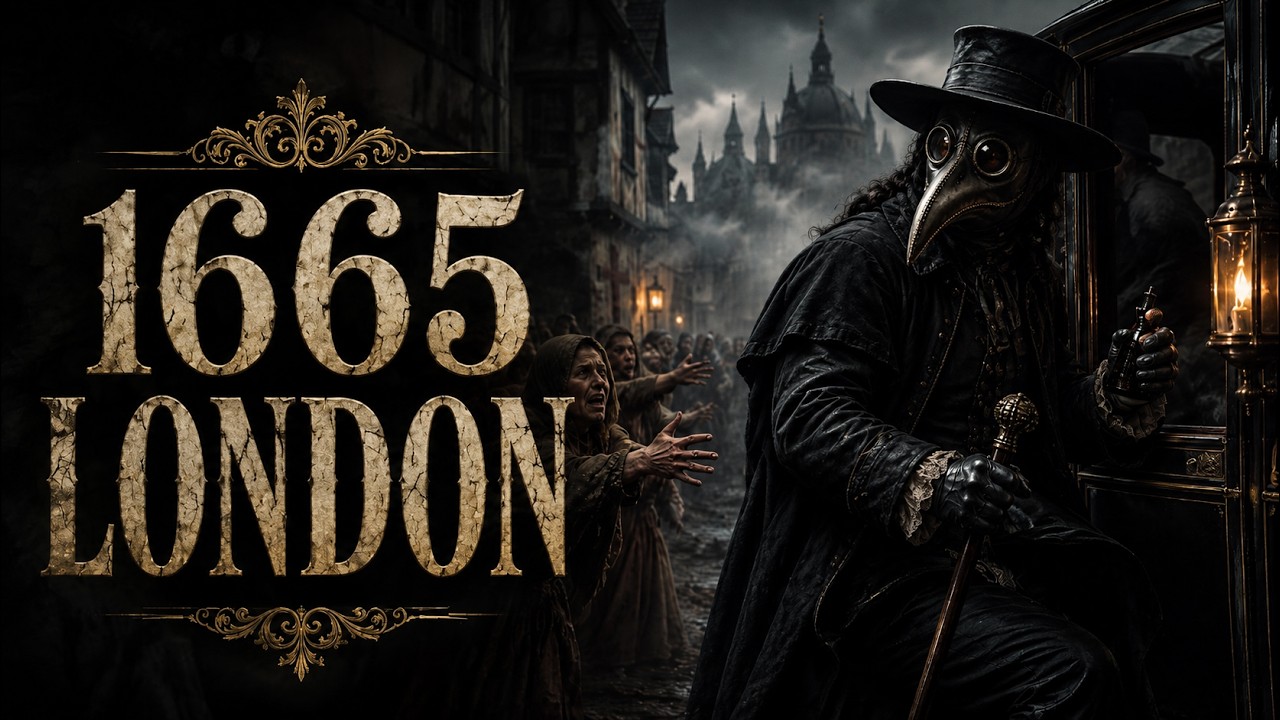
The image is one of the most enduring in the history of medicine: a figure in a black leather coat that reaches the ankles, gloves up to the elbows, and that mask. A long, curved beak stuffed with dried flowers and camphor, dark glass eyes staring out from beneath a wide-brimmed hat. The plague doctor. Moving through narrow streets lined with corpses, past doors marked with red crosses, toward houses where entire families are dying in the dark.
Almost none of it is true. They were not doctors. Most had no medical training whatsoever. They were barbers, butchers, and desperate unemployed men hired by parishes for a few shillings a week to examine bodies and certify plague deaths.
The beak costume was not professional equipment issued by a medical authority. It was a homemade improvisation built on a completely incorrect theory of how disease spread. The real doctors, the trained members of the College of Physicians in London, the men who had spent years studying medicine and held legal authority over the city’s health, fled. In the summer of 1665, with London’s plague deaths surpassing a thousand a week, the city’s medical establishment, its entire ruling class, and its king coordinated a departure that left the poor to die alone.
What followed was not a battle against disease. It was an abandonment that turned the epidemic into an event of class extermination, where wealth determined survival with mathematical precision, where official treatments killed as much as they cured, and where the dead were finally thrown into mass graves so large that when archaeologists opened them three and a half centuries later, they found hundreds of skeletons buried in such haste they were still wearing their shoes. This is the story of the summer London’s elite vanished. And what happened to those left behind.
The plague arrived quietly in the winter of 1664 in the parish of St. Giles in the Fields, west of London’s old walls. St. Giles was already synonymous with poverty.
Narrow wooden houses leaning against one another. Open sewers running through the middle of unpaved alleys. Multiple families sharing single rooms. The kind of place wealthy Londoners hurried past, trying not to look too closely.
When the first deaths appeared in late December, they were easy to dismiss. Fever, tuberculosis, the usual killers of the urban poor. By spring, the deaths were harder to ignore. Swollen glands in the neck, blackened fingers, symptoms appearing quickly.
But the official bills of mortality, the weekly printed lists of deaths by parish and cause, still recorded in carefully neutral language: spotted fever, an epidemic slowly building through March and April. The turning point came in early June 1665. The weekly death toll exceeded one thousand. The language of the data shifted from evasion to acknowledgment: the plague.
And London’s ruling class began to leave. It was not panic. There was no chaotic rush toward the gates, no riots or looting. It was organized, coordinated, almost bureaucratic.
King Charles II and his entire court moved first to Hampton Court, then to Salisbury, and finally to Oxford by the end of July, taking with them the machinery of government, the Privy Council, the courtiers, and the administrative apparatus of the state. The king did not return to London for eight months. The College of Physicians, the official governing body of medical practice in London and the institution legally responsible for overseeing the city’s health, issued formal advice to its members. Leave.
Of roughly forty members, only three remained in London throughout the epidemic. Three. The Lord Mayor stayed, as his office required. Most aldermen did not.
Wealthy merchants closed their businesses and departed for their country estates. Lawyers, landowners, anyone with property outside the city and the means to reach it, made the same calculation. Samuel Pepys, the naval administrator whose diary provides one of the few detailed accounts from those who remained, recorded walking through the Royal Exchange in July, London’s commercial heart, and finding it nearly empty, the great trading hall silent except for the sound of his own footsteps. The streets emptied in widening circles outward from the center.
The fashionable neighborhoods west of the old city were the first to empty, then the commercial districts within the old walls. What remained was a city turned upside down. Wealthy parishes shrank to small numbers of caretakers and servants left to guard empty houses. The poor parishes outside the walls, St.
Giles, Stepney, Whitechapel, Shoreditch, swelled with those who had nowhere else to go. This was not cowardice. It was rational self-preservation enabled by wealth. If you owned a country house, you left.
If you could afford a horse and cart, you packed and went. If you had relatives in the provinces willing to host you, you wrote ahead and packed your bags. The moral question was not whether the rich should have stayed and died. It was that the poor had no choice but to stay and die.
The evacuation created a city split in two. An outer shell of nearly abandoned wealthy neighborhoods, and a core of desperately overcrowded poor ones, now cut off from all legitimate medical infrastructure, all administrative authority, all institutional support. The parishes that were poor before the plague became incubators of disease, packed with people who could not leave and surrounded by neighbors in identical circumstances. The College of Physicians had gone.
The trained medical practitioners had gone. The city’s elite, those who could have organized relief, funded hospitals, or maintained a structure of care, had gone. The plague was just beginning. The parishes needed someone to do the work the doctors had abandoned: examine bodies, confirm plague deaths, and sign burial certificates so the weekly mortality records could continue.
Someone had to enter the houses where entire families were dying, examine the swollen buboes in necks and groins, and issue the official declaration that allowed a body to be moved. The College of Physicians had fled, but the administrative machinery of death registration still required a signature. So the parishes hired whoever was willing to work. They were called plague doctors, but the title was aspirational at best.
Most were men with no medical training at all. Barber-surgeons who pulled teeth and lanced boils, apothecary assistants, unemployed craftsmen desperate enough to accept a weekly wage and a high chance of infection. Some were foreigners with dubious qualifications, drawn to London precisely because the legitimate doctors had left a vacuum. A few may have had some medical education, but they were young and unestablished, the kind of men who did not have the luxury of leaving even if they wanted to.
The costume they wore became the visual symbol of the plague itself. The long waxed leather coat, the gloves, the boots, the wide-brimmed hat, and that unsettling beaked mask. It looks like official medical equipment, something issued by an institution of authority and expertise. It was nothing of the sort.
It was a personal protective improvisation based on a theory of disease that was wrong, catastrophically and completely. The miasma theory held that plague spread through contaminated air, foul odors rising from decaying matter, human waste, stagnant water, and the corpses of the dead. If bad air caused disease, then masking it with good smells might provide protection. The beak was not a respirator.
It was a container for aromatic materials. Dried flowers, rose petals, sponges soaked in vinegar and camphor, sometimes amber or cloves. The plague doctor breathed through this barrier of perfumes, believing he was purifying the contaminated miasma before it reached his lungs. He was right that there was a transmission mechanism.
Something in the environment was carrying the plague. He was completely wrong about what it was. The disease did not spread through smell. It spread through fleas carried by rats.
And fleas bit indiscriminately, whether you smelled of roses or rot. The beak did nothing to prevent infection. What it may have unintentionally done was enforce distance. The costume was heavy, hot, and difficult to move in.
The beak physically prevented the wearer from bringing his face close to a patient’s body. The leather coat and gloves formed a barrier that may have prevented some infected fleas from reaching the skin. Not from any real understanding of the vector, but because the suit was designed to repel foul odors and happened to repel some insects as well. The plague doctors wandered the city like figures from a nightmare, knocking on doors marked with a red cross signifying infection within, entering houses from which the living had fled and left the dead behind.
Their job was documentation, not treatment. They examined corpses for the telltale signs: the lymphatic swellings, the blackened extremities, the subcutaneous bleeding that gave the plague its name, the Black Death. Then they recorded the cause of death. Plague or not plague.
The distinction mattered because a plague death triggered quarantine regulations for everyone who had contact with the victim, which gave plague doctors leverage. Contemporary accounts describe them soliciting bribes. A family could pay to have a death recorded as fever instead of plague, avoiding the forty-day quarantine that would trap them in their homes without income and with dwindling food. Some plague doctors sold this service openly.
Others stole from the houses they entered, taking whatever valuables the dead or dying could not protect. A few offered false comfort, selling amulets, charms, and useless medicines to desperate families willing to pay any price for hope. They were not all predators. Some genuinely tried to help within the limits of their understanding.
They lanced buboes, opening the painfully swollen glands in a patient’s neck or thigh, believing that draining the poison might save them. It rarely did. Without anesthesia or antiseptics, the procedure often caused secondary infection or fatal blood loss. But it was something, an action that looked like medicine.
And in a city from which everyone with authority had fled, the appearance of expertise was all that remained. The few trained doctors who stayed in London were statistical exceptions. One was Nathaniel Hodges, a fellow of the College of Physicians who remained throughout the epidemic and later wrote an account of his experiences. He treated patients with the traditional remedies of the time.
Bloodletting to rebalance the humors. Purgatives to expel corrupt matter. And theriac, a paste containing dozens of ingredients including viper flesh and opium, applied to the swellings. None of it worked, but Hodges at least believed he was helping.
He survived, perhaps by chance, perhaps because his means allowed him to maintain better living conditions than his patients. The others who stayed were figures like George Thomson, a chemically minded physician who practiced outside the College’s authority, whose treatments included antimony purges and a mysterious plague water he sold at considerable profit. Thomson also survived and later published pamphlets claiming his methods were validated by his survival. A perfect example of survivor bias mistaken for medical evidence.
But these men were exceptions. The vast majority of London’s poor, trapped in parishes where the plague was killing dozens every day, had no recourse but the beaked figures roaming the streets at night. Men with no training, no tools except a costume built on a false theory, and a signature that could confirm your death. The Lord Mayor’s office published official plague remedies in broadsheets distributed throughout the city.
The College of Physicians, from its safe distance outside London, endorsed most of them. These were not fringe beliefs or street superstitions. They were mainstream medical advice backed by institutional authority and in some cases enforced by law. Tobacco smoking was mandatory in certain contexts.
The theory held that tobacco smoke purified the contaminated air before it entered the lungs. Eton College reportedly beat students who refused to smoke during the epidemic. Adult Londoners were encouraged to keep their pipes lit throughout the day. Tobacco sellers enjoyed booming business even as the rest of the economy collapsed.
The smoke did nothing to prevent plague. It filled the air with a different kind of pollution and gave people something to do with their hands while they waited to find out if they would become infected. Fires burned constantly in the streets of affected parishes. Fires of tar, pitch, and wood intended to disinfect the foul air hanging over neighborhoods where death rates had risen to hundreds per week.
The smoke was so thick in some areas that residents could not see across the narrow alleys. The irony was that the fires may have temporarily driven away some rats, disrupting transmission in ways no one understood or intended. The city ordered the killing of dogs and cats. Tens of thousands were slaughtered.
Their carcasses added to the general accumulation of decaying matter in the streets. The prevailing belief was that animals carried and spread the contaminated air. The result was the exact opposite. Without predators, the rat population exploded, bringing more fleas closer to human hosts.
Official policy made transmission worse while claiming to prevent it. For those who could pay, the market offered Venice treacle and theriac, ancient compound medicines containing sixty or more ingredients, including viper flesh, opium, crushed gemstones, and expensively imported herbs. Apothecaries sold them as universal antidotes to all disease. They were elaborate, expensive placebos that did nothing except prove that wealth could not buy effective treatment, only the illusion of it.
Unicorn horn, which was actually narwhal tusk, was ground and dissolved in wine. Bezoar stones, calcified masses extracted from the intestines of animals, were worn as amulets or consumed as medicine. The poor received different treatments, not because the theory differed, but because they could not afford the ornate remedies. Live chickens were split open and placed directly on the plague sores.
The belief was that the living animal would draw out the poisons through the skin. Patients lay for hours with raw chicken flesh pressed against their painfully swollen lymph nodes, waiting for relief that never came. Pigeons and frogs were used the same way. The practice most likely introduced infection into open wounds and added another layer of suffering to people who were already dying.
Plague doctors lanced the sores without anesthesia or sterilization. They used knives to cut into the swollen glands in a patient’s neck, armpit, or thigh, then drained the fluid and packed the wound with caustic substances intended to burn out the disease. Some patients died from shock or blood loss. Others developed secondary infections that killed them days later.
A few survived, not because the lancing helped, but because their immune systems overcame the bacterial infection despite the additional trauma. Mercury and arsenic were rubbed into the skin or swallowed in tinctures. Both were believed to purify the body of corrupt humors. Both caused poisoning, vomiting, convulsions, and organ failure.
Patients already weakened by plague were subjected to treatments that acted as a second, slower method of dying. Urine therapy appeared in many official treatment lists. Drinking urine or bathing in it was recommended as a way to recycle vital fluids and restore the body’s humoral balance. It did nothing except humiliate and exhaust people who were too sick to resist.
But the most brutal official treatment was not a medicine at all. It was quarantine. When a member of a household showed plague symptoms, the entire house was sealed from the inside by order of the parish authorities. A red cross was painted on the door with the words: Lord have mercy upon us.
Guards, often men compelled into service against their will, were placed outside with orders to prevent anyone from leaving. The quarantine lasted forty days. Food and supplies were supposed to be delivered. Often they were not.
Families were locked in with infected individuals, guaranteeing that everyone in the house would be exposed. Death rates inside quarantined houses approached totality in many cases. The healthy fell ill. The ill died.
The recovered were left in rooms with corpses for days or weeks, until the quarantine period ended and the authorities opened the doors. This policy was not applied equally. Wealthy families bribed the guards to look away while family members escaped through back doors or windows. They paid plague doctors to issue death certificates citing causes other than plague, avoiding quarantine entirely.
They fled before symptoms appeared, leaving servants behind to face their fate. Poor families had none of these options. They were sealed in and forgotten. Contemporary accounts describe people jumping from second-story windows to escape quarantined houses, only to be shot by guards or dragged back by force.
Entire families were found dead when the houses were finally opened. Fathers, children, infants, all in various stages of decomposition. Quarantine was not designed to save the people inside. It was designed to contain them, to prevent plague from spreading to the areas where the wealthy might later return.
It was a form of class control disguised as public health policy, and it killed as effectively as the disease itself. Every Thursday, the Company of Parish Clerks published the bills of mortality. Printed sheets recording deaths by parish and cause. The tradition was decades old.
But in the summer of 1665, these weekly lists became a statistical map of London’s catastrophe. They tracked the plague’s spread street by street, parish by parish, week by week, and revealed a fact that was impossible to deny. The plague did not strike randomly. It followed the inverse of wealth, hitting hardest wherever poverty had crowded people into conditions that made survival impossible.
The pattern was surgical in its precision. St. Giles in the Fields, where the plague first appeared, recorded more than four thousand deaths by September. Stepney, packed with dockworkers and itinerant laborers, lost nearly seven thousand people.
Whitechapel and Aldgate, parishes outside the walls where rents were cheap and multiple families shared single rooms, recorded devastation on a scale that left entire neighborhoods nearly empty. Meanwhile, the wealthy western parishes recorded almost nothing. St. James, Westminster, where aristocrats kept their London houses, recorded only dozens of deaths throughout the entire epidemic.
The evacuated areas within the old city walls showed similar patterns. Not because the plague could not reach them, but because there was no one left to infect. The bills did not just record deaths. They documented abandonment in real time, proving what everyone already knew.
Your address determined your fate. As deaths reached seven thousand per week, London’s burial system collapsed. Churchyards filled and overflowed. Individual burial became practically impossible.
There were not enough gravediggers, not enough daylight, not enough consecrated ground. The usual death rituals of the city, washing the body, saying prayers, marking the grave, were luxuries from a world that no longer existed. Death carts roamed the streets at night. They were preceded by a man carrying a bell, ringing it and calling out words that have become a permanent cultural memory: Bring out your dead.
Doors opened, bodies were carried out wrapped in sheets if families could spare them, or naked if they could not, then piled onto wooden carts. The drivers were condemned men. Either criminals offered a pardon for the work, or desperate men paid a few shillings a night, or plague survivors who believed they were immune. They moved through silent streets, the bell echoing off the empty buildings, collecting bodies like municipal waste.
The carts went to the plague pits. Massive trenches dug in fields outside the city walls. Hundreds of bodies thrown in without coffins, without names, without ceremony. When one pit was full, another was opened.
The dead were layered in the earth, covered with quicklime, and the pit was closed when it could hold no more. In 2013, archaeologists excavating for the Crossrail project at Charterhouse Square discovered one of these pits. They found skeletons still wearing their shoes, buried so quickly that no one had bothered to strip them. The bones confirmed what the written records had always said.
The plague killed the poor, and the poor were erased even in death. When King Charles returned to London in February 1666, the plague pits had been filled in, the streets cleaned, the death carts dismantled. The Great Plague is remembered as a natural disaster. It was not.
It was a class catastrophe, where the wealthy bought survival and the poor bought an unmarked grave. The beaked plague doctors saved no one. The real doctors never tried.
