The son has done everything he was told to do. He earned a degree his father never needed, worked for five companies in twenty years—not because he is disloyal, but because that is how it works now. He has a 401k that lost forty percent in the crash, a mortgage that takes two incomes to carry, and a retirement that is a math problem he cannot solve. His father worked at one company for thirty-five years.
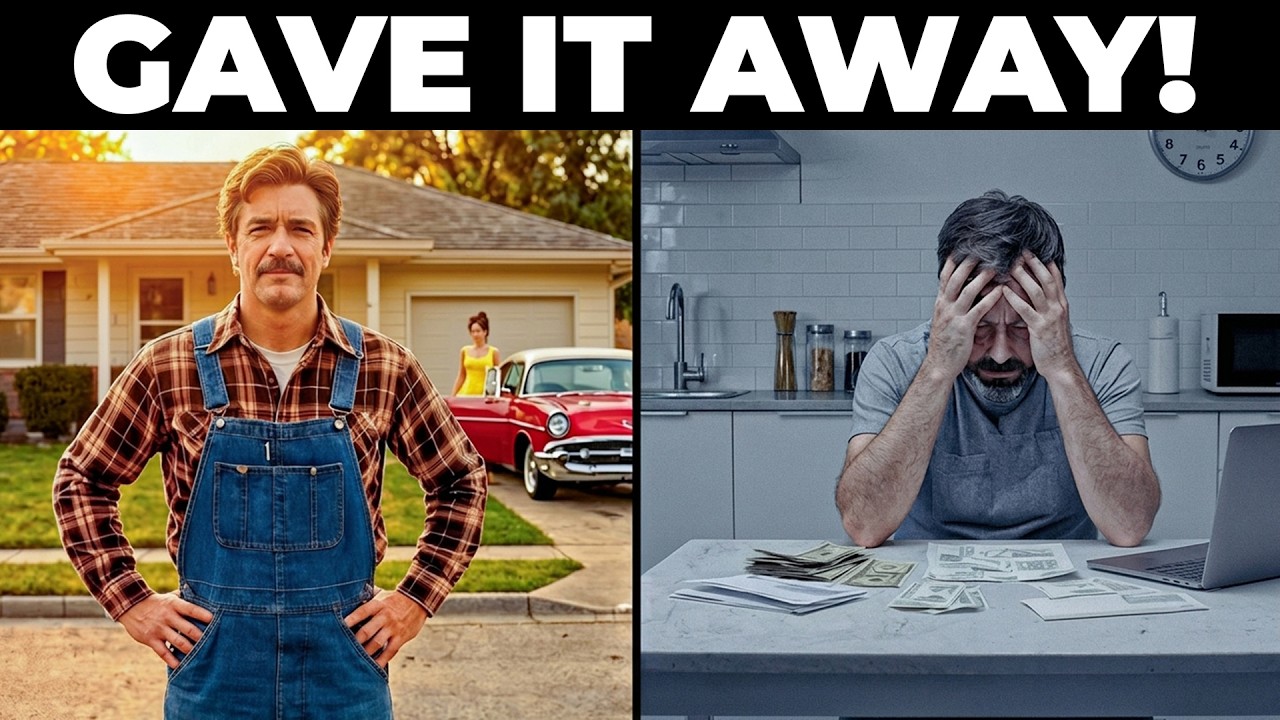
He had a pension, paid health insurance, and a house he bought on a single income. When he retired, the company threw him a party and mailed him a check every month for the rest of his life. Same blood. Same work ethic.
Same country. Completely different deal. This is the story of what happened between those two men. Not what went wrong with the economy, but what was given away—and who got it.
The father’s deal was not complicated. He showed up, he worked hard, he stayed. And the company held up its end. In 1965, according to the Economic Policy Institute, a CEO at a major American company made about twenty-one times what his average worker earned.
The boss made more; nobody pretended otherwise. But the distance between them was something a person could understand. It was the same neighborhood, the same parking lot, sometimes the same diner at lunch. Nearly two-thirds of American workers born in the 1920s through the 1940s had a defined benefit pension.
The company funded it. The worker did not have to manage it, gamble on it, or pray the stock market held up. He worked his years, and the money was waiting when he stopped. The father bought his house in the early seventies.
According to Census Bureau data, the median home in 1970 cost roughly two and a half to three times the median household income. A working family could save for a down payment in a few years. A single paycheck could carry the mortgage. That ratio held for decades.
Pension, house, health insurance, a wage that climbed when the company did well. That was the arrangement. And because of that arrangement, men stayed at one company for thirty years—not because they had no options, but because the deal was good enough to keep. People knew the name of the janitor.
They knew whose daughter just had a baby and whose father was in the hospital. The company Christmas party was not a corporate event; it was a neighborhood event. You worked with people you would see at the grocery store on Saturday and at church on Sunday. That was not sentiment.
That was the economic structure producing a social result. When the company invested in the worker, the worker invested in the company, and both of them invested in the town. The first thing they gave away was the retirement. In 1978, Congress passed a revenue act with an obscure provision buried in the tax code: Section 401, paragraph K.
It was designed as a supplement—a way for higher-paid employees to defer some compensation into tax-sheltered accounts. It was meant to sit alongside a pension and Social Security, a third leg on a three-legged stool. That is how its early architects described it. Nobody in Congress intended it to replace the pension system.
But within a few years, companies realized they could save enormous amounts of money by freezing their pension plans and steering workers into a 401k instead. The difference was structural. Under a pension, the company bore the cost and the risk. Under a 401k, both shifted to the worker.
One of the human resources executives who helped champion the early 401k told NPR years later that the program he pushed had not created enough for him to retire on comfortably. He said he would have been better off staying at one company with a traditional pension for thirty years. The man who helped build the replacement admitted the replacement did not work. According to the Center for Retirement Research at Boston College, nearly two-thirds of workers born in the 1920s through the forties had pensions.
For late baby boomers, that number collapsed to six percent. The son entered the workforce in the nineties, right as the last wave of pension freezes was rolling through corporate America. GE, IBM, Motorola, Verizon. One by one, major companies shut the door.
And when the stock market crashed in 2008, it was not the company that lost its retirement fund. It was the worker. Millions of Americans watched decades of savings drop by thirty to forty percent in a matter of months. Some were years from retirement; others were just months away.
Under a pension, the company would have absorbed that loss. Under a 401k, you absorbed it alone, at your kitchen table, watching a screen. The father retired with a guaranteed check. His son logs into a brokerage app and hopes.
Here is what the numbers look like at the other end. According to the Economic Policy Institute, nearly half of American families have no retirement savings at all. Not a small 401k. Not a modest IRA.
Nothing. They will retire on Social Security alone, which replaces about thirty-five percent of what they earned. For millions of people, the retirement plan is not to retire. It is to work until they physically cannot.
And then figure it out from there. The second thing they gave away was the profits. For most of the twentieth century, when a company made money, some of it flowed back to the people who helped make it: higher wages, better benefits, investment in new equipment and new hires. That was the cycle.
It was not charity; it was how the economy grew. Then, in 1982, the Securities and Exchange Commission adopted rule 10b-18. The rule did not make stock buybacks legal overnight—they were not technically illegal before—but it created what is called a safe harbor: a set of conditions under which a company could buy back its own stock without fear of being charged with market manipulation. Before that rule, most companies avoided large-scale buybacks because the legal risk was real.
After it, the floodgates opened. In 1980, American corporations spent about six and a half billion dollars on buybacks. By 2024, according to S&P Global, the figure had reached 942 billion—nearly a trillion dollars in a single year. Not invested in factories, workers, or research.
Spent on their own stock. When a company buys back its shares, the stock price rises, and the executives who are paid largely in stock options benefit the most. Economist William Lazonick, writing in the Harvard Business Review, found that from 2003 to 2012, S&P 500 companies spent fifty-four percent of their net income on buybacks and another thirty-seven percent on dividends. That left nine cents of every dollar for wages, equipment, training, and new hires.
Nine cents. And the gains did not land evenly. Federal Reserve data shows the top ten percent of American households own roughly eighty-four percent of all stock. The bottom half owns almost none.
So when a company spends billions on buybacks, the benefits concentrate at the top. The worker with a small 401k gets a fraction of the benefit. The executive with a stock option package gets a windfall. The Roosevelt Institute found that if McDonald’s had redirected the money it spent on buybacks between 2015 and 2017, it could have given each of its nearly two million workers an additional four thousand dollars a year.
That is not a hypothetical about some future policy. That is money that existed, that was earned, and that was sent to shareholders instead of workers. The father worked at a company that reinvested in its workers. His raises came because the union negotiated them and the company’s profits supported them.
His son works at a company that posts record earnings and announces a five-billion-dollar buyback program in the same quarter. His raise was two percent. The stock went up twelve. That is not a broken system.
That is a system doing exactly what it was redesigned to do. The third thing they gave away was the house. The father bought his home in the early seventies. Census data from that era shows the median home price was roughly two and a half to three times the median household income.
The math was straightforward. A working family could afford a house. That was not a miracle; that was the ratio. By 2023, according to an analysis of Census Bureau figures, the median new home cost more than five times the median household income.
In some markets, it was far higher. The ratio had nearly doubled in a generation. The son did not buy a house in his twenties like his father did. He could not.
He was paying off student loans that his father never had. By the time he was ready, the market had moved beyond him. When he finally bought in his late thirties, it took two incomes to qualify for the mortgage. Both parents working, both commuting, both stretched.
Two paychecks doing what one used to do. That is not progress. That is a treadmill. Here is the number that connects all three giveaways.
According to the Economic Policy Institute, from 1978 to 2024, the compensation of the typical American worker rose twenty-six percent after inflation. Over those same forty-six years, CEO compensation rose 1,094 percent. That is not a gap. That is a canyon.
The reason the house became unaffordable was not because houses changed. It became unaffordable because the wages stopped keeping up. And they stopped keeping up because the money was being redirected into stock buybacks, into executive compensation, into returns for shareholders. The same money that used to build the middle class was given to the people who were already at the top.
The father’s house cost three times his salary. His son’s house costs five times a salary that barely moved in forty years. Same dream, different math. And the math was changed on purpose.
So here is what the bill looks like. A generation of workers was promised a pension and handed a stock market account that was never designed to replace it. They were promised that wages would rise with productivity and instead watched the gains flow to shareholders. They were told that hard work would buy a house and then watched the price pull away while their paychecks barely moved.
One woman, a retired nurse, said online that not one job in her entire career offered her a pension. She is sixty-seven. She is relying on Social Security and the equity in her home. And she considers herself fortunate because she has a home.
Many people her age do not. Another man, fifty-three, said he did all of the things he was supposed to do. Got educated, worked hard, stayed employed. He watched his profession hollow out, watched the pension goalposts move over and over again, and now describes his retirement plan as working until he can’t.
The money did not disappear. It went somewhere. According to the EPI, in 1965, CEOs made twenty-one times the typical worker. By 2024, it was 281 times.
The Federal Reserve reported that in 2022, the top one percent of earners held more wealth than the entire middle class combined. These are not opinions. They are measurements. Every shift described here—pensions to 401ks, profits to buybacks, wages to stock prices—had a specific policy change behind it.
A rule, a law, a vote. None of it was weather. All of it was decided. The father had a pension.
The son has a 401k. The father bought a house on one income. The son needs two. The father’s company reinvested its profits in wages and equipment.
The son’s company spent nine hundred billion on its own stock. Same family, same work ethic, same country, but not the same deal. The thing about a deal that was given away is that it was not destroyed. It was redirected.
And things that were redirected can be redirected again. Every one of these changes was a decision made by people with names, on specific dates, in specific rooms. They can be unmade the same way. The question is not whether it is possible.
The question is whether the people who lost the deal have the memory to name what was taken and the nerve to demand it back. The father looks at his son and says, “I do not understand why you cannot do what I did. ”
And the son looks at his father and says, “I am doing exactly what you did. The rules just changed.
”
They are both right. And the distance between them is the entire point of this story.
