In July of 1974, a few miles northwest of a tiny place called Thornhill in southern Manitoba, men were digging gray clay out of a hillside. This is farm country. Wheat, canola, straight gravel roads, and grain elevators on the horizon. The nearest ocean is well over 2,000 kilometers away in any direction.
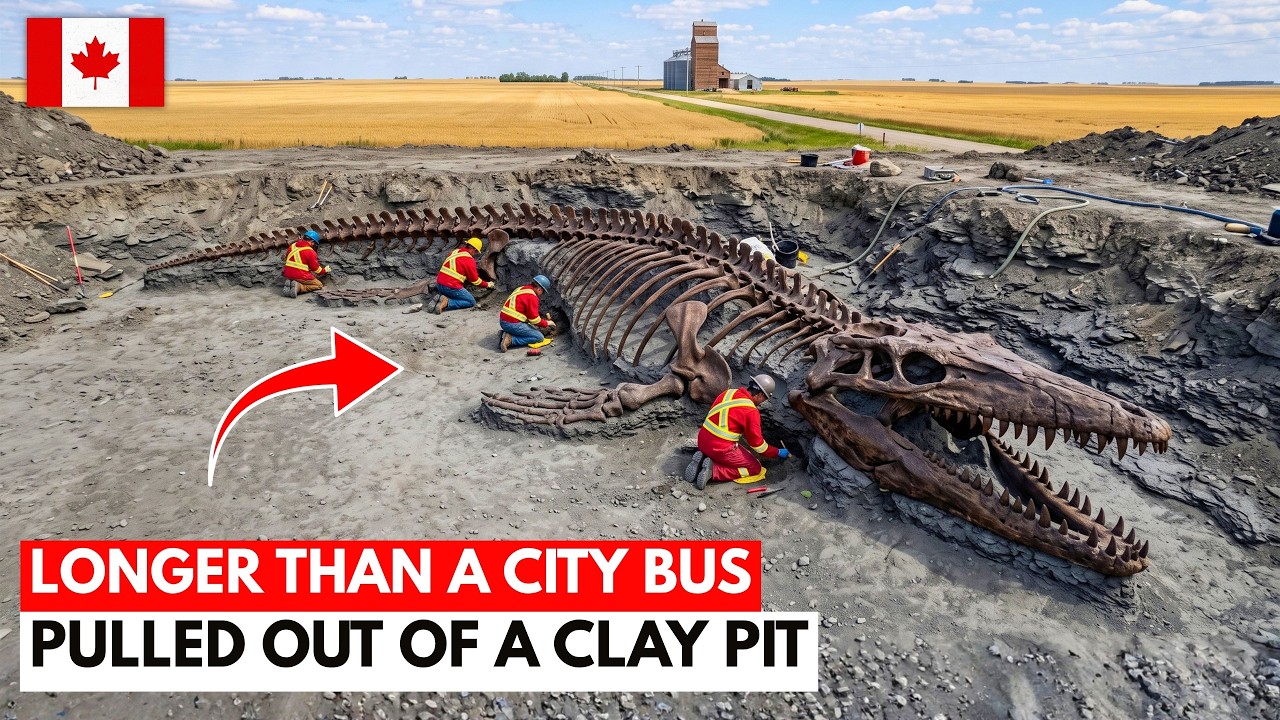
They cut into a layer of black shale and there was a bone in it. Then another one. Then a line of them running back into the hill. There were vertebrae the size of a fist, a piece of jaw, and long curved ribs.
And the bones kept going, and going, and going, far past the point where anything that should be buried in a Manitoba field could reasonably continue. By the time that skeleton was fully out of the ground, two field seasons later, it measured 13 meters from the tip of the nose to the tip of the tail. That is almost 43 feet, longer than a city bus. And it was not a dinosaur.
That is the most common mistake made about this animal. It was a mosasaur, a giant marine reptile that swam in the sea, and it is no more a dinosaur than a crocodile is a fish. It is about 80 million years old. It has a name: Bruce.
It holds a Guinness World Record. It is the official fossil emblem of the province of Manitoba. It has been put on a Canadian coin. And it was pulled out of a field where farmers grow grain.
So here is the puzzle worth working out. How a 13-meter sea monster ended up buried in the middle of the Canadian prairies. Why that one hillside is full of them. What this animal actually was, and how something that size hunted.
Why a very small town museum, and not a national one, ended up with the record. And why that record says something slightly different from what most people assume. Start with the sea, because that is the part that sounds impossible and is the easiest to prove. Between roughly 100 million and 66 million years ago, North America was not one piece of land.
It was two, with an ocean in the middle. That ocean is called the Western Interior Seaway. It ran from the Gulf of Mexico all the way north to the Arctic Ocean, cutting the continent in half. It was over 3,000 kilometers long, around 1,000 kilometers wide, and at its deepest, several hundred meters deep.
Everything now called the Great Plains was underwater. Montana, Wyoming, the Dakotas, Saskatchewan, and southern Manitoba were seafloor. And southern Manitoba was not near the shore. It was well out in open water, so far from land that hardly anything from land ever reached it.
What settled on that bottom was marine life. That is why the fossils here differ so sharply from the famous Canadian dinosaur sites further west. Alberta has badlands full of dinosaurs because Alberta was the coastal plain. Manitoba has marine reptiles because Manitoba was the sea.
Now the second piece, the one that made the discoveries possible. Along a ridge in southern Manitoba called the Manitoba Escarpment, there is a thick layer of dark shale. Running through that shale are pale seams of a soft clay called bentonite. Bentonite starts as volcanic ash.
Far to the west, volcanoes were erupting, most likely in what is now Montana, and the ash drifted east on the wind and settled through the water onto the seafloor. Over millions of years, sitting in seawater, that ash turned into clay. Bentonite is useful. It is used in drilling, in foundries, and in dozens of industrial processes.
From the late 1930s onward, a company quarried it out of the hillsides near the towns of Morden and Miami, from a whole series of pits along that escarpment. Which meant that decade after decade, machinery was cutting into a Cretaceous seabed. The miners kept hitting bones. That is the quiet mechanism behind this entire story.
Nobody went looking for a mosasaur in a wheat field. An industry that needed volcanic clay kept slicing open the layer where the animals had settled, and the fossils came out as a side effect. The first Canadian mosasaurs were found in Manitoba in 1934 by one of the most famous fossil hunters in Canadian history. From the 1960s onward, the finds accelerated as the mines expanded and local people started paying attention.
By the early 1970s, a small museum in Morden was working directly with the mining company. In two years of digging, a group of local volunteers, including high school students, recovered around 30 mosasaurs and 20 plesiosaurs. Thirty giant marine reptiles in two years, out of the hillsides of a farming district. And then came July of 1974, and a mine site on a farm belonging to a local family a few miles from Thornhill.
The team working the site that summer included people from the Morden Museum and from the Royal Ontario Museum in Toronto. What they uncovered was not another partial skeleton. It was the biggest one anybody there had seen. The excavation took roughly two field seasons.
When it was finished, they had around 65 to 70 percent of the entire animal, which for a fossil of this size is remarkable. And it got its name in the least scientific way imaginable. The crew that summer were fans of a British comedy show. In one famous sketch, every character is called Bruce.
So the diggers started calling each other Bruce, and the enormous skeleton coming out of the ground got called Bruce as well. The name stuck. It never went away. But what exactly had they dug up?
A mosasaur is not a dinosaur, and it is not a swimming crocodile either. Mosasaurs were lizards. Their closest living relatives are monitor lizards and snakes. At some point in the Cretaceous, a group of lizards went into the water and stayed there.
Over millions of years, their bodies were completely rebuilt for the sea. Their legs became four flippers. Their bodies became long and streamlined. Their tails developed a downward bend near the end that supported a fin with two lobes, a shape that works a lot like the tail of a shark, arrived at completely independently.
They still breathed air. Fossil evidence shows they had two working lungs like a land lizard rather than a snake. And this is the part that is easy to miss: this was not a slow, clumsy animal that happened to live in water. Mosasaurs appear in the fossil record late in the age of the dinosaurs, and within a relatively short span of geological time, they became the dominant hunters of these seas all over the world.
They were the last great reptile predators of the ocean, and they were still spreading and getting larger right up to the moment the Cretaceous ended. And they did not come ashore to lay eggs. The evidence indicates that mosasaurs gave birth in open water, which means the young were born straight into the sea. Bruce belongs to a group called Tylosaurus, and the members of this group have one very distinctive feature.
The front of the snout sticks out past the teeth, forming a solid, toothless point. That is unusual, and researchers have suggested it worked as a ram: a reinforced snout for striking prey or for fighting rivals. Behind that point, the jaws carry rows of conical teeth, and in some species, the cutting edges are finely serrated. Tylosaurus was not a fish specialist with a mouthful of delicate needles.
It was built for large prey. And we know what that meant in practice, because the stomach contents of Tylosaurus specimens have been studied. They ate fish. They ate sea turtles.
They ate plesiosaurs, those long-necked marine reptiles. And they ate other mosasaurs. So picture this animal in the water above southern Manitoba 80 million years ago. Thirteen meters of muscular lizard with a hard, pointed snout and serrated teeth.
It gives birth at sea and eats anything else large enough to be worth the effort, including its own kind. There is nothing alive today that does that job. The nearest things we have are large sharks or killer whales, and both of those are completely different kinds of animals. Which raises a question that is easy to skip past.
Why is there anything left of it at all? A 13-meter animal that dies in open water is, in normal circumstances, an enormous free meal. Scavengers pull it apart. Currents scatter it.
Bones sitting exposed on a seabed are broken up and worn away, and almost nothing survives to become a fossil. The answer is the mud. It is not a glamorous answer, which is usually a sign that it is the right one. The seafloor here was fine dark mud, and the water at the bottom appears to have been very low in oxygen.
Low oxygen means very little life down there to tear a carcass apart, and it means slow decay. A body that sank into that mud was covered quickly and quietly and then left alone. So the same conditions that made the bottom of this sea a dead zone are the reason we can stand next to one of its predators today. And the ash layers do something else as well.
Volcanic ash falls all at once right across a region, and it contains crystals that can be dated in a laboratory. So those pale bentonite seams are not only what the mines wanted; they are also markers that let geologists pin down the age of everything lying between them. Now to the record, and the careful part. On the 22nd of August 2014, Bruce was recognized by Guinness World Records.
The measurement is precise: 13. 05 meters from the tip of the nose to the tip of the tail. That is 42. 8 feet.
But read the title carefully, because it matters. The record is for the largest mosasaur on public display. It is not a claim that this was the largest mosasaur that ever lived. Fossil fragments exist from very large individuals of several species, and estimating the size of an animal from a piece of jaw is uncertain work.
What the record says is that of the mosasaur skeletons you can walk up to and stand next to in a museum anywhere in the world, this one is the longest. And that is still extraordinary, because of where it is. Bruce is not in Ottawa, Toronto, or New York. Bruce is in Morden, Manitoba, a town of a few thousand people, in a museum that began in the early 1970s and spent years in the lower level of a local recreation center.
That museum, now the Canadian Fossil Discovery Centre, holds what has been described as the largest collection of marine reptile fossils in Canada. More than 500 specimens have been recovered from those hillsides. And Bruce is not alone in the building. In 2015, the centre unveiled another mosasaur, a 9-meter animal nicknamed Suzie.
There is a short-necked plesiosaur excavated in 2004 and 2005 whose stomach contents have been studied and published. There is a Cretaceous squid from the northernmost place that particular animal has been found in North America. And in 2016, researchers announced a new species of flightless diving bird from these deposits, a bird that swam and fished in the same water Bruce hunted in. That is the thing people miss about this site.
Bruce is the headline, but the hillsides around Morden have produced an entire ecosystem, from the giant hunters down to the birds and the squid they shared the water with. Now the honest limits, because this story gets told carelessly. First, again, Bruce is not a dinosaur. Mosasaurs are marine lizards.
They lived at the same time as the dinosaurs, and they died out in the same extinction event, but they are a different branch of the reptile family tree. Second, the skeleton is around 65 to 70 percent complete. That is very good for a specimen of this size, but it also means the mounted animal you see includes reconstructed parts, and the overall length is a careful estimate built on the bones that exist. Third, the species itself has a complicated history.
When this animal was formally described in 1988 by a Canadian paleontologist, it was placed in a different genus. It was later moved into Tylosaurus. Arguments about how these giant mosasaurs are related, and which names belong where, continue among specialists. The animal is real.
The label on it has changed, and it could change again. And fourth, the record is about display, not about the record for the biggest mosasaur that ever swam. With those limits in place, the rest of the story is straightforwardly remarkable. Bruce became the official fossil emblem of Manitoba in 2015.
The province put a marine lizard on its list of official symbols, alongside a flower and a bird. In 2013, the Royal Canadian Mint issued a 25-cent collector coin showing this species. The design was painted by a well-known paleo-art illustrator, and the coin has a trick built into it. In daylight, you see the animal as it might have looked in life.
In the dark, the coin glows. And what glows is the skeleton. A creature dug out of a clay mine in a farming district, printed on the national currency with its own skeleton hidden inside the picture. Hold the whole shape of it.
Eighty million years ago, the middle of North America was an ocean, and southern Manitoba was open water far from any shore. In that water swam a 13-meter lizard with a reinforced snout and serrated teeth, which gave birth at sea and hunted plesiosaurs and other mosasaurs. It died, and it settled into the mud of the seafloor, and the sea eventually drained away. The mud hardened into shale.
Volcanic ash from mountains to the west turned into clay. Grass grew on top, then farms, then gravel roads and grain trucks. And in the 20th century, people started mining that clay for industry. They cut into the hillsides, and the seafloor came open again, and the bones of its animals came out one after another.
In July of 1974, one of those cuts hit a skeleton that kept going and going. A group of volunteers, students, and museum staff spent two seasons freeing it from the rock, joking in the voice of a comedy sketch, calling it Bruce. Forty years after that, Bruce was recognized as the largest mosasaur on display anywhere in the world, in a small prairie town, surrounded by fields of wheat that grow on the bottom of a vanished ocean. And those hillsides are not finished.
The same layers are still there, still being exposed, still producing specimens. The museum runs public digs in the summer, which means ordinary visitors can go out onto that old seafloor and look for what is still in it. Every year, the prairie gives back a little more of the sea.
