Anne Boleyn was going to die. She knew it, and in the Tower of London, in her final days, she answered the dread with something that unsettled everyone around her: an eerie calm, even a kind of happiness. The woman who had once set the English court ablaze with her dancing and her wit now spent her last hours speaking quietly with her guards, arranging the details of her own death. At one point, she tried to reassure one of them about the professional executioner sent over from France.
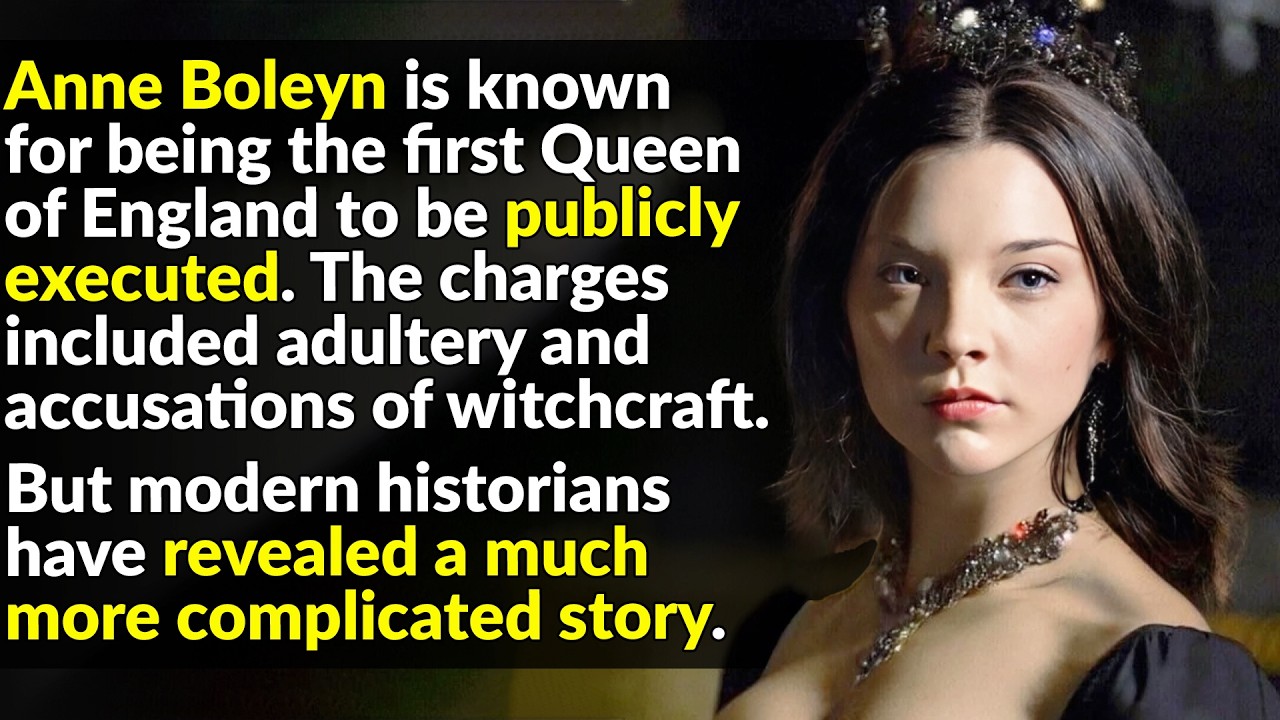
The king had chosen his swordsman carefully, and Anne had heard the man was good at his work. She reportedly smiled as she said it: she had been told that he was quite good, and besides, she had a very small neck. On May 19, 1536, she walked to the scaffold. She wore no crown, no royal purple, but in her final moments Anne Boleyn held onto her composure, and she held onto her own peculiar style.
While her ladies wept around her, she had them tie a blindfold over her eyes and knelt before the block, in the French manner she had always favored. The swordsman proved as skilled as she had been promised. It took only one stroke to behead the Queen of England. To understand how she came to that block, you have to go back more than twenty years, to a girl born into one of the most ambitious families in England.
Anne Boleyn was built for greatness from the start. Her father, Thomas Boleyn, was a favorite at the court of the old king, Henry VII, and the Boleyns were among the top families in the country. Thomas spent his career shuttling across Europe on diplomatic missions, and as Anne grew up, that constant travel handed her a date with destiny. In 1513, she took a position as maid of honor to Queen Mary of France.
The appointment mattered for a single, simple reason: Queen Mary was the sister of Henry VIII, and through her service Anne was edging ever closer to the royal inner circle. With Mary’s help, Anne stayed in France for nearly seven years, absorbing the most cosmopolitan culture in Europe and turning herself into a refined young woman. When she finally returned to England, the court could not believe its eyes. French culture at the time was so liberal it bordered on scandalous, and Anne had taken notes.
The English were astounded at how exotic and seductive the young woman had become, praising everything from the way she moved to the way she dressed. She favored the sleek French hood over the matronly English gable hoods that other women wore, a small choice that set her apart at a glance. Almost everyone who met her agreed: Anne Boleyn was excruciatingly attractive, slim and dark, with long black hair and brown eyes. Men found her captivating, but not only for her looks.
Her friends knew her as lively, quick-witted, and charming, often the smartest person in any room. Beneath that perfect surface, though, lay a darker side. For all her joviality, Anne was moody, sharp-tongued, and quick to anger when she did not get her way. During one argument with her uncle, she reportedly spoke to him with language that should not have been used on a dog.
That temper would one day help destroy her, but in these early years it was merely part of her dangerous appeal. Her older sister Mary Boleyn had already made a splash at court, and she proved to be a rival to Anne’s beauty. Although Henry VIII was married to Katherine of Aragon, he had taken Mary as his mistress. But when Anne arrived at Henry’s court, she brought her own secret weapon: her dancing.
No one seemed able to look away. On March 4, 1522, she made a jaw-dropping debut, dancing with her sister at a public fete at the royal palace. Anne vibrated with a magnetic new energy, and the records still remember how resplendent she looked in a gown of white and gold. That performance attracted the wrong kind of attention.
Anne collected admirers by the dozen, and King Henry was among them. His affair with Mary Boleyn was winding down, and he had developed a taste for the women of his favorite family. He simply could not help himself. But Anne refused to fall in line.
She had a very different suitor in mind: the dashing Henry Percy, heir to the Earl of Northumberland. She poured all of her energy into capturing his heart, not the king’s. She succeeded. The two fell into an intense romance over the following days and weeks.
Anne loved Percy so completely that she made a rash decision with disastrous consequences: after longing gazes and an exchange of letters, they became secretly engaged. There was a disturbing reason for the secrecy. Percy was already formally engaged to an entirely different woman. That was the least of Anne’s problems.
The young couple were in love, but no one else was on their side. Percy’s father absolutely refused to support the match, and Cardinal Wolsey, one of the most powerful men at court, refused his backing as well. Beaten down, Anne and Percy eventually had to give each other up and go their separate ways. With his rival out of the picture, King Henry began pursuing Anne in earnest around 1526.
He showered her with precious gemstones, pearls and rubies, carefully stashed away from his wife Katherine. His very first gift took the cake: an elegant gold bracelet set with his own portrait. The narcissism may have put Anne off, because she did not react well. While Henry threw every trick in the book at her, she remained uninterested.
She refused to become his mistress, and even when he promised to promote her from a regular side piece to his chief mistress, she still turned him down. Anne’s rejection of one of the most powerful men in Europe seems bizarre until you look deeper. She wanted to be much more than a mistress. She wanted Henry to annul his marriage to Katherine of Aragon and make her queen.
And she played her cards shrewdly: the more hot and bothered Henry became, the more putty he would be in her hands. Her timing was impeccable. By the time she arrived, Henry’s marriage was already on the rocks. Queen Katherine had given birth to Princess Mary, but she had not given Henry the male heir he so desperately wanted.
Even worse, Henry had begun nursing a deranged idea. Since Katherine had been briefly married to his older brother, Prince Arthur, before the prince’s death, Henry convinced himself that God was punishing him for taking his brother’s wife. Katherine swore the marriage had never been consummated, but it was no good. Henry began angling for an annulment, the only way the Catholic Church would condone his remarrying.
When Henry started talking about casting Katherine aside, Anne was thrilled. Still, she kept him away from her bed. She happily accepted his proposal of marriage, and while he was, of course, already married, the two of them assumed it would be the work of a snap of the fingers to oust Queen Katherine. It did not go well.
The public took the idea of Anne becoming queen poorly. The common crowds adored Katherine and blamed Anne for splitting the marriage apart. As Anne rose in power, the grumbling grew louder. People called her cruel names and accused her of beguiling Henry with witchcraft.
One evening, the hostility turned terrifying. Near the Thames, Anne was heading outside when a mob of angry women attacked her, convinced she was bringing their king and country to ruin. A terrified Anne had to make a narrow escape on a boat to save herself from their rage. The situation reached a fever pitch until Henry made a fateful decision that changed England forever.
After seven long years of fighting with the church, he had had enough. He split from the Roman Catholic Church entirely and installed himself as the head of a brand new Anglican Church. In 1533, after years of maneuvering, Anne Boleyn became Queen consort of England, marrying Henry on January 25. Even after this great victory, she could not resist one last bit of revenge against her predecessor.
She made sure her coronation outdid Katherine’s. Beginning June 1, 1533, the event lasted four glorious days, with Anne wearing a series of covetable outfits the entire time. On the last day, she wore an unforgettable gown dyed royal purple and trimmed with ermine. Anne had a twisted sense of humor, and as queen she put it on full display.
In response to the angry protests against Henry’s choice, she temporarily adopted a motto: “Grumble all you like, this is how it’s going to be. ”
At that moment, Anne was a pregnant queen of England, more powerful and more smug than she had ever been. There was nowhere to go but down. After her coronation, Anne settled into royal life and prepared to give Henry his long-desired son.
All signs pointed to a boy. Almost all of the king’s astrologers said the stars mapped out a male heir, and Anne and Henry were confident. Instead, in September 1533, she gave birth to a healthy child—but not a boy. She had a little girl, the future Queen Elizabeth I.
The shock sent the royal couple into a tailspin. Henry cancelled his celebratory jousting match, and the royal scribes hastily changed “prince” to “princess” in the official announcement. No one knew it then, but it was the beginning of the end. When Anne did not immediately give Henry a male heir, his patience with his testy wife drained away.
He began to resent her sharp intelligence and even sharper tongue, demanding she submit to him as a wife, not as his equal. Over the next three years, Anne became pregnant numerous times, and each time it tragically ended in miscarriage. All the while, Henry grew more distant, more regretful that he had married her at all. Darker problems were at play.
The king had always had a wandering eye, and as his marriage frayed, he turned his attentions elsewhere: to the pretty, sweet, and comparatively submissive Jane Seymour, who would eventually become his third wife. Jane was also Anne’s second cousin, so Henry was clearly still obsessed with the family. But despite their ties, Anne and Jane were not close. Anne was no fool.
She knew a relationship was growing between Henry and Jane right under her nose. One day at court, Jane began brazenly opening and shutting a locket in front of Anne. Once Anne realized what was going on, she flew into a fury and tore the chain so violently that she cut her fingers open. Jane was not done shoving the affair in her face.
One evening, Anne walked into a room and found her treasonous cousin sitting on her husband’s lap. Anne’s response went down in infamy. Giving in to her notorious temper, she reportedly flew into a very public rage at the sight. Shortly afterwards, she miscarried again, losing the child she was so desperate to give Henry.
And then came the most harrowing part: when the attendants looked at the infant, they saw that it was a boy. When Henry VIII turned on Anne at last, his spite was swift and brutal. People say things go the same way they came, and nothing could be truer of Henry. Within days of losing his love for Anne, he had installed Jane Seymour in the royal quarters.
Then came the bloodiest phase of his plan. The king detained and questioned a series of male courtiers who knew Anne, accusing them of sleeping with his wife. Chillingly, Henry even took in Anne’s own brother, George, accusing him of having romantic relations with his sister. In mid-May, Anne was finally put on trial.
She stood in the courtroom while her brother George suffered through a similar trial the same day. The crown accused her of everything from witchcraft to plotting Henry’s death so that she could remarry. A jury of twenty-seven men found Anne guilty on all counts and condemned her to execution. One detail of the trial was gut-wrenching.
As Anne looked into the jury’s eyes, she saw a familiar face: Henry Percy, her old love, the man she had tried to marry all those years ago, before King Henry pulled her into his destructive orbit. The jury’s decision was unanimous, which meant Percy had personally sent his old flame to the block. The decision destroyed him. When an aide read out the decree, Anne’s ex-fiance was so overcome with emotion that he collapsed on the floor and had to be hauled out of the room by attendants.
He never got over the shock. He passed away, childless, a mere eight months later. In her final days in the Tower, visitors to the Queen of England described her as eerily calm, even happy. Even as she awaited the executioner’s blade, she never once spoke ill of King Henry, nor did she admit to any guilt.
She had a cunning, selfless reason. At this point, Anne likely did not want her family to suffer any further punishment after she was gone. Anne died in her own style. While her ladies wept around her, she had them tie a blindfold around her eyes and knelt in front of the block in the classically French manner.
She had prepared every detail, and now it was time to face her end. Henry tried his best to forget her. He fully established Jane Seymour in the palace just eleven days after the execution. But it was not that simple.
Henry had such a difficult time erasing Anne’s memory that he soon ordered all likenesses of her destroyed. There are no contemporary paintings of her in existence. In the end, whether he loved her or hated her, it was not easy for the king to forget the woman who was Anne Boleyn.
