On the twenty-third of February 1669, a man walked into Westminster Abbey, lifted the upper body of a dead queen out of her coffin, and kissed her on the mouth. She had been dead for more than two hundred years, and she was never supposed to be there. The man was Samuel Pepys, a high-ranking official in the English Navy, and it was his thirty-sixth birthday. He had arranged, by what he called a particular favor, to see the tombs and the body of Queen Catherine of Valois.
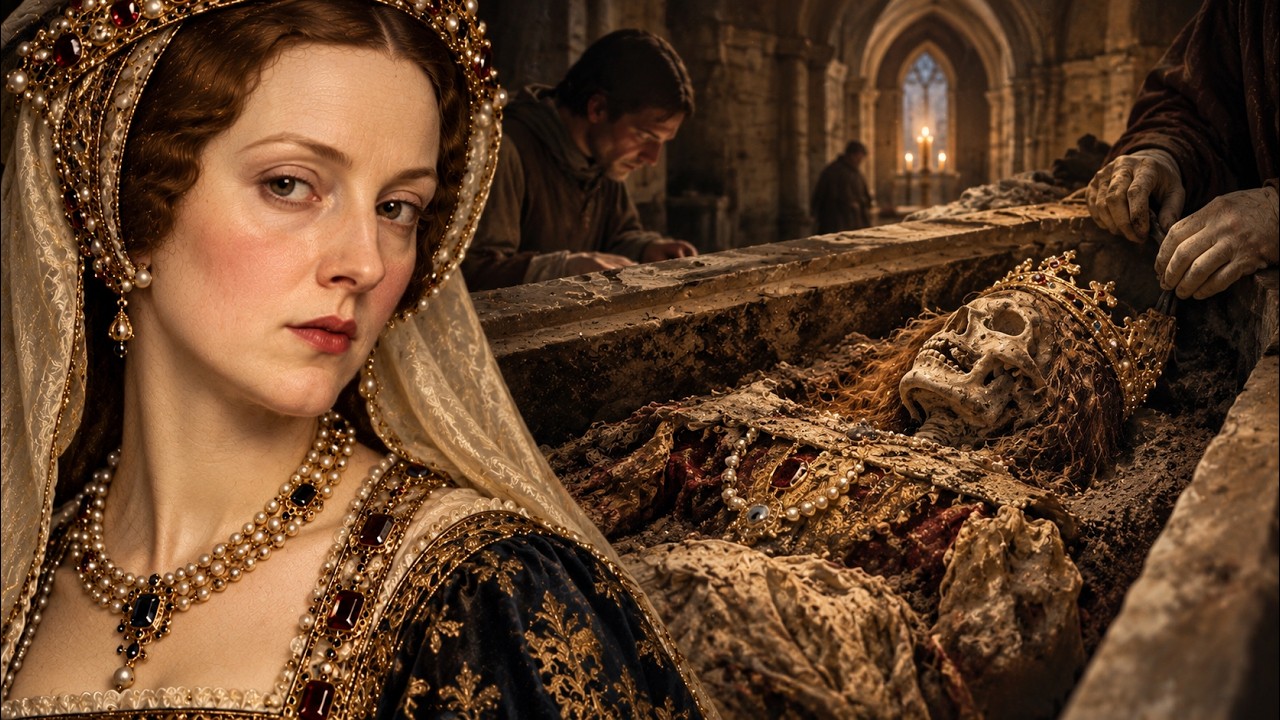
He took her in his hands and kissed her, and later he wrote it down proudly in his diary, as if it were the best present he could have given himself. To him, this was not disrespect. It was a curiosity, a story to tell, a moment of connection with history. Attitudes toward the dead were very different in the seventeenth century, and royal bodies had a strange status somewhere between a person, a relic, and a tourist attraction.
We would feel horror today. He felt delight. But in that diary entry lies something deeply sad. A queen who was crowned at Westminster Abbey, who gave birth to a king, who founded a dynasty by choosing love over law, was reduced to a birthday souvenir for a man who never even met her.
So how did a Queen of England end up on display like an attraction in a museum? And who was really responsible? Her name was Katherine of Valois. To understand how a queen ended up in that situation, we have to go back to the very beginning.
She was born in Paris on the twenty-seventh of October 1401, the youngest daughter of King Charles VI of France and Queen Isabel of Bavaria. It was a terrible time to be a French princess. Her father suffered from recurring bouts of severe mental illness. During some of them, he became convinced that his body was made of glass and might shatter at the slightest touch.
According to accounts from the period, he even wore reinforced clothing to protect himself from breaking. While the king struggled, France was falling apart. Rival noble factions were locked in a bitter civil war, and England was pushing deeper and deeper into French territory in what we now call the Hundred Years War. In the middle of all this chaos, young Catherine was neglected by many accounts, and she spent part of her childhood in a convent at Poissy, far from the turmoil of the court.
Then, in 1415, the English King Henry V crushed the French army at the Battle of Agincourt. Soon afterward, he began demanding Catherine’s hand in marriage, along with an enormous dowry and large pieces of French land. For years, the negotiations dragged on, and the war dragged on with them. Finally, in 1420, the Treaty of Troyes settled everything.
Henry would marry Catherine, and he would be recognized as the heir to the French throne, passing over the French king’s own son, the dauphin. Catherine was not a bride in any romantic sense. She was a peace treaty in the shape of an eighteen-year-old girl. They married on the second of June 1420.
In February of 1421, she was crowned Queen of England at Westminster Abbey. On the sixth of December 1421, she gave birth to a son at Windsor Castle, the future Henry VI. His father was away fighting in France and never got to meet his child. On the thirty-first of August 1422, the warrior king died of illness near Paris.
He was only thirty-five years old. Catherine was twenty, a widow and the mother of a baby just nine months old. Within weeks, her own father died too, and that baby boy became king of England and, according to the treaty, king of France as well. But the little king’s mother did not rule.
The real power sat with the royal council and with the king’s ambitious uncles. Catherine, a French woman in an English court still at war with France, was kept close but kept out of politics. Her husband’s body was carried home in a grand procession and buried at Westminster Abbey in November of 1422, with Catherine walking as chief mourner. That image of a grieving young queen following a coffin into the abbey matters, because that same building would become the stage for the strangest chapter of her story.
So what does a twenty-year-old dowager queen do with no power, no husband, and no way out? She lived under watch. The council worried about whom she might marry, because whoever married the mother of the king could become dangerously influential. In 1428, Parliament passed a law saying that no one could marry the queen dowager without the king’s permission, and the king at that point was a small child.
Any man who broke that rule risked losing his lands and his property. But that law was about to collide with a Welshman named Owen Tudor. Owen came from a well-connected Welsh family on the island of Anglesey, and he found his way into Catherine’s household, most likely as the keeper of her wardrobe. There is a famous legend that he first caught her eye when he tripped while dancing and fell into her lap.
Historians doubt that story, and it sounds a little too convenient. What we do know is that gossip about the two of them started around 1425, and that sometime between 1428 and 1432, they most likely married in secret. No marriage record has ever been found, which is why historians still argue about the exact date and even the exact details. Think about how dangerous this was.
Owen was a Welshman at a time when harsh laws passed after the rebellion of Owain Glyndŵr treated Welsh people as second-class subjects. In 1432, Parliament granted him the rights of an Englishman, which gave him legal protection he badly needed. They had at least four children, including two sons who would change English history forever: Edmund and Jasper Tudor. Their daughter, born at the very end, would not survive.
For about a decade, this secret life held together. Then in 1436, something broke. Owen was arrested and thrown into Newgate Prison. Catherine, ill and exhausted, withdrew to Bermondsey Abbey, a religious house on the south bank of the River Thames.
We do not know for certain what illness she had. Some writers have suggested cancer, but that is only a guess built on thin evidence. What we do know is that she gave birth to a daughter at Bermondsey, that the baby did not survive, and that Catherine dictated her will just three days before the end. On the third of January 1437, Katherine of Valois died.
She was thirty-five years old, exactly the same age her first husband had been when he died. Her body lay in state near the Tower of London in February, was carried to St. Paul’s Cathedral, and was then taken to Westminster Abbey, where she was buried in the Lady Chapel, the church’s eastern chapel dedicated to the Virgin Mary. A wooden effigy of her was carried in the funeral procession, and amazingly, that effigy still survives today in the abbey’s museum.
It is one of the closest things we have to seeing how people at her own funeral pictured her. For a moment, everything about this burial looked right. A queen, a funeral, a proper tomb. This is where the story should have ended.
It did not. Meanwhile, the world she left behind kept moving. Owen Tudor was put on trial after her death, and he was acquitted. Her eldest son, Henry VI, grew up to be a gentle, deeply religious, and troubled king, and he looked after his Tudor half-brothers.
In 1452, he made Edmund the Earl of Richmond and Jasper the Earl of Pembroke, and Parliament formally recognized the legitimacy of their parents’ marriage. The secret marriage had finally been made official fifteen years after the bride was gone. By then, England was sliding into the Wars of the Roses, the long and bloody struggle between the rival houses of Lancaster and York. Henry VI was a Lancastrian king, and his Tudor half-brothers stood firmly on his side.
In 1455, Edmund Tudor married a girl named Margaret Beaufort, who was only twelve years old and who carried her own claim to the royal bloodline. Edmund died of plague the following year, in November of 1456. A few months later, in January of 1457, Margaret gave birth to their only child, a boy named Henry, at Pembroke Castle in Wales. That baby was Katherine of Valois’s grandson.
And what happened to the man who started it all? In 1461, Owen Tudor was captured after a Lancastrian defeat at the Battle of Mortimer’s Cross and sentenced to death in the town of Hereford. According to a famous tradition, as he knelt, he looked at the block and murmured that his head would soon lie on the block that once lay in the lap of a queen. Whether he said it or not, it is one of the most haunting lines in Tudor history.
Then came the twist nobody could have predicted. In 1485, Catherine’s grandson Henry Tudor landed in Wales with a small army, marched into England, and defeated the Yorkist King Richard III at the Battle of Bosworth Field. He became King Henry VII, the first Tudor king, and he founded a dynasty that would produce Henry VIII and Elizabeth I. Think about that for a second.
The Tudor dynasty, one of the most famous royal families in history, exists because a lonely French widow fell in love with a Welsh servant and defied the law. Every Tudor monarch descends from that secret marriage. So surely the grandson who owed his crown to Catherine would honor her memory with the grandest tomb in England. Surely.
Here is what he actually did. In the early 1500s, Henry VII began building a spectacular new chapel at the eastern end of Westminster Abbey. It still stands today, and it is a Gothic masterpiece famous for its breathtaking fan-vaulted ceiling. But to make space for it, the old Lady Chapel had to be torn down.
And inside that old chapel was the tomb of his own grandmother. Her tomb was destroyed. Her coffin was lifted out of the ground, and she was never properly buried again. Instead, her remains were placed in a chest near the tomb of her first husband, Henry V, in the chantry chapel above the abbey’s eastern end.
The lid of her coffin was loose, and at some point it was raised, which left her body open for anyone to see. There was no grand ceremony and no new tomb, just an exposed body in a corner of one of the most famous churches in the world. Why did the king allow it? Honestly, nobody knows for sure.
Some historians have argued that Henry VII wanted to distance himself from the scandal of his grandmother’s secret marriage. But that theory has a problem, because he actually put up a new monument over her grave naming her marriage to Owen Tudor. Others believe it was simply carelessness, a building project that overran with a coffin that nobody planned for. And at the end of the day, the king died in 1509 with his grandmother still sitting above ground.
Think about how strange that is. The person who benefited most from her life was the one who left her without a grave. Henry VII died, and his son Henry VIII took the throne. Henry VIII had a lot on his mind.
He broke with the Church of Rome. He dissolved the monasteries, and in 1538 even Bermondsey Abbey, the very place where Catherine had died, was shut down. England changed completely. Kings came and went.
Queens came and went. Civil war broke out. A king was executed, and a king was restored. And through all of it, in the middle of Westminster Abbey, the body of Katherine of Valois remained above ground.
Her body was loosely wrapped in lead, which helped protect it. Visitors to the abbey described her body as remarkably well preserved, with the bones still firmly joined and thinly covered in dried flesh. That made her something worse than forgotten. It made her fascinating.
At that time, Westminster Abbey was not only a church. It was also one of the most visited sites in London, and the people who looked after it earned money by showing paying visitors the tombs of the great and the famous. By some accounts, you could pay a small fee and have the lid of her coffin lifted. Imagine being a visitor in the 1600s.
You walk into the abbey, you pay a few coins, and a guide shows you the preserved body of a medieval queen with her face and hands still visible. And that brings us back to where we began. It is the twenty-third of February 1669, a day known as Shrove Tuesday, the day before Lent began. A man named Samuel Pepys walks into Westminster Abbey with his wife and some companions.
Pepys was a high-ranking official in the English Navy, and today he is best remembered for the diary he kept in the 1660s. It is one of the most important historical records we have of everyday life in Restoration London. It covers the Great Plague, the Great Fire of London, and the personal life of a man who was brutally honest with his diary, even when he really should not have been. On this particular day, it was his birthday.
He was thirty-six years old. He arranged, by what he called a particular favor, to see the tombs and the body of Queen Catherine of Valois. And then he did something that still makes people gasp. He took the upper part of her body in his hands, and he kissed her mouth.
It did not stop with Pepys. Catherine’s body stayed on display for generations. Visitors came, looked, and left. The exact amount of time she was exposed is debated, but historians generally agree that her remains were above ground for roughly two and a half centuries.
Then, in the year 1778, there was a small change. Her coffin was moved into a vault in the chapel of St. Nicholas, underneath the grand monument of the Villiers family, the family of the Dukes of Buckingham. So she was finally out of sight, but a vault under someone else’s monument was not a tomb of her own.
She was in the abbey, but she still had no resting place that was truly hers. And that is how she stayed for another hundred years. It took the Victorian age to correct it. By the 1870s, the dean of Westminster was a man named Arthur Stanley, a historian who cared deeply about the abbey’s past.
He felt that the abbey owed its royal dead better treatment. Working with the architect Gilbert Scott, he arranged for Catherine to be moved again. In 1878, in the reign of Queen Victoria, Katherine of Valois was finally laid to rest under the stone slab that had once been the altar of her husband’s chantry, in the chapel of Henry V. She was placed close to the man she married for a treaty, in the same abbey where she had once been crowned and where she had once walked behind his coffin.
Do the math. She died in 1437 and was finally laid to rest in 1878. That is 441 years. Her tomb was destroyed in the early 1500s, which means that for roughly three and a half centuries, she had no tomb of her own at all.
Why does a story like this matter? It matters because it shows us how much of history depends on who gets remembered and how. Katherine of Valois was a princess, a queen, a mother of a king, and the grandmother of a king. Without her, there would be no Tudor dynasty, no Henry VIII, no Elizabeth I, no six wives, no break with Rome.
The history of England looks completely different without her. And yet she spent more than four centuries as a footnote. There is another thing worth thinking about. For most of her adult life, Catherine was a pawn.
Her father’s mental illness decided her childhood. A treaty decided her marriage. A council decided the limits of her widowhood. But she made one choice that was entirely her own.
She chose Owen Tudor. She did it in secret, against the law, with everything to lose. And that single choice, made by a woman nobody thought had any real power, created a royal house that ruled England for 118 years. That is a remarkable way to change history: quietly, privately, and against the rules.
Today, you can still visit her tomb. It is in the Henry V chantry chapel at Westminster Abbey, in a quiet space above the abbey’s eastern end. The wooden effigy that was carried at her funeral is displayed nearby in the abbey’s museum, looking much as it did when mourners saw it in 1437. The inscription on her tomb gives her name and her titles.
It does not mention the odd and unsettling journey that her body took over nearly five centuries. Perhaps that is the final irony. After everything that happened, the tomb is peaceful, and the visitors who walk past it rarely know about the queen who was moved from tomb to chest, from chest to vault, from vault to chantry, kissed on his birthday by a diarist, and shown to strangers for coins. But now you do.
Katherine of Valois began as a bargaining chip in a war, became a widow with no power, and ended as one of the most unusual royal stories in English history. A queen who changed the fate of a kingdom and who waited more than four hundred years for a place to finally rest.
