The child had stopped shivering, and that was the most dangerous sign of all. Mrs. Fletcher sat on the edge of the narrow bed in their Bethnal Green room, watching her youngest daughter’s breath come in shallow clouds beneath the threadbare blanket. It was February 1895, three in the morning, and frost had formed on the inside of the window.
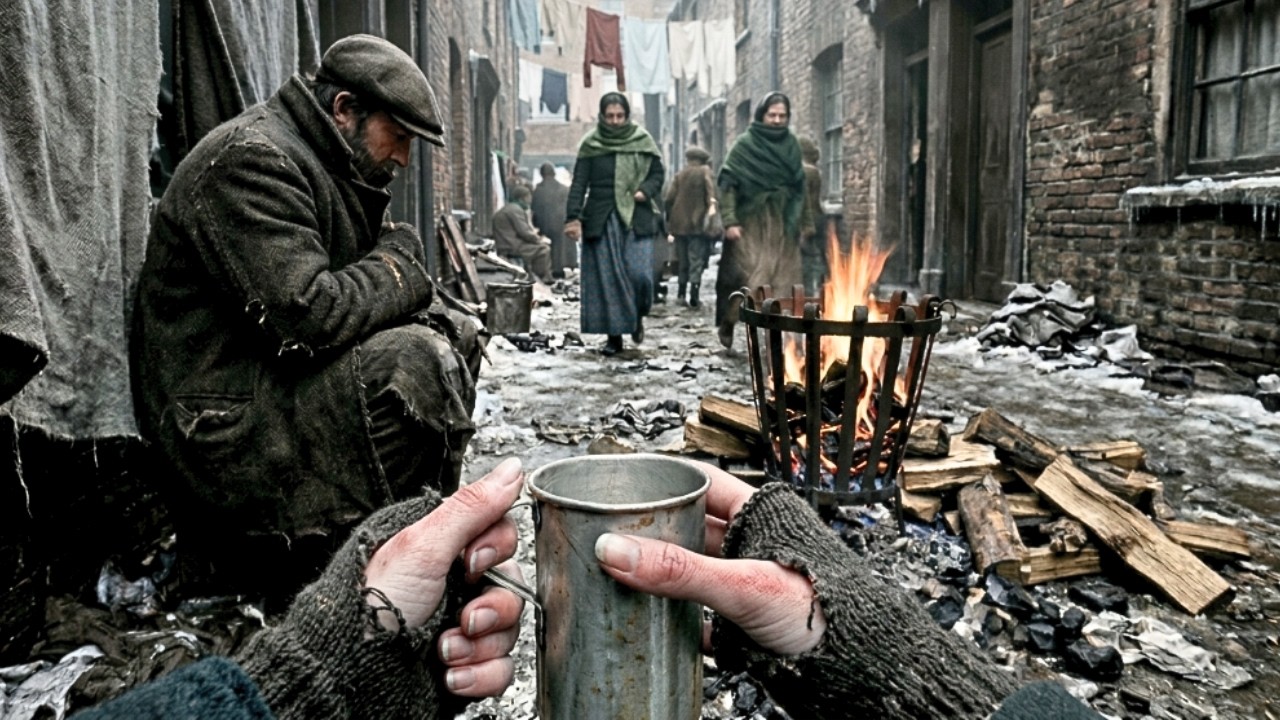
The candle beside her had burned down to a stub, its flame trembling in the draft that came through gaps in the doorframe wide enough to see the corridor beyond. There was no coal left. There had been no coal for three days. Tomorrow she would have to choose again, bread or warmth, and either choice might kill them.
She placed her hand on the child’s forehead, felt the cold skin, and thought about the workhouse. But the workhouse meant separation, her older children taken to different wards, and she would rather freeze together than survive apart. This was not unusual. Across London’s East End, in ten thousand rooms just like this one, mothers sat awake through the coldest night of the century, counting breaths and making calculations that had no right answers.
The winter arrived not with drama but with quiet, relentless persistence. In late December of 1894, temperatures across London began to fall, and they did not stop falling. By mid-January the Thames had frozen solid for the first time in decades, a thick crust of ice stretching from bank to bank, strong enough to bear the weight of a man. It was not a spectacle to celebrate.
It was a catastrophe disguised as a curiosity. The river was London’s artery, and when it froze, the lifeblood of commerce stopped. Coal barges could not move. Food shipments halted.
Prices surged overnight, and those who had money began to hoard while those who had nothing began to freeze. London in 1895 was the largest city the world had ever known, home to more than five million souls pressed into streets and courts and tenements that had never been designed to hold so many. Wealth concentrated in the West, in Mayfair and Belgravia, where thick walls and multiple fireplaces and armies of servants kept the cold at a manageable distance. But in the East, in Bethnal Green and Whitechapel and Spitalfields, poverty had settled like sediment, dense and immovable.
Here one in five families lived in destitution, a word that meant not merely hardship but the edge of survival itself. And here the cold struck with a cruelty that those in the West would never fully comprehend. The temperatures that winter plunged to fifteen degrees below freezing, a cold so severe that even those who had lived through hard winters could not recall its equal. It was not the damp, penetrating chill that Londoners knew well, the sort that seeped into bones and made joints ache.
This was something arctic, something that turned breath to ice crystals in the air and froze standing water within minutes. The cold held for six consecutive weeks, from the second week of January through the third week of February, without relenting. And during those weeks, coal, the only defense against freezing to death indoors, became as precious as gold. Before the freeze, coal cost roughly one shilling per hundredweight, an amount a laboring family could manage if work was steady and no one fell ill.
But when the Thames froze and the barges stopped, the price doubled within days. A hundredweight of coal, which might last a family a week if they burned it carefully, now cost two shillings, sometimes two shillings and sixpence. For families whose total income after rent was fourteen shillings a week, and whose food alone required ten shillings to keep starvation at bay, the arithmetic became impossible. There was simply not enough money for both warmth and survival, and so choices had to be made, choices that no mother should have to make, choices that killed.
The city transformed under the cold. The streets, always filthy, became crusted with ice and frozen horse manure, sharp and treacherous underfoot. The thick coal smoke that perpetually hung over the East End now mixed with frozen fog, each creating a yellowish haze that reduced visibility to a few yards and left a bitter taste in the throat. Gas lamps struggled to penetrate the gloom, their flames dim and wavering.
The usual noise of the city, the clatter of cartwheels on cobblestones and the shouts of street sellers, grew muffled and sparse. People moved quickly when they moved at all, heads down, collars turned up, desperate to reach shelter. The workhouses, those grim institutions that offered survival at the price of dignity and family, began to overflow in late January. The Whitechapel workhouse, built to hold eight hundred, housed over a thousand by the first week of February.
Still, hundreds were turned away each night, told there was no room, sent back into streets where the cold waited with patience. Dr. Thomas Barnardo, who operated homes for destitute children, sent his workers out on nightly patrols through the worst districts. They returned with reports that seemed impossible to believe: families burning their furniture for warmth, children with blue lips huddled in corners, mothers wrapping their own shawls around infants and shivering through the night in their underclothes.
The newspapers began to take notice in early February. The Times ran a headline that read simply, “The poor are perishing. ” The Daily Chronicle published eyewitness accounts from the slums, descriptions of rooms where frost formed on the inside walls and families slept fully clothed under every scrap of fabric they owned. The first deaths were reported in mid-January, quietly at first, a line or two in the back pages.
By February the numbers were climbing, and the city could no longer pretend it did not see. To understand what this cold meant, one must first see where it struck hardest, the slums themselves, built not for human comfort or survival but for profit alone. The tenements stood four and five stories high, pressed so closely together that sunlight rarely reached the courts and alleys between them. Their walls were a single brick thick, roughly four inches of clay and mortar separating the interior from the winter outside.
There was no insulation, no cavity, no air gap. The cold passed through those walls as easily as through a sheet of paper. The windows were single panes of thin glass, and many of those panes were broken. Landlords did not repair what did not affect the rent they could collect, and so families stuffed the gaps with rags, with newspaper, with whatever could be wedged into the frames to slow the wind.
It never stopped the wind entirely. On cold nights the rags moved and fluttered as drafts found their way through, and the temperature inside was often barely warmer than the temperature outside. The window frames themselves were wooden and warped with age, shrinking and expanding with the seasons until gaps appeared that no amount of stuffing could seal. Frost formed on the inside of the glass by early evening and remained until midday if the sun was strong enough to melt it at all.
The floors were uneven, laid over earthen foundations that allowed damp to rise perpetually into the rooms above. Floorboards warped and split, and cold air seeped upward through the gaps, making it impossible to warm the space near the ground no matter how much coal was burned. The ceilings were low, seven feet at most, and sometimes lower, so that a tall man had to stoop indoors. The rooms themselves were small, ten feet by twelve feet in most cases, and into these cramped spaces entire families lived.
Six people, seven, eight, all sharing a single room that served as kitchen, bedroom, and living space at once. In Bethnal Green, one of the poorest districts, a survey conducted in early 1895 found that 45 percent of families were living below the level of subsistence, a carefully calculated line that represented the absolute minimum income needed to sustain life. The average family of five earned roughly eighteen shillings a week, and of that four shillings went immediately to rent. That left fourteen shillings for everything else, for food and coal and clothing and medicine.
Food alone, if one was to avoid starvation, required at least ten shillings. The mathematics left no room for illness, for accident, for winter. The cold in these rooms was not merely uncomfortable, it was dangerous. By February, when temperatures outside had been below freezing for weeks, ice had begun to form on the interior walls, half an inch thick in places, a glittering crystalline skin that never melted.
Condensation from breath and body heat froze overnight on the blankets that covered sleeping children, so that they woke beneath stiff, icy cloth. The air itself felt thick and damp, heavy with moisture that had nowhere to go, and mold spread in dark patches behind furniture and along the baseboards, filling the room with a musty, rotting smell. The chimneys were shared between multiple rooms, poorly designed and prone to backdrafts that sent smoke curling into living spaces rather than up and out. When families could afford coal and lit their small grates, the smoke often filled the room, acrid and choking, burning eyes and throats.
But smoke was preferable to cold, and so they endured it, coughing through the night because the alternative was freezing. The smells of the slums were layered and inescapable: damp plaster and coal smoke, unwashed bodies pressed together for warmth, the chamber pots that were too cold to empty in the night and sat uncovered in corners. Through the thin walls came the sounds of other families, coughing that never stopped, the crying of infants, the scurrying of rats in the spaces between floors. To step into one of these rooms was to understand immediately that survival here was an act of endurance, not of living.
Everything was damp. Everything was cold. Everything smelled of decay and desperation. Metal door handles burned the skin with cold when touched.
Candles, when they could be afforded, guttered in the drafts and gave off more shadow than light. The world inside these tenements existed in a permanent twilight, dim even at midday, darker than it should have been because the windows were small and filthy and often blocked by buildings just feet away. Mrs. Harriet Clements, interviewed months later, remembered that winter with a clarity that had not faded.
“We stuffed every crack we could find,” she said. “We hung a blanket across the window. Still, you could see your breath all day and night. The children’s noses ran constantly, froze on their upper lips.
”
Yet even in these conditions, survival was possible if one had coal. Without it, the mathematics of winter changed entirely. Coal was not merely a commodity in Victorian London. It was the difference between life and death.
And in the winter of 1895 it became unaffordable for thousands. Before the freeze, a hundredweight of coal, roughly 112 pounds, cost one shilling. A careful family could make that last a week if they burned it sparingly, feeding the fire only enough to take the edge off the cold, banking it at night to preserve what little warmth had been generated. But when the Thames froze and the barges could no longer move, the price doubled overnight.
Two shillings per hundredweight, sometimes two shillings and sixpence, and in some neighborhoods even more. For families already living on the thinnest margin, this increase was not an inconvenience. It was a sentence. The weekly budget of a laboring family revealed the impossibility with brutal clarity.
Rent for a single room was four shillings, paid every Monday without exception, because eviction came swiftly and without mercy. That left fourteen shillings from an eighteen-shilling income. Food, if one was to keep a family of five from starvation, required at least ten shillings: bread, potatoes, a bit of cheap meat when possible, tea, milk for the youngest children. Ten shillings bought survival, not comfort.
To heat the room adequately through a week of sub-zero temperatures required two or even three hundredweight of coal, which at the inflated winter prices meant four to six shillings. The equation did not balance. Fourteen shillings needed, fourteen shillings available. There was no margin, no flexibility, no room for both warmth and food.
And so mothers made choices that no human being should have to make. On Monday the rent was paid because homelessness meant certain death. On Tuesday coal was purchased, and the family ate only bread. On Wednesday and Thursday the children’s hunger grew, but at least they were not freezing.
On Friday the coal ran out, and food was bought instead, because starving children cannot wait. On Saturday the room was so cold that the children could not eat properly, their bodies shivering too violently to keep food down. On Sunday there was no clear answer, only the terrible knowledge that the next week would bring the same impossible arithmetic. Families burned whatever they could find when coal became unaffordable.
They scavenged wood from markets, broken crates that had held vegetables, splintered boards pulled from derelict buildings. The wood burned fast and gave little heat, gone within an hour, but it was something. They burned paper and cardboard, which caught quickly and died just as quickly, a brief flare of warmth that mocked more than it comforted. Some burned rags soaked in grease when grease could be found, which produced thick choking smoke and a smell that lingered for days.
And when there was nothing left to scavenge, families began to burn their own furniture, chairs first, then tables, then the floorboards themselves. By February, rooms that had been sparsely furnished in January were empty, stripped of everything wooden, everything combustible. Children were sent to bed early, not because they were tired but to save coal and candles. Twelve-hour nights became common, the family huddled together under every piece of clothing they owned, using body heat as the only source of warmth.
The elderly suffered first, their bodies no longer able to generate sufficient heat to sustain life. Infants suffered next, their small frames losing warmth faster than they could produce it. Mothers lay awake through the night, listening to their children’s breathing, counting each breath, waiting for morning. The death statistics from previous harsh winters offered grim foreshadowing.
In the winter of 1866, severe but not as cold as 1895, two thousand excess deaths were attributed directly to cold and its complications. The winter of 1894 to 1895 produced estimates ranging from three thousand to four thousand excess deaths, though many went unreported, recorded simply as pneumonia or bronchitis, the immediate cause rather than the root, which was cold and hunger and the impossible choice between the two. Those with shelter at least had walls, but thousands of London’s children had neither walls nor choice, only the frozen streets and whatever pennies they could earn before nightfall. The streets in winter belonged to the children, not by choice but by necessity.
Families desperate for every penny sent their daughters and sons out to sell whatever might earn a few coins before darkness fell. Girls as young as five stood on corners with boxes of matches, bundles of bootlaces, wilted flowers salvaged from yesterday’s market refuse. They were expected to return with three pence, perhaps six on a good day. And if they came home empty-handed, there would be no supper, and perhaps worse.
The cold made no exceptions for age or size, and many of these children had no shoes. Leather was expensive, and children’s feet grew quickly, and so they went barefoot even when the streets were crusted with ice and frozen filth. Hans Christian Andersen had written his tale of the little match girl in 1845, and those who read it in comfortable parlors dismissed it as sentimental fiction, too tragic to be real. But it was not fiction at all.
It was reportage. The journalist Henry Mayhew had documented identical cases in 1851, girls freezing to death against London walls, matches scattered around their bodies, and in 1895 nothing had changed. The children were still there, still freezing, still dying in doorways where they were found at dawn, small bodies stiff and cold, sometimes still clutching the matches they had failed to sell. Sarah Mills was nine years old in February of 1895 when a charity worker found her outside Covent Garden and recorded her testimony.
She sold matches from six in the morning until nine at night, fifteen hours standing in one place, her feet wrapped in newspaper tied with string because she had no shoes and her mother had no money to buy them. On a good day she earned four pence. On a bad day, one penny. She said that her hands stopped hurting after the first hour, that the pain gave way to numbness, and that numbness was better because at least she could no longer feel them.
Her mother sent her out despite the frostbite that had already blackened two of her fingers, not because her mother was cruel, but because Sarah’s four pence could buy a loaf of bread, and bread meant her younger siblings might survive another day. There were other children whose work took them not to street corners but to the river itself. They were called mudlarks, and they scavenged the Thames riverbanks at low tide, searching through the exposed mud for anything that could be sold: coal fragments, nails, bits of rope, bones that could be sold to bone grinders, anything with value, however small. But in the winter of 1895 the Thames was frozen, and the mudlarks grew desperate.
Some walked out onto the ice despite the danger, searching the frozen mud at the edges where the ice was thinnest. Several fell through into the black water below, their bodies carried downstream by the current beneath the ice, recovered only weeks later when the thaw finally came. The older children, those between ten and fourteen, sometimes chose to sleep rough rather than return home empty-handed. They huddled in doorways, covered themselves with newspapers, shared body heat in groups of three or four, and hoped to survive until morning.
The police moved them along when they were found, because sleeping in doorways was not permitted, and so they stumbled through the night, half frozen, looking for another place to rest. Many were found dead in the morning, frozen upright where they had finally stopped moving. The flower girls stood outside theaters and restaurants in the evenings, selling wilted stems to patrons who stepped past them without seeing. They worked for adult minders who took the majority of their earnings and allowed the girls to keep only pennies.
They stood for six and eight hours in the coldest part of the night, their thin dresses no protection against the wind, their hands too numb to make change. Theatrical audiences in fur coats and fine gloves passed within inches of them, and most did not look down. The physical toll was terrible and permanent. Frostbite claimed fingers, toes, ears, noses, the tissue dying and turning black, infection setting in, sometimes requiring amputation if a doctor could be afforded.
When night came and the streets emptied, those without homes faced a different horror, the doss houses, where a penny bought not rest but only the right to remain upright until dawn. The doss houses were the cheapest accommodation London offered, and they operated for profit in slum basements and abandoned buildings with no regulation and no standards. Men, women, and children were packed together in spaces designed to hold as many bodies as could physically fit, fifty or a hundred people crammed into rooms meant for twenty. The air inside was foul beyond description, thick with the smell of unwashed bodies, of clothes that had not been removed in weeks, of disease and desperation.
And in winter, when the cold drove the desperate indoors, the doss houses filled to capacity every night. For one penny, a person could buy what was called a sit-up. This entitled them to a place on a wooden bench where they would sit upright from the time they paid until six the following morning. Lying down was not permitted.
The deputy, the manager of the establishment, enforced this rule with a stick, walking between the rows of benches and striking anyone whose head drooped too far forward or whose body began to slide sideways into sleep. There was no fire, because fire cost money, and no blankets, because blankets could be sold. There was only the bench and the cold and the long hours until dawn. For two pence, one could purchase an upgrade known as the two-penny hangover.
A rope was stretched across the room at chest height, and men draped their arms over it and leaned forward, letting the rope bear some of their weight. In this position they could doze without falling, their bodies hanging from the rope like laundry on a line. It was called a hangover because men woke feeling as though they had been drinking, their bodies stiff and aching from the unnatural position, their heads throbbing from exhaustion. At six in the morning the deputy cut the rope, and the men collapsed forward onto the floor and were told to leave.
For four pence, the wealthiest of the desperate could afford what was called a coffin. These were wooden boxes, six feet long and two feet wide, stacked like shelves along the walls. A man could crawl inside and lie down fully, though there was no mattress, only bare boards. The lid was left open, and the boxes were stacked three or four high, so that those on the upper levels had to climb a ladder to reach their sleeping place.
It was still freezing, still lightless, still filled with the same foul air, but it offered the possibility of sleep. In winter, men entered the doss houses with their clothes soaked through from snow and rain, and there was no way to dry them. They sat or hung or lay in frozen dampness until morning, their body heat insufficient to warm the wet fabric, and hypothermia was common. Men were found dead on the benches at dawn, still sitting upright, their bodies stiff with cold.
The deputy would remove the corpse, wipe down the bench, and admit the next customer. Deaths were unremarkable and often went unreported. Coroners recorded them as death from exposure or death from natural causes, and there was no investigation, no accountability, no follow-up. At six every morning, regardless of the weather or the condition of those inside, everyone was expelled.
The deputy shouted and struck the benches with his stick, and the doors were opened, and the night’s customers stumbled out into the frozen streets. There were no exceptions. The sick, the dying, the barely conscious were all turned out because the building had to be cleared for the day. They had nowhere to go and nothing to do until the evening labor markets opened, and so they walked to stay warm, burning energy they could not afford to lose, growing hungrier with every step.
Yet even the doss house seemed merciful compared to the institution every poor mother feared most, the workhouse, where warmth came at the price of her children. The workhouse offered what the streets could not. It had thick walls that kept out the wind, fires that burned through the night, beds that were hard and crowded but infinitely better than frozen pavements. It provided food, thin gruel and hard bread, but food that came regularly, and it had an infirmary where the sick could lie down under supervision.
For a family facing death from cold, the workhouse represented survival, almost certain survival, and that made it both a salvation and a curse, because survival came at a price that many mothers could not bear to pay. At the workhouse gate, families were separated immediately. Men were directed to the men’s ward, women to the women’s ward, and children over the age of seven were taken from their mothers entirely. Boys went to the boys’ school, girls to the girls’ school, and once separated, family members were not permitted contact.
They might see each other across the exercise yard on Sundays, but they could not speak, could not touch, could not offer comfort. Children under seven remained with their mothers, but even then the rules were strict, the oversight constant, the threat of separation ever present. Mrs. Elizabeth Howard stood at the gates of Whitechapel workhouse in January of 1895 with her three children aged nine, seven, and four.
Her husband was dead, she had no income, and eviction was two days away. The officer at the gate explained the terms clearly. She and her youngest could enter together. The two older children would be taken to the school wards and cared for separately.
She stood in the snow for two hours, unable to decide, her children shivering beside her, and finally she turned away and walked back to the frozen room that would kill them. Three weeks later her youngest child died of pneumonia. The stories mothers had heard made the decision harder: children apprenticed out without their mothers’ knowledge or consent, sent to factories or to sea, never seen again. Once a family entered the workhouse, leaving together was difficult, sometimes impossible.
The institution had legal authority over paupers, and that authority did not end simply because a mother changed her mind. There was also the moral weight of it, the public admission of failure that came with entering, the loss of identity that transformed Mrs. Howard into pauper number 347, stripped of her name and her dignity and dressed in the workhouse uniform. Inside, the regime was designed not for comfort but for deterrence.
The dormitories held forty to sixty women in a single room, beds spaced eighteen inches apart, no privacy, no quiet. The children’s wards were larger still, eighty or a hundred children supervised by matrons who ruled with strictness and sometimes cruelty. Silence was required during meals and after eight in the evening. Wake time was half past five, and work began immediately.
Women picked oakum, the tedious and painful task of unraveling old rope fiber by fiber, which destroyed the hands. Children scrubbed floors and did laundry and learned trades that would keep them in servitude for life. Margaret Price entered the Bethnal Green workhouse in February with her two daughters aged five and eight. The girls were taken from her immediately, and she was allowed to see them for thirty minutes each Sunday afternoon across a table with a matron watching.
She could touch them, could not hold them, and when the thirty minutes ended they were taken back to the children’s ward, and she returned to the women’s ward to begin another week of oakum picking. She lasted three weeks. Then she took her daughters and left, choosing the cold over the separation, and within a fortnight she was back at the workhouse gate, begging for readmission, her daughters’ faces blue with cold. The workhouse took them in again, and the cycle continued until the thaw.
The mother’s choice defied easy judgment, because both options killed. Some mothers, unable to bear the separation, refused the workhouse entirely and stayed with their children in the frozen rooms, choosing death together over life apart. They were found in the mornings, mothers and children tangled together under every scrap of cloth they owned, their bodies stiff, their faces peaceful, having made the only choice left to them. For those who remained in the slums, another invisible killer waited, one that did not announce itself with cold but with thirst and sickness.
In late January of 1895 the water stopped. The pipes that supplied the East End ran above ground or in shallow trenches, never buried deep enough to protect them from severe cold, and when temperatures remained below freezing for weeks, the water inside them froze solid. Ice expanded, burst the pipes from within, and repairs were impossible. The metal was too cold to work, the ground frozen hard as iron, and so entire neighborhoods went without running water for days, then weeks, waiting for a thaw that seemed as though it might never come.
A family of five needed at least four gallons of water each day to survive. Two pints per person for drinking, another pint or two for cooking gruel and making tea, and more still for washing bodies, washing clothes, emptying and cleaning chamber pots. Four gallons of water weighed forty pounds, and it had to be carried from wherever it could be found, which in winter meant walking farther and farther as closer sources failed. The public standpipes, one per several streets, operated only a few hours each day, and even then they often froze and produced nothing.
Women and children lined up before dawn, hundreds waiting in the cold with buckets and jugs, and when their turn finally came, the water that trickled out sometimes froze during the walk home and had to be melted over a fire that might not exist. Some desperate families lowered buckets through holes chopped in the ice of the Thames, but the Thames was an open sewer filled with waste from two million people, and drinking it meant typhoid and cholera, diseases that killed slowly and painfully. Without clean water, disease spread with terrible speed. Typhoid cases quadrupled in February.
The fever started with headache and fatigue, then came the high temperature and the distinctive rash, and then the intestinal bleeding that turned deadly. Children and the elderly died first, their bodies already weakened by cold and hunger. Cholera was less common in winter, but it was still present, and dehydration killed infants within days. Pneumonia complicated by the inability to drink enough claimed hundreds more.
The lack of water made sanitation impossible. Chamber pots that would normally be emptied each morning were kept indoors because the cold was unbearable, and the contents froze solid. Indoor toilets in the few buildings that had them backed up and became unusable. The outdoor privies shared by twenty or thirty families overflowed with waste that froze in piles.
When the thaw finally came in late February, the accumulated sewage melted all at once and flooded through the streets, contaminating everything it touched. Washing became a distant memory. Bodies went unwashed for weeks because there was no water and no way to heat it. Clothes could not be laundered, and even if water had been available, there was nowhere to dry them in the cold.
Lice multiplied, body lice and head lice and clothing lice, and with them came typhus, another killer spread by lice bites. Skin infections appeared, sores that would not heal, and the smell in the tenement rooms became unbearable even by the standards of people accustomed to hardship. For infants, the crisis was especially severe. Mothers who were themselves malnourished and dehydrated could not produce milk.
Bottle-feeding required clean water, and there was none. Babies died of diarrhea and dehydration, their small bodies unable to survive more than a few days without proper fluid. The mortality rate for children under five tripled during February of 1895. By late February the city began counting its dead.
The true number would never be known, but the names, faces, and final moments of some were recorded by those who witnessed them. On February 21st, 1895, the temperature climbed above freezing for the first time in six weeks. The snow began to melt, the ice on the Thames cracked and broke apart, and the river flowed again. Bodies emerged from doorways and alleys and from beneath bridges, frozen where they had fallen, many never identified.
They were buried in unmarked graves in pauper sections of cemeteries across the city. The official death toll recorded 3,247 excess deaths attributed to that winter, though the true number was certainly higher. Children made up an estimated 40 percent of the dead, over twelve hundred young lives ended by cold and hunger and disease. Mrs.
Fletcher, the mother from Bethnal Green who sat awake through that frozen night in February, survived with two of her three children. Her youngest daughter did not. The child was buried on March 3rd with no headstone and no ceremony. There were thousands of stories like hers, most unrecorded, most forgotten.
Spring came and the city moved on, but the slums remained, and the cold would return.
