Japan’s attack on Pearl Harbor is often remembered as an act of reckless aggression, the opening move of an empire so blinded by ambition that it launched a war it could never win. That version is comforting, but incomplete. The men who ordered the strike did not believe they were committing suicide. They believed they were forcing the United States to negotiate.
To understand that calculation, one has to start with oil. By the late 1930s, Japan was an empire running on borrowed fuel. The home islands sat on almost no natural petroleum of their own. Roughly 80 percent of Japan’s oil was imported, and nearly all of it came from one source: the United States.
Every warship, every aircraft, every tank in the Imperial Japanese military depended on American oil crossing the Pacific. Japan’s planners understood this vulnerability with painful clarity. If Washington ever turned off the tap, Japan’s ability to wage war, or even to function as a modern industrial state, would collapse within months. For most of the 1930s, Washington kept the tap open.
Japan seized Manchuria from China in 1931 and launched a full-scale invasion of China proper in 1937, but America was deeply isolationist. The memory of the First World War was still raw. The Great Depression had turned the country inward. While the State Department issued protests and condemnations, the oil kept flowing and the scrap metal kept shipping.
That began to change in 1940, when Japan signed the Tripartite Pact with Nazi Germany and Fascist Italy. The Roosevelt administration started tightening restrictions on aviation fuel and scrap iron. Then, in the summer of 1941, Japanese forces occupied the southern half of French Indochina, positioning themselves within striking distance of the oil-rich Dutch East Indies and British Malaya. Washington responded swiftly.
On July 26th, 1941, President Franklin Roosevelt signed an executive order freezing all Japanese assets in the United States. Britain and the Dutch government in exile followed suit. A mid-level State Department official named Dean Acheson, responsible for administering the freeze, interpreted the order aggressively, effectively turning it into a complete oil embargo. Almost overnight, Japan lost access to 94 percent of its oil supply.
Inside Japan, the reaction was shock, followed by cold, methodical panic. The leadership understood they were now on a countdown. Their strategic reserves would last roughly 18 months to two years under wartime consumption. After that, the Imperial Navy could not put to sea, the army would grind to a halt, and the empire would unravel through economic suffocation.
Vice Admiral Hoshina, chief of the Naval Affairs Bureau, later stated bluntly that the reason Japan went to war with the United States was the stoppage of oil imports. There were months of agonizing debate before war was chosen. The army and navy argued. Hawks clashed with moderates.
Diplomatic negotiations with Washington continued. Japan’s ambassador, Kichisaburo Nomura, and special envoy Saburo Kurusu, held intensive discussions with Secretary of State Cordell Hull. In early November 1941, Japan offered what it called Proposal B: a withdrawal from southern Indochina in exchange for an end to American aid to China, a freeze on military deployments in Southeast Asia, the resumption of oil supplies, and help securing resources from the Dutch East Indies. From Japan’s perspective, this was a significant concession.
From America’s, it was nowhere near enough. Hull initially considered a temporary three-month arrangement that would have partially eased the embargo, but pressure from the Chinese government, the British, and voices within Washington killed it before it could be offered. Instead, on November 26th, 1941, Hull delivered the Hull Note, which demanded that Japan withdraw all military forces from China and Indochina, abandon its puppet state in Manchukuo, and renounce the Tripartite Pact. In exchange, the United States would resume normal trade.
Historians debate whether the Hull Note was technically an ultimatum. It left room for negotiation and did not threaten war. But Japanese leaders received it as an utter demand for capitulation. Diplomacy was dead.
The oil would not flow again unless Japan surrendered its empire. Japan’s strategic thinking was rooted in one historical precedent above all others: the Russo-Japanese War of 1904–1905. Japan had gone to war with the Russian Empire, a vastly larger power, and won by achieving decisive military victories, most spectacularly the annihilation of the Russian Baltic Fleet at the Battle of Tsushima in May 1905. Japan was exhausted afterward, its treasury empty, its manpower depleted, but it had arranged for a diplomatic solution before the war even began.
President Theodore Roosevelt brokered the Treaty of Portsmouth in September 1905. Japan received recognition of its dominance in Korea, control of the Southern Manchurian Railway, the southern half of Sakhalin Island, and the Russian lease on the Liaotung Peninsula. It had fought a short, sharp war, won decisively, and negotiated from strength. This was the template that shaped Japanese thinking: Kantai Kessen, the decisive battle doctrine, drawn from the writings of American naval theorist Alfred Thayer Mahan.
The idea was that Japan could win wars through a single devastating naval engagement that would shatter the enemy’s will. Win the big battle, force the enemy to the table, negotiate from strength. That was the lens through which Japan viewed a conflict with the United States in 1941. They were not planning to conquer America.
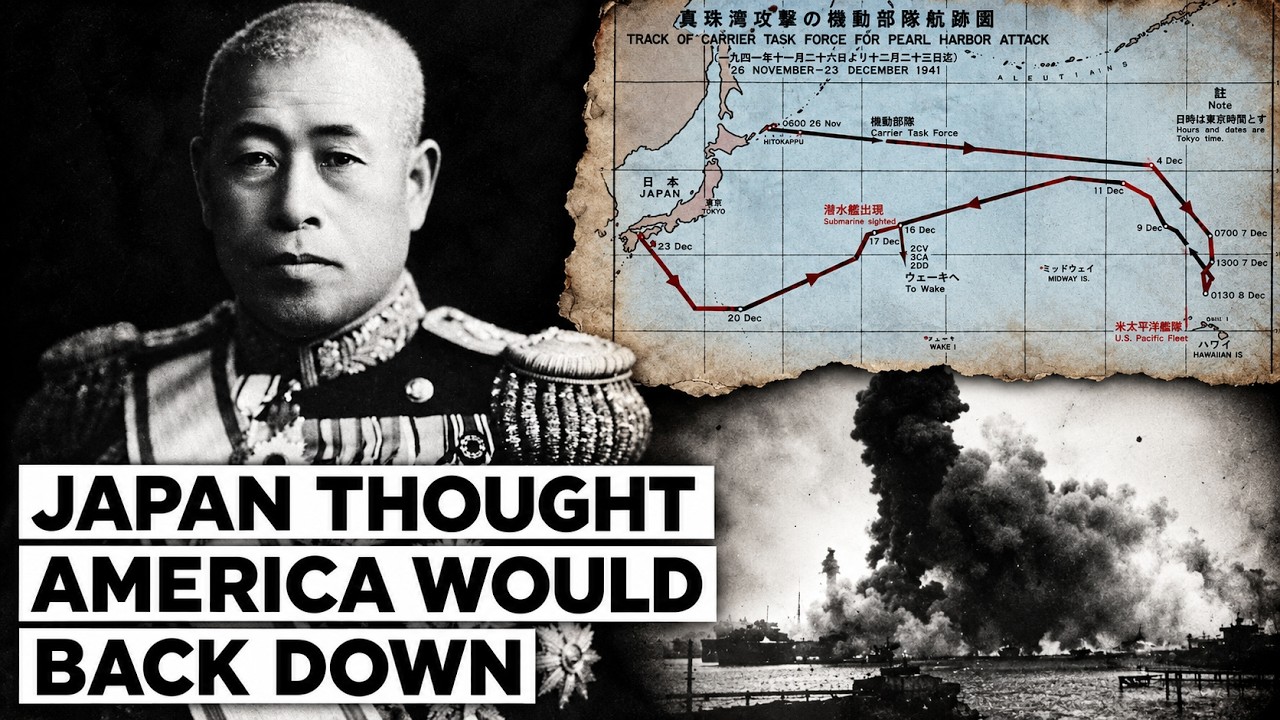
They knew that was impossible. Admiral Isoroku Yamamoto, the architect of the Pearl Harbor attack, had studied at Harvard and traveled across America, observing the scale of its industrial capacity. When Prime Minister Fumimaro Konoe asked him what chances Japan had, Yamamoto answered with chilling honesty: he could raise havoc for one year, at most 18 months, but had no expectation of success beyond that. Yet he planned the attack anyway, because once the decision for war was made above him, a devastating opening strike was Japan’s only chance at achieving anything other than annihilation.
The traditional strategy called for luring the American fleet westward into Japanese home waters for a decisive showdown. Yamamoto rejected this. He proposed striking first, hitting the heart of American naval power in the Pacific before it could begin its advance. Six aircraft carriers, over 350 aircraft, and dozens of supporting vessels sailed across the northern Pacific in radio silence in late November and early December 1941, undetected, arriving within striking range of Oahu.
Pearl Harbor was not the main event. It was the opening move. The real prize was Southeast Asia: the oil fields of the Dutch East Indies, the rubber and tin of British Malaya, the strategic position of the Philippines. Japan’s war plan called for simultaneous invasions of all these territories in a lightning campaign that would give Japan the resources it desperately needed.
Pearl Harbor’s purpose was to neutralize the one force that could interfere with those invasions. Knock out the battleships, buy time to consolidate a vast defensive perimeter, and then wait, assuming that a crippled fleet and a long, bloody ocean would break the American will to fight. Japan’s leaders believed Americans were soft, comfortable, and unwilling to endure sustained sacrifice across thousands of miles of hostile ocean. They looked at the isolationist movement, the America First Committee with its hundreds of thousands of members, the polls showing most Americans opposed entering the war.
They recalled the Panay incident of 1937, when Japanese aircraft sank an American gunboat on the Yangtze, killed three sailors, and the episode ended with an apology and an indemnity. No war. Barely any outrage. Some Japanese leaders concluded that Pearl Harbor would be a much larger version of that incident: a painful blow, but not one that would transform a reluctant isolationist nation into a ferocious adversary.
They also expected Germany to keep America distracted in the Atlantic. The Tripartite Pact was a strategic calculation, not just a diplomatic gesture. If Hitler could neutralize Britain and the U-boat campaign could strangle transatlantic shipping, America would face a two-front nightmare and would be forced into a negotiated settlement in the Pacific. The calculation rested on a final, fatal assumption: that the attack would demoralize the American public.
Instead, the exact opposite happened. Because it was a surprise attack, because it came before a formal declaration of war, because it killed over 2,400 Americans on a quiet Sunday morning, it unified a deeply divided nation overnight. The isolationist movement collapsed within days. The America First Committee disbanded.
Congress voted to declare war with a single dissenting vote in either chamber. Recruitment offices were overwhelmed. Factories converted to wartime production with astonishing speed. “Remember Pearl Harbor” became the most potent motivational slogan of the war.
The Russo-Japanese War analogy broke down completely. In 1905, Japan fought a distant war against Russia, a nation convulsed by internal revolution with no emotional investment in the conflict. Roosevelt’s mediation was welcomed because it offered an exit from a war most Russians did not care about. In December 1941, American territory had been bombed, American ships sunk, American service members killed.
It was personal, visceral rage. And no amount of Japanese military success in the following months could change that. In the short term, Japan’s plan worked brilliantly. Pearl Harbor crippled the battleship fleet.
The offensives across Southeast Asia succeeded beyond expectations. Within six months, Japan had conquered an empire stretching from Burma to the Solomon Islands. The Dutch East Indies oil fields were in Japanese hands. The defensive perimeter was established.
But beneath the surface, the foundations were already cracking. The three American aircraft carriers of the Pacific Fleet, the Enterprise, the Lexington, and the Saratoga, were at sea during the attack and survived. The massive fuel oil storage facilities at Pearl Harbor, containing four and a half million barrels of oil, were untouched. The submarine base, the repair yards, and the intelligence facilities all survived.
The attack was devastating but incomplete. Then American industry began to move. In 1941, the United States produced roughly as much steel as all the Axis powers combined. Six months after Pearl Harbor, at the Battle of Midway in June 1942, Japan lost four fleet carriers and their irreplaceable veteran air crews in a single day.
It was the decisive battle Japan had always planned for, except the Americans won it. And there was no neutral great power to broker a peace. What followed was exactly the long, grinding campaign Japan had hoped to avoid: Guadalcanal, Tarawa, Saipan, Iwo Jima, Okinawa. American submarines, using intelligence gleaned from broken Japanese codes, systematically hunted down Japan’s merchant fleet, severing the lifelines between the conquered territories and the home islands.
The oil from the Dutch East Indies, the very resource that had driven Japan to war, could not reach Japanese refineries because American torpedoes were sending the tankers to the bottom of the sea. By 1945, Japan’s cities were burning under waves of firebombing. Its navy was destroyed. Its people were starving.
It took two atomic bombs and a Soviet invasion of Manchuria to end the war. Japan’s leaders confused a historical analogy for a strategic template. They misread American public opinion, mistaking reluctance to fight someone else’s war for a reluctance to fight at all. They underestimated how a democratic nation responds to direct attack.
And they fell victim to a psychological trap as old as decision-making itself: they wanted to believe their plan would work, so they overweighted the evidence that supported it and dismissed the evidence that contradicted it. The tragedy of Pearl Harbor was born of mutual misunderstanding. America believed economic pressure would force Japan to back down, underestimating how deeply the oil embargo threatened Japan’s survival. Japan believed a devastating strike would force America to negotiate, underestimating the fury it would unleash.
Japan chose to fight not because its leaders believed they would win, but because they could not accept the alternative. The price of that miscalculation was measured in millions of lives, ruined cities, and the complete destruction of the empire they had sacrificed everything to preserve.
