By February 1945, the United States Marine Corps believed it understood the Japanese soldier completely. On island after island across the Pacific, the pattern had held: defenders fought hard at the shoreline, held for a few days, and then, when the position broke, rose up in one screaming charge and threw their lives away against American machine guns. It was brave, terrifying, and, from a cold military standpoint, a gift, because it ended battles quickly. So when planners looked at a tiny volcanic island called Iwo Jima, they were confident.
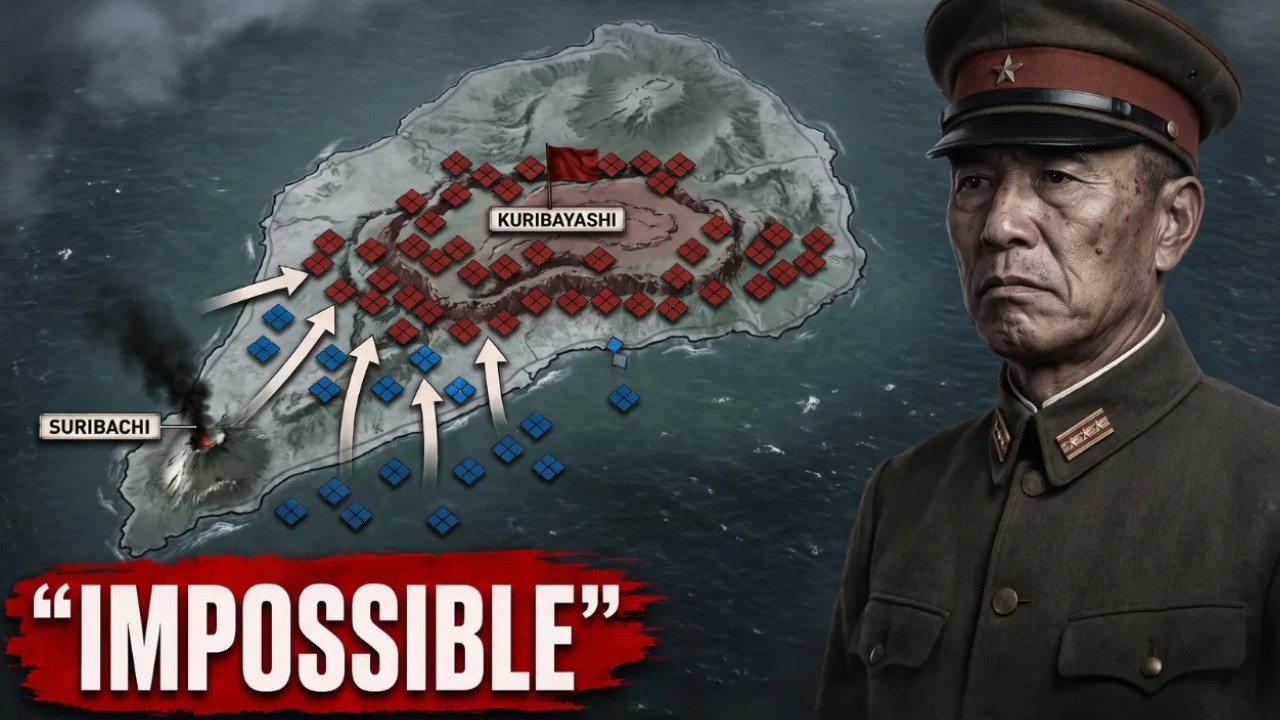
The island was only about eight square miles of ash and rock. For more than two months it had been pounded from the air, the longest bombardment of any island in the Pacific War. The estimate passed quietly through the staff: five days, perhaps less. The battle lasted thirty-six days.
It cost the United States more casualties than any other battle in the history of the Marine Corps. It produced twenty-seven Medals of Honor, the most awarded for any single battle in American history. One man was responsible for turning that confident five-day estimate into the bloodiest month the Marines ever knew. His name was Tadamichi Kuribayashi.
Kuribayashi was doubted by many of his own officers, who thought his ideas bordered on cowardice. He never expected to leave the island alive, and he told his family so. Yet the American commanders who fought him came away describing him as the most formidable defensive general they faced in the entire Pacific. To understand the man, one must understand where he learned his trade.
In the spring of 1928, a thirty-six-year-old cavalry captain named Kuribayashi sailed for the United States. Most ambitious Japanese officers of his generation chose Germany or France for foreign study. Kuribayashi chose America, and that choice shaped everything. He lodged with an ordinary family in Buffalo, New York.
He studied at Harvard and the University of Michigan. He traveled the country from Washington to Boston, from Texas to Kansas, from New York City to San Francisco and Los Angeles. He bought a Chevrolet and had an American officer teach him to drive. He trained at Fort Riley and made genuine friends among the American officers there.
Later, he became Japan’s first military attaché to Canada. What he saw in America never left him. He saw the factories, the endless roads, the sheer scale of industry. Years later, he described standing in the industrial heart of Detroit and realizing that with the push of a single button, all of that power could be turned to war.
He wrote to his family a warning that would prove exact: America, he told them, was the last country in the world Japan should ever fight. That was the mind Japan sent to defend Iwo Jima: not a fanatic, but a realist who had shaken the hand of the enemy and counted his factories. He took command of the 109th Division and received orders to hold the island in June 1944. Iwo Jima mattered because of where it sat, roughly halfway between the American bomber bases in the Marianas and the Japanese capital.
Whoever held it shaped the air war over Japan. When his wife asked about the assignment, he offered no comfort. He told her it was unlikely that even his ashes would come home. He arrived on the island later that June and found a place he called a living hell: a wasteland of sulfur steam with no fresh water.
He knew he could not win, so he set himself a different goal. He would make the price of the island so terrible that it would be carved into the enemy’s memory forever. That goal led directly to his first great decision, one that broke with everything the Japanese army believed about defense. Every Japanese commander before him had followed one sacred rule: destroy the invader at the water’s edge, meet the landing craft with everything you have, and throw the enemy back into the sea before he can gain a foothold.
It had been doctrine at Tarawa and Saipan. Kuribayashi looked at that doctrine and threw it away. He was not the first Japanese commander to sense that the old way had become suicidal, but no one else applied the new thinking as completely. He had watched what American naval guns and carrier aircraft did to beach defenses on other islands.
He knew any soldier placed on the shoreline would simply be pulverized before the first Marine ever stepped onto the sand, and the Imperial Navy that was supposed to support a beach battle no longer existed in any meaningful strength. So he made his choice: he would give the Americans the beach. He pulled his defenses back into concealed, mutually supporting positions dug into the high ground and ridges. The plan was patient and merciless.
Let the Marines land. Let them crowd onto the beaches. Let them believe for one hour that it would be easy. Then, once the shoreline was packed with men and machines with nowhere to hide, open fire from a hundred hidden guns at once.
His own officers were appalled. To many, surrendering the beach without a fight was heresy. Navy officers on the island argued with him for months through the summer of 1944, insisting on concrete pillboxes along the shore. Kuribayashi compromised only a little.
He allowed a scattering of positions near the southern beaches, roughly 135 of them, and expected most to be destroyed. They were bait as much as defense. In the battle to come, the Americans would overrun them quickly in the opening hours, exactly as he had foreseen. Then came the proof.
Before the invasion, Marine generals asked for ten days of naval bombardment to break the island open. They were granted only three. And when those three days of shelling ended, they had barely scratched what Kuribayashi had built, because the real defenses were not on the surface at all. On the morning of February 19, 1945, the Marines came ashore around 9 a.
m. , and for a while it was strangely quiet. The deep black volcanic ash swallowed their boots to the ankle and bogged down their vehicles. The ash was so loose that a man could not dig a proper foxhole; the sides slid back in as fast as he shoveled, leaving the Marines exposed on open ground.
But the enemy guns held their fire. The Marines pushed inland, packing the beaches behind them thicker and thicker, thirty thousand men coming ashore through the day. Then Kuribayashi opened fire. Pre-registered artillery, mortars, and machine guns tore into the crowded shoreline from positions no one could see.
That first day cost more than 2,400 American casualties, over 500 of them killed, losses comparable to Omaha Beach. The easy island was already a killing ground, and the man who built the trap had not shown himself once. If abandoning the beach was Kuribayashi’s plan, the underground was his masterpiece. He ordered his men to dig not trenches but a subterranean world: tunnels connecting caves to bunkers to blockhouses to buried artillery, engineered so that nearly every yard of the island lay under interlocking fire.
When Marines captured a position on the surface and moved on, Japanese soldiers could move through the tunnels and silently reappear behind them in a spot the Americans thought they had already cleared. It happened again and again, and it drove the Marines to a special kind of dread. The official Marine Corps history, drawing on captured Japanese documents, describes a planned network of some 38,000 meters of tunnels, of which only about 5,000 meters were actually completed when the Americans landed. The great tunnel spine meant to link the volcano in the south to the northern defenses was never finished.
But what was completed was still staggering. In all, the island held more than 600 blockhouses, pillboxes, and gun positions on a speck of ground, and American intelligence badly underestimated how much was there. The digging itself was torture. The island is volcanic, and in places the underground rock ran to temperatures between roughly 30 and 50 degrees Celsius.
Sulfur fumes rose through the tunnels so thick that men had to work in gas masks. In the hottest passages, a digging team could only last about five minutes before being relieved. Kuribayashi brought in engineers who had built fortifications in China and Manchuria. The soft volcanic stone was easier to cut, and mixed with cement it made unusually strong concrete.
His own command post in the north was buried around twenty meters underground; a separate communication center was buried just as deep, protected by a concrete roof many feet thick. The fortress swallowed even the island’s tanks. Kuribayashi’s armored force was led by Baron Takeichi Nishi, a cavalryman who had won an Olympic gold medal in horse jumping at the Los Angeles Games of 1932 and had been a celebrated figure among the Hollywood set. One of the transports carrying his tanks was torpedoed by an American submarine in the summer of 1944, sending its tanks to the bottom of the sea.
Replacements were fed in over the following months, and by the best modern count around thirty-five tanks reached Iwo Jima. Nishi did not send them charging into the open, where American guns would have destroyed them in minutes. For the most part, they were dug into hillsides and camouflaged, buried to their turrets as fixed steel strong points, with more gun placements prepared than there were tanks so crews could shift from one to another and create confusion. Later, some were used in sharp local counterattacks.
He even fortified the island’s most famous feature, the extinct volcano at the southern tip, Mount Suribachi. Because the north-to-south tunnel was never completed, Suribachi became almost its own fortress, honeycombed with caves and gun positions, standing over the landing beaches like a watchtower. On February 23, 1945, four days into the battle, Marines fought their way to the summit and raised a small American flag. A few hours later, a second, larger flag went up so it could be seen across the whole island.
An Associated Press photographer named Joe Rosenthal captured that second raising, and the photograph became one of the most reproduced images in history. But the photograph hides part of the story: the flag went up on day four, and the battle went on for another month. Taking the mountain did not break Kuribayashi’s defense because the heart of his fortress was in the north. The Marines pushed into ground they named in the language of a nightmare.
A complex of high points and ravines in the center of the island they called the Meat Grinder, built around a hill known as Hill 382, an exposed hollow they named the Amphitheater, and a strong point called Turkey Knob. These positions supported one another. You could not take one without being shot from the others. They had to be reduced together slowly, men fighting for days to advance a few hundred yards, clearing each cave with flamethrowers and explosives, only to be fired on from tunnels they had already passed.
There was no single decisive moment, no line that could be broken to end it. There was only the grinding, and the grinding was the point. Which brings us to his third decision, in many ways his most radical. Building the fortress was only half of it; he also had to change the way his soldiers were willing to die.
The Marines expected the Japanese defender who, at the end, gathers his strength and charges headlong into the guns in one final banzai attack. For the Americans, that charge was terrible but welcome, because it brought the fighting to a quick and final close. It traded a mass of defenders for a bloody afternoon, and then it was over. Kuribayashi forbade it.
He regarded the mass suicide charge as a waste, a beautiful and useless death that served pride and nothing else. He did not want his men to die well. He wanted them to make the enemy pay. He issued a set of instructions to the entire garrison, vows every man was to live by.
The core was simple and chilling: each soldier was to kill ten of the enemy before he himself fell. No man was to expect to survive, but no man was to throw his life away for nothing either. They were to hold their positions, fight from the tunnels, and if it came to it, harass the enemy as guerrillas even if only one man was left alive. The discipline held almost to the very end.
On the very first night, General Holland Smith, the American commander of the landing forces, sat aboard his command ship waiting for the charge that never came. He was a hard man who had seen every kind of Japanese defense, and he understood at once that he was facing something new. By many accounts, he admitted he did not know who the enemy general was, but that the man running the battle was one very smart commander. Only in the final days, when the defense had been compressed into a last pocket in the rocky north that the Marines called Bloody Gorge, did organized resistance finally collapse.
Even then, Kuribayashi did not order a wild banzai charge. In the pre-dawn hours of March 26, 1945, around 300 Japanese soldiers moved quietly out of the gorge and struck at airfield encampments where pilots, engineers, and support troops were sleeping. Some accounts have called this a final banzai charge, but the official Marine history describes it differently, as a planned and deliberate attack meant to cause maximum confusion and damage. By daybreak, more than 200 Japanese dead were counted around the airfield.
Kuribayashi was not among the identified bodies. To this day, no one knows for certain how he died or where he lies. What is known is that he had removed the insignia of his rank so he would fall as an ordinary soldier, indistinguishable from his men. He had been promoted to full general in his final days.
In his last messages to Tokyo, he sent his apologies and three short death poems, sorrowful and unbroken. His body was never found. When the fighting finally ended, the numbers told a story unlike any other in the Pacific. Kuribayashi had defended the island with a garrison of around 21,000 men.
To take it, the United States suffered more than 26,000 casualties: close to 6,800 Americans killed and more than 19,000 wounded. On the Japanese side, roughly 18,000 to 21,000 men died. During the battle itself, only a little over 200 were taken prisoner, though more would surrender in the months and even years that followed. Astonishingly, two holdouts did not give themselves up until 1949, four years after the war had ended.
Iwo Jima holds a grim distinction: it was the only major amphibious battle of the Pacific War in which the American attackers suffered more total casualties than the Japanese defenders. The men who beat him began to speak of him with something close to awe. Holland Smith later wrote that of all the enemy commanders he faced across the Pacific, Kuribayashi was the most formidable. Admiral Raymond Spruance and the operation’s senior officers judged that, given the ferocity of the defense, it was fortunate that less seasoned and less resolute troops had not been sent to take the island.
Admiral Chester Nimitz, who commanded the entire Pacific Fleet, spoke of the Marines who fought and died on that ash heap and said that among the Americans who served there, uncommon valor was a common virtue. It was meant as a tribute to his own men, but it was also, silently, a measure of the enemy who had demanded such valor of them. What happened on Iwo Jima did not stay on Iwo Jima. American leaders looked at that thirty-six-day ordeal and then at the even longer horror of Okinawa that followed, and they tried to imagine what an invasion of the Japanese home islands would cost.
The Secretary of War warned that Japan’s own terrain would allow a last-ditch defense exactly like the one Kuribayashi had shown was possible. Casualty projections climbed into the hundreds of thousands. That grim arithmetic, born in part on the black sand Kuribayashi defended, became part of the calculation that led to the end of the war. Historians still debate whether the island was truly worth what it cost to take.
But no one debates the skill of the man who defended it. Tadamichi Kuribayashi took a hopeless position and a doomed garrison, and with realism, engineering, and iron discipline, he fought one of the most effective defensive battles in modern military history. He never saw his family again. He never expected to.
He asked only that his men make the cost unforgettable, and they did.
