In February 1977, in a hospital room in a small town in West Wales, a speech therapist named Anne Treharne set up a cassette recorder, pressed record, and then walked out of the room. She had spent weeks trying to get a sound out of the two girls sitting in front of her. They were thirteen. They were identical.
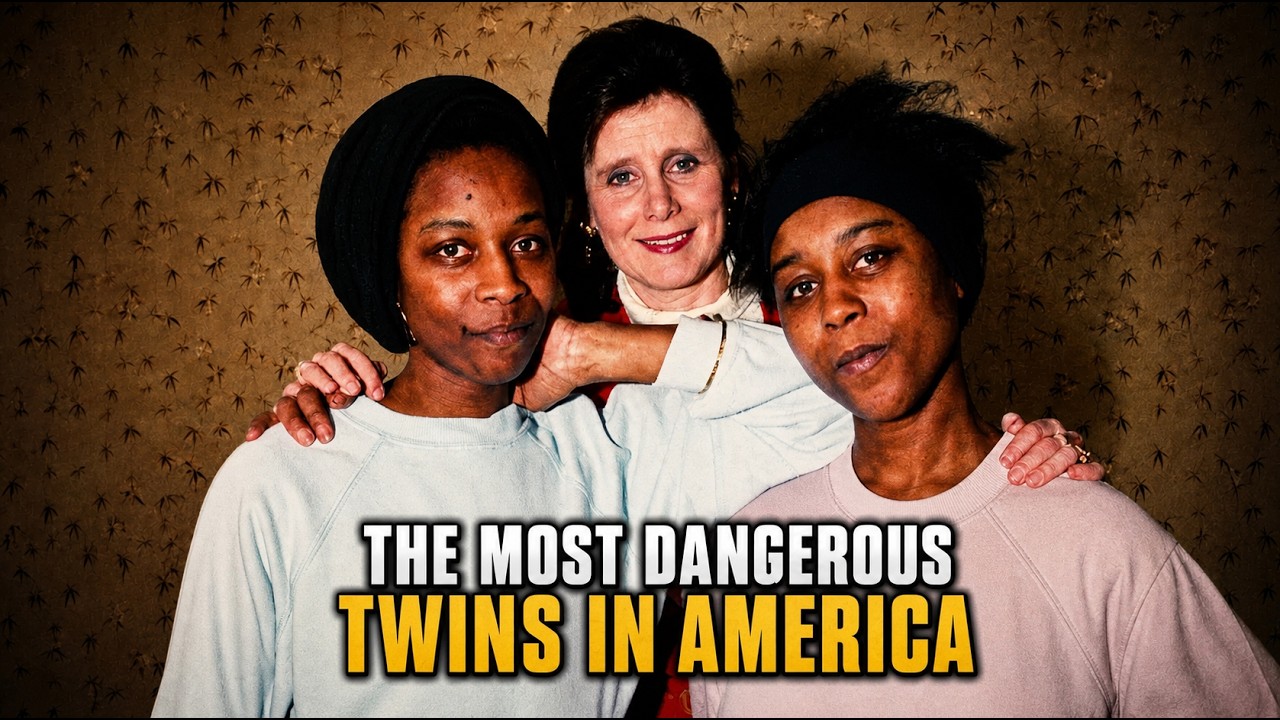
They held their heads at the same angle, and when one of them shifted her weight, the other shifted about half a second later, like an echo arriving. Other professionals had already been through. A school medical officer had raised a flag about them. A child psychiatrist had looked at the case and effectively handed it back because you cannot assess someone who will not answer a question.
The label that had stuck to them by then was elective mute—chosen silence, as though it were a preference. But the girls had agreed to one condition. They would read out loud if she left them alone. So she left them alone.
Afterwards she sat down and played the tape back. What came out of the speaker was fast, absurdly fast. A dense run of syllables with no gaps in it, like two radios tuned to the same station and left going in an empty room. Then somebody slowed it down, and at reduced speed the noise turned into words.
Not a code, not an invented tongue. English, compressed, clipped, run through with the Barbadian slang their parents had brought from the Caribbean, and blurred further by a speech impediment neither girl had ever had properly treated. They had been talking the whole time. Everyone else had simply been listening at the wrong speed.
That image repeats for the next sixteen years, and the stakes climb every time. Adults with power over June and Jennifer Gibbons kept looking at two teenagers who would not speak and kept concluding that there was nothing in there to reach. And the entire time, in a nine-by-twelve bedroom in Haverfordwest, those two teenagers were producing roughly three thousand words a day each. Novels, short stories, plays, radio plays performed into a tape machine for an audience of dolls and diaries.
Enormous, relentless, forensic diaries in which each sister analyzed the other with a coldness most adults could not manage about themselves. The journalist who eventually read them compared the pair to the Brontës, and she was not being kind for the sake of it. She had read them. When the state finally opened those notebooks—and it did open them carefully, line by line—it read them for exactly one purpose: to establish guilt.
It found what it needed. The passages that might have helped never made it into the courtroom. In May 1982, at Swansea Crown Court, two nineteen-year-olds with no history of violence pleaded guilty to sixteen joint counts of burglary, theft, and arson. They were expecting a few months.
Instead, they were sent for an indefinite period to Broadmoor, the maximum security hospital that also held Peter Sutcliffe, Ronnie Kray, and Charles Bronson. They stayed eleven years, and they came out as one person. June Allison Gibbons and Jennifer Lorraine Gibbons were born on the 11th of April 1963 at a British military hospital in Aden, in what is now Yemen. June arrived first by a matter of minutes, and that ordering would matter for the rest of both their lives, though not in the direction anyone would have guessed.
Their parents, Gloria and Aubrey Gibbons, had come to Britain from Barbados in the early sixties, part of the Windrush generation that arrived to fill jobs the country had advertised and to a welcome the country had not prepared. Aubrey worked as a technician for the Royal Air Force. Gloria kept the house. There were two older children, Greta and David, and four years after the twins, a younger sister, Rosie.
Aubrey’s job moved the family the way service jobs do. Posting to posting, base to base, England to Wales. A new school and a new set of strangers every couple of years. For most children, that is difficult.
For two small girls with an unusual way of speaking, it removed the one thing that might have fixed it: time. Every time a playground began to get used to them, the family packed. Somewhere in that sequence, the twins stopped bothering with the outside audience. Their speech was already hard for others to follow.
Their father would later describe the frustration plainly. At home, the girls made sounds, talked, carried on, and nobody could make it out. So the circle of people worth talking to contracted. First to family, then to the two of them and Rosie, then to the two of them.
June has described the moment of collapse without any mystique at all. They had a speech impediment. Nobody could understand them, so they stopped talking. That is her account, given in her own voice decades later, and it is far less exotic than the version the world preferred.
In 1974, when the girls were eleven, Aubrey was transferred to a base in Pembrokeshire, and the family moved onto a housing estate in Haverfordwest in the far west of Wales. They were the only black family in the area. Haverfordwest in the mid-seventies was a market town of about ten thousand people, agricultural, insular, and almost entirely white. The Gibbons children walked into the local secondary school as the only black pupils in it.
What happened next is not complicated and does not need dressing up. They were bullied for their color, for their accents, for the way they spoke, for the way they moved together. It got bad enough that the school arranged for the twins to be released from lessons early, before the bell, so they could get clear of the building before the other children came out. The staff knew the girls were being hunted through the corridors.
The solution was not to stop the hunting. The solution was to give the prey a head start. That is the environment in which the twins’ silence stopped being a speech problem and became something closer to armor. If every time you open your mouth you get laughed at, mimicked, or chased, then a closed mouth is not a symptom.
It is a strategy. A bad one, with a terrible long-term price, but a strategy. By thirteen, they had stopped speaking to teachers entirely, then to their parents, then largely to Rosie. They moved through the school like two figures in a diving suit.
Slow, deliberate, synchronized, eyes forward. Specialists who studied them later concluded that the eerie mirroring was not telepathy and not magic. It was two people watching each other constantly for cues, because each was the only reliable source of information the other had left. The professionals who came through in those years used words like elective and voluntary.
And those words did a lot of quiet damage. They put the situation in the category of things the girls were doing rather than things that were happening to them, which meant that the appropriate response was pressure rather than treatment. So the system applied pressure. The theory was reasonable on paper.
If the bond was the problem, break the bond. Split them up. Put each girl somewhere she has no twin to hide behind, and she will have to talk to somebody. In their teens, they were separated and sent to different schools, one of them boarding away from home.
It took only weeks. One of the twins stopped eating. Both deteriorated sharply. What the adults had read as a comfortable mutual dependency turned out to be load-bearing.
Remove one half, and the other half did not adapt. It shut down. The experiment was abandoned, and they were brought back together. The separation did not just fail.
It taught both girls something that would eventually kill one of them: that they could not survive apart. That belief—installed by the state, tested by the state, and confirmed to them in the worst possible way—is the seed of every catastrophic decision that follows. Fifteen years later, in a psychiatric hospital in Berkshire, they would take it to its logical conclusion. They left school at sixteen and went home.
And home from that point meant one room. The world of June and Jennifer Gibbons shrank to a shared bedroom with a window, a typewriter, a tape recorder, and a stack of library books. Their mother left meals outside the door. Sometimes they were in there for weeks with no meaningful contact with anyone in the house.
What they did with those years is the single most important fact about this case, and it is the one that almost every retelling treats as a curiosity. They educated themselves. They read Austen, D. H.
Lawrence, Kingsley, Amis—pulling apart sentences to see how the machinery worked. They wrote to a correspondence course in creative writing and enrolled by post, systematically teaching themselves plot, character, and structure the way you would teach yourself accountancy. And here is the detail that is the whole story in miniature. The course registered them as a single student.
One name on the ledger, one student number for two writers. Nobody did that out of malice. It was administrative common sense, the same common sense that had put them in one school report, one referral, one file. But it is worth noticing how early it starts and how consistently it recurs.
From the correspondence course to the charge sheet to the hospital order, the institutions that handled June and Jennifer Gibbons could only ever count to one. Inside that single registration, two very different writers went to work. June wrote a novel called The Pepsi-Cola Addict about a teenage boy in Malibu addicted to Pepsi, seduced by his teacher, and destroyed by a system that keeps deciding things about him. She wrote it at sixteen.
She sent it to a vanity press in England, and to pay the printing costs, the sisters pulled their benefit money. Jennifer took the cover photographs—dozens of frames of June in wigs, pouting at the camera, playing at being an author. In 1982 the book was actually printed, a real object with a spine and a title page and her name on it. Jennifer wrote The Pugilist, in which a surgeon kills the family dog to harvest its heart for his dying son, and the dog’s spirit comes back through the child to take revenge on the father.
She wrote Disco Mania about a young woman who realizes the dancers at her local disco are being driven into homicidal frenzy. She wrote The Taxi-Driver’s Son, plays, and a pile of short stories. Both of them sent work to magazines. Both of them collected rejections.
And every day, in parallel, they kept the diaries. Three thousand words apiece, mostly about each other. Love, resentment, surveillance, guilt. June writing that she felt watched by a shadow that never left the room.
Jennifer writing about her sister with a hostility that reads in places like a hostage describing a captor. They recorded their own rituals—the elaborate rules about which twin was allowed to wake first, which one was allowed to move first, which one was permitted to breathe first with the other required to wait. That is not a friendship. It is not a fantasy world either.
It is two people who have been fused by circumstance and are now administering a system neither of them can leave. Now put those two facts side by side. Fact one: from 1977 onwards, a series of doctors, psychiatrists, and educational specialists examined these girls and reported, in effect, that there was no way in, no access, no material, nothing to work with. Fact two: at that exact moment, in that exact house, the two of them were generating the most detailed written record of an adolescent interior life that any clinician in Britain could reasonably have hoped for.
Dated daily, in duplicate. Nobody asked to read it. They would read it eventually, in 1981, as evidence. By eighteen, the sisters had run out of patience with their own experiment.
The books were not selling. The magazines were not answering. Their twenties were visible on the horizon, and June has said the feeling in the room was that their youth was draining away while they waited for a letter that was never going to come. So they went outside.
In the summer of 1981, they attached themselves to a group of local boys, among them the sons of an American serviceman stationed nearby. To two girls who had built an entire private mythology out of American fiction, American music, and imagined Malibu streets, actual Americans in actual Pembrokeshire were not people. They were a door. What followed was five or six months of the crudest possible education.
Vodka by the bottle, cigarettes, glue, sex that was mostly humiliating, sometimes competitive, and observed—because the twins did not do things separately, and that included this. Jennifer lost her virginity in a church while June was present. The boys ignored them, insulted them, and moved on. The diaries from that period are brutal, and brutal in a very specific way.
Each sister writes about watching the other be chosen or not chosen, and about the arithmetic of who was being left behind. Whatever fragile equilibrium the two of them had maintained in that bedroom, the boys destroyed it in a matter of weeks. By the account Marjorie Wallace assembled later, this is also the period in which the physical violence between them became serious. There was an incident with a cord around a throat.
There was an incident in a river. Two people who could not be separated and could not stand being together, doing what people in that position eventually do. And then, in late October 1981, they went out and started setting things on fire. The spree lasted about five weeks, and it was, by the standards of a British crime wave, pathetic.
Broken windows, break-ins, small thefts, supplies, equipment—things they did not need and mostly did not keep. And arson. A tractor shop. An attempt on a technical college.
A handful of other fires. June has explained the logic of it since, and her explanation deserves more weight than it usually gets. They were not building toward anything. They were signaling.
Smash a window, light a fire, and see whether anyone in the world will come and stop you. She has described it more or less as ringing the police and daring them to arrive. They were caught on the 10th of November 1981, red-handed, at the technical college. Then the police searched the bedroom, and they found the diaries.
Everything was in there. Every fire, every break-in, every date, written out in two hands, in enormous detail. Because these were two people for whom writing something down was not a record of the event. It was the point of the event.
June has been blunt about it. The confession was sitting there in black and white, and it convicted them. Investigators read those notebooks closely enough to build sixteen counts out of them. They extracted a complete chronology of offenses from thousands of pages of adolescent handwriting.
Nobody can claim the material was unavailable, or unread, or too obscure to interpret. They just read it for one thing. Because also in those notebooks, according to Marjorie Wallace, who went through the whole archive afterwards, was the fact that before the twins set each fire, they checked that the building was empty. That detail never reached the people deciding what to do with them.
The twins were held on remand for around seven months at Pucklechurch, where a psychiatrist assessed them. Consider the position he was in. Two nineteen-year-olds in front of him who would not speak to him, would not speak to their own solicitor, and would not speak to each other in his presence. No interview, no history in their own words, a charge sheet with arson on it, and a legal framework—the Mental Health Act—that offered him a small menu of boxes to tick.
He ticked psychopathic disorder and recommended Broadmoor. That phrase needs unpacking, because it has done enormous harm in the retelling of this story. Psychopathic disorder in British law at that time was not a diagnosis in the sense a doctor uses the word today. It was a statutory classification, a legal container for people who did not fit anywhere else, defined broadly enough to catch almost anyone whose conduct was abnormally aggressive or seriously irresponsible.
It did not mean the twins were psychopaths in the sense that word carries now. But once it was written down, everyone downstream read it that way, including the twins themselves. June has recalled being told, in so many words, that this was a hospital for people like them. There was also a practical problem underneath the legal one.
Because the offenses included arson, other institutions did not want them. Broadmoor was where the system put people nobody else would take. In May 1982, at Swansea Crown Court, on their solicitor’s advice, June and Jennifer Gibbons pleaded guilty to sixteen joint counts of burglary, theft, and arson. Sixteen counts, two defendants, one plea entered together.
Marjorie Wallace watched the hearing and described it afterwards as a procedure that took place in the vicinity of the twins rather than involving them. A legal performance carried out around two people who had no access to it. They stood there. It happened near them.
It ended. The judge made an order under the Mental Health Act committing them both to Broadmoor for an indefinite period. June has said they had been expecting something like six months. Here is why an indefinite hospital order is not simply a long prison sentence, and why this particular one was a trap with no key in it.
A prison sentence has an end date. You serve it. Time passes on your behalf whether you cooperate or not, and eventually the door opens because the calendar says so. An indefinite hospital order has no end date.
It ends when you demonstrate, to the satisfaction of clinicians and eventually the Home Office, that you are well enough and safe enough to be released. Demonstrate, to professionals, out loud. June and Jennifer Gibbons were committed for an unlimited period to a system whose only exit was a conversation. And the defining feature of their condition—the thing every report about them had noted since they were eleven years old—was that they could not have one.
They were not sentenced to eleven years. They were sentenced until they could speak to strangers, by an institution that had never once managed to get them to speak to a stranger. That is the design flaw at the center of this case. And it is worth being clear that nobody built it on purpose.
Nobody sat down and decided to make an escape-proof room. It was assembled piece by reasonable piece out of a statute written for other people. A psychiatric category with fuzzy edges. A defense solicitor’s tactical advice.
A hospital that took the cases nobody else wanted. Reasonable pieces. Eleven years. At nineteen, they became the youngest female patients in the hospital.
The population they joined included Peter Sutcliffe, who murdered thirteen women; Ronnie Kray; Charles Bronson. June has described looking across a field and seeing the Yorkshire Ripper eating a hamburger, and deciding not to hold his gaze. Ronnie Kray came over to her table once, took her hand, and kissed it, and for years afterwards sent both sisters Christmas and birthday cards. Two girls whose worst act was burning an empty tractor shop spent their twenties inside that.
And there is a detail from those years that says more about the institution than any statistic could. Jimmy Savile—then a celebrity, later exposed as one of the most prolific sex offenders in British history—was brought in to chair a task force on Broadmoor’s therapeutic regime and was given his own set of keys. Marjorie Wallace was visiting the twins on a day when Savile leapt onto their table, pointed at each sister in turn, and announced the order in which he intended to have them. Wallace has recalled the twins’ reaction.
They looked at her in astonishment and observed that they were supposed to be the mad ones—the man with the keys, the girls under the order. Clinically, the eleven years followed a pattern that is now well documented. They were moved onto antipsychotic medication and kept on it through changes of drug and dose. They were separated onto different wards at points, which produced deterioration in both.
They were reunited, which produced fights. Repeat. June has been consistent about what the medication took from her, and it is the cruelest part of the whole stretch. The drug slowed her hands and flattened her head.
The sentences stopped arriving. The two of them had built their entire selfhood—their only private territory, the only place either had ever been an individual—out of writing, and the treatment made writing hard. They kept trying. Both continued to produce diaries and poetry inside, but the industrial output of the bedroom years was over.
They also wrote for years to the Home Office—formal, patient, repeated requests to be moved somewhere less severe. That correspondence, from two people officially classified as unable to communicate, went on for the better part of a decade. In the early eighties, a Sunday Times journalist named Marjorie Wallace came across the case and did something no professional in the previous twenty years had done. She went and sat with them, repeatedly, for years.
She spent weekends at Broadmoor. She brought food. She learned to catch their humor, which she has always insisted was the dominant feature of both women. Not sinister, not spooky.
Funny. And crucially, she read the archive. All of it. The novels, the plays, the three thousand words a day.
Her book, The Silent Twins, was published in 1986, and it changed the story from a local curiosity into an international one. Oliver Sacks reviewed it in the New York Times and called it remarkable. A BBC film followed. Years later, the Manic Street Preachers wrote a hit single about them.
In 2022, a feature film starring Letitia Wright and Tamara Lawrance put the sisters in front of the largest audience they had ever had. Wallace also became, in effect, their advocate—pushing for the transfer, giving the case a public profile the Home Office could feel. But the shape of this is uncomfortable. The mechanism that finally moved June and Jennifer Gibbons out of maximum security was not clinical review.
It was not the legal system correcting itself. It was a journalist writing a bestseller. Their words had been available in their own handwriting since 1977. It took an outsider with a newspaper column to turn those words into consequences.
The strongest possible case against the twins exists, and it is not stupid. They committed arson repeatedly, not once in a moment of crisis, but over five weeks, deliberately, with planning. Arson is treated with particular severity in every legal system on Earth for a reason that has nothing to do with cruelty. Fire cannot be aimed.
It does not respect the intentions of the person who set it. A tractor shop burning at night is a fire brigade turning out. And firefighters are people. The fact that a building was checked and empty at one in the morning is mitigation, and it is real mitigation, but it is not a guarantee.
The psychiatrist who assessed them had a genuinely impossible job. Two silent defendants, an arson charge, and no way to establish whether he was looking at frightened teenagers or something more dangerous. Send them to prison, and they get no treatment at all. Send them home, and if there is another fire, it is on him.
And the parents, who get a rough ride in most versions of this story, had been failed as comprehensively as their daughters. Aubrey and Gloria Gibbons were described by everyone who met them as warm and hospitable. They had spent a decade taking their children to professionals and receiving in return labels and no plan. They had no idea about the fires until the police arrived.
So: no monsters. A statute, a shortage of options, and a series of defensible individual decisions. Now the rebuttal, which is short. Nobody was hurt.
Nobody was even close to being hurt. They were first offenders. They were nineteen. Two years is what a comparable young offender could have expected at the time.
That is roughly June’s own assessment, and it is not far off. They served eleven years in maximum security and nearly thirteen years in total confinement. And there is a question that cannot be answered but should not be skipped: whether the only black teenagers in a Welsh market town, from a service family with no money for private psychiatric reports and no vocabulary the system recognized, received the same benefit of the doubt that two other nineteen-year-olds might have. You cannot run the counterfactual.
You can notice that the girls with no advocate got the open-ended order, and that the professional consensus about them for fifteen years was that the problem was something they were choosing to do. The transfer finally came through in March 1993. They were to be moved from Broadmoor to the Caswell Clinic in Bridgend. Lower security, closer to home, the beginning of a road out.
They were twenty-nine. Before the move, Marjorie Wallace came to see them, expecting to find two women who were about to get their lives back. Jennifer told her she was going to have to die. Wallace tried to laugh it off.
Jennifer did not laugh. She said the two of them had decided. This was not new. It had been forming for years inside Broadmoor.
The conviction that as long as both of them existed, neither of them could. That one of them held the other in place. That the only way for either to have a separate life was for the other to stop having one at all. In their long negotiation over which of them it would be, Jennifer—the more dominant one, the one everyone from the speech therapist onward had identified as the stronger—took the role.
In the days before the transfer, her speech began to slur. She kept telling June she was dying. June thought she was performing. On the morning of the 9th of March 1993, the two of them got into the vehicle at Broadmoor.
Jennifer put her head on her sister’s shoulder and said that at last they were out. She slept the whole way with her eyes open. When they arrived at Caswell, she could not be woken. She was taken straight to hospital in Bridgend.
She was pronounced dead at six that evening. She was twenty-nine years old, one month short of thirty. The post-mortem gave the cause as acute myocarditis—sudden inflammation of the heart muscle. There were no drugs in her system beyond her prescribed medication.
No poison, no injury. Her twin had been on the same drugs for eleven years without incident. Jennifer had never reacted badly to anything. An inquest recorded death by natural causes.
That finding is almost certainly correct, and it explains nothing at all. Acute myocarditis is usually viral. It kills young healthy people, and it is unpredictable. Nothing about it is mysterious in itself.
What is not explicable by any post-mortem is why it happened on that day, in that vehicle, to the sister who had announced it in advance, on the one journey both of them had been waiting eleven years to make. There is no answer. Neither does anybody else have one. And anyone who offers a confident one is selling something.
June Gibbons began to speak. Not slowly, not after years of therapy. Almost at once. The thing that thirty medical professionals, two boarding schools, and a maximum security hospital had been unable to produce in twenty-eight years happened by itself within days once her sister was gone.
She has explained it since without any drama. The agreement was over. It had been an agreement, and it had had two parties, and now it had one. She spent a further period at Caswell and was released in 1994, after almost thirteen years inside institutions.
She went home to Pembrokeshire—a halfway house first, then a flat of her own near her parents. She has given interviews. She has spoken on the radio. In 2023, at sixty, she told her side of the whole thing in her own voice for the first time on a BBC podcast.
She never married and has no children. She has said that Broadmoor is still in her head most mornings, that she wakes up and hears keys, and that when she thinks about the hospital, she thinks about Jennifer. Thirty years on, she describes living for two—that whatever she sees and does, her sister does as well. That is not a triumphant ending, and it should not be dressed up as one.
But look at the shape of it against everything the record predicted. The woman the state classified as having a psychopathic disorder and detained without limit as a danger to the public has lived quietly and lawfully in a Welsh town for over thirty years, and has not been a danger to anyone. One thing has to be said clearly, because the way this story usually gets told does real damage to people who are alive right now. June and Jennifer Gibbons are not an illustration of what silent children are like.
What they had, by every modern reading of the evidence, was selective mutism. An anxiety condition. Not a choice, not defiance, and not a warning sign of violence. A child with selective mutism is not withholding speech.
In the situations that trigger it, they physically cannot produce it, the same way a person with a phobia cannot simply decide to be calm. It is most common in young children. It is strongly associated with social anxiety, and it responds well to treatment. The overwhelming majority of children who have it grow up into ordinary adults with ordinary jobs and no forensic history whatsoever.
Two of those children were dropped into 1970s rural Wales as the only black family in the town, carrying a speech impediment, an immigrant accent, a bullying campaign, a family that had to move every two years, and a professional vocabulary—elective, voluntary, chosen—that put the blame for the whole thing on the two people least able to argue about it. Nothing about that outcome is a property of silence. All of it is a property of what was around the silence. The same two girls presented at the same school today would very likely have a diagnosis within a term and a treatment plan within the year.
In 1980, a sixteen-year-old sent a novel called Disco Mania to a small English vanity press. It was rejected. The press told her it was too violent, too sexual, and too futuristic. She was dead thirteen years later, and the manuscript was assumed to be lost.
Thrown out, burned, misplaced somewhere in the enormous churn of two lives that had been packed up and moved by other people over and over again. It was not lost. June had kept it. For forty-six years, she kept her sister’s typescript.
In May of this year, Disco Mania by Jennifer Gibbons was published, with her sister’s blessing, by a press in London. You can walk into a bookshop and buy it. The girl who wrote it was sixteen, and she has been dead for thirty-three years, and she is on a shelf in the fiction section with her own name on the spine. That is what all of it was for.
Not the fires. Not the pact. The books. The ledger, in one place.
Two children who arrived speaking and were laughed out of the habit. A school that solved a bullying problem by releasing the victims early. A separation experiment that proved to two teenagers that they could not survive alone. A correspondence course that enrolled two writers under one number.
A charge sheet that fused two people into sixteen joint counts. A psychiatric category from a statute, applied to two teenagers who had not said a word to the man applying it. An indefinite order whose only exit was a conversation, imposed on the one pair of defendants in Britain who could not have one. Eleven years in a building designed for Peter Sutcliffe.
A journalist who did what the professionals had not, which was read. And a heart that stopped on the one afternoon that mattered, in the back of a vehicle heading home. There were words available at every single stage of that. Millions of them, dated and filed and sitting in a bedroom in Haverfordwest.
They were used exactly once—to convict. For sixteen years, everyone with authority over June and Jennifer Gibbons was listening to them at the wrong speed. The tape was never the problem.
