For centuries, circuses made fortunes off the public’s hunger for the strange, turning real people into monsters, villains, and legends. Some of these individuals were born with rare conditions that barely sound real. Others were complete fabrications, dressed up, renamed, and marketed as nightmares. Whether real or staged, the crowd didn’t care.
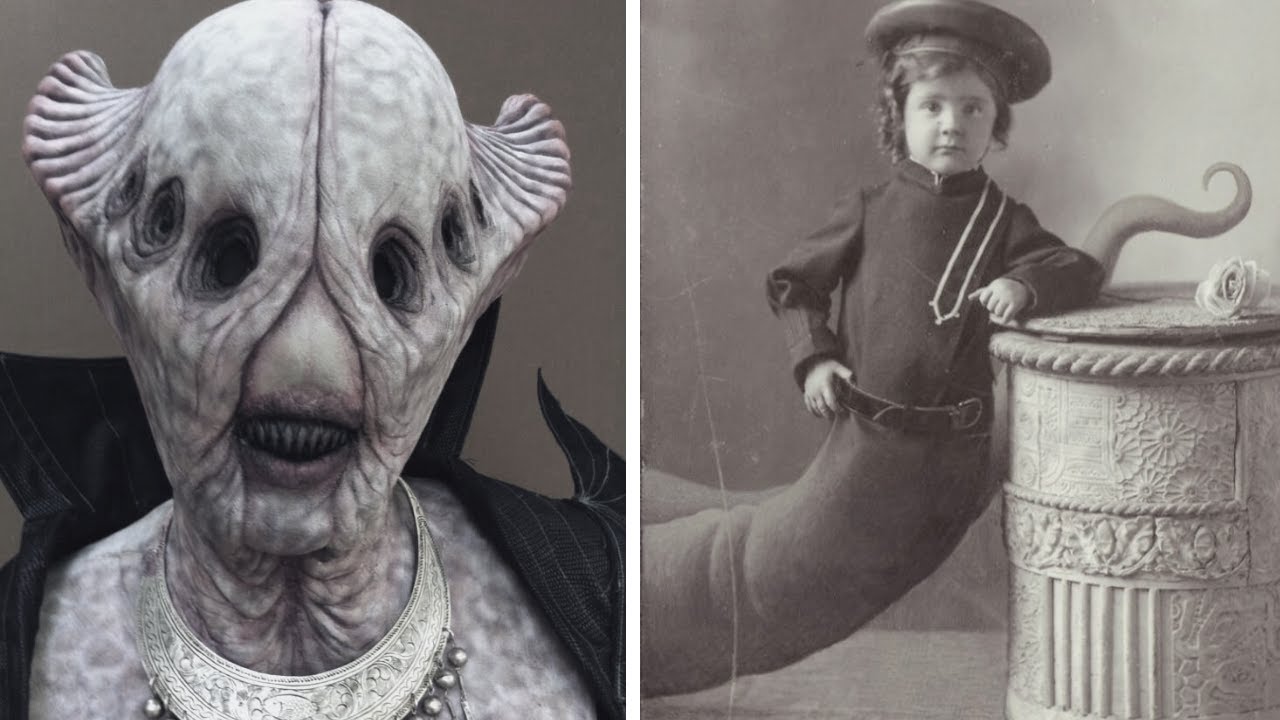
As long as it looked terrifying and sold tickets, it worked. Some leaned into it. Others had no say at all. Ratica and Dudica were born conjoined in 1888 in Orissa, India, connected only by a thin band of tissue.
Their village saw them as a curse from God. After their own father attempted to separate them, local monks took the girls in. In 1893, a London showman named Captain Coleman acquired them and brought them to Europe. They toured extensively, often paired with a dwarf performer known as Peter the Small.
Coleman reportedly treated them more like daughters than sideshow acts, and the twins seemed content until Dudica fell ill with tuberculosis in 1902. Hoping to save Ratica, Coleman allowed a French surgeon, Dr. Eugène Louis Doyen, to operate. The separation was filmed and promoted as a groundbreaking success.
Dudica died shortly after, and Ratica passed the following year, also from TB. She spent her final days alone in a Paris sanatorium. The surgery footage later circulated in grindhouse freak films—an unsettling legacy for two sisters who just wanted to stay together. In 1956, a woman named Elena Sese gave birth to four sons—Bernardo, Benito, Benjamin, and Bernabé—in a poor barrio of Buenavista, Marinduque.
At the time, they were the only documented quadruplets in the Philippines. Their arrival caused a national stir. Doctors, reporters, and politicians came to witness them. Movie stars sent gifts.
Tourists peered through hospital windows. The babies were moved to the provincial hospital, where Dr. Pablo Marquez oversaw their care. Four nurses and a governess were assigned to them, and for years they lived as wards of the state.
Donations poured in from private citizens and civic groups. They later attended public school and were frequently asked to recite poems, sing, or perform for visitors. Despite their early fame, the Sales brothers eventually disappeared from public view. Their story, once a national sensation, quietly faded.
But for a brief moment in the 1950s, four boys from a rural island became the most watched children in the country. Eddie Reynolds, often billed as the Madagascar Lady, was one of many performers with albinism who found a place in Victorian-era sideshows. Albinism, a genetic condition that results in very little pigment in the skin, hair, and eyes, was both mystified and misunderstood in nineteenth-century Europe. Albino performers were seen as ethereal or otherworldly, and Eddie’s pale features only intensified that fascination.
She followed in the footsteps of others like Millie Lamar and Little Ida, who were marketed with names like Fairy Queen or the Beautiful Albino. These women weren’t just hired for their talents. They were sold as walking myths. Sideshows offered rare safety and steady income, but the price was constant objectification.
Eddie’s image still floats among collectors of vintage circus memorabilia, usually in lace, framed by parasols or velvet curtains. While little is known about her personal life, Eddie’s stage presence captured the contradiction of her time: adored as a marvel, but never quite seen as a human being. Daniel Cajanus, known as the Swedish Giant, stood around 7 feet 8 inches tall—a towering figure in the 1700s. Born in Finland to a clergyman, he left home young and joined the Potsdam Giants, a regiment of exceptionally tall soldiers.
He later toured Europe, appearing in royal courts and public theaters from Poland to Paris, even being received by King Louis XV himself. Cajanus eventually settled in London, where his height drew scientists, artists, and curious onlookers. Portraits of him still hang in museums, his long arms and weary expression captured in ink. He spent his final years in Harwich, living quietly at the Provident House and writing poetry.
When he died in 1749, he requested a heavy coffin buried deep in stone to deter grave robbers. They didn’t listen. His bones ended up in anatomy museums. Even in death, Cajanus was exhibited.
His body became his livelihood, his burden, and his legacy, all measured in inches. The Murray brothers remain among the most mysterious performers of the sideshow era. Born in the 1860s, they were billed as triplets despite noticeable differences in height—a likely ploy to boost ticket sales. The smallest stood 37 inches tall, the tallest 42.
Their mother acted as their manager, crisscrossing the country to support their careers. By the 1880s, they had joined Barnum’s Circus and later performed in dime museums scattered across industrial America. Almost nothing personal survives: no journals, no interviews, no confirmed photographs beyond show posters. Still, their act reflects an era when physical differences were commercialized as spectacle.
Audiences came for the novelty. The Murrays gave them warmth and wit. But behind the curtain, they were sons—three small men trying to carve out a living in a world that reduced people to curiosities. Their mother’s fierce devotion and their quiet endurance made their story more human than any advertisement ever could.
Matilda de Fassi didn’t just perform in the show. She ran it. She began performing in Italy in the 1800s and was later adopted by Thomas Price, a well-known circus manager. When he passed the reins to her, Matilda kept the whole thing moving.
She married William Parish, and together they launched Circo Price in Madrid in 1880. She performed on horseback, but also booked talent, mapped out touring schedules, and made the kinds of business decisions most women of the era were shut out from. After William died in 1917, she didn’t hand it over. She kept going until her own death a year later, and the circus didn’t crumble.
It remained one of Spain’s most iconic names. Her name rarely shows up in English-language circus history, but her efforts built one of the longest-running acts in Europe. She wasn’t background or filler. She held the whole thing up—not behind the curtain, not in secret, just working because it was hers.
Aloia Wagner was born in Germany without arms or legs. That never stopped her from building a long, respected career in the spotlight. She moved to New York with her stepbrother and began performing in sideshows like Coney Island’s Dreamland and Ringling Brothers. She used her mouth and shoulders to do everything others used hands for: sewing, styling hair, writing, and dressing herself.
Audiences came expecting pity. She offered poise instead. Critics described her as graceful and elegant, dubbing her the Beautiful Armless and Legless Venus. Later in life, she married, wearing her wedding ring on a chain around her neck.
Violetta held on to her dignity and independence even when the industry didn’t treat her fairly. She performed for years until she died in 1940. She didn’t need sympathy to be memorable. She was focused and proud—a living reminder that strength doesn’t come from limbs, it comes from what you do without them.
Rosita Royce didn’t need curtains or suspense. Her act started with birds. Born Marguerite Rose Corrington in 1918 in Lincoln, Nebraska, she was the daughter of a dentist. She trained in dance, possibly under Ruth St.
Denis, and may have toured with Earl Carroll’s Vanities. Her signature piece, Dance of the Doves, featured live birds trained to remove parts of her costume during the act. No wires, no tricks, just birds. She performed it at the 1939 New York World’s Fair and later in Striparama.
People remembered it because it didn’t try too hard. It was quiet, surreal, and unforgettable. Her time in the spotlight was short—cancer claimed her in 1954. She never became a household name, but she didn’t fade into the crowd either.
Where others wore feathers for flair, she let them take center stage. No flash, no noise, just birds doing what they were taught. And it worked. No one forgot the woman who let doves undress her.
Susan Barton was known only by one cruel title: the Mammoth Lady. A single illustration published by Currier and Ives in 1849 is nearly the only proof she existed. She was said to weigh 579 pounds, her waist over 7 feet around. Whether those numbers were real or circus exaggeration, they were enough.
Barnum’s American Museum hired her soon after, and crowds paid just to stare. Nothing personal remains. No letters, no quotes, no record of her voice—just a picture of a woman standing still while the world gawked. We don’t know if she saw it as survival or shame, but either way, it paid.
She stood beneath a banner that reduced her to a number. Crowds laughed, whispered, and walked away. She stayed behind the curtain, silent. And that’s where her story ends.
No drama, no fanfare—just a woman who carried not only the weight of her body, but of every stranger’s judgment. That’s what history kept. Dolores Vallecita, also known as Dolly Hill, was one of the rare women in vaudeville trusted to work with big cats. She trained leopards, lions, and other exotic animals for major names like Frank Bostock and Popcorn Hill.
By 1906, she was performing across the US, appearing at Keith and Proctor’s, Luna Park, and other premier venues. Her act was sharp. Six Indian leopards performed synchronized stunts, balancing on globes, seesaws, and pyramids, and ringing bell routines, all while she played piano beside them. She didn’t craft the act for shock value.
She built it for precision. In 1925, while training in Bay City, Michigan, her favorite leopard lunged. It wasn’t an attack, just a bad landing. The cat caught her throat.
It killed her. For decades, her grave remained unmarked until the town finally gave her one in 2010. She didn’t die under a spotlight. She died the way she lived, trying to keep the rhythm between herself and the animals.
That’s what stayed with people. There was a time when a man in a fur suit could drop to all fours, bark at his handler’s feet, and steal the entire show. That was Alfred Latell. He never needed words.
His act was all movement—scratching, prowling, mimicking the creatures he spent years studying. Dogs, cats, birds. He became them fully, believably. He started on church stages, then moved to vaudeville and eventually headlined across the country.
It was odd. It was unforgettable. He’d bark. Someone else would sing, usually his wife.
They made it work year after year. As American vaudeville faded, he took his act overseas—Australia, small theaters, even a few strange film roles. Always as an animal, always committed. He performed into his sixties.
When he died in 1951, there was no applause. His widow threw out the old dog suit, but a few photos survived—scratched, fading, but real. Just enough to say he existed. And for a while, he was the show.
Nicholas Ferry was born in 1741 in a quiet corner of France. He was small, never more than 3 feet tall, and the world took notice. King Stanisław of Poland brought him into court life, nicknaming him Bébé and showering him with attention. But kindness soon blurred into mockery.
He became a favorite spectacle—dressed up, paraded, and laughed at, a living ornament. When another dwarf, Joseph Boruwłaski, arrived at court, brilliant and composed, Bébé’s pride cracked. He lashed out in jealousy and was beaten by the king’s order in front of everyone. He never recovered.
By twenty, his body had withered. He died at twenty-three. His skeleton ended up in a Paris anatomy exhibit. His tiny clothes and furniture are in museums, but not his voice, not his dignity.
Bébé’s story wasn’t one of fame or greatness. It was the quiet tragedy of a child turned into amusement—loved but never respected, known but never truly seen. Before lion tamers became icons, there was Isaac Van Amburgh. Born in 1811, he started small, just a cage cleaner at the New York Zoological Institute.
But it didn’t stay that way. He stepped into the lion’s den dressed in a Roman-style robe and made the beasts bow, sit, snarl, and obey. He was the first to put his head in a lion’s mouth—not for thrills, but to show dominance. And it worked.
By 1821, he was headlining shows. Then came London, then Queen Victoria. But the act had a price. He used whips.
He starved the animals. He ruled with force. Even in his own time, it raised eyebrows. Still, the crowds came.
They watched and paid again. His name stayed on circus posters long after he died in 1865, used for decades by others riding on his legacy. He didn’t invent taming, but he made it theater. And behind every bowing lion, there was a man holding fear by the throat.
Not every act came with shock and noise. Some, like Olympia de Val, moved with grace. Born Olympia Blumenfeld in 1876 in Germany, she came from a long line of performers. Her specialty was horses.
Then came dogs, then birds trained to follow her like wind following music. By 1907, she was performing at the New York Hippodrome. In 1914, she joined Barnum & Bailey. A year later, she took the Keith circuit by storm.
Trade papers called it the best bird act in the business. Her sons grew into performers too—two formed the Devine Brothers comedy animal act, while the youngest became a beloved clown named Nollie Tate. Olympia kept performing into the 1920s. When a steamship company lost her props and costumes, she took them to court.
Her birds stayed with her. She died in 1963. She didn’t just perform in the ring. She made it feel like home.
And then there were the Jones twins. They were barely out of the womb when they became a show. Conjoined and still in diapers, they were paraded across America in the late 1800s. They weren’t seen as children.
They were treated as a rare exhibit. People paid to stare. Doctors poked, strangers whispered, and while we’ll never know what their parents truly felt, it’s likely money made the choice for them. The twins lived for just fifteen months.
And for half of that, they lived under a tent. There’s no clear record of how they died—just silence. No headlines marked their passing. No crowd protested the loss.
They were gone before they could speak a word, forgotten in a world that remembered bigger names and louder acts. The Jones twins weren’t stars. They weren’t even given the time to be people.
In a world hungry for spectacle, they were two lives sold off too soon—never given peace, only permission to be stared at.
