The voice came from the darkness of the hallway, six feet from the office door, and it said the one word that no person in Braden County, Tennessee, should have known. Ruthie Bird. Nobody in that county knew that name. Nobody in the entire state knew it.
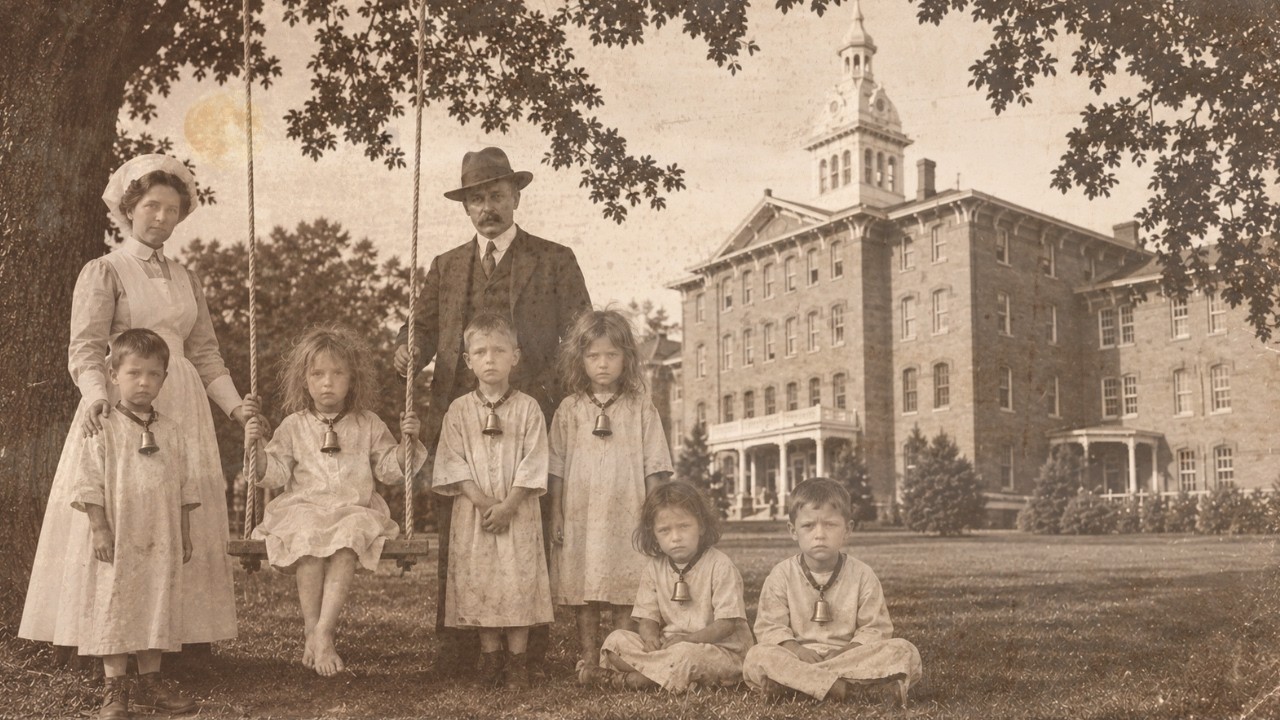
It was a name that existed only between two sisters, and one of those sisters had been dead for four years, and the name should have died with her. But Ruth Arden had written the name Caroline in her field notebook on her second day in the building, and the building had read the name, and the building had followed it backward through Ruth’s memory to every voice that had ever spoken it. There was only one. And the voice was coming up the stairs.
Ruth did not answer. She counted backward from a hundred, standing at the top of the main staircase, and the bells came up one step with each number. They were the sound of small bells moving on fabric, swaying, the sound of a person walking in a garment covered with bells. At seventy-three the bells reached the first landing.
At fifty they were on the second floor. At thirty they were in the hallway. Ruth backed down the corridor toward the superintendent’s office, counting, and the bells followed her. At fourteen she hit the office wall and could not go any further.
The bells stopped. Not at one, not at zero, but at fourteen, the same number as the first patients, the same number as the first marks on the stone. She stood in the dark with her back against the wall, and the voice spoke again. Ruthie Bird.
She did not answer. She started counting again, and this time the count reached one, and the voice did not return. She walked down the stairs and out the front door and drove twelve miles through the dark to the Mountain View Motel, and sat in the parking lot with the engine running and her hands shaking for twenty minutes before she turned the car around and drove eight miles up the North Fork of the Pigeon to a road that was not on any county map. The cabin had a mailbox with no name on it and a dog on the porch.
Granny Reeve Combs opened the door before Ruth could knock. She looked at Ruth’s face and said, “You stopped counting. ” Ruth said, “No, I counted the whole time. But it offered her name.
It offered the name nobody knows. ” Granny Combs stepped back and waved her in. Braden County sits in the eastern part of Tennessee, in the corrugated stretch of country between the broad valley of the Tennessee River and the first real ridges of the Smoky Mountains. It covers 387 square miles.
In the 1990 census it held 11,643 people, 1,400 fewer than 1980, 900 fewer than 1970, and the direction had been the same for so long that the people who stayed had stopped thinking of it as decline and started thinking of it as weather. The county seat is Lacy, population 2,140, with a courthouse built in 1884 of local limestone that has gone the color of old bone. The North Fork of the Pigeon River comes down out of the ridges and runs twenty-six miles to where it meets the South Fork outside the county. State Route 73 follows it, paved for the first fourteen miles out of Lacy.
Then it narrows, the yellow line disappears, the potholes become suggestions, and the trees come in close on both sides. At mile twenty-two there is a turning, a gravel road 210 yards long climbing at a grade that makes a sedan work. At the top of that road there is a bluff, and on that bluff there is a building. Kelmore State Asylum for the Chronic Insane.
Red brick, three stories, a central bell tower with a copper dome gone green to black, 112 windows, a foundation of poured concrete over blue limestone bedrock, and a sub basement deeper than the original plans account for. It was built in the summer and fall of 1896, and it closed on the 14th of March 1947. For fifty-one years patients were brought up that gravel road in county wagons with their belongings in paper sacks, and for fifty-one springs they were carried back down in pine boxes or walked out with nowhere to go or simply remained year after year. The building was the idea of Dr.
Phineas Kelmore, a physician who had served as a field surgeon on the Union side at Shiloh and Chickamauga and carried two pieces of shrapnel in his left thigh for the rest of his life. He was a good doctor. He was a decent man. And he was wrong, in a way that the state did not have the vocabulary to understand.
The land had been bought in 1895 from the heirs of Wallace Hensley, who had used it for pasture and never dug on it. Before Hensley it had belonged to a tanner named Elden Furth, who built a tannery on the bluff in the 1850s because the bluff had good drainage, the river had good water, and the limestone underneath was good for building lime pits. In the summer of 1858 Furth dug a soaking pit twelve feet deep into the blue limestone. On the second of August, at a depth of about nine feet, his shovel broke through the ceiling of a cave.
The Braden County land records include a surveyor’s note from 1859 when Furth sold the property. It says: “Natural cavern discovered at approx 9 ft depth extending below grade to unknown distance. Owner states, cavern has been filled with rubble and sealed. ” Thirteen words, and none of them are the word why.
Furth filled the hole with rubble the same day, sold the land within the month for twelve dollars, moved to Chattanooga, and was dead by the spring of 1860. The cause of death in the Chattanooga city records is drowning. He walked into the Tennessee River on a clear evening in March and did not come out. His wife told the coroner he had been hearing bells for six months.
That is the first time the word bells appears in the record for that piece of ground, thirty-six years before Dr. Kelmore had the first one made. Kelmore broke ground in May of 1896. The foundation was poured directly onto the bedrock, three feet thick, in August in heat that the foreman’s daybook described as intolerable, men down twice.
Kelmore wanted the building to sit on the earth the way a tooth sits in a jaw, rooted, immovable, permanent. He got what he wanted. The building has not shifted a quarter of an inch in 127 years. The first patients arrived on the 21st of September 1896, fourteen of them transferred from the county poorhouse.
Eight women and six men, the oldest seventy-one, the youngest nineteen. The first patient entered the building at nine in the morning. Her name was Mabel Oaks. She was thirty-four years old, committed by her husband for chronic melancholia following the death of two of her children in a diphtheria outbreak.
Kelmore’s intake note describes her as quiet, cooperative, and not a danger to herself. Kelmore himself later wrote that he believed the speaking of names was how it started, that the first name spoken was the first door opened, and that he had opened it himself without knowing there was a door. For the first three months the asylum ran as any well-run rural institution would. Staff of six, a matron named Josephine Bird, a cook, two attendants, and a groundskeeper named Hosea Webb who lived in a cottage at the bottom of the bluff road and walked up every morning at six and down every evening at six and never once slept in the building in thirty-one years.
The patients slept. Kelmore wrote the word slept the way any doctor would write it, meaning the patient was unconscious for a normal period and woke in a normal state. Then, on the 14th of January 1897, the night attendant, a twenty-three-year-old named Pruitt Cobb making his two o’clock round, held his lantern up to the window in the door of room seven and found Mabel Oaks sitting upright in her bed facing the wall, speaking in a low, steady, conversational tone. She was using a man’s name, Ezekiel or Ezra, not the name of any patient or staff member he knew.
When he touched her shoulder she turned and said, “He is counting. ” She told him she had heard counting from below the floor and had answered to a name, and the voice had called another name, and she had answered again. She said it had been like being read to from a list, and she had felt it would be rude not to answer. Kelmore wrote in the ledger: “Patient reports auditory experience consistent with hypnogogic state.
No treatment indicated. Will monitor. ” Below that line, in pencil rather than ink, he added: “Checked sub-basement this morning. Found nothing.
But the temperature at the bottom of the stairs was 9° warmer than the corridor above, and I do not have an explanation for that, and I do not like not having an explanation. ”
Within six weeks two more patients began speaking at night, both to the wall, both using names no one recognized, both saying they had been answering a roll call from below. Kelmore decided it was the pipes. He wrote steam pipes in his ledger, though he knew the building was heated by coal stoves, one per wing, with no pipes in the walls and no pipes in the sub-basement.
He wrote the answer he wanted to be true rather than the answer he was afraid was true. It was the last time in sixteen years of records that Phineas Kelmore lied to himself on paper. From March of 1897 onward, the ledger became the notebook of a man watching and measuring and writing down what he saw instead of what he wished he saw. In April he descended to the sub-basement for the second time and recorded: “Upon the far wall of the lower chamber, below the level of the foundation, upon the exposed face of the natural limestone, I observe a series of marks.
They are not natural. They are too regular to be natural. They are arranged in vertical rows, evenly spaced, and they are shallow, as if scored into the surface with a tool no wider than a nail. I count them.
There are 14. ” Fourteen marks. Fourteen patients. He does not write what he thinks about it.
He moves on to the next entry, which is about a patient’s appetite. In June of 1897 Kelmore admitted his fifteenth patient, a man named Lester Boggs. Kelmore descended to the sub-basement that night and counted the marks. There were fifteen.
He had admitted one patient since April, and the marks were accurate. He wrote: “I am forced to consider the possibility that the enumeration on the wall is not a historical artifact, but an active record. I do not know who is maintaining it. I know only that it is accurate.
” Between June of 1897 and December of 1898 he recorded eleven more admissions. Each admission added a mark. The marks did not go away when patients died or were discharged. Once a name entered the building, the stone remembered it.
By the fall of 1898 nine patients in the east wing were sitting up at night speaking names no one recognized. Kelmore tried moving them to the west wing. The behavior stopped for a few days, then started again, but differently. In the west wing the patients did not speak to the wall.
They got out of bed and lay flat on the floor and pressed their faces against the tile and spoke downward, as if the thing they were answering was not beside them but beneath them. On the morning of the 14th of January 1899, exactly two years and one day after Pruitt Cobb found Mabel Oaks speaking to the wall, a patient named Virgil Sams, patient number three, fifty-two years old, an original admission, was found in his bed in room three of the east wing. Eyes open, breathing, heartbeat, responsive to nothing. He did not speak, did not blink, did not flinch from pain.
He was alive. He was not there. He lived eleven more years in that bed, fed by tube, bathed by staff, turned every four hours to prevent bedsores, and never spoke again. Kelmore’s ledger entry for that day runs four pages.
At the end he wrote: “I went to the sub-basement tonight. I stood at the wall and listened and I heard it. A vibration, a frequency, regular, rhythmic. It was counting, working its way through a list, and the list was made of names, and it was reading them as a teacher reads a roll, and it was waiting for an answer.
His name had been called and he had answered as a bell answers when it is struck, because that is what bells do. A bell does not choose to ring. It rings because it has been made to ring. And a name is a bell.
And whatever is beneath this building has learned to strike it. ”
Two months later Kelmore commissioned forty small brass bells from a foundry in Knoxville. He had them sewn to every garment in the building, sleeves, collars, hems, and ordered them worn after sundown by patients and staff alike. On the first night the bells were worn, the nighttime speaking stopped entirely, immediately, as if the counting below had been interrupted by a frequency it did not expect, a sound that was not a name, not a voice, not an answer, but simply a number, 4,000 hertz made physical, made constant, made into a wall of arithmetic that the thing in the limestone could not get through.
For a year the arithmetic held. 1899 was the best year Kelmore ever had. The ledger entries read like the records of any well-run rural asylum. The marks on the stone continued to accumulate with every admission, but the marks were a recording, not a threat.
Kelmore had built a thing that worked, and he did not yet know that enough is not the same as safe. The first case of bell fever appeared in January of 1901. A patient named Agnes Pine, admitted in 1898 for senile dementia, refused to take the bells off. She said she could hear bells that were not on her clothing, bells in the walls, bells in the floor, bells in the silence between the actual bells.
By March of 1901 six patients were experiencing what Kelmore began calling persistent bell perception, shortened by May to bell fever, the term that appears on fifteen separate patient records between 1901 and 1912. Kelmore documented the progression meticulously. Stage one, the patient hears bells when no bells are present, constant, low, not distressing, duration four to eight weeks. Stage two, the patient becomes agitated in silence; any environment without the sound of bells produces anxiety, restlessness, and panic.
Stage three, the patient begins to hear beneath the bells a single voice, saying the patient’s name, but just below the frequency of the bells, just under the threshold of clear hearing, so that the patient is never certain whether they are hearing their own name or hearing the bells ring in a pattern that sounds like their own name. Kelmore wrote: “This is the cruelest stage because it offers no resolution. The patient cannot confirm the voice and cannot deny it. ” Stage four, the patient answers, not out loud, not voluntarily, but physically, a turning of the head, a step toward the wall, the body remembering what roll calls are for.
Stage five, recorded only twice, the patient stops answering to their own name when spoken by the living. They answer only to the name as spoken by the thing beneath the building. Agnes Pine reached stage five in the autumn of 1901. She lived until 1906, but the woman who lived those five years was not the woman who had arrived in 1898.
She had answered a question, and the question had been her name, and the answer had been herself, and the transaction was complete. What remained in the bed was what remains in a bell after the ringing stops. The shape, the hollow, the memory of a sound. Kelmore understood in 1901 that the bells were not keeping the frequency out.
The bells were tuning the patient to it. But the bells worked, so he could not take them away. Without the bells, the nighttime speaking returned within forty-eight hours and escalated within a week. With the bells, the patients developed bell fever.
The bells did not block the frequency. They translated it, took a sound the human ear could not parse and turned it into a sound the human ear could almost parse. And a sound you can almost hear is a sound you will chase until you find it. Kelmore was trapped between two kinds of loss.
He chose the slower one. He kept the bells. He tried thicker bells, cast iron instead of brass. The iron bell stopped the speaking but produced bell fever in half the time.
He tried intermittent bells, worn on alternate nights. The speaking returned on the silent nights. He tried a bell schedule, sundown to midnight, silence from midnight to dawn. The speaking came at 12:01.
In 1904 he brought in a second physician from Knoxville, a Dr. Harold Strike, who stayed three months and left without writing a report. He did not descend to the lower corridor. He did not count the marks.
In 1907 Kelmore recorded: “I have been avoiding the lower corridor for 14 months, and I will be honest about the reason. The formation is larger. The height has increased by approximately 3 inches since 1897. The width by 2 inches.
The depth by 1. 5 inches. These are within the margin of error for a tape measure. But the shadows are not.
In 1897 my standard lantern cast shadows extending 2 feet 11 inches from the base of the formation. They now extend 4 feet 7 inches. The formation has grown by 3 inches. The shadows have grown by 20 inches.
The shadows are growing faster than the thing that casts them. ”
And then the sentence that Ruth Arden read three times and then closed the ledger and did not open again for four days: “I put my hand on the formation tonight and it was warm and it vibrated and the vibration was a frequency and the frequency was 4,000 hertz. And 4,000 hertz is the frequency of the bells. ” The original frequency had been subaudible, felt in the teeth and the bones of the hands, but not heard by the ears, and Kelmore had chosen 4,000 hertz because it was effective, and the formation had learned it, absorbed it, added it to its vocabulary, and now it was speaking the language of the bells back at the bells.
The bells were not a wall. They were a window. Kelmore wrote five years later: “I have made a terrible error. The bells do not keep it out.
The bells taught it what a frequency is. I have given it the grammar of a language it did not have, and the first word it learned was my name. ” Every protective measure he took, every bell he sewed onto every garment, all of it was the formation getting what it wanted. By 1911 Kelmore had the bricks made on site from local clay, fired in a kiln he built behind the building.
He laid them himself at night, sealing the passage that led to the formation’s chamber, a wall two feet thick laid with Portland cement. He recorded it in three sentences: “I have sealed the lower passage. The wall is 2 ft thick and laid with Portland cement. It will hold.
” It held. Ward Picket told Ruth Arden not to touch those bricks because the wall is still there and behind it the formation is still there and whether it is still growing is a question nobody has answered. In 1909 Kelmore began wearing the bells himself, not just after dark but day and night, and noted it without explanation: “The sound is constant and it is not enough. ” His handwriting began to change, the slant reversing, leaning backward and to the left as if he were writing in a mirror.
In January he wrote that the formation had begun to ring, not vibrate, ring, the shape of a bell heard through stone. In 1910 Virgil Sams finally died. Kelmore’s death note includes one sentence that does not belong in a medical record: “Whatever answered to his name in 1899 is not what died today. What died today is what was left.
” The last entry in the ledger is undated, written in the reversed hand. It reads: “There are 47 names on the stone, and mine is the last, and it is spelled correctly. I did not write it. I do not remember not writing it.
” Kelmore died on the 12th of August 1912 at age seventy-one, found in his bed wearing his bells. The matron, Hattie Dunlap, who stayed until 1917, told Anson Pool on tape in 2003: “He had been dead for hours, and the bells were still ringing. Not swinging. Not moving.
Still flat against his shirt, but ringing. I could hear them from the doorway. It was not the bells ringing, Mr. Pool.
It was him. He was ringing. His whole body was ringing at the frequency of the bells as a tuning fork rings after you strike it. He had become the shape of the bell.
It did not stop for 45 minutes. And then it stopped, and the quiet was worse than the ringing. ” His will left the asylum to the state of Tennessee with one condition: “The lower passage is to remain sealed in perpetuity. The bricks are not to be disturbed.
This is not a request. ”
The state accepted the bequest and ran the asylum for thirty-five more years with a series of superintendents who kept the bells and did not keep the ledger, because the ledger was sealed in the wall of the superintendent’s office and none of them knew it was there. The turnover was six times the state average for comparable institutions. In the final year of operation, 1946 to 1947, the superintendent, Dr.
Leland Marsh, wrote a letter to the state commissioner of health that exists only because Anson Pool found it in a shoebox in a closet in Memphis in a secretary’s personal papers. The letter reads: “I am writing to request the immediate closure and transfer of all patients from Kelmore State Asylum. The building is occupied by a presence that I cannot explain and that the state’s medical vocabulary does not have a term for. The bells we have been requiring our patients to wear for the past 48 years are making it stronger, not weaker.
I am asking you to close this institution before the bells teach it anything else. ” The state closed Kelmore three months later. The word bells does not appear in the official record of the closure. Marsh resigned from the state medical service in June of 1947, moved to California, never practiced medicine again, and died in 1971.
His obituary does not mention Kelmore or Braden County. The building stood empty for forty-six years. Then, in the summer of 1993, the Braden County Historical Society received a small grant to survey and catalog the contents before the county decided the building’s future. They wanted a records preservationist who could work alone, because the grant was $5,000 and that was the entire budget.
They hired Ruth Arden. She was forty-one, a freelance archivist living in a rented apartment in Nashville that she had chosen because it was on the third floor and had no basement. She had spent nine years at the Tennessee State Library and Archives in Nashville, cataloging and conserving documents that other people had decided were too damaged or too fragile or too unimportant to save. She took the job because it was $5,000 and because the building was in the mountains, and the mountains had always been the place where the noise in her head went quiet.
She did not know the ledger existed. Nobody had told her about the ledger because the society had it in their own reading room and did not think of it as part of the building. Ruth drove down to Braden County on the 4th of October 1993 and met the society’s director, Lorna Pace, who gave her a key and a set of incomplete floor plans and said: “Ward Picket will meet you up there in the morning. He has been going up to that building by himself for 39 years.
He is the only person in this county who will go up there at all. I do not know why he is willing to do it. I would take seriously whatever he tells you. ” Ward Picket was seventy-one, a large, stooped man with thick hands that had spent thirty-nine years boarding windows and patching roofs.
He looked at the building, looked at Ruth, and said, “You are the one from Nashville. ” He showed her the building. The front steps’ mortar was sound, which was wrong for a building empty for forty-six years. The air inside was warm, warm the way a building is warm when someone has been heating it.
The rooms were clean in a way that abandoned buildings are not clean. The mattresses were in better condition than they should have been. At the end of the tour Ward said, “There is one more floor. ” Ruth knew, the floor plans showed a sub-basement.
Ward said, “There is one more floor below that. The plans are wrong. ” He took her down a narrow, steep staircase to the sub-basement, which was long, dark, and warm, and at the far end, past where the floor plan said the sub-basement ended, another staircase cut into the limestone itself, twelve more steps down to a natural passage, a corridor not built but carved, roughly five feet wide and seven feet high, with a concrete floor cracked and buckled from below. At the end of that corridor, about thirty feet from the bottom of the stairs, a wall of brick, newer brick, smaller, laid tight with good mortar, no gaps, no door, no window.
A wall that said: do not go further. Ward stood behind her with a flashlight and told her three things, and said he would tell them once. “First one, do not go below where we are standing. That wall was put there by men who knew what they were doing.
Behind that wall there is a room that is not on any drawing the state ever filed. Whatever is in that room is what the building was built on top of. ” “Second one, if you hear bells at night, and you will hear bells, you stand still. You do not walk toward them and you do not walk away from them.
You stand where you are and you count backward from a hundred out loud in the dark. And when you reach one, you stop. If the bells have stopped, you can move. If they have not stopped, you count backward from a hundred again.
” “Third one, if somebody calls your name from inside this building after the sun is down, you do not answer. It is counting the voices it can make you answer to. Every time you answer, it has one more. ” Then he put his cap back on and said, “That is all I have to say about it, and I will not speak of it again.
” Ruth filed the three warnings under “auditory phenomena” and went to work. She set up her base in the superintendent’s office, checked the humidity meter on her first day and read 38 percent, low for a building with broken windows in the Tennessee mountains in October, the humidity of a building with functioning climate control, and there was no functioning climate control. On the second day she found a document in room nine of the east wing, a single sheet of paper handwritten in pencil, a list of fourteen names numbered one through fourteen, and on the back, in the same hand, a single line: “The count is not ours. ” She did not know what it meant.
She went to the historical society on her second Monday, the 11th of October, and Lorna Pace showed her the ledger, open to a safe page near the middle. Ruth put on gloves, lifted the ledger out, and read it from front to back. It took her nine hours. She arrived at ten in the morning and did not stand up until seven in the evening, when Lorna came to the door and said the building was closing.
Ruth looked up with the face of a person who has read something that has rearranged the furniture of the world. She went back to the building the next morning and went directly to the sub-basement. She measured the floor, held her hand against the warm bricks, and took eleven photographs. The temperature readings she recorded were 61 degrees in the second-floor reading room, 64 on the ground floor, 71 in the sub-basement, 78 in the lower corridor at the brick wall, 40 feet below ground with no heat source in October.
On Wednesday she found a series of marks scratched into the plaster behind the last bed in the east wing infirmary, tally marks, frantic clusters of five, 47 clusters. On Thursday she found the same tally marks behind the last bed in the west wing, 47. On Friday behind the bed in the last room of the third-floor staff quarters, 47. The same number in three different parts of the building.
Forty-seven was the total number of patients admitted from 1896 to 1912, the years covered by the ledger. Next to each cluster of tally marks, scratched deeper, was a single letter. K. Kelmore, the forty-eighth name, his own.
He had added himself to the count. On Saturday the 16th of October, Ruth went down to the lower corridor and counted the marks on the stone with a flashlight and a notebook, and her hands were shaking. There were not forty-seven. There were 347, three hundred additional marks accumulated in the 81 years since Kelmore’s last entry.
The stone did not distinguish between the committed and the free. It counted everyone who came in. Every name spoken in the building, every voice raised in a corridor, every signature on a form, every roll call, every introduction. 347 names, and one of them now was hers, because she had written her name in her field notebook inside the building, and the building had read it.
She did not know that yet. The knowledge was waiting for her, patient, constant, and getting closer. The bells came on her fourth night in Lacy. She woke at two in the morning in room six of the Mountain View Motel, twelve miles from the asylum, to the sound of small bells moving on fabric, swaying, walking.
The motel owner confirmed room five was empty all week. She heard the bells again the fifth, sixth, and seventh nights, always between one and three in the morning. On the seventh night she remembered Ward’s warning and counted backward from a hundred. The bells stopped at sixty-three.
The next night, forty-one. The next, nineteen. Each night the count reached a lower number before the bells stopped, and the lower the number, the longer the silence held, and the silence was not peace. It was the space between a name being called and the answer being given.
She wrote in her field notebook on the 19th of October: “The bells are not coming from the motel. They are coming from me. The frequency is in my body. It was put there by the warmth from the sub-basement floor.
And the warmth is the frequency made thermal. ” Bell fever. Ruth was developing bell fever twenty-six days after walking into a building empty for forty-six years without wearing a single bell. She began counting every night, setting an alarm for 12:30, counting preemptively, and the counting held the bells off.
But she was sleeping three hours a night by early November, losing weight, making mistakes in her field notes, transposed dates, misspelled names, a room number written backward. On the 12th of November she fell asleep at the desk in the superintendent’s office and woke at 4:15 to a building gone dark. Bells were coming from below, from the sub-basement, the sound of small bells walking slowly up the kitchen stairs, one step at a time, rising through the building the way warmth rises. Ruth counted from the top of the main staircase.
At seventy-three the bells were on the first landing. At fifty, the second floor. At thirty, in the hallway. At fourteen she hit the office wall and the bells stopped, and the voice spoke from six feet away.
Ruthie Bird. She did not answer. She counted down to one, and the voice did not come again. She drove to Granny Reeve Combs.
Granny Combs was born on the grounds of Kelmore Asylum in 1900 and lived there until she was nineteen. Her grandmother Birdie Combs was a laundress at the asylum for twenty-three years, washing the clothes, sewing the bells on, taking the bells off, and hearing the bells for the rest of her life. Her last words were “Make them stop ringing. ” Granny Combs explained what the formation was.
“Some rock is just rock. Some rock remembers. The remembering rock is down deep where the water has been working on it since before there were people to name things. And it has been learning as a child learns, one sound at a time.
And then people came and brought names. And a name is a sound that belongs to somebody. The rock had never heard a sound that belonged to somebody before. It wanted that.
Wanted it like a mirror wants a face. A mirror does not eat a face. It wears it. But this rock does not let go.
It wears the names one at a time. It puts a name on like you put on a dress, and it walks around in it, and it speaks with the voice that belongs to the name, and it looks out through the face that belongs to the name, and it does not know that it is not the person. It builds everything from a reflection. It has never seen a person face to face, only heard them from below as a reflection hears from inside the glass.
When it puts a name on, it puts the face on backward. Left becomes right. A scar switches sides. A part in the hair flips.
A left-handed woman becomes right-handed. ” Ruth asked how she would know if it came for her as her sister, wearing her sister’s face. Granny Combs said, “Count the hands. Count the habits.
Count the things that a mirror would reverse. Your sister was left-handed. Then the thing wearing your sister will be right-handed. That is all.
And it is enough if you see it, and it is nothing if you do not. ”
Ruth asked how to stop it completely. Granny Combs said, “You do not. You give it an empty name, a name that has never belonged to anyone.
Write it on a piece of paper and go down there and say it three times in the dark and leave the paper where it can reach it. It will take that name and put it on, and for years it will be busy with that name, trying to find the face that goes with it. It will not find anyone because there is no one. And while it is chewing on that empty name, it will put your name down as a dog puts down a bone when you give it a better bone.
And while your name is down, the frequency lets go of you. And the walking away is the only cure there is. ” Ruth asked, “How do I stop it completely? ” Granny Combs said, “You do not.
The empty name will buy you time. It will not buy you freedom. The rock is patient. It will chew on the empty name for years.
Then it will realize the name is empty. And it will go back to the names that are not empty, and yours will be among them. And the next time the count will start lower. It is getting closer.
Every time it reaches you, it gets closer. There is only the empty name and the counting and the leaving and the years between one calling and the next. ”
Ruth went back to the building on Thanksgiving, the 25th of November, because she thought a day full of names was the best day to offer an empty one. The name she had written on the paper was Leodin Vas, assembled from syllables that pleased her, with the weight and shape of a name but no person behind it.
She had checked the census records and the Social Security death index back to 1820. There had never been a Leodin Vas. She stood in the lower corridor with the paper in her right hand, and the face of her dead sister stood at the end of the corridor, smiling with the wrong mouth, tapping the collarbone with the wrong hand, and saying Ruthie Bird in a voice that was perfect except for the loop, the repetition that Caroline never had. Ruth counted, and at forty-one the face was ten feet away and closing, and she spoke the name.
Leodin Vas. The face stopped as a sound stops when you press the mute button. The walls vibrated with a single frequency, 4,000 hertz. She spoke it a second time, and the face turned its head like a camera on a tripod and looked at the paper.
She spoke it a third time, and the face opened its mouth not to speak but to receive, and from the mouth came a sound that was not Caroline’s voice and not a bell and not a scream but all three combined, and the formation was reaching for the name on the paper. Ruth dropped the paper. It landed face up, and the face descended, pressing itself against the paper as a person presses their face against glass, and the paper absorbed the face as blotting paper absorbs ink, drawing the dimensions out, reducing the three-dimensional face of Caroline Arden to a two-dimensional mark on a piece of paper bearing the name of a person who did not exist. And the bells stopped.
The warmth was gone. The bricks were cold. The paper on the floor was blank. The name was gone, the face was gone, the frequency was gone.
Ruth picked up the blank paper, folded it, put it in her jacket pocket, and walked out into thirty-four-degree November air and felt the cold as the most beautiful thing she had ever felt, because the cold was the temperature of a world that was not vibrating at 4,000 hertz. She drove to Granny Combs’s cabin. Granny Combs looked at her face and said, “You gave it the empty name. It always works.
That is not the question. The question is how long. My grandmother gave it an empty name in 1908. The bells came back for her in 1912.
Four years. I gave it an empty name in 1919. The bells came back for me in 1937. Eighteen years.
But I was young. You have years, not decades. ” Ruth asked what happens when the years run out. Granny Combs said, “You give it another empty name, or you count, or you leave, or you do all three over and over for the rest of your life, and you call it living because that is what living is, the space between one calling and the next.
”
Ruth left Braden County on the 30th of November 1993. She delivered her survey report on the 15th of December, fourteen pages cataloging the contents of every room, and nowhere in the report did she mention the bells, the warmth, the voices, the face, the empty name, or the formation. She cataloged the contents. She did her job.
She married Glenn Harker in 1995, a carpenter from Murfreesboro who built bookshelves and did not ask why his wife counted backward from a hundred before sleep every night. He assumed it was a relaxation technique. They lived in the house on Shelby Avenue for twenty-six years. Ruth worked at the state archives, processed collections, wrote finding aids, trained interns, published three articles in the Tennessee Historical Quarterly.
None mentioned Kelmore. Granny Reeve Combs died on the 14th of March 1996 at the age of ninety-six, in her cabin with the dog on the rug and the fire going, and her last words were the same as her grandmother’s. Make them stop ringing. Ward Picket called Ruth to tell her.
He said, “She went easy. She went in her sleep. The dog howled at 2:00 in the morning. She heard bells for 77 years.
The bells were her whole life. She just called them a different thing. ” Ruth asked what she called them. Ward said, “Memory.
”
For most of those twenty-six years Ruth did not hear bells. The empty name held, the years stretching into a decade and then into two, and she began to believe carefully, without letting the belief become certainty, that Leodin Vas had been enough. She was wrong. The bells came back on the night of the 17th of October 2022, twenty-nine years after the empty name.
Ruth was seventy. She had retired from the state archives in 2018, Glenn from carpentry in 2021, and they had moved to a smaller house in Chattanooga, closer to Glenn’s sister, closer to the mountains, closer to Braden County. She woke at 1:45 in the morning. The dog was awake, looking at the bedroom door, and beyond the door in the hallway of a house ninety-three miles from Kelmore Asylum, Ruth heard bells.
She lay still and counted backward from a hundred, and the bells stopped at fifty-one. The next night at thirty-three. The night after that at nineteen. The count was starting lower.
On the seventh night the bells stopped at seven, and in the silence a voice spoke from the hallway. Ruthie Bird. The voice was Caroline’s, exactly Caroline’s, the pitch, the warmth, the particular way Caroline said the first syllable like a question. Ruth counted, and the voice said it again at seventy-two, and again at forty-four, and again at eighteen, and at each saying it was closer to the bedroom door, and beneath the voice was a low hum, 4,000 hertz, the frequency of the formation, in her old bones.
At one she stopped counting. The voice stopped. The silence was not peace. It was the space between attempts.
Ruth did not make another empty name. She did not drive to Braden County. She did not seek out another wise woman, because Granny Combs was dead and the chain was broken and Ruth was the last link. She counted every night, setting an alarm for one in the morning, counting preemptively, and the counting held the bells off, but the bells came more frequently, three times a night, then five, then seven.
The bells were learning the count. The learning was slow but inexorable, and when it finished, the counting would not work anymore, and the bells would reach zero, and zero was where the putting on happened, and the putting on was permanent. On the night of the 3rd of December 2022, she woke at 1:15 and looked at the bedroom door and saw the shadow standing there. The height of a person, the width of a person, the hair parted on the wrong side, the right hand raised, tapping the collarbone, twice, pause, twice.
The proximity rule was gone. The formation had learned to project at a distance. It had learned that a name can travel as a sound travels, through stone and air and bone and time and ninety-three miles of Tennessee mountain and valley. Ruth Arden died on the 11th of August 2024, aged seventy-two.
The death certificate noted cardiac arrest. Glenn found her in the kitchen at 6:45 in the morning, sitting at the table wearing a robe and slippers, reading glasses on the table, a cup of coffee in front of her, half full, still warm. Anson Pool visited the house four days later. He had been working on the Kelmore material for six years, had interviewed Ruth seven times, recording forty-one hours of testimony, and had visited the building twice in daylight only, wearing earplugs rated at 33 dB of noise reduction, sufficient to block 4,000 hertz at the volume levels recorded in the sub-basement.
On Ruth’s desk in her study was a sealed cardboard box addressed to him in her handwriting: “Open in daylight. Do not open after dark. ” Inside, wrapped in cotton batting, was a single brass bell, approximately two inches in diameter, with a clapper and a loop at the top for sewing onto fabric. The kind of bell you might buy at a hardware store.
The kind of bell you might put on a cat’s collar. The bell was warm. Not room temperature. Warm, the warmth of skin, of a surface that has been touched recently by something alive.
Inside the bell, folded into a square no larger than a postage stamp, was a piece of paper with six words in Ruth’s handwriting: “Do not ring. Do not say the name. It is still chewing. ” Glenn told Pool that after the numbers, sometimes, she would whisper a name.
Not his name, not anyone’s name he recognized. She would say Leodin Vas three times, and then she would go back to sleep. Ruth was still speaking the empty name thirty years later, three times in the dark, refreshing the bait, keeping the chewing going, buying time in increments of one night, one count, one speaking, for thirty years. Pool took the bell, wrapped it back in the cotton batting, sealed the box, drove to his office in Knoxville, put the box in a filing cabinet, and locked it.
Kelmore Asylum is still standing, closed since 1947. The lock on the front door rusted through in the 1980s and no one replaced it because no one goes there. Ward Picket died in 2009 at the age of eighty-one, found in a chair on his front porch facing the road, hands in his lap, eyes open, and a look on his face that his granddaughter described as listening. There is no one watching the building now, no one checking the warmth, no one counting the marks.
The building is alone with its names and its frequency and Leodin Vas, which it has been chewing on for thirty-one years and which it will finish someday. When it finishes, it will go back to the names it put down, and Ruth Arden’s name will be among them. But Ruth Arden is dead, and the dead cannot answer a roll call. Or can they.
Pool checks the cabinet once a month. He opens the drawer, opens the box, and checks the bell. The bell is still warm, two years after Ruth Arden’s death, one year after the last person who had ever been inside Kelmore Asylum retired and moved to Florida. The bell is warm with the frequency, 4,000 hertz, the frequency of a formation that has been listening since before there were names and has not stopped listening and will not stop listening, because stopping requires a beginning, and this thing did not begin.
It was there when the rock was water and the water was fire. It was there before counting. It was there before names. It was there before bells.
It is still there, under the building on the bluff above the Pigeon River, in the warmth, in the stone, with 347 names carved into its surface and a frequency it learned from a brass bell in 1899 and has not forgotten. The name on the wall is spelled correctly, and the count is not ours, and the part that answers when the roll is called is still waiting. Count backward from a hundred, and do not answer when it calls your name in the dark, in the silence between the bells.
