On September 19, 1944, fog covered the plateau east of Nancy in Lorraine. A German tank gunner in a Panther of the 113th Panzer Brigade spent his morning doing the calculations every tank gunner makes, the private arithmetic of armored warfare. He fired. He watched.
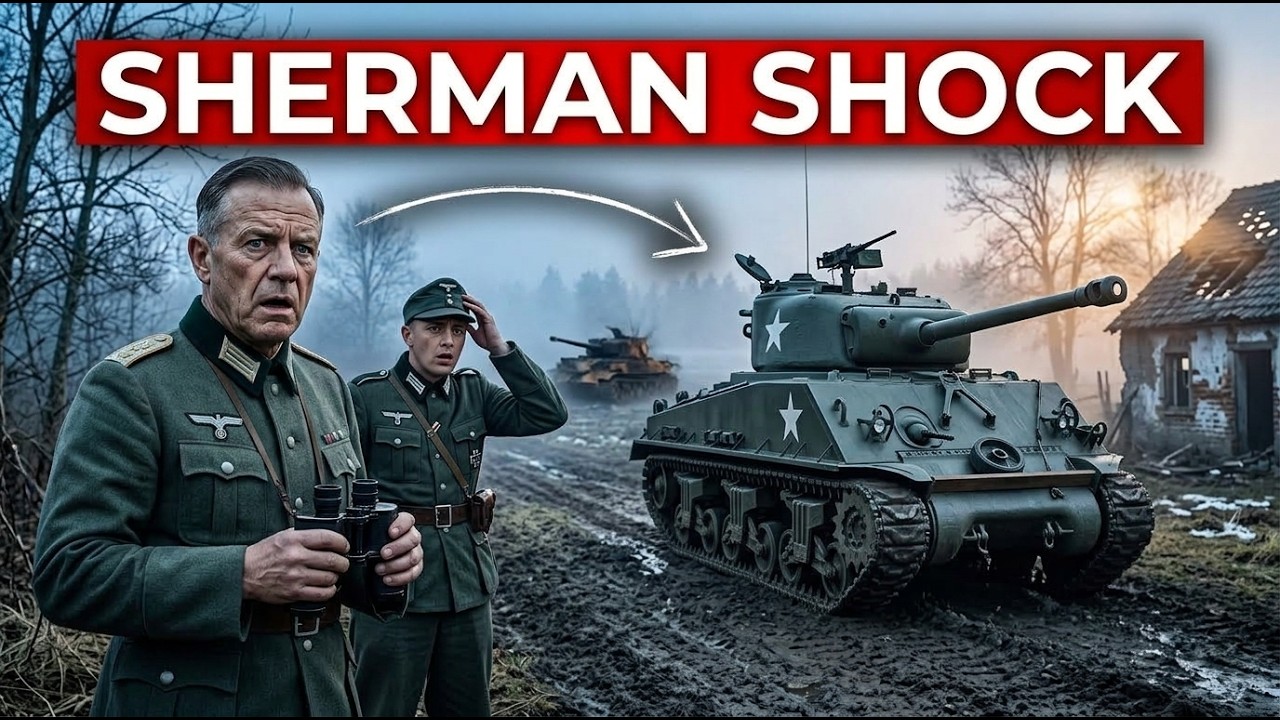
He counted. Three American Sherman tanks were burning in the mist before his position. He saw two of them explode. He watched the crews climb out of the hatches.
He knew precisely what a disabled Sherman looked like at four hundred meters. By the standards of that arithmetic, his morning had been a success. His brigade had been formed, equipped, and sent to Lorraine for one purpose: to cut off the American armored spearhead. Its Panthers were brand new from the factory, carrying the best gun on the battlefield and frontal armor that the American 75-millimeter gun could not penetrate from any reasonable range.
In theory, by every metric the German officer corps had trained its gunners to use, the 113th should have turned the American 4th Armored Division into scrap. Over the following days, in weather that grounded aircraft and fog that turned combat into close-range murder, the German brigades in Lorraine were not merely damaged. They were destroyed. The 113th, along with the 111th, was eliminated as a fighting formation in a series of direct clashes around a place called Arracourt, a battle historians have argued about ever since.
The detail that appears endlessly in German accounts of that fighting, and in their accounts of Normandy before it and the Ardennes after it, has nothing to do with American guns or American tactics. It is a logistical complaint, and it seems almost trivial until you understand what lies behind it. The Americans who had their tanks knocked out yesterday kept coming back. Not always the same men.
Not always the same tanks. But the unit, the company that should have been at half strength after the attack at dusk, returned at first light at full strength, ready and mobile. German tank crews recorded it. German intelligence officers noticed it.
The explanation the German side generally reached for was the obvious one, the one their own propaganda had been feeding them since 1942: American factories and endless production. They simply had more. That answer is partly correct, and the wrong half of it is the part that matters most. Because the tanks that came back at dawn were, in many cases, not new tanks from the ships.
They were yesterday’s tanks. The first thing to clarify is what “knocked out” actually means here, because nearly every popular account of tank warfare gets it wrong. A tank that is taken out of action is not usually destroyed. A tank is a vehicle with tracks, an engine, a transmission, a hull, a turret, a gun, optics, radios, and a crew.
Most of the things that stop it in combat affect only one of those parts. A track blown off by a mine. A final drive that seizes. A shell that penetrates the engine deck.
A hit that passes through the side and kills two men without starting a fire. A hull that sinks into soft ground under fire and is abandoned by a crew that had ten seconds to make a decision. To the gunner four hundred meters away who watched it stop, all these things are one event. It stopped.
The crew bailed out. It is a kill. To the men who must decide what the unit can do tomorrow morning, they are five completely different problems, and four of them are repairable. That means the number that actually decides an armored campaign is not how many enemy tanks you destroyed.
It is how many of your own tanks you recovered, and how fast you did it. That number depends on two things. The first is whether you have the equipment, the organization, and the spare parts to recover and repair. The second is so simple it has nothing to do with engineering.
You can only recover tanks on ground you still hold. If you control the battlefield at the end of the day, a disabled tank is just a work order. If you give up the ground, that same tank, with the same damage and the same repairable fault, is a permanent loss, and the enemy gets the wreck. From the summer of 1944 onward, in the west, the Americans were the ones holding the field at the end of the day almost every single time.
That one fact turned every tactical German success into a strategic failure in the accounting. The Germans understood recovery operations well. They were not amateurs. They built purpose-designed recovery vehicles and wrote sound doctrine for their use.
The problem was that they built their army around vehicles that were extremely difficult to recover, and then they did not build enough machines to recover them. Consider the physics. A Panther weighs about forty-five tons. A Tiger is heavier.
A King Tiger approaches seventy tons. To pull a dead vehicle of that weight out of mud, up a slope, or off a road, you need a tractor with real capacity. The standard German heavy tractor, the eighteen-ton half-track known as the Famo, was a remarkable machine, but it was not big enough alone for the heaviest jobs. Extracting a stuck Tiger could require several of them working together.
Several. For one tank. The Germans developed the Bergepanther, a turretless Panther fitted with a crane and a spade, an excellent recovery vehicle. But they never had enough of them.
Total production was a few hundred during the entire war, against tens of thousands of armored vehicles in service. So German units did what units under pressure always do. They improvised against orders. Crews towed disabled tanks with other tanks, a practice explicitly discouraged because towing one Panther with another destroyed the transmission and final drives of the towing vehicle.
And German final drives were already the weakest component of the vehicle. Here is where a supply problem becomes a catastrophe. From July 1944 onward, the German army in the west was in retreat. Every breakdown on the road during a withdrawal, every tank that threw a track in a ditch, every vehicle that ran out of fuel because its supply column had been bombed from the air, was not a repair job.
It was a demolition job. Crews blew up their vehicles or set them on fire and walked away. The alternative was handing a working Panther to American weapons intelligence. When the Allies closed the Falaise pocket in August 1944 and swept across the ground, they did not find a graveyard of tanks destroyed by enemy fire.
They found a graveyard of abandoned tanks. Vehicles without fuel, vehicles with mechanical faults, vehicles blown up by their own crews at the roadside. Battlefield studies showed that a large portion of the German armored vehicles in that area were destroyed by their own crews or simply left behind, not knocked out by enemy fire. That is the image of the German tank force at the end: not defeated in combat, but stranded.
Now consider the machine that went out and recovered them. On the American side, tank recovery was treated not as a support service but as a combat capability with its own vehicles, its own units, and its own doctrine, built into the armored division from the start. The M32 tank recovery vehicle was a Sherman with its turret removed and replaced by a fixed structure carrying an A-frame crane and a heavy winch capable of pulling tens of thousands of pounds. It kept the Sherman’s mobility, its armor, its speed, and most importantly, its spare parts.
Because it was a Sherman, the same engine family, the same track, the same suspension, everything interchangeable. A recovery vehicle that broke down was repaired with the same spare parts as the tanks it was recovering. That is the quiet, unglamorous secret of the entire American armored force, and the reason the Sherman, routinely and correctly described as inferior to the Panther in gun and armor, defeated the Panther as a system. The Sherman was standardized.
One basic hull produced in enormous numbers, with variants sharing the vast majority of their components. A maintenance sergeant who could fix one could fix them all. A spare-parts truck carrying suspension wheels carried wheels that fit everything in the battalion. Against that, consider what a maintenance company in a German panzer division faced by 1944: Panzer IVs, Panthers, sometimes Tigers, assault guns, tank destroyers on three different hulls, half-tracks, and a fleet of captured French, Czech, and Soviet vehicles pressed into service.
Different engines, different tracks, different final drives, different spare parts arriving on different trains over a railway network being bombed daily. Then the organization. American armored divisions had maintenance battalions with mobile workshops, welding equipment, machine tools, and heavy cranes. Doctrine called for repairs at the front, pushing repair work as close to the fighting as safety allowed, rather than dragging every broken vehicle to the rear.
The chain operated in successive echelons. Crew-level repairs done by the crew themselves with the tools on the tank. Then the battalion maintenance section moved forward, often at night, often within earshot of the German positions. Then the ordnance companies.
Then the great depots in France and Britain, where hulls were rebuilt, engines overhauled and returned to stock, and tanks written off as combat losses were brought back to life. At the core of it all was cannibalization, the systematic stripping of unsalvageable vehicles so that three wrecks became one working tank by morning. That is the answer to the question the German gunner in the fog was asking. The Shermans that came back at dawn had spent the night hanging from the end of a tow cable, pulled out of the mud by a turretless Sherman into a field, where a maintenance section worked by generator and welding torch in the dark with their lights covered.
The men who did that work were mechanics. They received no medals for it, and no memorial bears their names. Run the arithmetic. A German artillery line destroys ten American tanks in one day and loses three of its own.
By the metric the German gunner uses, that is a crushing victory. Ten to three. Now run it through the recovery system. The Americans hold the battlefield.
Of the ten, some are total losses, burned out, ammunition exploded, hull split open. Say that is a minority. The rest are towed away overnight. Tracks are replaced.
Engines are swapped from the hulls of irreparably damaged vehicles. Optics are replaced. Some return to the front line within a day. Some go to the rear for a week.
Some go to a depot and return to a different unit two months later with a new serial number stamped on the hull. The Germans control nothing. Of their three tanks, the ones that could not move are burned by their crews when the position is abandoned that night. Ten to three becomes much closer to a draw, and it happens every day, and the effect compounds.
Not because American factories were making more tanks, though they were, but because the American army was recovering the same tanks. Then comes the second number, the one that matters more than any other: the crews. The Sherman’s reputation as a death trap is one of the most durable legends of the war, and it comes mainly from the fact that it burned. Early-model Shermans, which stored ammunition in sponsons above the tracks, caught fire when penetrated, and the fire was almost always from the ammunition, not the gasoline engine.
The Americans identified the cause, and in 1944 introduced wet stowage. Ammunition was moved low in the hull into racks surrounded by a mixture of water and antifreeze that quenched the hit before the propellant could ignite. The percentage of penetrated tanks that burned dropped significantly. Allied operational research consistently found survival rates better than the reputation suggested.
A Sherman that was penetrated and knocked out did not usually kill its entire crew. Most men got out. Wounded, burned, or concussed, but they got out, went to the hospital, and in many cases came back to a tank. Put those two facts together and you get the real machine.
The tank came back. The crew came back. And a crew that was knocked out once and returned is not a replacement. It is a veteran crew that now knows exactly how fast to get out of the hatch.
The Germans, retreating, got none of that. The crew that abandoned a Panther in Lorraine and walked east lost its vehicle permanently, and a portion of those men were killed or captured on foot in the following days. German tank forces bled out their trained crews, which they could not replace, exactly as the fighter arm was bleeding out its pilots at the same moment and for similar structural reasons. There is a secondary effect that is almost never counted.
A crew that recovers its own tank, the same hull repaired, with the same track marks and the same nickname painted on the front glacis, is a crew that trusts its vehicle. A crew issued a strange rebuilt tank knows at least that the controls are identical, that the gun is boresighted the same way, that the tools are in the same places. Standardization is not just a logistical decision, it is a morale decision. By late 1944, German tank crews pushed into unfamiliar vehicles from three different factories had lost that too.
The verdict is that the two armies were counting different things, and only one of them was counting the thing that decided the campaign. German tactical reports were built on kill counts. That is not a criticism; it is how almost every army measured armored battle, and German claims in Normandy and Lorraine were generally honest by the standards of wartime claims. German gunners really were very good on average.
German optics really were excellent. The Panther’s 75-millimeter gun really was a superb weapon, and the Sherman’s frontal armor really could not stop it. Every one of those statements is true, and together they were not enough, because “destruction” is a claim made by a man looking through a periscope at a vehicle that has stopped moving at four hundred meters. “Readiness” is a number written in a morning report by a maintenance officer who spent the night with a crane, a torch, and a battered hull.
The Americans built their entire armored force around that second number. The tank was standardized so it could be repaired. The recovery vehicle was built on the tank chassis to share its spare parts. Maintenance units were pushed forward so repairs happened near the fight.
Ammunition was placed in water jackets so the tank would not burn and the crew would come home. The whole system rested on a logistical network that could deliver a suspension wheel or a final drive to a muddy field in Lorraine within days. None of it is glamorous. None of it appears in gun-camera footage or kill tallies.
It is welding, towing, cannibalization, and paperwork. And that is how a German brigade could win an engagement in the fog and lose the entire campaign, because winning the engagement had not removed the enemy tanks from the war. It had only removed them from the battlefield for that evening.
