There is a kind of sign you used to see from the highway. The orange roof. The big striped pole spinning lazily over a parking lot. The friendly cartoon man waving from a flat sign on a corner you once knew by heart.
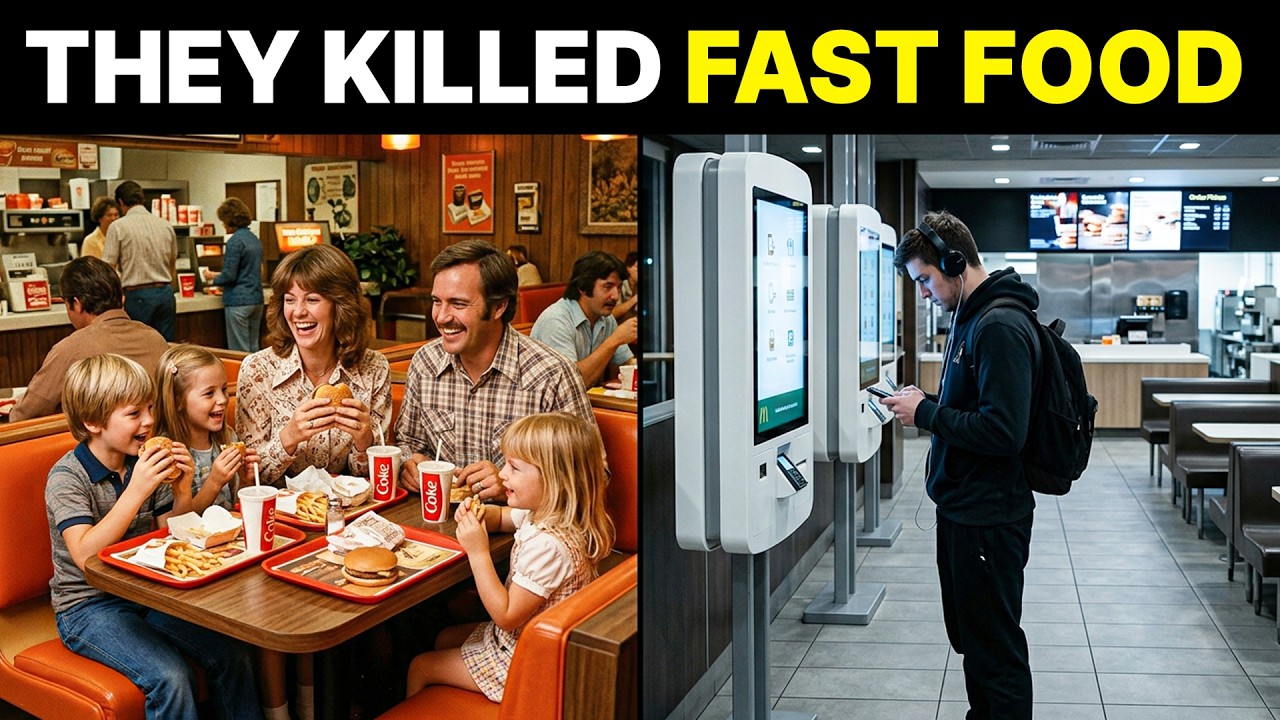
They were everywhere, and then, very slowly, almost without anyone noticing, they all began to vanish. America’s greatest fast-food chains did not die because of the food. They died because of the deal. Four of them tell the story: Burger Chef, which invented the kids meal six years before McDonald’s did, sued for it, and lost; Howard Johnson’s, bigger than McDonald’s in 1965, with 28 flavors of ice cream and a roof you could spot from a mile out; Friendly’s, started by two teenagers with $547 in the middle of the Great Depression; and Steak ’n Shake, where a Marine veteran ground your hamburger right in front of you in 1934 because that was the only way to prove it was beef.
Four chains. Four decades of trouble. None of them killed by the customer walking away. In 1957, in Indianapolis, Indiana, two brothers named Frank and Donald Thomas were not trying to open a restaurant.
They were engineers. They had patented a new kind of broiler, a machine that cooked hamburgers over an open flame in high volume. The prototype could produce 2,000 burgers an hour. They opened a place called Burger Chef to demonstrate what the machine could do.
The plan was to license the broiler. The restaurant was only supposed to be the demo. It got slightly out of hand. By 1959, two years in, they had 40 stores.
By 1960, Burger Chef was the second-largest hamburger chain in America. Around that time, they started doing things nobody else in fast food was doing yet. They began inventing things. The combo meal — burger, fries, drink, one price — came before any other major chain offered one.
They had an open toppings bar years before “have it your way” became somebody else’s slogan. And in 1973, six full years before the Happy Meal existed, they introduced the Fun Meal: a burger, fries, a drink, a small toy, and a paper box covered in puzzles. The mascot characters were called Count Fangburger and Burgerini. It was 1973, and they were three steps ahead of every chain in the country.
In 1978, they landed the Star Wars promotional deal, collectible character posters with every large drink. Lines wrapped around the block. Six years after the Fun Meal, McDonald’s launched the Happy Meal. Burger Chef sued for copying the concept and lost.
That kind of loss tells you something. By 1978, Burger Chef had a problem most fast-food chains never get to have: too many good ideas and not enough operational discipline to scale them. The reason was upstream. In 1968, before any of these innovations had reached their full potential, Burger Chef was bought by General Foods, the packaged-grocery giant behind Jell-O, Maxwell House, and Birds Eye.
A company that knew how to ship a million boxes of pudding mix to a million pantries. A company that had never run a restaurant in its life. Under General Foods, Burger Chef peaked at 1,200 stores in 1972. That same year, it lost $39 million.
The innovations kept coming. The execution did not. In 1982, General Foods sold the chain to Hardee’s for $44 million. The signs came down a few at a time.
The very last Burger Chef closed in 1996, a single franchise in Cookeville, Tennessee, hanging on long after the rest were gone. The flame broiler the Thomas brothers patented did not disappear. The technique is now standard across the industry. Burger King built an entire identity around the same approach.
Burger Chef had the ideas. They had the customers. What they did not have was a patient owner who could turn a workshop full of good inventions into a chain that would still be standing 50 years later. The best run of innovation in the history of American fast food came out of Indianapolis.
Almost nobody alive today knows that. In 1925, in Quincy, Massachusetts, a man named Howard Johnson borrowed $2,000 to take over a small corner pharmacy. He kept the soda counter going, but he had one stubborn idea he could not let go: what if the ice cream was actually great? Not decent.
Great. He doubled the butter fat. He tested 28 flavors when every other place in town offered three. The ice cream sold.
It paid for the pharmacy, and then, very quietly, the pharmacy turned into something else entirely. By 1939, there were 107 Howard Johnson’s restaurants up and down the East Coast. By the mid-1960s, Howard Johnson’s was the largest restaurant chain in the United States. Bigger than McDonald’s.
Bigger, for a stretch, than all the early burger chains put together. If you were a family on a road trip in 1965, you did not pull over for fuel. You pulled over for the orange roof, the fried clams in a paper basket, the chicken pot pie in a brown ceramic dish, the counter stools that spun a little too easily, and those 28 flavors waiting at the end of a long day in the car. Howard Johnson’s did not just live on the highway.
It defined what stopping felt like. By the early 1970s, the highway itself was changing. Drive-thrus were spreading. McDonald’s could feed a family of four in eight minutes for under a dollar.
Howard Johnson’s offered something richer, but it cost more, took longer, and asked you to sit down. That was a real problem. It deserved a real strategic response. What it got instead was a sale.
In 1979, the founder’s son sold the company to Imperial Group PLC, a British conglomerate whose core business was tobacco. They paid $630 million for it. They had never run a restaurant. To their credit, they were enthusiastic.
They came in with new ideas. They launched experimental concepts inside the system. One was called Bumbershoots. Another was called Deli Baker Ice Cream Maker.
To save the most trusted name in American roadside dining, they opened something called Bumbershoots. It did not work. Six years after buying Howard Johnson’s, Imperial Group sold it to Marriott for $314 million, half of what they had paid. Marriott kept some locations going for a while, but much of the prime highway real estate was already earmarked for other uses: Big Boy conversions, Marriott concepts, sales to other operators.
The franchisees who held on tried to keep the orange roof up. Their chairman said publicly in 1987: “Howard Johnson was allowed to become tired and stale. Anything is salvageable, but it needs time, money, and effort. ” The money never came.
By 1995, only 85 locations were left. The very last Howard Johnson’s restaurant, a holdout in Lake George, New York, closed quietly in March of 2022. There was no press conference. There were two people in the booth that morning finishing their breakfast.
In 1935, in Springfield, Massachusetts, in the middle of the Great Depression, two brothers, Presley and Curtis Blake, were 20 and 18 years old. They borrowed $547 from their parents and opened an ice cream shop. Double-dip cones for a nickel. Two teenagers running the counter on a quiet street in Western Massachusetts.
They named it Friendly’s because their mother said the name should describe what the place actually was. If you grew up in New England, Friendly’s was not a restaurant. It was a specific Tuesday evening in 1986. The Fribble, so thick it barely moved through the straw.
The Jim Dandy sundae that no 8-year-old ever finished alone. The birthday dinner your parents took you to because it was nicer than McDonald’s and easier than a real restaurant. A waitress who knew which table was yours. The slightly sticky vinyl on the seats.
It was not trying to be anything it was not. That was the whole promise. At its peak, Friendly’s had more than 500 restaurants across the Northeast and around 10,000 employees. A lot of those employees had been there 15, 20, 30 years.
In the mid-2000s, private equity arrived. Sun Capital Partners took over. Friendly’s was a low-margin family diner in high-cost labor states, the kind of business that runs on patience. What private equity tends to bring is leverage and timelines.
Borrow against the company to fund the buyout, ask the company to pay the money back out of its own operating cash, and run the clock. For some businesses, that math works. For a chain selling Fribbles in Massachusetts, the math was always going to be tight. By 2011, the math caught up.
Friendly’s filed for Chapter 11. About 100 stores closed. As part of the restructuring, certain pension obligations to long-serving workers were transferred to the Federal Pension Benefit Guaranty Corporation. Affected retirees received reduced benefits, meaningfully reduced in some cases.
People who had built their retirement around what they had been promised had to recalculate the rest of their lives in their early 60s. The chain came out of 2011 and kept going for almost another decade. Then, in November 2020, it filed for bankruptcy a second time. This time, the sale price tells the whole story: under $2 million for a 90-year-old chain that started with $547 in the middle of the Great Depression.
The whole thing went, in the end, for barely enough to cover three months of rent on a single restaurant in Boston. Friendly’s did not fail because the ice cream got worse. It failed because the financial structure laid on top of it was incompatible with the actual shape of what it was: a small, warm, patient business that needed a small, warm, patient owner. The Blake brothers borrowed $547 to build something around being friendly.
Their grandchildren watched the whole thing get sold for less than a used car dealership. In 1934, in Normal, Illinois, during the Great Depression again, a Marine veteran named Gus Belt converted an old gas station into a hamburger stand and pulled one of the strangest stunts in the history of American food. He waited until the restaurant was full, then rolled a barrel of T-bones, sirloin, and round steak right past the dining tables, out in the open. He ground the beef into patties in front of every customer in the room.
In 1934, ground beef had a reputation problem. Health codes were inconsistent. Roadside food was a gamble. Gus Belt’s solution was not a marketing campaign.
It was a magic trick, a live demonstration. Watch me grind it. You can see it’s beef. I can see you watching.
His motto was four words long: “In sight, it must be right. ”
That principle held for 70 years. By 2000, Steak ’n Shake had 370 locations and $408 million in annual sales, a 24-hour institution. Late nights after the high school game.
College towns at 2:00 in the morning. Sunday lunches after church in every small town from Indiana to Tennessee. Then the founder’s heir, the man who had rebuilt the chain through the 1980s, died in 2003. The chain drifted for three years.
By 2008, it was losing $100,000 a day. That is when a 30-year-old activist investor named Sardar Biglari took control through a proxy fight in August 2008. His turnaround actually worked at first. Recession-era discount menus brought customers back through the door.
Twenty-nine consecutive quarters of same-store sales growth. But something else was happening alongside it. From 2009 through 2020, according to Biglari’s own shareholder letters, his own published words, Steak ’n Shake sent close to $300 million back up to Biglari Holdings, his personal investment company. He paid himself $32.
5 million in a single year, more than the CEOs of McDonald’s and Chipotle combined that same year. He renamed the parent company after himself. He licensed his own name to that company in 2013, structured so that if he were ever removed for anything short of a criminal conviction, the company would owe him 2. 5 percent of all sales for five years.
Analysts have estimated that figure at over a hundred million dollars. In 2019, while the chain itself was declining, he quietly removed his own $10 million annual compensation cap. And in 2020, after 86 years of table service, table service ended. Servers were replaced by kiosks.
$50 million was spent, not on better burgers, not on cleaner stores, but on removing the human being from the room. The chain that was founded on showing you exactly what went into your food pointed its customers at a screen. There were 628 locations in 2018. By the end of 2024, there were 426.
More than 200 restaurants gone. The shareholder letters were public. The SEC filings were available. None of it was hidden.
It just was not the kind of paperwork most people open on a Tuesday afternoon. So here is what actually happened. Burger Chef invented half the things you take for granted at a fast-food counter and was handed to a company that mostly knew how to ship pudding mix. Howard Johnson’s defined what stopping on the highway felt like and was bought by a tobacco conglomerate that opened something called Bumbershoots.
Friendly’s built itself out of $547 and a name that meant exactly what it said, and was loaded with a debt structure it was never built to carry. Steak ’n Shake survived the Great Depression on a barrel of beef and a four-word motto, and sent $300 million up to its owner’s holding company while its dining rooms emptied out. Four different stories. One thread runs through all of them.
The chains that came through this same era are not perfect. McDonald’s, Chick-fil-A, In-N-Out, Whataburger: they have cut corners, they have had bad years. What they had, and what these four did not, is something less glamorous than founding genius and harder to dramatize than a lawsuit. Operational consistency.
The patience to reinvest. An owner in the room who actually wanted the chain to outlive them. Competition was real for all four of these places. Tastes changed.
Highway culture changed. Fast casual happened. Those were genuine pressures. But none of these chains ever really got the chance to adapt, because by the time the work needed to start, the people in charge had something else on their mind.
That is the real story. Not that the chains failed, but that they never really got to try. One footnote. In January 2025, Steak ’n Shake, yes, that one, switched all 436 of its remaining locations to 100 percent beef tallow fries.
The internet went briefly insane about it. The chain’s third quarter of 2025 was the strongest performance it had posted in years. Whether that is a real operational comeback, or the smartest piece of cultural positioning since the McRib first vanished, the jury is still out.
And the next time you see a chain you love get sold to a company you have never heard of, remember what happened to these four.
