The messenger from the king of Spain knocked on the door of a small house in a remote village in the region of Burgos. Inside was a six-year-old girl who had spent nearly her whole life hidden from the world. Her name was Eugenia Martínez Vallejo, and the court would come to call her La Monstrua—the monster. The king had heard about her.
He wanted to see her. And in a place where no one says no to a king, that was an order, not an invitation. Eugenia had been born in that village in 1674, on a Sunday morning inside the local church. Her mother, Antonia de la Bodega, had gone to mass, and in the middle of the service her waters broke.
There was no time to get home or to call for help. The baby came into the world surrounded by the neighbors who had gathered for worship. In a small, deeply religious village in seventeenth-century Spain, this was not seen as an accident. It was a sign.
People believed the child was blessed, born under a lucky star, and they gave her a name to match that hope: Eugenia, which carried the meaning of being wellborn. Her father was José Martínez Vallejo. Historians believe the family was humble, poor or close to it, the sort of people who worked hard and owned very little. Their exact occupations are not known.
But for a while, the blessing seemed real. As a baby, Eugenia was healthy and strong, with a very big appetite. To her parents, this looked like a gift. In the seventeenth-century countryside there were almost no doctors, and many babies never reached their first birthday.
A plump, well-fed child was a sign of good fortune, of fertility, even of a family that could afford to feed its children well. Nobody thought anything was wrong. But then something began to change. Eugenia started growing much faster than other children, far faster.
Stories from the time claimed she looked like a twelve-year-old before she turned one, which historians suspect was an exaggeration. The number that is not an exaggeration is this: by her first birthday, she reportedly weighed around 20 kilos, about 44 pounds. A typical one-year-old weighs nine or ten. Eugenia weighed double that, and she kept growing.
Her brothers and sisters grew the normal way. Everyone in the house could see the difference between them and Eugenia, and her parents grew scared. They did what any loving parents would do: they brought in a physician. The doctor put the little girl on a strict diet.
Her body told her she was starving every hour of every day, while the adults around her took away her food. It did not work. She kept growing. And then the neighbors began to laugh.
Children pointed. Adults whispered. People made jokes, some of them right to her face. A little girl just a few years old became the favorite target of an entire village.
Her parents tried to protect her. They kept her inside the house. They hid her from the people outside, thinking that if nobody saw her, nobody could hurt her. But in a small village, secrets do not stay secret.
Word spread about the giant girl. It traveled to the next town and then to the next village. Soon strangers were walking to the house just to catch a glimpse of her, to stare, to mock her. A child sitting in her own room could hear people outside her window who had walked miles just to laugh at her.
By the age of six, she reportedly weighed around 65 kilos, about 143 pounds. She spent nearly all her time locked in her room—a six-year-old girl, hidden away, hungry all the time, laughed at by strangers. Then came the knock on the door. The man standing there was a messenger from the royal family.
He was not there to bring help. He was there with an order. The king of Spain wanted to see the girl. Charles II had become king when he was only three years old.
He was sickly all his life, so fragile that people called him Charles the Bewitched, believing some dark power was making him ill. He ruled one of the biggest empires in history, yet he would die at the age of thirty-eight with no children to take his throne. The man who decided Eugenia’s fate was himself a fragile, unhappy person, surrounded by people who bowed to him and never said no. And when a king says he wants to see a child, nobody says no to him.
Eugenia’s parents were nervous. They may have hoped the court doctors would find a cure, or that the king would help the family. But they did not have a choice. You cannot refuse a king.
So in 1680, six-year-old Eugenia and her parents made the long journey to Madrid. When they arrived, the royal tailor got to work right away. Eugenia needed a proper dress to stand before the king. A girl from a poor village, who had spent most of her life locked in a room, was now being measured for clothes by the royal tailor.
Then she was brought before Charles II. The king was fascinated. He looked at this little girl and could not stop looking. Almost at once he suggested to her parents that Eugenia should stay, that she should be taken care of, that she should become part of the royal court.
Her parents accepted, saying yes almost right away. And just like that, the girl from the church was gone from her village for good. A writer of the time, a man named Juan Cabezas, published a short pamphlet about her arrival. He wrote that the wonders of nature had come to the court in the form of a giant girl.
He wrote that the king, seeing this miracle of nature, had called for her to be brought to his palace, where the whole royal household and the nobles of Spain now admired her. Admired her. That was the word he chose. But what had the king really invited her into?
It was not a school. It was not a hospital. It was not a home. In the courts of Europe there was an old tradition going back to the Middle Ages: kings and queens kept a group of people around them just for entertainment.
In Spain they were called the gente de placer, the people of pleasure. They were jesters, dwarves, people with physical differences, people thought to be mentally ill. They lived inside the palace. They were fed and dressed.
But they were not there as guests. They were there to be looked at, to be laughed at, to be played with as if they were toys. Eugenia was now one of them, and she was far from alone. Charles’s own father, King Philip IV, is said to have kept around 110 court dwarves.
That many people kept for amusement could fill a small village, and all of them lived at the mercy of the royal family. There was another reason for this practice, one of the cruelest. The nobles believed that keeping people who looked different made the royal family seem more perfect. The more unusual the entertainers looked, the more beautiful and powerful the rulers appeared.
Even the ladies at court used Eugenia this way. Many of them asked to be painted or drawn standing next to her, so that their own slim figures would look even more elegant beside her. A young girl standing in a room while a noblewoman says, paint me beside her so I look more beautiful. Eugenia and the others like her were not paid.
Not one coin. They worked long hours performing for the nobles and received no wages. They had no rights. If their lord decided he was tired of them, he could throw them out into the street with nothing.
Some historians argue this life may not have been completely terrible for everyone. The nobles spent a lot of money on their entertainers. They made sure they had food. They kept them warm during the cold Madrid winters.
They gave them clothes, sometimes many different outfits, more than most peasants in Spain could ever dream of. So imagine the choice: a life of hunger, cold, and poverty in the countryside, or a life of warm beds and full plates in the palace, but as a human object. Eugenia did not get to choose. She was six.
And the people who kept her did not see her as a girl. They saw her as a treasure, a curiosity, a thing to show. But something made her story different from the thousands of others at that court. The king did something for Eugenia that he did not do for almost anyone else in that palace, something that would keep her face alive for centuries.
First, the nickname may not mean what modern ears assume. Today the word monster means something frightening, something evil. But some historians point out that in seventeenth-century Spain, the word monstruo was also used for something extraordinary, a wonder, a marvel of nature, a thing so unusual that people could not stop talking about it. At court the word was used partly in that old sense.
It was cruel, a label that stuck to her skin, but it was not always meant as hatred. Second, despite the mockery, records from the time say Eugenia was popular at court. People liked her. Visitors admired her face and enjoyed her pleasant personality.
Even members of the royal family are said to have appreciated her. As she grew into her teenage years and then into adulthood, she is said to have stayed well liked. Many historians believe she may have actually enjoyed living in the palace, at least more than the village where she had been hidden and laughed at. In the palace, for the first time in her life, nobody was locking her in a room.
But being liked is not the same as being free. She could be popular and still have no power. She could be praised and still not be paid. She could be fed and dressed and admired and still be called the monster.
She could smile at the nobles and still wake up each morning knowing she could be sent away at any moment. She never had a choice in her life—not where she lived, not who looked at her, not what name people used for her. Both things were true at the same time. She was cared for and she was used.
She was liked and she was looked down on. She found some kind of happiness, and she lived inside a cage. The thing that made Eugenia different from every other entertainer at court was not her size and not her name. It was the king’s paintbrush, or rather the brush of the man he hired.
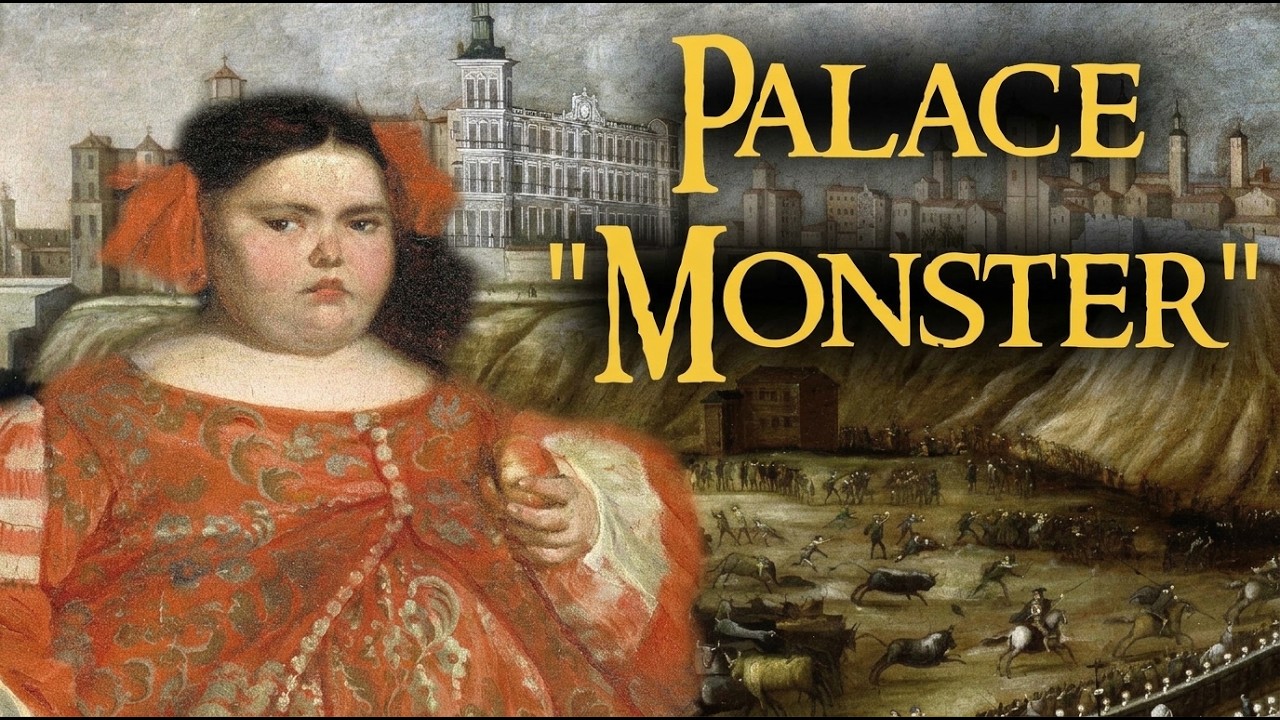
The king commissioned two portraits of her, painted by Juan Carreño de Miranda, one of the most respected painters in Spain and the official painter to the royal court. He painted kings, queens, and nobles, and he was asked to paint a six-year-old girl. The portraits are dated to around 1680, the same year she arrived at court. There are two of them.
One is called La Monstrua Vestida, the monster dressed. In this one, Eugenia wears a rich red gown and holds apples in her hands. The second is called La Monstrua Desnuda, the monster undressed. She is not fully naked; she is partly covered with drapery and decorated with vine leaves and grapes.
Some art historians see this as a playful echo of old paintings of the Roman god of wine, where the figure is shown surrounded by grapes. Both paintings are big. Each canvas is about 165 centimeters tall, nearly five feet five inches, almost life-size. When you stand in front of them, you are not looking at a small picture.
You are looking at a girl almost as tall as a grown woman looking back at you. Today both portraits hang side by side in the Prado Museum in Madrid. Thousands of people walk past them every week. Some see sadness in them.
They say Eugenia looks tired and uncomfortable, like a child who had to stand still for a very long time, maybe in pain, while an artist painted her for a king’s amusement. The titles make it worse. But other experts look at the same paintings and say the painter treated her with respect, with gentleness and honesty. He did not make her look ugly.
He did not make a joke of her. He painted her as a real human being with a real face, a real dress, and real presence. Maybe both are right. Maybe the king ordered the paintings as a display of a curiosity, and the painter quietly turned them into something more human.
That is why the portraits are so powerful. Hundreds of years later, we do not see a joke. We see a girl. Something else about those paintings troubled one visitor to the museum in a way that changed medicine.
A famous doctor once stood in front of these portraits and stopped. He looked at her face, her hands, her feet, her body, and he said he recognized her illness. The doctor’s name was Andrea Prader, a Swiss children’s doctor who spent his life studying hormones and growth. When he saw the portraits in the Prado, he recognized features that matched a rare genetic condition, a condition that in his own lifetime had only just been described.
It is called Prader-Willi syndrome, named for him and his colleagues who helped describe it in the 1950s. Your body has instructions inside it called genes, which sit on structures called chromosomes. In Prader-Willi syndrome, a small piece of chromosome 15 does not work the way it should. One of the biggest effects is on hunger.
Normally when you eat, your brain gets a message that says you are full. You can stop now. In Prader-Willi syndrome, that message does not arrive properly. The brain keeps saying, eat, eat.
You are still hungry. Imagine just finishing a huge meal and yet feeling as hungry as if you had not eaten for days, and that feeling never goes away. Not after an hour, not after a whole day, not ever. It is not greed and it is not a lack of willpower.
It is a medical problem written into the body from birth. Doctors today say children with the condition often have other signs: short height, small hands and small feet, weak muscles as babies, delayed growth in adolescence. Most people with the condition are not able to have children. Think back to Eugenia: the strong appetite as a baby, the fast weight gain, the diets that never worked, the reports that she got tired easily and had trouble keeping up with others, the reports that she never had a period even as a grown woman.
The doctor stopped in front of the portraits for all of those reasons. That is the heartbreaking part. In the village, her parents put her on a strict diet because they thought she just ate too much. But her body was sending her a signal she could not turn off.
She was not choosing to be hungry. She could not stop being hungry. Nobody can be completely sure. Eugenia lived more than three hundred years ago, and there are no medical records and no tests.
One Spanish doctor in the 1940s suggested a different hormonal explanation, a condition linked to stress hormones. Other experts have leaned toward Prader-Willi. The best that can be said is that Prader-Willi is the most widely accepted explanation today. Doctors estimate it affects somewhere between 1 in 10,000 and 1 in 30,000 babies.
Today, with early diagnosis, careful food management, and support from doctors and family, many people with the condition can live into adulthood with a good quality of life. Eugenia had none of that. She had a strict diet that failed, strangers who laughed, and a palace that wanted to look at her. Eugenia Martínez Vallejo died in the year 1699.
She was around 24 or 25 years old. She had spent eighteen of those years inside the palace, nearly three-quarters of her life, as a member of the court. She never left. We do not know exactly how she died.
We do not know where she is buried; her grave has been lost to history. Historians believe her death was probably linked to her condition, because people with severe weight-related illness in that era often did not live long. There is an eerie detail. She died only one year before the king who brought her to Madrid.
Charles II died in 1700 at the age of thirty-eight. Two sickly, fragile lives, very different in rank, ending almost side by side. With his death, the long rule of his royal family in Spain came to an end. A king with every power in the world, and a girl with none.
In the end, neither of them escaped their fate. We usually forget the people who were used and discarded at court. There were 110 dwarves at one court alone. Almost nobody knows any of their names.
But we know Eugenia’s. We know her name because a painter looked at her and chose to paint her face with honesty. Centuries later, people are still standing in front of that canvas asking who she was. In the Spanish city of Ávila, there is a bronze statue of her.
The sculptor is Amado González Hevia. It is based on the dressed portrait, and it stands on a street named after the painter himself, Carreño Miranda. It is one of the most photographed statues in the city. Tourists take pictures with it.
Children climb on it. Couples pose next to it. But many of them, as local newspapers have noticed, have no idea who she was. The girl who was hidden away from the world and then put on display for the world now stands in public view in a street full of people.
Only this time nobody is laughing. Only this time she is remembered. She never asked for any of it. She never asked to be famous.
She never asked to be painted. She was a child who was hungry, who was stared at, and who was sent to live with strangers. And yet here she is, three hundred years later, still looking at us.
