The county recorder, Wilkin Yarrow, reached under the seat of the chair at the head of the table and turned it onto its side, very gently, so as not to disturb the plate. The wood was pale where the knife had cut, the letters clean, carved within the last year, perhaps within the last month. He read the names in the order they were carved. And at the bottom, so fresh that a tiny curl of pale wood still clung to the edge of one letter, he read: W.
Yarrow, 1923. He set the chair back upright. He walked to the door. He stepped out onto the porch, and the light had changed.
He looked at his pocket watch. It was a quarter to five. He had time, he told himself, to get down to the logging road before dark. If he started now.
If he started this minute. If he simply turned and walked. He turned to go back inside only to fetch his satchel. The door was closed.
He had left it open. He was certain of that. He had arrived in Hollow Bend on a Tuesday afternoon in October 1923, on a late train and in a fine slow rain that did not seem in any hurry to stop. He was 38 years old, lean, a little stooped from 20 years bent over ledgers and deed books, with brown hair that had already begun thinning at the crown and going silver at the temples.
He wore wire-rimmed spectacles he was always pushing back up the bridge of a long, narrow nose, and hands that were soft except for the callus on the inside of his right middle finger, where a fountain pen had worn its mark over half a lifetime of writing other people’s names into the public record. He wore a brown wool suit two seasons out of fashion and carried a leather satchel that was always heavier than it looked. Inside were a notebook with a stitched green cover, a steel ruler, a small bottle of ink, an envelope of carbon paper, and a tintype photograph of his late mother, kept between two pieces of stiff card because the corners had begun to flake. He did not believe in ghosts.
He did not believe in luck. He believed in straight columns of numbers, in his own neat handwriting, and in the slow, sure mechanism of the law. He often said the world was much smaller and much more sensible than people gave it credit for, and that most mysteries dissolved on contact with paperwork. That autumn, he would have cause to question it.
The county had sent him up into the hollows north of Hollow Bend, in the western part of Greenbrier County, to put a value on property whose owners had died with nothing left to give. Their names were Othmar and Cordelia Whitlock. Nobody in his office had ever met them. What was known came in fragments pinned together in the back of a thin folder that smelled of pipe smoke and old glue.
Othmar Whitlock had bought a parcel of mountain land in the spring of 1873—50 acres of timber, one good spring, one bad slope. He married Cordelia Hennick that same year. They built a cabin on the highest dry shelf above the spring and lived in it for 48 years, until Cordelia died in the winter of 1921 and Othmar followed her quietly in the spring of 1922. They left no children.
They left no will. The land, by law, was the county’s now, and the county wanted to know what it was worth. That was Wilkin’s errand, and nothing more. The boarding house was the second best in town, and the best one had closed in 1917, so it was, for the moment, the only one.
The landlady was a tall, narrow woman named Verla Crim, who looked at his papers without taking off her reading glasses, then looked at him over the top of them, and her face changed just slightly, the way a face changes when somebody mentions an illness in the family. “You’re the one going up to the Whitlock place,” she said. She handed him his key—room number four scratched into a small brass tag—and watched him walk up the stairs without saying another word about it. In the morning, he crossed the muddy street to a general store and asked the proprietor for directions to the old Whitlock Road.
The proprietor, Cruzen Mott, was a heavy, slow-moving man in his middle 60s with a beard the color of wet ash and eyes that had stared so long at the mountains they had taken on the same blue-gray. When Wilkin said the word Whitlock, Mott set down the can he was stacking and rested both palms flat on the counter. “You go up there for a reason, mister? ” “County business,” said Wilkin.
“I’m to assess the property. There are no heirs. ” Mott was quiet for a long moment. Then he said, “You ought to go up in the morning and you ought to be back down before supper.
” Wilkin smiled politely. “I appreciate the advice. ” “It isn’t advice, it’s a courtesy. ”
An old woman sat on a chair by the stove with her ankles crossed and her hands folded in her lap, and she had been listening.
She wore a black dress mended at the cuffs more than once. He had taken her for a customer, but she had not asked for anything, and nobody had brought her anything, and he understood suddenly that the chair by the stove was hers. She spoke without turning her head. “My uncle was a surveyor, sir.
He went up to the Whitlock place in 1898 to look at a boundary line. Took his lunch and a flask and his pipe and his rod. Told my mother he’d be back by sundown. ” She paused, and turned her head slowly.
She had the lightest eyes he had ever seen on a living person. “And he never come back. ”
Her name was Ruta Divine. She never married.
“They take in travelers, mister. They always took in travelers. Anybody who came up that path, the Whitlocks would set them at their table and feed them. And some of those travelers stayed for the season, and some stayed past winter, and some of those travelers are still up there.
” Behind the counter, Cruzen Mott made a low sound in his throat. He was looking at the floorboards. “Don’t eat at their table,” Ruta Divine said. “Don’t sit in their chairs.
And don’t stay past sundown. ”
Wilkin took the directions Mott had drawn for him, folded them into his coat, paid for a tin of crackers and a wedge of hard cheese, and walked back out into the gray light. His hands were not steady. He did not let himself think about why.
He had hired a man named Halsey Penny to take him as far as the old logging road in a small wagon pulled by a small horse. Penny was about 50, with a face weathered into a permanent squint and a hat so old the brim drooped on one side. They left Hollow Bend at about ten in the morning and rode for nearly two hours up a road that was at first a real road, then a country road, then just two wagon ruts in the leaves. The trees got older the farther in they went—tall oaks and silent hemlocks and the occasional skeleton of an ash that had given up.
The sound of the wagon was very loud in the absence of any other sound at all. The horse was nervous. Penny kept having to talk to her in a low, even way to keep her from balking. At a point where a creek crossed the logging road and the bank on the other side rose into the first of the steep hollows, Penny stopped the wagon.
“This is as far as I take you, mister. ” Wilkin asked why. Penny looked at the creek, at the trees on the other bank, at his horse, who was standing with her ears flat back against her skull and her nostrils very wide. “My granddaddy went up there once.
And he come back, but he wasn’t right. Not after. ” “In what way wasn’t he right? ” Halsey Penny took a long time to answer.
“He set a place at supper for somebody nobody could see. Did it every night till he died. 18 years. ”
He looked at Wilkin then.
“You go up. You do what the county sent you to do, and you come back here before dark, and I will be here. If you are not back by dark, I will not be here. I will be most of the way home by dark, and that is no insult to you, mister.
Is that understood between us? ” It was. Wilkin climbed down, shouldered his satchel, and took the path that began at the far side of the creek. The forest closed in around him.
He noticed, after a while, that there were no birds. He stopped walking just to listen. No birds, no squirrels in the canopy, no insects in the leaf litter. Just the sound of his own breath, which seemed too loud, and the soft creak of his satchel against his hip, and a faint, far-off rustle that could have been wind, except there was no wind.
None at all. He kept walking. He thought about Pell Divine—his rod at the spring, his pipe on the porch, his coat on the peg. He told himself he did not believe a word of it.
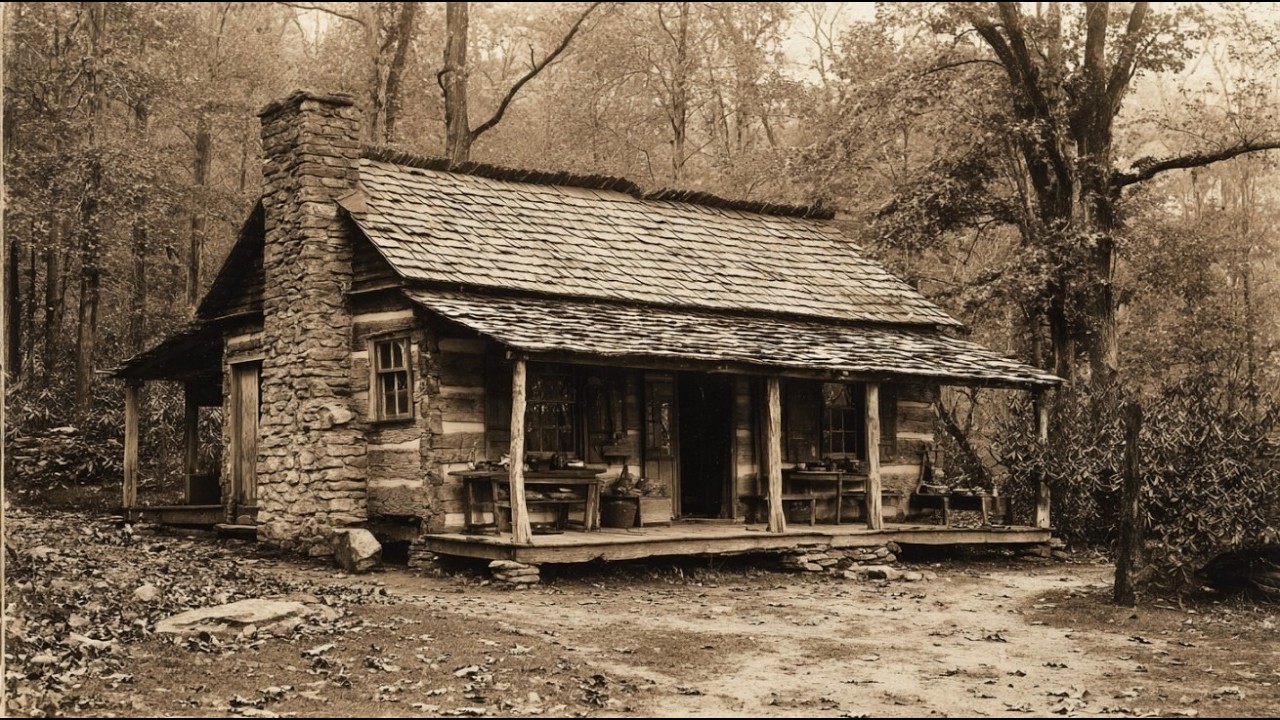
He told himself that several times on the way up, and he kept walking. He came over a rise, and the cabin was just there. It startled him how suddenly it appeared: a long, low building of squared chestnut logs with a stone chimney at the gable end, a porch running most of the front, a roof of cedar shakes weathered to the color of bone but unbroken, every one of them. The garden in front was wild—the herb beds gone to seed, the rose by the gate post throwing long tangled canes in every direction.
But the porch was swept. Not freshly; there were leaves on it. But swept, sometime, in a way that suggested someone had stood there with a broom in their hand in the year and a half since Othmar Whitlock had gone into the ground. Wilkin set this fact aside.
He took it out of the front of his mind and put it in the back. He went up the three stone steps and tried the door. It was unlocked. The hinges did not even creak.
It opened on a single long room with a stone hearth at the far end, a kitchen at the near end, and a table in the middle. The table was set. Seven place settings, three down each long side and one at the head. The plates were white china with a small blue line painted around the rim, and they were clean.
Set down with a precision that suggested somebody had walked around the table after laying them and adjusted each one with a fingertip until each plate sat exactly where it ought to sit. The forks were laid with the tines down in the old country way. The cups were turned upright and dry. There was no food, but a small wooden bowl in the center held three apples, brown and shriveled and gone old.
And a candle in a brass holder beside the bowl, with about an inch of wick remaining and a small black puddle of melted tallow around the base, as if it had been burned recently, for a long time. He took out his notebook and wrote down what he saw. Seven place settings. Brass candle holder, wooden bowl, three apples, withered.
Table cleared, dust minimal. Hearth cold, no fire laid, floor swept, walls intact, window glass intact, smell faintly of beeswax. He wrote that last part and stopped, because the cabin did smell of beeswax, faintly but distinctly, the way a parlor smells when somebody has just finished polishing the furniture. He stood there in the open door for a long minute with his pen in his hand and listened.
The cabin was quiet, but it was not empty. That was the only way he knew how to describe it, then or later. The way a church is quiet but not empty. The way a courtroom is quiet between sessions.
He stepped inside, leaving the door open behind him. He counted the chairs. There were eight: seven at the table, and one in the corner by the hearth, a rocker with a wool throw folded over its back. He counted the rooms: the long main room, a small bedroom off the back, a pantry behind the kitchen.
The bedroom contained one wide bed made up neatly with two pillows and a green ring-patterned quilt, a chest at the foot, a chair, and a small framed photograph on the wall above the bed. It showed a man and a woman standing very stiffly in clothes that were old even for the time the photograph was taken. The woman was small and dark, hands folded in front of her, smiling very slightly in a way that suggested the photographer had told her not to. The man was taller, with a beard that came down to the second button of his coat.
His eyes, even in a tintype, were pale. Cordelia and Othmar Whitlock, dated in a careful pencil hand on the back: 1876. He took it down, turned it over, read the date, and put it back exactly as he had found it. Back in the main room, he stood in front of the hearth and saw on the mantel, between two pewter candlesticks, a small book in a brown leather binding with a black silk ribbon laid into it as a marker.
It was a diary. The handwriting on the inside cover was small and slanted to the right, and it read, in faded ink: Cordelia Hennick Whitlock. Began this 4th of April, 1881. He sat down in the rocker by the hearth because it was the only chair in the cabin not at the table, and he opened the diary.
The early entries were ordinary—the entries of a young wife newly settled into her cabin, writing about the weather, the price of flour, a hen that wouldn’t sit, a neighbor named Vesper Hoyle who had walked over to borrow a spool of thread. Wilkin skimmed. He turned years. And he came to the first one, a spring entry in 1886.
“A man came up the path today. He said his name was Asher Quill. He had been walking for two days and his feet were blistered and he had not eaten since the morning before. ” Othmar set him a place at the table.
He stayed the night. He stayed three nights. Two weeks later: “Asher Quill is still with us. He has not spoken of moving on.
Othmar says it is the mountain. The mountain has settled in him. He says some men come up and they cannot quite go back down. It is not a sadness.
They simply become part of it. ” And six months later: “Asher Quill has not been at the table for some weeks now. Othmar continues to set his place. He says he likes to know that the chair is there.
I have stopped asking. The mountain is very quiet tonight. ”
The fine hairs lifted along the back of Wilkin’s neck. He turned a page.
There was another in 1889, a peddler named Lot Fruen, who came up with a pack on his back, sold them a tin coffee pot, was invited to supper, stayed the night, stayed the week, stayed the month. The diary stopped mentioning him the same way it had stopped mentioning Asher Quill—a slow fade, like a candle going out so gradually you can’t say when it has gone. There was one in 1893. One in 1896.
Pell Divine in 1898: “A surveyor came up today. His name is Pell Divine. He has come about the boundary. He is a tall man with a thin mustache and a sad way of looking at the trees.
Othmar liked him at once. He has stayed for supper. He will stay the night. ” Two weeks later: “Pell Divine remains with us.
He is not gone down to the town. We have not asked why. He sits by the fire in the evenings and he does not say much, but he hums an old hymn under his breath while he carves. And Othmar says it is good to have a hymn in the house again.
” Four months later: “Pell Divine sits with us at supper. Othmar sets his place. He is very quiet at the table now. ”
Wilkin sat very still in the rocker.
He could feel his own pulse against the inside of his collar. He turned pages. Names. So many names.
Each one came up the path, each one was given a chair, each one, by and by, faded out of the running text in that same slow, soft way. The diary did not say they died. It did not say they left. It just stopped mentioning them as people who came and went and started mentioning them as people who were there.
Othmar set the table for nine tonight. Othmar set the table for eleven tonight. Othmar set the table for fourteen tonight. The candles burned low and the chairs were all in their places and we had a quiet supper.
He closed the diary for a moment, then turned to the last quarter of it. The entries grew shorter and shorter until they were only one or two lines a day. In the last twenty pages, the handwriting changed. Still Cordelia’s hand, but loosened.
The letters had grown slightly rounder, the lines slightly less even—the way a hand changes when a person is older or tired or afraid. In the spring of 1921: “Othmar set the table tonight without telling me. I came in from the garden and the cloth was laid and the plates were down. I asked him for the count and he said, ‘Seven.
‘ Only seven. I asked him about the rest. He said the rest had gone on. I asked him, ‘Going on where?
‘ He smiled and he did not answer. ” Two weeks later: “Othmar set the table for seven again. He says they prefer it now. He says the house is more comfortable for seven.
I do not ask who the seven are. I have learned not to. He hums while he sets it. ” A month later, the last entry in Cordelia Whitlock’s hand: “Othmar set the table without me again.
He says they’ll be hungry tonight. I asked him, ‘Who? ‘ He just smiled. ”
Below that, in a different hand, in pencil, in letters heavy and slow and small: “Cordelia has gone to her rest.
I have laid her in the back room. I will keep setting the table. They liked her. They will want her at supper.
”
Wilkin closed the diary. He sat in the rocker for a long time without moving. He could hear his pocket watch ticking from inside his coat. He could hear the very faint sound of wind beginning to move in the canopy outside, although when he had come up the path there had been no wind.
He stood up. He walked to the table. He bent down, reached under the seat of the nearest chair, and ran his fingertips along the underside of the wood. He felt the rough lines of carved letters.
He turned the chair onto its side, very gently, so as not to disturb the plate. There were six names. Asher Quill, 1886. Lot Fruen, 1889.
A man named Holcomb, no first name, 1893. A woman named Iolanthe Spry, 1896. Pell Divine, 1898. And at the bottom of the list, newer than the others, the wood around it still slightly pale where the knife had cut: Beulah Crim, 1921.
He went around the table. He checked each chair. Some had four names. Some had eight.
One had twelve. They went back to the late 1870s and came forward year by year, neat and small and patient, into the present. The most recent on every chair was within the last decade. Then he came to the chair at the head of the table.
He turned it on its side. And at the bottom, very fresh, he read W. Yarrow, 1923. He set the chair back upright.
He walked to the door. He stepped out onto the porch, and the light had changed. The sun was down behind the western ridge; only the tops of the trees were still gold. He looked at his pocket watch.
A quarter to five. He had time, he told himself, to get down to the logging road before dark. He turned to go back inside only to fetch his satchel. The door was closed.
He tried the latch. It opened easily. He stepped back inside. The cabin smelled different—of wood smoke now, a low faint thread.
And the hearth, which had been cold, had a small bed of orange coals in it. Not a fire, just coals, as if a fire had been burning for some time and somebody had let it die down to its embers. The candle on the table was lit. There was food on the plates.
Six plates, with food—bread, a wedge of yellow cheese, a piece of cold pork, a spoonful of beans—set out the way a country supper is set out when the women have come back from the fields. And one plate empty. He knew which plate. He looked at the chair at the head of the table.
It was pulled out just slightly, the way a chair sits when somebody has stood up from it recently and forgotten to push it back. Wilkin Yarrow took one step backward toward the open door behind him. A voice said, “Won’t you sit? ” It was a woman’s voice, low, soft, polite.
It was very close to his ear. He felt the breath of it on his neck. He did not turn around. He took another step back.
He felt the cool air of the outside on the boards of the porch behind him, and he understood that the door was still open behind him, which meant that whatever had spoken into his ear had not come through the door, which meant that whatever had spoken into his ear had been in the cabin with him the whole time. He stepped backward all the way out onto the porch. He turned slowly and looked back in. The room was empty.
The table was set. The candle was lit. The chair at the head of the table was pulled out. But there was no one in the room.
Then he saw, on the bench by the wall where his satchel had been, a small pile of objects laid out neatly the way a man might lay out his pocket things at the end of a day: a surveyor’s pipe, a folded coat, a pair of wire-rimmed spectacles. His own spectacles. He put his hand to his face. His spectacles were still on his face.
There were two pairs—his own on his face, and another pair exactly identical laid out on the bench beside the surveyor’s pipe. He understood then what the cabin was doing. He understood the way a man understands the look on the face of an animal that has decided it is no longer afraid of him. He understood that the cabin had been setting its table for him from the moment Halsey Penny had pulled the wagon up to the creek, and probably from the moment the county clerk had taken the Whitlock file out of the cabinet two weeks ago, and probably from before that.
He understood that the spectacles on the bench were not a warning. They were an arrangement. They were where his spectacles would be soon, when he was the one whose coat hung on the peg by the door. He turned.
He ran. He ran across the porch, down the three stone steps, across the wild garden, through the gap in the rose canes, and out onto the path down through the hemlocks. And he did not look back, because he had read enough of those old stories to know what happens to the ones who look back. The light was going fast.
The trees on either side had begun to lose their shapes. Behind him, the soft, polite voice was still close. It did not seem to be getting any farther away. “Won’t you sit, Mr.
Yarrow? We always set a place. ”
He ran. The path was steep going down, and he slipped twice.
The second time he tore his trousers at the knee and skinned the heel of his hand on a root, and he didn’t stop. He could feel something walking at exactly his pace just behind his right shoulder. He could feel the soft brush of cloth at the back of his collar. He thought very clearly about Pell Divine.
He thought about a coat on a peg. He thought about a name freshly carved into the underside of a chair, and about how it must feel to a man to sit down at a table and not realize for some hours that he is no longer the guest. That he is the meal. He came around the last bend, and the path opened out, and the creek was there.
On the other side, in the very last gray of the dying light, was Halsey Penny in his wagon with his small horse. Exactly where he said he would be. The look on Halsey Penny’s face when Wilkin Yarrow came stumbling across that creek with his trousers torn and his hair wet with sweat—that look is something that was told of by a man who heard it from a man who heard it from Halsey Penny himself. Halsey Penny did not say a word.
He took the reins, brought the horse around, and drove Wilkin Yarrow back down the logging road in the dark faster than was safe, faster than any sane wagoner would drive a small wagon on a bad track in the West Virginia mountains after sundown. He did not stop. He did not slow. He did not speak.
Once on the way down, the small horse threw her head and tried to stop, and Halsey Penny spoke to her very low, and the horse went on. They reached the edge of town at almost ten at night. Halsey Penny pulled the wagon up in front of the boarding house. He did not get down.
He sat with the reins in his hands, looking straight ahead at the dark street. Finally, without turning, he said, “You stayed past supper, didn’t you? ” Wilkin couldn’t answer. He nodded.
Halsey Penny nodded back, just once. Then he said, “I will not come up to your room, mister. I will not sit at any table with you, either. You take no offense at it, but I will not.
You go on inside. You wash. You sleep if you can. And you take the morning train out of this place, and you do not come back.
” He flicked the reins, and he was gone. Wilkin Yarrow went into the boarding house. He climbed the stairs. He sat on the edge of the bed in room number four with his satchel still on his lap, and he did not turn down the lamp until the eastern sky had begun to gray.
And even then, he only turned it down. He did not put it out. He took the morning train. He filed his report at the courthouse three days later.
It was a short report. It was not an honest report. He listed the acreage, the structure, the spring, the timber, and recommended a low, unattractive value. He recommended the property be marked unsuitable for resale and entered into the county’s permanent inventory as a hold parcel.
He recommended that no further assessor be sent up to look at it for at least twenty years. He recommended the access road be allowed to grow over. His superior, an older man named Ovid Trill, read the report without comment. He looked at Wilkin Yarrow for a long moment.
“We had similar from the man we sent in 1875. ” Then he said, “Thank you, Mr. Yarrow. ” He signed the report and filed it in a cabinet that was already half full of similar reports.
And nobody went up to the Whitlock cabin again, that anyone ever heard tell of, for the next twenty years. Wilkin Yarrow lived a long life. He married the following spring, a kind and steady woman named Hesper Mauld, who worked at the county library and who liked him without quite knowing why. They had no children.
He never spoke to her about what had happened in the autumn of 1923. He never spoke to anyone about it. He continued his work as a county recorder for thirty-one more years until he retired. Then he sat on a small porch in a small house on a small street in a small town that was nowhere near the mountains.
He read his books. He kept his garden. He did not, by anyone’s account, seem to be a haunted man. Except for one thing.
Every evening of his married life, from the spring of 1924 until the night he died in the autumn of 1966, Wilkin Yarrow set an extra place at the supper table. He did it without thinking about it: a plate, a fork, a knife, a spoon, a cup, set across from himself. If Hesper asked him, in the beginning, why he did it, he would smile and say it was a habit from his mother’s table. And she would let it go, because she loved him, and because his face, when she asked, was not quite the face she knew.
So she stopped asking. After a while, the extra plate was simply a custom of the house. Their nieces and nephews, when they came to visit, were told it was Uncle Wilkin’s way, and that there was no need to ask about it. Hesper died in the winter of 1963.
After her death, Wilkin Yarrow set two extra places. One for Hesper. And one for whatever it was that had walked behind his right shoulder all the way down the path. His grandnephew, a young man named Casper Mall, came to live with him in the last year of his life to look after him.
Casper told a story later, a story he never told anyone but his own children, and only when they were grown enough to handle it. He said that on a cold November evening in 1966, about a week before Wilkin Yarrow’s 81st birthday, he had heard his great-uncle speaking very softly in the kitchen. Casper stopped in the hallway and listened. There was no one else in the kitchen, just Wilkin Yarrow sitting at the table with the two extra plates in front of him in the dim light from the one lamp.
And Wilkin Yarrow was saying, in a low, even voice, the voice of a man finishing a polite negotiation that had taken many years: “I’m not ready yet. ” And then: “But I will be soon. ” And then, after a pause, the kind of pause a man takes when somebody he respects has spoken to him, the kind of pause that suggests an answer: “All right. All right, then.
I understand. ”
Casper did not go into the kitchen. He went back to his room. He never asked.
Wilkin Yarrow died in his sleep on the night of his 81st birthday, the 9th of November, 1966. He died peacefully. His face, the undertaker said, was the face of a man who had finished a long piece of work and was glad to set it down. The wake was held at the small house on the small street.
Family came, neighbors came. The table in the parlor was laid for the meal afterward, as is the custom in the country, and the women of the family had set down a great many plates, more plates than there were people, because that is the country way of saying that the dead are welcome, too. When everyone had gone home late in the night, Casper Mall was the last one left, washing the dishes in the small kitchen. When he came back through the parlor with the last of the plates, he stopped, and he counted.
There were exactly two more places set than the women had laid out. One was at the head of the table, one was beside it. The plates were the same plates, the forks were the same forks, the cups were upright and dry. No one in the family had set them.
Casper Mall stood there for a long time with a dish towel in his hand. Then he put the dish towel down on the back of a chair, went around the table, picked up each plate very carefully, and set them back in the cupboard. He picked up each fork and knife and spoon and cup and set them back in the drawers. He blew out the lamp.
He never spoke of it. He told the story to his children once, when they were old enough. He told them he believed his great-uncle had kept a promise all his life by setting a place. He told them that when his great-uncle died, the promise had been kept, and there had been nothing more to wait for.
He told them he believed his great-uncle had gone finally to sit at the table he had been politely refusing to sit at for forty-three years. And for a man who had been refusing for forty-three years, his great-uncle had looked in the coffin surprisingly like a man who was glad to be going home. The cabin by then was long since abandoned. The road up the hollow had grown over the way Wilkin Yarrow had recommended.
Nobody walked that path anymore. Nobody had walked it in a long, long time. But somebody who knew the country said that if you go up there now on a still autumn afternoon, find the place where the path used to be, and climb up to the shelf above the spring, and stand quietly in the clearing where the rose canes have long since covered what used to be a garden, you can still see the corner of the cabin leaning gently into the trees that have begun to grow up through its floor. And if you watch the chimney for a while on a cold day in the right kind of weather, you’ll sometimes see a thin thread of smoke.
Not much. Just enough to know that someone up there has lit a fire. Just enough to know the table has been set.
And just enough to know that they’re still hoping, very patiently, for a guest.
