In the spring of 1995, in the attic of a crumbling brick building beside Seneca Lake, a man climbed through a locked door and found something no one was supposed to see again. Rows of wooden shelves, dust thick as snowfall, and on them hundreds of suitcases. Each one carried a name written in fading ink and a date. Some of those dates were more than fifty years old.
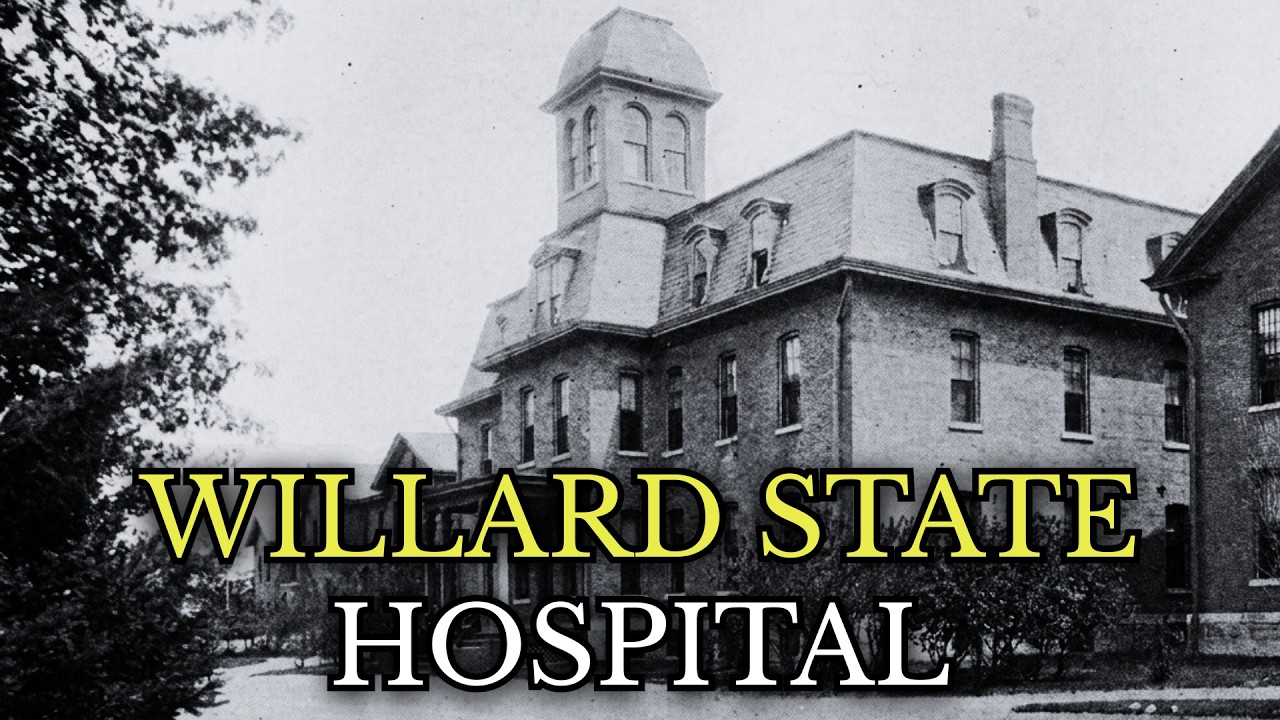
These were not lost bags. They were never picked up because the people who packed them never left. This was Willard State Hospital. And for over a century, it did something quieter and stranger than any ghost story could invent.
It kept people. Not for a season, not for a diagnosis, but for a lifetime. A woman admitted at twenty-four might not leave until she was buried in the ground behind the building, her name reduced to a number on a metal marker. The suitcases in that attic were not a mystery to be solved.
They were proof that every single person who packed one fully believed they were coming back for it. The hospital simply never gave them a reason to unpack. Long before Willard existed, before its lawns and lake views and gentle name, the mentally ill of New York State had almost nowhere to go. If a family could not care for a relative who heard voices or fell into fits, or simply could not function in the world as everyone expected, there were only a handful of grim options: the poor house, the jail, or a locked room at home.
Sometimes for years. Sometimes for a lifetime. In the county alms houses of the 1800s, so-called lunatics were often kept alongside criminals, the elderly poor, and the disabled, with no real distinction made between madness and misfortune. Some were chained to walls.
Some were kept in cages built for animals. Reports from the period describe men and women left without adequate clothing or heat, without anyone to speak to for months at a time. One woman was said to have spent nearly ten years confined to a single cell, found crouched in a corner with nothing but a blanket and the four walls around her. This was not the exception.
This was the system working as designed. It took a reformer named Dorothea Dix to force the country to look directly at what it had been ignoring. She traveled from institution to institution, documenting the suffering she found. By the 1840s, she had begun petitioning states across America to build hospitals instead of cages.
Her warnings reached the New York State Legislature. But reform is slow, and suffering is patient. It would take another two decades before her petition became something more than paper. In 1864, the state finally acted.
It appointed the secretary of the state medical society, a doctor named Sylvester D. Willard, to investigate. His task was simple to describe and brutal to carry out: travel to the alms houses and poor houses of New York and report exactly what he found. What he found confirmed everything Dix had warned of, and worse.
Neglect. Abuse. Human beings treated as burdens to be stored rather than patients to be treated. In January of 1865, Dr.
Willard delivered his report to the state, and it landed with the force of a verdict. Lawmakers could no longer pretend the problem did not exist. A bill began moving through the legislature calling for a new state asylum, one built specifically for the chronic insane. But Dr.
Willard would not live to see his own reform become reality. In the early months of 1865, he fell ill with typhoid fever. On April 8, 1865, the bill Sylvester Willard had fought for was signed into law. He had died days before the signing, never seeing his name attached to the institution that would carry it for more than a century.
Lawmakers decided the new asylum would bear his name, not as a title of honor he had asked for, but as a memorial to the man who had looked directly at suffering everyone else preferred not to see. It was meant to be different from everything that came before it. No chains and cages, but a place of open air, honest treatment, and dignity for people the rest of society had already discarded. Nobody in that room could have imagined what this institution would eventually become, or how long some of its future patients would stay inside its walls.
The land that would become Willard did not begin its life as a place of healing. It began as a gamble that had already failed. Years before the asylum was ever imagined, the state had backed an ambitious project on the eastern shore of Seneca Lake: a place called the Ovid Agricultural College, built to train young men in scientific farming on a stretch of high ground overlooking the water. It was meant to be a symbol of progress.
Then the Civil War came. The entire student body enlisted. The classrooms emptied overnight. By 1862, the college had closed its doors for good, leaving the state holding a mortgage of $40,000 on buildings nobody was left to use.
For a few years, the site sat abandoned, its future undecided. There was even talk that a man named Ezra Cornell might take the grounds for his own new university. That plan fell through. So the empty halls of a failed college sat waiting for a different kind of institution entirely.
When lawmakers went looking for a location for the new state asylum in the mid-1860s, this abandoned campus offered exactly what they needed. Land already owned by the state. Buildings already standing. A remote position beside one of the largest and deepest of the Finger Lakes, far enough from the cities that no one would have to think too hard about what was happening inside its walls.
Construction began in the summer of 1866, adapting the old college structures and raising new ones beside them. The design followed the accepted institutional model of the era, a style used for prisons as often as hospitals: a central administrative building, three stories tall, with long wings extending outward on either side, one wing for men, one for women. Each wing was further divided into wards meant to separate patients by how disturbed or how calm they were believed to be. The board of trustees organized itself formally on May 15, 1869, taking on the powers of the commissioners who had overseen the project until then.
By the autumn of that year, the main building stood ready to receive its first residents. On October 13, 1869, a steamboat pulled up to the dock at Ovid Landing, and the asylum that had existed only on paper for four years finally became real. Several men walked down the gangplank leading a woman in chains. Her name was Mary Rote, and she would be remembered as the first patient of Willard Asylum for the Insane.
Before her arrival, she had spent nearly a decade confined, deprived of adequate clothing, and kept in a single cell with nothing around her but bare walls. When she was found and brought to the boat that would carry her north to Seneca Lake, she was wrapped only in a blanket. She was not the only arrival that day. Three men came with her, each carrying his own history of neglect from whatever alms house or jail had held them before.
By the end of that first month, there were 63 patients living inside the asylum’s walls. Within a single day, that number climbed to 80. By December 31, 1869, the hospital held 142 patients cared for by a staff of 141, almost one employee for every person in their charge. It was something close to the vision its founders had described.
Space. Attention. A ratio of care that no alms house in the state could have matched. What the founders built on the shore of Seneca Lake did not stay a single building for long.
Within a few short years, Willard began spreading outward across the property like a town deciding to grow. The original structure, which patients and staff came to call Chapen House, became only the first piece of something far larger. As the population climbed, the state added new buildings rather than simply packing more beds into the old ones. By the 1870s, a second major structure rose for the women’s population.
They called it Grand View, a name chosen for the sweeping view it offered of the lake below, as if the architects wanted to remind the women inside that beauty still existed somewhere beyond the wards. By 1877, Willard had grown into the largest asylum in the state of New York, home to 1,500 patients spread across 475 acres of farmland, orchards, and shoreline. It no longer resembled a single hospital so much as a self-contained village, complete with its own rhythms, its own economy, and its own close relationship with the small communities of Ovid and Romulus that bordered its land. Unlike many asylums of the era, which kept their patients locked indoors behind barred windows, Willard’s doctors believed in something they called moral treatment: a philosophy built on fresh air, purposeful labor, and the healing power of open space.
Patients were not confined to their wards during the day. They walked the grounds. They tended gardens. They worked the hospital’s own farm, growing crops, raising cattle, pigs, and chickens, tending orchards whose fruit fed the very people who had planted the trees.
The institution ran its own sewing room and tailor shop where patients stitched aprons, nightgowns, and shirts, along with the uniforms worn by the nurses and orderlies who supervised them. For a portion of its patients, work was not punishment. It was structure, purpose, a reason to rise in the morning inside a place that offered very few other reasons. Willard did not stop at farmland and workshops.
Over the following decades, the campus added a bowling alley, a gymnasium, and eventually a theater that showed motion pictures on Monday nights, open not only to patients but to the surrounding community. Families from Ovid would walk onto the hospital grounds on an ordinary evening, sit beside patients they might otherwise never have spoken to, and watch the same flickering picture on the same screen. The local newspaper carried a regular section devoted to social events held at Willard, treating hospital dances and gatherings with the same casual interest it gave to any other town. There was even a golf course open to residents of Ovid as well as to the patients well enough to play it, blurring a line that most other asylums in America would never have allowed to blur at all.
For the people living just outside its gates, Willard was not a distant, frightening institution locked away behind fences. It was a neighbor. Children from town grew up watching movies on the hospital’s screen. Nurses trained at Willard’s own nursing school and stayed to build careers there, sometimes for their entire working lives.
One woman who later worked at the hospital remembered decades afterward that the town and the hospital were very interconnected, and that she had grown up watching films on those very same Monday nights as a child, never imagining she would one day wear the uniform of the staff who worked there. This closeness was part of what made Willard so unusual, and part of what would make its eventual fall so difficult for the surrounding community to reconcile. It was never an isolated fortress of suffering, sealed off from ordinary life. It was woven into it.
But beneath everything lay a population that kept climbing. A campus built for hundreds now holding thousands. And a set of ideals that would soon be tested by the one thing no philosophy of fresh air and honest labor could ever fully solve: the sheer number of people the world kept sending through its gates. The philosophy that built Willard’s farms and theaters was only half of what happened inside its walls.
The other half took place in rooms far removed from the golf course and the bowling alley, rooms where the hospital’s gentler ideals collided with the harder science and pseudoscience of its era. Moral treatment had promised fresh air and purposeful labor as a cure for the mind. But as the population climbed past 1,000, then 2,000, then closer to 3,000 patients by the 1930s, the doctors of Willard reached for other tools as well. Tools that reflected both the genuine medical understanding of the time and its enormous, often frightening blind spots.
Restraint was one of the earliest and most enduring of these tools. Among the devices kept in use for decades was something staff called the strong dress: a heavy garment of thick gingham fabric designed to be pulled over an agitated patient and bound in place, restricting movement without the visible cruelty of chains. There were wooden chairs as well, built directly on the hospital grounds, deliberately heavy and fitted with wide armrests where restraints could be fastened, built heavy enough that a struggling patient could not tip them over. Decades later, one of these chairs would sit inside a small museum near the hospital grounds, its wood darkened with age, a printed card beside it explaining plainly what it had once been used for.
As medicine changed through the twentieth century, so did the treatments Willard offered. Electroconvulsive therapy became a standard practice inside its wards, along with a treatment called hydrotherapy, though patients who endured it often remembered it more simply as the ice bath: a method of forcing calm onto an agitated body by plunging it into cold water for extended stretches of time. These were not treatments invented at Willard, nor practiced only there. They were the accepted medicine of psychiatric hospitals across the entire country during the middle decades of the twentieth century, methods that doctors at the time genuinely believed represented progress.
What made Willard’s version of this story especially difficult was scale. A hospital built with a ratio of nearly one staff member for every patient in its first winter had by 1934 grown to hold almost 3,000 patients at once. By 1950, more than 1,000 employees worked across the Willard campus, a number that sounds substantial until it is measured against the population it was meant to serve. Wards that had once held a manageable number of patients per nurse now held far more.
In some reported cases, ten times what a given space had originally been designed to hold. In the more crowded corners of the hospital, patients considered unmanageable were confined in enclosures never meant for people, placed directly in the hallways, a detail that stood in stark contrast to the golf course and movie nights taking place elsewhere on the very same grounds. It would be simple and inaccurate to call Willard a house of horrors from its first day to its last. It would be equally inaccurate to call it the gentle, sunlit farm community its brochures and local newspaper coverage often suggested.
It was both, layered over one another, shifting in balance depending on the decade, the ward, and the doctor making the decisions. What tied every era of treatment together was the same assumption sitting beneath all of it, one that would come to define the hospital far more than any single scandal or any single cruel employee ever could. Every hospital has an admissions office. Very few hospitals build their entire identity around what happens on the other side of that same door, the side marked exit.
At Willard, that side of the door functioned differently than almost anywhere else in American medicine. A patient could not simply decide they were ready to leave. Discharge required approval from hospital administrators, a decision made by the very institution that benefited from a stable and predictable population. There was no outside authority checking whether that approval came quickly, slowly, or not at all.
And so for tens of thousands of people who passed through Willard’s gates across the full span of its operation, admission turned out to be far easier than release. Across its entire history, roughly 54,000 people lived within Willard’s walls at some point in their lives. More than one in three of them died there, never returning to whatever town, apartment, or family they had left behind on the day they arrived. For the ones who survived long enough to leave, the average length of stay was not measured in weeks or months, the way a modern hospital stay might be.
It was measured in decades. A person committed at 25 might not walk back through the gates until they were nearing 70, if they walked out at all. Consider Rodrigo L. , a man who had been sent from the Philippines as a boy of only nine years old to be educated in the United States, who went on to teach high school in Chicago before eventually working as a servant in upstate New York.
He was admitted to Willard in 1919, suffering from persistent delusions that he had sinned and hearing voices that accused him without end. Two years later, in 1921, he wrote a letter to his uncle, ending it with a line that captured the entire uncertainty of life inside Willard’s walls. He had no definite knowledge yet of when he would obtain his freedom. He would spend the rest of his life waiting for an answer to that question.
Rodrigo L. died at Willard in 1981, sixty-two years after he first arrived, having spent more time inside the hospital than most people spend in their entire adult lives outside of one. Then there was Meline C. , a graduate of the Sorbonne, a single French woman of considerable means who had once traveled the world, photographed beside a fur stole in front of a mansion, snapshots of the seashore labeled in careful French cursive.
She sought psychiatric help while living in New York City and eventually found herself a patient at Willard, where staff came to consider her difficult, sharp-tongued, resistant to the routines expected of her. She was finally transferred out of Willard in 1975, when she was nearly eighty years old, a woman who had once toured Europe, Canada, and California, now leaving an institution she had entered decades earlier as a woman still in the middle of her life. Another was Frank C. , a United States Army veteran born in 1919 who worked as a chauffeur in New York City before enlisting and serving his country.
After his discharge from the military, he struggled to support himself, and following a single outburst at a restaurant in the Flatbush neighborhood of Brooklyn, he was admitted to Willard in 1946 at the age of thirty-five and diagnosed with paranoid schizophrenia. In a letter he wrote afterward, never sent or perhaps kept only in duplicate, he tried to explain what had happened to him in his own words. “I am not sick,” he wrote. “I got excited on Fulton Street and I was throwing garbage.
My blood temper. I was angry. ” Whatever the truth of that single afternoon on Fulton Street, it was enough to determine the rest of his life. Lastly, Freda B.
, born in 1908, a schoolteacher and a single woman, was admitted to Willard in 1932 following episodes of screaming in public, discharged the following year, then readmitted again not long after. Nursing records described her as withdrawn to the point that staff had to intervene to keep her fed, lying in bed with her eyes closed, indifferent to everything and everyone around her. In her own words, recorded during an interview with hospital staff, she said only this: “I think I will be here all my life. ” Her later records were lost, but nothing in what survived suggests she was wrong.
These were not unusual cases inside Willard’s walls. They were the ordinary shape of life there. A veteran who lost his temper once on a city street. A schoolteacher whose public breakdown became a permanent diagnosis.
An immigrant who arrived as a child and left as an old man, if he left at all. A woman of means and education who simply became inconvenient to manage. None of them had committed a crime. None of them had been sentenced to a fixed term, the way a prisoner might understand exactly when their punishment would end.
They had been admitted, and then the calendar simply continued turning around them, year after year, decade after decade, with no clock counting down toward a release date because no such date had ever been set. This is the door that gave Willard its particular unspoken horror, more unsettling in some ways than any restraint chair or any ice bath. Not a single dramatic act of cruelty, but an ordinary bureaucratic absence: the simple fact that nobody outside the institution was ever required to ask when a person might be allowed to leave. And so for thousands of people, nobody ever did.
Every institution has two histories. The one told by the people who ran it, and the one told by the people who lived inside it. At Willard, those two histories rarely matched. A woman who grew up in the nearby town of Ovid and later graduated from Willard’s own nursing school in 1969 remembered the hospital with genuine warmth.
She recalled watching movies on the hospital’s screen as a child, long before she ever wore its uniform, and she spoke of the campus as a place woven so tightly into the surrounding community that she struggled even decades later to describe the two as separate. She remembered specific patients by name and manner rather than diagnosis, recalling one man, an immigrant from the Philippines, as a formally dressed gentleman who always wore a suit and who left Willard for the outside world more than once, only to return each time because he felt more comfortable within its walls than beyond them. To her, Willard had, in her own words, felt like a kind of family. Terry Garahan saw the same institution and described something considerably darker.
Garahan worked at Willard during the 1970s, helping to transfer patients out of the hospital and into community care settings as the broader system began its long unwinding, before going on to a career as a social worker and later as a hostage negotiator for the Federal Bureau of Investigation, performing threat assessments related to mental illness for law enforcement agencies. When later asked about the fonder memories shared by the woman quoted earlier, Garahan pushed back directly, noting that she had, in his words, a very sunny view, one built around the idea of Willard as a family. He rejected that framing outright. “People were placed there against their will,” he said.
“They wanted to get out. They wanted to regain their freedom. ”
Garahan described witnessing staff members resort to physical violence as a means of managing patients considered uncooperative. And he spoke more broadly about how vulnerable patients could be exploited by the people who held power over them, a detail he offered not to shock but simply because he had seen it firsthand and considered it part of the honest record.
Patients, he said, had lost their human rights inside those buildings. They had no agency over their own lives. That was not any kind of family he would ever want to belong to. Both of these accounts came from people who had actually walked Willard’s halls and watched its population move through the daily reality of institutional life.
A hospital housing thousands of patients across more than a century could hold both of these realities at once: a nurse who genuinely cared for the people under her watch, and a ward elsewhere on the same campus where power was abused by those who held it. What made Willard’s version of this story worth remembering was not that it was uniquely cruel nor uniquely gentle, but that both of these truths existed under the same roof, depending entirely on which ward a patient occupied and which staff member happened to be on duty. Not far from the wards and workshops of Willard, past the orchards the patients themselves had planted, sat a stretch of land that would eventually hold more of the hospital’s story than any building on the main campus. This was the Willard Cemetery, twenty-nine acres set aside for the patients who died within the hospital’s walls, and across more than a century of use, it filled with more people than most small towns ever hold.
A sign at its entrance today states the number plainly: 5,776 departed Willard patients rest inside its boundaries. Almost none of them are marked with a name. For decades, the state’s approach to patient privacy meant that a person who had spent thirty, forty, sometimes sixty years inside Willard’s wards would, upon death, be given a grave marked only by a number: a small metal spike or a flat aluminum disc set into the grass, disconnected from the name the person had carried their entire life. Somewhere in a hospital ledger, that number was matched to an identity.
But the ledger itself was treated as confidential, sealed away from families who might spend years searching for a relative they knew had died there and simply could not locate in the ground. One man, however, became inseparable from that cemetery in a way no other patient did. His name was Lawrence Mocha, born in 1878 in a region then part of Austro-Hungarian Galicia. He served in the military in his youth before immigrating to the United States, eventually finding work at Bellevue Hospital in New York City.
He arrived at Willard in 1918 and would remain there for the rest of his life. Rather than living solely within the wards, Lawrence Mocha took on work as the cemetery’s gravedigger, a role he held for roughly fifty years. During the warmer months, he lived in a small shack built in the middle of the cemetery grounds themselves, close enough to his work that the line between his job and his residence nearly disappeared. Because groundwater in the region would seep into a freshly dug hole almost as quickly as he could dig it, Lawrence Mocha worked in hip waders, standing in the rising water of his own excavation.
Over the five decades he spent at this task, he is estimated to have dug more than 1,500 graves, a number that likely includes many of the very numbered plots surrounding his own eventual resting place. When Lawrence Mocha himself died, he was buried in that same cemetery under a marker bearing only a number, exactly like every other patient he had spent half a century helping to bury. For years, this was simply how his story ended: an unnamed grave among thousands of other unnamed graves, dug in part by his own hands. It took a group of local volunteers working through what became known as the Willard Cemetery Memorial Project to change that ending.
They petitioned the state to allow a memorial plaque acknowledging at least one of the thousands buried on the grounds, hoping a single named marker might serve as a gesture of respect toward everyone else still resting anonymously beside him. The state’s Office of Mental Health initially resisted, citing the same patient privacy concerns that had kept every grave unnamed for over a century. Then, in December of 2014, following newspaper coverage of the dispute, a letter arrived informing the volunteers that a living relative of Lawrence Mocha had been located and had given consent for a memorial to be placed. In May of 2015, a small crowd gathered under a white tent at the Willard Cemetery to unveil a stone memorial in his honor.
A shovel handle was set into the gravel beside it. A plaque described the fifty years he spent digging graves for the patients around him. A minister read aloud an old saying to the gathering that day: that a person dies twice, once when their breathing stops, and a second time when no one speaks their name again. For one grave among 5,776, that second death had finally been undone.
For nearly all the others, it remains to this day still waiting to happen. In February of 1995, New York Governor George Pataki announced that Willard would finally close. Part of its campus would be converted into a drug treatment center. The rest would be shuttered permanently.
Before any of that could happen, someone needed to walk through the hospital’s remaining buildings and document what was left behind: the furniture, the equipment, the nineteenth-century medical instruments that had outlived the doctors who once used them. That task fell to a man named Craig Williams, then a curator at the New York State Museum in Albany, who spent much of that spring moving through Willard’s emptying halls with a clipboard and a camera. One morning in April of that year, a longtime storehouse clerk named Beverly Courtright told Williams there was something he needed to see. She led him to a deteriorating brick building that had once housed the hospital’s medical laboratories and its occupational therapy rooms.
Together, they climbed several flights of stairs to an open attic space, exposed wooden rafters overhead, and a brick wall at one end of the room. Set into that brick wall was a door. Courtright did not open it herself. She simply pointed and let Williams go through alone.
On the other side was a large room lit only by broken windows and holes torn in the roof, dust floating through the shafts of daylight like something suspended in water. Along the walls stood rough wooden shelves, and on those shelves sat hundreds of suitcases, trunks, and crates, each one bearing a handwritten tag with a patient’s name and the date they had been admitted. Williams called his supervisors in Albany to ask what he was supposed to do with what he had found. Under New York state law, property could be transferred freely from one state entity to another, meaning the museum was entitled to take the suitcases if it chose to.
His supervisors told him to keep no more than ten for archival purposes and destroy the rest. Williams could not bring himself to do it. He went back to the attic a few days later with several former Willard employees, and together they wrapped every remaining case in cloth and prepared them for transport. A handful of elderly patients were still living on the Willard campus at that time, awaiting transfer to other facilities, and their suitcases were returned directly to them.
The rest, 427 containers in all, not only suitcases but trunks, crates, and doctor’s bags as well, were shipped from the Willard grounds to a state museum warehouse outside Albany, where volunteers began the slow work of cataloging what they held. Most were never opened at all. What those cases contained, when they finally were opened, said more about the people who owned them than any medical file ever could. A green trunk belonging to Frank C.
held his old military uniform alongside a studio portrait of himself wearing that same uniform, war ration books, letters once sent from the War Department to an address in Brooklyn, and a deposit book from a Brooklyn savings bank, the ordinary financial record of a life interrupted. Rodrigo L. ‘s trunk was filled almost entirely with books: a copy of The Last Days of Pompeii, a worn edition of Don Quixote, a three-volume collection of Edgar Allan Poe, alongside a handwritten manuscript he had written himself, and a copy of the bylaws of a Filipino working men’s club he had once belonged to in Wyoming. Pressed between the pages of some of those books were leaves, flowers, and dragonflies.
Small fragments of the outside world he had carried inside with him and never let go. Meline C. ‘s trunk unfolded into an entire portable wardrobe, with drawers and a hanging rack built into the case itself, holding a library slip for a book by Sigmund Freud, two volumes of William James, and an address book filled with elegant handwriting connecting her to cities across three continents. And in one suitcase belonging to a man remembered only as Benjamin M.
, there was almost nothing at all. A single toothpick and no other object beside it. The entire recorded material trace of a human life reduced to one small, ordinary thing. Nearly a decade after Williams saved them, in 2004, a selection of these cases became the centerpiece of an exhibition at the New York State Museum built around a dozen of them, entitled Lost Cases, Recovered Lives.
It ran for close to a year and later toured the country for another decade beyond that. A photographer named Jon Crispin, granted access to the warehouse in 2011, would go on to spend six years photographing every one of the surviving suitcases, careful each time to remove any surname from public view, protecting the privacy of people who had never been given the chance to protect it themselves. What Williams and Crispin had really uncovered was not simply a curiosity in an abandoned attic. It was physical proof of the very thing this story had been circling from the start.
Every one of these suitcases had been packed by someone who expected to use it again. Someone who folded a nightgown, or a shaving kit, or a stack of beloved books, believing they would need them again soon in whatever life was waiting for them beyond Willard’s gates. For most of the people who owned them, that life never came. The suitcases simply waited in a locked attic behind a brick wall for a homecoming that would never happen.
By the middle of the twentieth century, the entire system that had built Willard was beginning, slowly and then quickly, to fall apart. In 1955, more than 93,000 patients lived inside New York State’s mental hospitals, Willard among the largest of them. A population so vast it required its own farms, its own rail landings, its own small cities built to house a problem the rest of society preferred not to think about. Change did not arrive all at once.
It arrived first as a shift in law, then as a shift in money, and only afterward as a shift in how the country actually saw the people locked behind those hospital gates. In 1960, New York made it illegal for patients to work without being paid a wage. A well-intentioned reform that nonetheless gutted the agricultural labor system Willard had depended on for nearly a century. The orchards, the dairy herds, the sewing rooms that had once given patients purpose and given the hospital free labor in equal measure began winding down almost overnight.
Then, on October 31, 1963, President John F. Kennedy signed the Community Mental Health Act, a law built around a genuinely hopeful idea: that patients could be treated closer to home, in their own communities, rather than warehoused for life inside distant state institutions. Two years later, in 1965, the introduction of Medicaid added federal funding specifically for outpatient mental health care, giving states a financial incentive to move patients out of state-run hospitals rather than keep them there indefinitely. Money had once flowed toward keeping Willard full.
Now money began flowing in the opposite direction. Public opinion turned as sharply as policy did. In 1972, journalist Geraldo Rivera aired an exposé on conditions inside Willowbrook, another New York State institution, revealing overcrowding and neglect so severe that it shocked a national audience already growing uneasy about large psychiatric institutions in general. Enrollment in large state hospitals across the country, Willard included, began falling sharply in the years that followed, as smaller community-based group homes became the preferred model of care.
In 1975, the United States Supreme Court delivered a ruling that struck directly at the foundation Willard had been built upon since 1869. A state could no longer confine a person to a mental hospital if that person was capable of living safely in the outside community. For the first time in Willard’s history, an outside authority had drawn a legal line around how long an institution could be permitted to hold someone against their will. By 1994, the statewide population that had once numbered 93,000 patients had fallen to fewer than 12,000.
The state had already threatened to close Willard on several prior occasions, only to reverse course each time. In 1992, a formal proposal called for the hospital to close entirely by the end of 1996. It would close even sooner than planned. In February of 1995, Governor George Pataki confirmed what years of shrinking budgets and shifting policy had already made inevitable.
In April of 1995, the hospital discharged its very last patient. On May 1, 1995, Willard officially closed its doors, 126 years after Mary Rote first stepped off a steamboat in chains. But the closing of an institution and the closing of a life are two very different things. And for some of the people who had spent decades inside Willard’s walls, the difference proved almost impossible to reconcile.
Former staff who helped manage the final transfers later recalled that some of the hospital’s oldest, longest-tenured residents did not want to leave, even as the last wards emptied around them. These were not patients still requiring confinement by any medical standard of the day. Many had lived at Willard for thirty, forty, even fifty years. Long enough that the outside world these transfers were meant to return them to no longer existed in any form they would recognize.
For them, Willard was not an institution to be escaped. It was the only home they had left, the only rhythm of days they had ever known as adults. And some had to be walked out of buildings they had entered as young men and women, and were now leaving as the very old. The doors that had been so difficult to open for over a century proved just as difficult to close.
When the last patient walked through Willard’s gates in the spring of 1995, the campus did not simply go quiet. Part of it changed uniforms almost immediately. Later that same year, on October 1, 1995, the state opened the Willard Drug Treatment Campus inside a building on the property once known as the Birches, converting roughly $8. 6 million of state funding into a 900-bed facility for convicts undergoing court-ordered drug treatment, a boot camp style program built to hold nearly as many people as the psychiatric hospital once had.
Where patients in hospital gowns had once walked the grounds under the belief they might someday be released, convicts in prison uniforms now walked similar paths under a sentence that at least came with a fixed and knowable end date. A small, strange improvement that the original patients of Willard had never been given. The rest of the campus received no such second life. Because the psychiatric hospital’s closing had come together so quickly, no real plan existed for securing dozens of aging buildings scattered across 475 acres of land.
Chapen House, the very first structure patients had entered back in 1869, could not even be saved as a preserved landmark. It was demolished in the early 1980s, years before the hospital itself closed, its wards reduced to rubble and hauled away. Other structures across the property were left simply to decay, their windows broken by weather and time, their interiors slowly given back to mold and dust. A small museum eventually opened inside what had once been the home of the hospital’s chief engineer, run for years by a former Willard nurse who gave tours to visitors curious about the institution’s history.
In 2021, the New York State Department of Corrections and Community Supervision announced that the Willard Drug Treatment Campus itself would close in March of 2022, ending even that second chapter of the property’s life after less than three decades in operation. Today, the site is managed by the Empire State Development Corporation, which continues to weigh what should be done with the buildings still standing. In 2022, the Preservation League of New York placed Willard on its list of historic sites most urgently in need of protection, describing the campus’s remaining buildings not as relics of one town’s local history, but as tangible reminders of a subject far larger than Willard itself: the way an entire country once chose to think about mental illness, and the cost of that choice, still standing in brick and broken glass on the shore of Seneca Lake. Meanwhile, the suitcases that Craig Williams had refused to destroy in 1995 found themselves caught in an entirely new kind of limbo.
In 2014, the New York State Museum determined that the collection raised what it called significant questions of ownership, concluding that the suitcases and their contents were personal property rather than belongings of the state, and that they would remain closed to researchers, artists, and photographers until the museum could identify rightful owners for each individual case and request that they be formally donated back. Nearly three decades after Beverly Courtright first led a curator up a flight of attic stairs, the very objects rescued from destruction sat locked away once more. Not behind a brick wall inside a crumbling laboratory building this time, but behind a different kind of door entirely, one built from paperwork and an unresolved question of who still had the right to open it. There is a particular kind of ghost story people expect from a place like Willard.
Cold hallways. Flickering lights. Something unseen moving through an empty ward at night. But the true haunting of Willard was never supernatural, and it never needed to be.
It was simpler than that, and far harder to shake. It was a woman admitted at 24, buried on the grounds at 70. It was a man who arrived from the Philippines as a child and died at Willard 62 years later, still uncertain of when he might be allowed to leave. It was 427 suitcases packed by people who fully believed they were coming back for them, sealed instead behind a brick wall for half a century.
It was patients in 1995 who, offered their freedom at last, chose instead to stay because the outside world had long since stopped being theirs to return to. None of these were paranormal events. They were simply what happens when an institution built with good intentions is allowed to operate for 126 years without anyone outside its gates asking a single necessary question. How long is too long?
Willard never set out to become a place where people disappeared into decades. It began as a genuine act of reform, a response to chains and cages and neglect that a doctor named Sylvester Willard uncovered and gave his final months to correcting. But reform without an exit built into it eventually becomes its own kind of confinement. The lesson the suitcases leave behind has little to do with ghosts and everything to do with time, and with the hidden danger of any system that forgets someone is always waiting on the other side of its decisions.
Today the wards stand empty. The cemetery holds 5,776 people, nearly all of them resting under a number instead of a name. And in a warehouse outside Albany, hundreds of suitcases still sit, waiting for an ending that has not yet arrived. Willard was never haunted by anything that walked its halls at night.
It was haunted by every person who packed a bag, expecting to use it again, and never got the chance. That is the only ghost this story ever needed. That is the haunting that actually matters.
