On January 14th, 1979, in a house in Queens, Tommy DeSimone walked through a door expecting wine, cigars, and the ceremony he had been chasing his entire life. Instead, he got bullets. Goodfellas told you he died because of Billy Bats, because of one barroom beating nine years earlier. That is the story Martin Scorsese sold you, but it is not the whole truth.
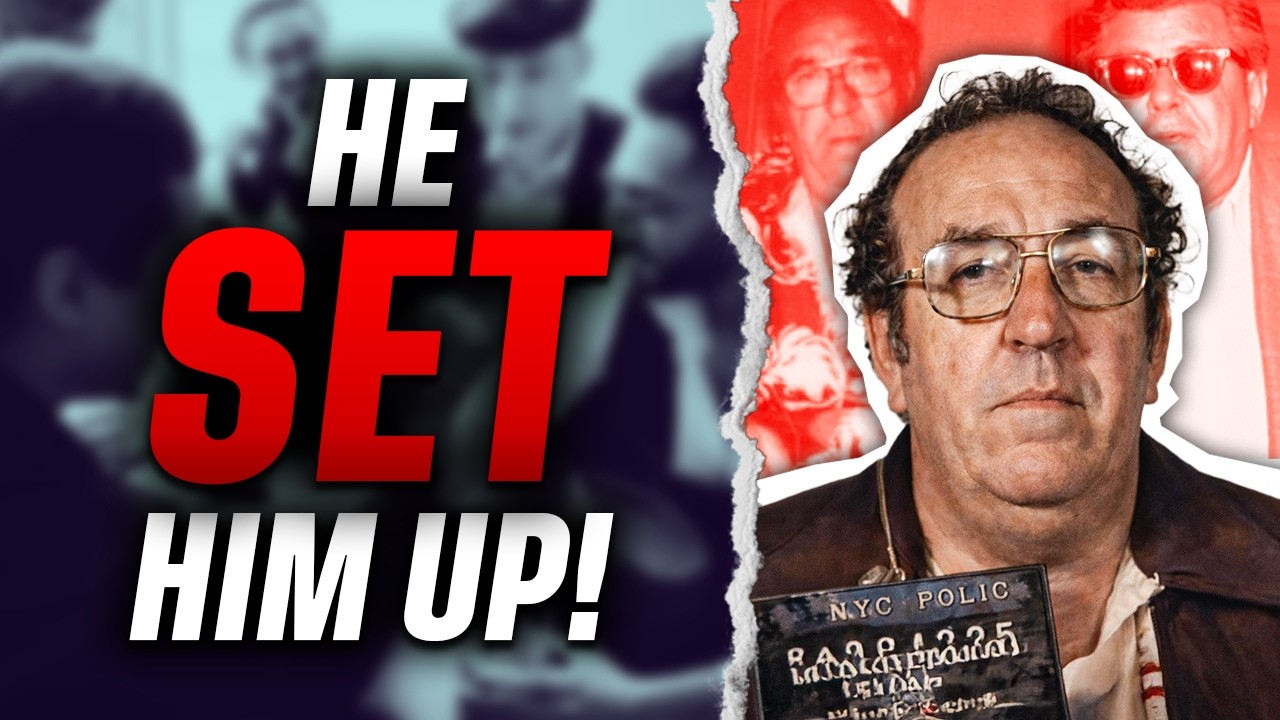
The man who actually signed Tommy DeSimone’s death warrant wasn’t a Gambino. It was the man Tommy called his boss, the man who smiled at him, vouched for him, and then stepped aside and let him die. Paul Vario. The version of Paulie that most people know comes from the movie, where Paul Sorvino plays him as a quiet, dignified patriarch, a man of few words and calm authority, someone who dispenses wisdom from lawn chairs, handles problems with a nod, and commands respect without raising his voice.
That version is partially accurate, but it is missing the single most important thing about him. Paul Vario was a survivor, not a warrior, not a legend, not a showman. A survivor. And in the mafia, that is the rarest thing of all.
Born in 1924 in Brooklyn, Vario spent four decades working his way through the Lucchese crime family. Not climbing. Working. There is a difference.
Climbers make noise. They chase titles. They want people to know their name. Vario did the opposite.
He kept his head down, kept earning, and kept his name out of every conversation that didn’t need to include it. By the 1970s, he was a capo with his own crew, his own earners, and his own carefully maintained political relationships inside and outside the family. His operations ran through Brooklyn and Queens: loan sharking, gambling, stolen goods, airport hijackings out of Kennedy. He had people in the unions.
He had people inside cargo terminals. He had people in legitimate businesses feeding him information, tipping him off, moving cash through front companies. Vario had built an ecosystem, and he sat at the center of it, invisible to everyone except the people who needed to know he existed. That invisibility was the strategy.
He didn’t want his name in newspapers. He didn’t want FBI surveillance parked outside his social club. He didn’t want city councilmen calling press conferences about organized crime in Queens with his photograph on a poster board. He wanted one thing: to earn quietly, stay out of prison, and protect his standing inside the Lucchese family.
His entire philosophy could be condensed into three rules: stay useful, stay invisible, stay alive. For four decades, that philosophy worked perfectly. His relationship with Jimmy Burke was the centerpiece of everything. Burke was Irish.
He could never be made, never hold a formal rank inside a family. But Burke was one of the most talented earners in New York organized crime, and Vario was too smart to let ethnicity get in the way of a profitable partnership. Burke generated income consistently. He generated loyalty from his crew.
He generated results on scores that other crews couldn’t pull off. And Vario, in exchange, provided the one thing Burke couldn’t generate himself: cover. The family umbrella. The political protection that allowed Burke to operate freely without interference from other crews who might otherwise see him as a target.
Henry Hill fit into that structure as the connector. He linked Burke to Vario when Hill was still a teenager. He became a liaison, a fixer, a man who understood the politics well enough to navigate them without creating friction. Vario valued that.
Hill didn’t make problems. He solved them. Tommy DeSimone was different, and Vario knew it from the very beginning. Here is something Goodfellas never makes fully clear: Tommy DeSimone was valuable to Paul Vario the way a loaded gun with a broken safety is valuable.
Extremely useful. Extremely dangerous. And eventually inevitable. Tommy was a killer.
Not a strategic killer, not a man who killed when the business required it. Tommy killed when Tommy felt like it. He killed bartenders. He killed made men.
He killed associates. He killed people who looked at him wrong, spoke to him wrong, reminded him of a version of himself he didn’t want to remember. Tommy’s violence wasn’t a tool. It was a compulsion.
But that compulsion made him useful to Vario’s crew in specific circumstances. Hijackings needed enforcers. Debt collections needed men who didn’t hesitate. Situations that required physical intimidation needed someone whose reputation alone could end a confrontation before it started.
Tommy filled that role completely. Vario kept Tommy around because Tommy produced. He was part of scores. He was part of Burke’s hijacking network.
He moved product. He collected money. He was, in the language of organized crime, an earner. But here is the distinction that Goodfellas glosses over entirely: Tommy was never protected.
Not really. He was useful. Those are two completely different things. A useful man gets work.
A protected man gets defended when the politics turn against him. Vario never confused the two. Tommy did, and that confusion is what killed him. In Vario’s world, men had value as long as their contribution outweighed their cost.
The moment that equation flipped, the moment Tommy cost more than he earned, Vario’s loyalty evaporated completely. Not because Vario was cruel. Because Vario was a businessman, and businessmen don’t carry dead weight. Especially not dead weight that keeps making powerful enemies.
In organized crime, every unsanctioned killing goes on a ledger. Tommy DeSimone’s ledger was catastrophic. June 11th, 1970, the Bamboo Lounge. Tommy beats Billy Bats unconscious.
Bats is a made man in the Gambino family. Jimmy Burke helps finish him. They bury the body in upstate New York. The Gambinos suspect Tommy immediately, but they have no body.
They have no proof, and without proof, they can’t move against another family’s associate without triggering a war. So the Gambinos wait. They log it. They remember.
They build the case slowly, the way patient men build everything, one fact at a time. Then, December 18th, 1974, Tommy kills Ronald Jerothe, known as Foxy, a Gambino associate connected directly to John Gotti’s crew. The motive was personal: a dispute, a woman, a threat. The exact details depend on who is telling it, but the result isn’t disputed.
Tommy went to Jerothe’s apartment and shot him. Jerothe was found. The Gambinos knew who did it. Understand what this meant for Paul Vario.
Every time Tommy killed a Gambino-connected man without permission, that debt landed on Vario’s desk. Not Tommy’s desk. Vario’s. Because Tommy was Vario’s associate.
Tommy operated under Vario’s umbrella. In the protocol of the five families, the capo is responsible for his men. If your man crosses a line, the other family doesn’t go to your man. They come to you.
So while Tommy was out there killing without consequence, Vario was accumulating political debt he hadn’t agreed to carry. Every conversation Vario had with Gambino representatives after 1974 was conducted in the shadow of those two killings, Bats and Jerothe. Two names that sat on the table every time business required cooperation between the families. Vario couldn’t ignore that forever, and the Gambinos knew it.
The genius of the Gambinos’ approach was patience. They didn’t demand immediate restitution. They didn’t go to war. They simply waited, because they understood something important: eventually, Tommy would make himself too expensive to protect.
And when that day came, they wouldn’t need to fight for justice. They would just need to ask. December 11th, 1978, Kennedy Airport. Six armed men.
Five point eight million dollars in cash, eight hundred fifty thousand in jewelry. The biggest cash robbery in American history. And Tommy DeSimone was right in the middle of it. The Lufthansa heist should have been Tommy’s greatest score, the job that finally gave him the kind of money and standing he’d been chasing since he was a teenager shining shoes in Queens.
Instead, Lufthansa accelerated everything that was already working against him. Here is why. The heist went perfectly. The cleanup did not.
Parnell “Stacks” Edwards was given one job: drive the van to a junkyard in New Jersey, have it crushed, destroy the evidence. Stacks got high on cocaine instead and left the van parked on a street in Ozone Park. Three days later, police found it. FBI forensic technicians pulled fingerprints off the steering wheel, the door handles, the gear shift.
The entire crew was suddenly visible in a way that Jimmy Burke’s careful operation had never allowed before. Burke made the calculation quickly. Dead men don’t testify. He started eliminating everyone connected to the heist: Martin Krugman, the Capores, Frenchy McMahon, Joe Manri.
One by one, people who knew what happened on December 11th stopped existing. Tommy participated in those killings. He walked into Stacks Edwards’ apartment in Ozone Park on December 18th, 1978, raised a . 38 caliber revolver, and fired six times.
Five shots hit Stacks in the face and chest. One missed. The whole thing took eleven seconds. But here is what nobody asked at the time: who authorized that?
Stacks Edwards was a low-level errand runner. He wasn’t made. He wasn’t protected. Killing him wasn’t a political act.
It was housekeeping. Burke ordered it. Tommy executed it. But the killing drew FBI attention directly back to Burke’s crew.
Agents who’d been watching the Lufthansa investigation saw the bodies piling up. They started building a picture, and that picture had Tommy DeSimone’s face in it. For Paul Vario, the post-Lufthansa period was a nightmare in slow motion. His crew was being dismantled by federal investigators.
His most reliable earner, Burke, was going to end up in prison. And his most volatile associate, Tommy, was now on the FBI’s radar for multiple murders connected to the biggest unsolved heist in American history. Tommy hadn’t become more powerful after Lufthansa. He’d become more exposed.
And exposed men make everyone around them nervous. Especially the capo who is supposed to be invisible. Sometime in late 1978 or early 1979, the Gambinos made their move. Not with violence.
With protocol. You have to understand how this conversation actually happens. In the mafia, you don’t call up another family and announce you’re going to kill their guy. That’s not how it works.
What you do is communicate through proper channels that a problem exists. That certain violations have occurred. That the families involved have an outstanding matter requiring resolution. And then you wait for a response.
The Gambinos’ position was simple. Tommy DeSimone had killed two of their men. One of them was made. The debt was nine years old for Bats, four years old for Jerothe.
Both remained unpaid. And the Gambinos were prepared to collect. But they couldn’t act unilaterally. Not against a Lucchese associate.
The political consequences of an unauthorized interfamily killing were too severe. They needed Vario’s silence at minimum, his cooperation at best. So the question was put to Vario. Not directly, because powerful men never ask for things directly.
It was communicated the way all mob business is communicated: through intermediaries, through suggestion, through the kind of conversation where nothing is stated but everything is understood. And Vario had to do the math. Option one: defend Tommy. Go to the Gambinos and argue that Tommy’s killings were provoked, that the debts were disputable, that the Lucchese family stands behind its men.
That option preserves Tommy’s life. But it costs Vario the goodwill of one of the most powerful families in New York. It means ongoing tension, ongoing debt, ongoing complications to every piece of business that requires Gambino cooperation. And for what?
For an associate who was already drawing FBI heat? For a man who had proven repeatedly he couldn’t control himself? Option two: step aside. Communicate in the language of omission that Tommy was no longer under active protection.
That if a problem required solving, the Lucchese family wouldn’t interfere. That option solved four problems simultaneously. It repaid the Gambino debt. It eliminated a liability.
It removed an FBI heat magnet from Vario’s orbit. And it preserved the political relationships Vario had spent forty years building. For a man like Paul Vario, that wasn’t even a difficult decision. That was arithmetic.
The betrayal was business. Here is the part that Goodfellas completely sanitizes. Tommy’s death is presented in the movie as mob justice, almost poetic. He killed a made man, and eventually that crime caught up with him.
The universe balanced itself. The system worked. But that framing removes the most important human element in the story: Paul Vario’s choice. Because the Gambinos couldn’t have killed Tommy without Vario’s silence.
That’s not speculation. That’s how the protocol works. If Vario had gone to the Lucchese administration and said Tommy is one of mine and I’m protecting him, the calculus changes entirely. An interfamily killing without resolution creates war.
And nobody wanted war in 1979. Not with the FBI already circling the entire New York mob structure. Vario’s silence was the weapon. He didn’t pull the trigger.
He didn’t order the hit. He simply declined to prevent it. And in the mafia, declining to prevent something is the same as authorizing it. What did Vario get in return?
Everything that mattered to him. He cleared a nine-year political debt with the Gambinos. He removed the single most volatile member of his crew. He distanced himself from the Lufthansa investigation by eliminating one of its most visible participants.
And he sent a message to every other associate under his umbrella: there are limits. Cross them, and the umbrella disappears. Tommy thought loyalty was personal. He thought because he’d killed for Vario, earned for Vario, bled for Vario, that Vario would protect him the way you protect family.
But Tommy wasn’t family. Tommy was an asset. And when the asset’s liabilities exceeded its value, Vario did what any rational businessman does. He wrote it off.
That’s not betrayal in the emotional sense. It’s betrayal in the coldest possible sense. The kind that looks like nothing from the outside. No confrontation, no accusation, no warning.
Just a door that doesn’t open when you need it to. Just a phone call Vario doesn’t make. Just a man who spent his whole life being violent on behalf of people who never intended to protect him, walking into a room in Queens, and finally understanding in the last seconds of his life that he was always alone. Martin Scorsese made one of the greatest films in American history.
This isn’t a criticism of the movie. It’s a correction of the record. Goodfellas frames Tommy’s death as the inevitable consequence of killing Billy Bats. The Gambinos waited.
The Gambinos collected. Justice arrived. Late, but certain. That’s a clean narrative.
It’s dramatically satisfying. It gives Tommy’s death the weight of Greek tragedy: one terrible act, one inescapable punishment. But that version removes Paul Vario from the equation entirely. In the movie, Paulie is visibly shaken when he hears Tommy is dead.
Sorvino plays the scene with genuine grief. It suggests Vario didn’t know, couldn’t have known, and mourned the loss of someone he cared about. That reading is almost certainly wrong. A man of Vario’s experience, his decades inside the Lucchese family, his intimate knowledge of the Gambino grievances, his awareness of Tommy’s escalating liabilities after Lufthansa: that man didn’t get surprised by Tommy’s death.
That man, at minimum, saw it coming. At maximum, he cleared the path. Scorsese and Nicholas Pileggi focused on Henry Hill’s perspective. Hill was close to Tommy.
Hill grieved genuinely. His account reflects his own emotional truth. But Hill wasn’t in the room when Vario made his calculation. Hill didn’t know what conversations happened between Lucchese and Gambino representatives in late 1978.
Hill knew the surface. Vario operated underneath it. The real story isn’t Tommy dying for Billy Bats. The real story is a capo deciding that one of his men had become more expensive than he was worth, and acting accordingly.
That’s not cinematic. It doesn’t lend itself to dramatic music and slow-motion sequences. But it is the truth, and the truth is always colder than the movie. Paul Vario went to prison in 1979 for obstruction of justice connected to Henry Hill’s activities.
He was released, then convicted again on other charges in the early 1980s, largely as a result of Henry Hill’s cooperation with federal authorities after Hill entered witness protection in 1980. Vario died in federal prison in 1988. He never publicly discussed Tommy DeSimone. He never admitted what he knew or when he knew it.
His silence, in death as in life, was total and deliberate. Tommy DeSimone’s body was never found. He was twenty-eight years old. He’d killed more people than anyone in Burke’s crew.
He’d participated in the biggest cash robbery in American history. He’d survived things that killed better-protected men. And in the end, he was undone not by FBI investigation, not by a rival crew, not by his own recklessness alone. He was undone by the man who was supposed to be in his corner.
In organized crime, proximity to power is not the same as having power. Tommy killed for Vario. He earned for Vario. He took risks on Vario’s behalf for years.
And he interpreted all of that as a relationship, as protection, as loyalty flowing in both directions. It wasn’t. It never was. Vario saw Tommy the way a contractor sees a specialized tool: exceptional for specific jobs, irreplaceable in certain moments, but ultimately replaceable.
And when the tool started creating more problems than it solved, Vario set it down and walked away. Tommy confused being used with being valued. That confusion cost him everything. The real danger in that world isn’t the rival crew.
It isn’t the FBI. It isn’t even your own violence catching up with you. The real danger is the quiet man at the top of your organization who has been doing math on your value since the day he met you. And the day the numbers stop working in your favor, you don’t get a warning.
You get a phone call telling you it’s time to be made. Then you walk through a door that doesn’t lead where you think it does. Paul Vario didn’t betray Tommy DeSimone out of anger or fear or weakness. He betrayed him out of calculation.
Clean. Cold. Completely rational.
That is the story Goodfellas never told you, and it is the most important story in the whole film.
