Interrogation Room C, Augsburg, Germany, 1420 hours. The overhead bulb hums. Colonel Hans von Luck sits with his hands folded on a scarred wooden table. An American intelligence officer slides a single sheet of paper across to him.
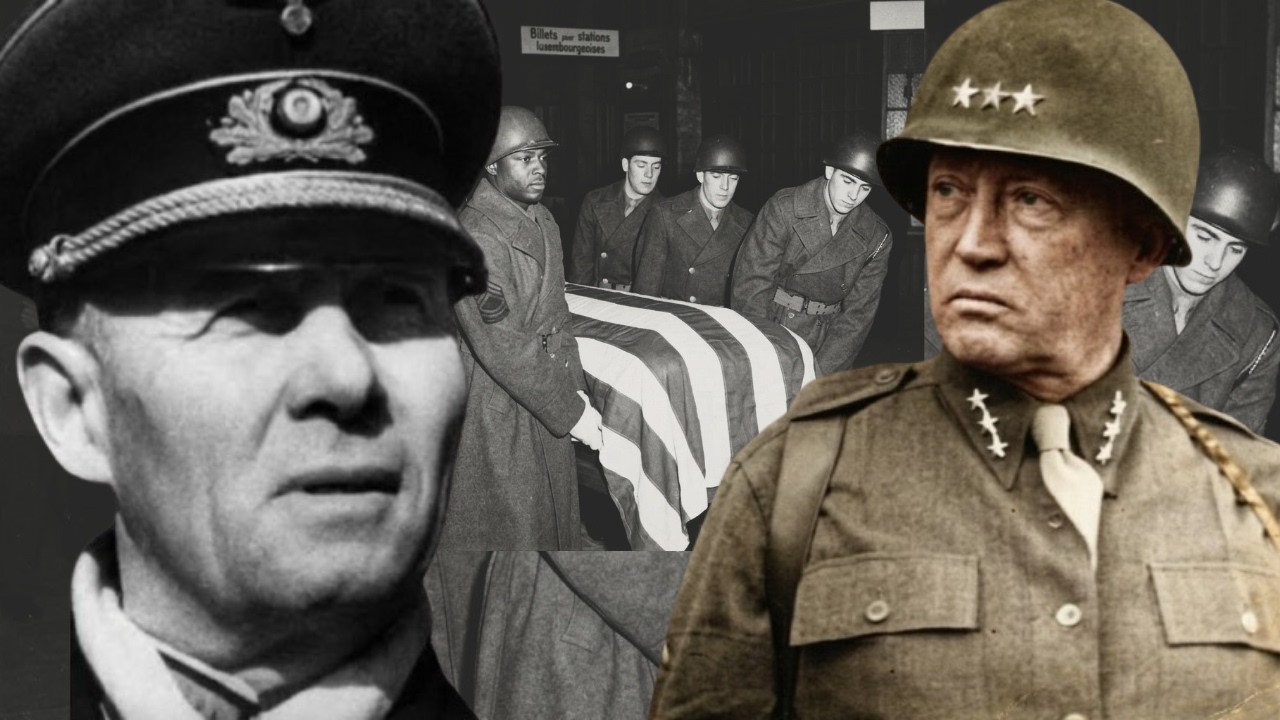
The words are stark. General George S. Patton Jr. died this morning.
Injuries from a motor vehicle accident. December 9th. Funeral at Arlington National Cemetery. Von Luck’s hands go still.
The paper doesn’t shake. There’s no relief on his face, the reaction the Americans expected from a man who spent months evading Patton’s Third Army across France. Instead, something closer to grief crosses his features. He looks up and speaks five words in careful English.
“Then we have lost him, too. ”
Silence fills the room. The interrogator says nothing. Outside, a truck engine starts, then fades into the distance.
Von Luck looks down at the memo again, as if reading it a second time might change what it says. It doesn’t. The sole Allied general who understood the language of tanks, the only one who fought the way the Germans did, was gone. Not at the hands of an enemy, but in an automobile accident.
Just gone. And somewhere in the minds of Germany’s broken officer corps, a strange thought took hold. The man who had terrified them and impressed them in equal measure was no longer in the world at all. By winter 1945, Germany’s military elite existed in a strange kind of purgatory.
Generals who once commanded entire army groups now sat behind the concrete walls of detention blocks. Their days were filled with interrogations, war crimes proceedings, tribunal preparations, and the slow, humiliating routine of occupation. Some waited for execution. Others faced decades behind bars.
All of them carried the weight of total defeat. And yet, underneath that defeat, a strange kind of professional pride survived. In their minds, they hadn’t lost to lesser soldiers. They had lost to industrial power and strategic brilliance.
No name carried more weight in those cells than Patton’s. Officers spoke of him with a mix of dread and grudging admiration—the aggressive, tank-obsessed American who tore through their lines in France using the very same Blitzkrieg principles German doctrine had once taught the world. He wasn’t like the others. Not like Montgomery, whom they saw as overly cautious.
Not like Eisenhower, dismissed as more politician than soldier. Not like Bradley, viewed as capable but unremarkable. Patton earned something rarer. He earned the respect of the men he had defeated.
In jail libraries, some officers stored newspaper clippings of his victories over them—not as proof of their own failure, but as proof they had lost to the very best. America, in their eyes, had finally produced a general who moved like a panzer commander. For men clinging to whatever professional identity remained after their ideology had collapsed, that idea offered a kind of psychological survival. They hadn’t lost because they were incompetent.
They had lost because Patton was exceptional. But on December 21st, that comfort died with him. Throughout late 1945, German officers operated under an unspoken assumption. Patton’s survival validated their own military credibility.
If they lost to the best, their competence remained intact. In mess halls and detention barracks, former panzer commanders discussed his tactics—not with bitterness, but with the detached interest of chess players studying a grandmaster’s game. General Blaskowitz, awaiting trial in Nuremberg, remarked to a cellmate that Patton understood terrain and speed the way Rommel once did. The sentiment spread through the prison population.
The Americans had produced one general who would have thrived commanding panzers in France back in 1940. One general who proved that doctrine, not blood, not race, was what determined excellence on a battlefield. That belief became a psychological shelter. The collapse in France wasn’t a systemic German failure.
It was simply being outmaneuvered by a rare American, one who operated outside the caution they associated with the other Allied commanders. As long as Patton lived, that narrative held. The vehicle collision on December 9th went mostly unreported in the correctional cells at first. According to rumor, he was healing.
Some predicted he would stay in Europe as military governor. The possibility brought a strange comfort. A living Patton, even a paralyzed one, kept the myth intact. A living Patton meant Germany had lost to a titan, not to bureaucracy, not to chance.
They didn’t yet understand what his death would take from them. December 10th through 20th, 1945. Fragmentary reports reached the prison camps. Patton, critically injured, paralyzed from the neck down, prognosis uncertain.
The updates arrived in pieces—half-overheard conversations between American guards, brief mentions in Stars and Stripes left behind in common areas. At one detention facility, a Wehrmacht intelligence officer noticed his interrogator arrive late one morning. The American’s eyes were red. When asked if something was wrong, the man muttered, “General Patton might not make it.
”
The German sat forward. For the first time, the possibility truly landed. Their mirror, their validator, might die—not in honorable combat, but from a shattered spine in a hospital in Heidelberg. Unexpected anxiety spread among some of the officers.
If Patton died, who would inherit the occupation? Eisenhower? Bradley? Men they viewed as soft on fraternization policy, perhaps, but potentially far harsher when it came to denazification tribunals.
A morbid hope began to surface in whispered conversations. Let him live, even paralyzed. A living Patton, even diminished, preserved what they needed. A dead Patton, killed by nothing more than a car crash, made their entire defeat feel absurd.
It reduced the grand tragedy of 1944 to a footnote in someone else’s accident report. They didn’t yet admit this fear out loud, but it grew in the silence between interrogation sessions. And that silence was only getting louder. December 15th through 20th.
The guards stopped giving updates. At one interrogation center, the absence of information became impossible to ignore. A Luftwaffe general, being debriefed on the Battle of the Bulge, asked his interrogator directly, “Is General Patton still alive? ”
The American paused a moment too long before answering.
“He’s stable,” he finally said. The German didn’t believe him. That night, officers whispered among themselves in the detention barracks. Months of confinement had taught them to read their captors’ moods.
American soldiers loved Patton in a way they never loved the other generals, and the grief settling over the guards felt like something final. A former Waffen-SS officer, awaiting trial for war crimes, offered a bitter remark. “If he dies, we’ll have outlived our executioner. ”
By morning, the phrase had spread through the camp.
It was meant as a joke. Nobody laughed. By December 20th, the imprisoned German leadership shared a single unstated premonition. The man who shattered them was dying, and they did not know whether what they felt was relief or dread.
Relief, because his aggressive politics, his push for harsh occupation terms, his refusal to let any former Nazi hold a position of authority, might die along with him. Dread, because his death would erase the one thing that made their defeat bearable—the knowledge that they had lost to someone worthy. The news arrived the next day, and it was worse than any of them imagined. December 21st, 1945.
14:05 hours. At the detention facility in Nuremberg, a US Army lieutenant walked through the administrative wing carrying a stack of freshly typed memoranda. They were routine military documents, prepared in the same format used for countless official notifications sent across occupied Germany. One copy was pinned on a bulletin board outside the mess hall by an American sergeant.
As German officers passed by, several stopped and quietly read the notice. The language was formal and unemotional. General George S. Patton, Jr.
02605 died 17:45 hours 21 December 1945 pulmonary embolism secondary to vehicular trauma body to be repatriated funeral Arlington 24th December. There were no personal remarks, no tribute, no words of farewell. The document recorded only the essential facts, following standard military procedure. Within the next hour, identical notifications reached detention facilities throughout Bavaria.
News of Patton’s death spread quickly among the prisoners, moving from conversation to conversation long before any official announcements were discussed in detail. General Major Fritz Bayerlein, the former Panzer commander who confronted Patton during the Normandy battle and later in the Ardennes, analyzed the notification quietly. After reading it several times, he turned to another officer and whispered in German, “Der Einzige ist tot. ”
The only one is dead.
The brief statement required no further explanation among those listening. Each man understood what Bayerlein meant from his own experience on the battlefield. For many of the former German officers, Patton had earned a reputation as one of the Allied commanders who consistently pushed his forces with speed, determination, and aggressive maneuver. They had encountered his methods firsthand and had come to respect his abilities as an opponent, even while fighting against him.
With his death, an important chapter of the European campaign had come to a close. For soldiers on both sides who had witnessed those battles, the announcement marked the passing of one of the war’s most recognizable military commanders. Across occupied Germany, the moment of realization differed by camp. But the reaction was the same everywhere.
In Augsburg, Colonel von Luck took the memo straight from his interrogator’s hand. The American slid it across without a word. Lamplight caught the paper as it moved. Von Luck read it.
His jaw tightened. He folded it once, carefully, like a military order. Then he unfolded it and read it again. In Dachau, a Wehrmacht logistics officer overheard two American MPs talking outside his cell.
He didn’t speak English well, but he caught two words, and the rest he read in their tone. The way voices drop when the news is bad. In Nuremberg, General der Panzertruppe Walter Warlimont stood at his cell window, gazing out into the courtyard. A crowd had formed around the bulletin board.
A dozen men leaned in to read a single sheet of paper. He knew before he ever went down the stairs. He knew from how they stood afterward—motionless, hands at their sides. Across every camp, the same thing happened.
A sudden, involuntary stillness. Hands stopped moving. Conversations broke off mid-sentence. These were men trained to hold their emotions under fire, but this news got past all of that.
It didn’t ask permission. One officer in Regensburg would later describe it to another prisoner this way: “Like hearing that your greatest enemy and your most respected teacher had died in the same sentence. ”
The contradiction never resolved. It just sat there, heavy, impossible to put down.
The hours after the announcement brought no celebration, only a strange, heavy silence. In the detention barracks, officers who used to argue over tactics or gripe about rations now sat still on their bunks. Some wrote letters they knew would never be sent. Others stared at maps of France and Germany pinned to the walls—maps marking the places where they lost to him.
Falaise. Metz. The Saar. Bastogne.
The American guards expected relief, maybe even quiet celebration. Instead, they found something else. Grief. An American captain at Oberursel later told his superior, “The Germans took it harder than our own men did.
Some of them looked like they lost a brother. ”
The observation unsettled him. He couldn’t explain it. At Nuremberg, Generaloberst Heinz Guderian, the creator of Blitzkrieg doctrine and the man who taught Germany how to deploy tanks, requested permission to send a condolence note to Patton’s widow.
The request was denied, but the impulse told everything. In private conversations picked up by hidden microphones in the barracks walls, the same phrase surfaced again and again across camp after camp. “He would have understood us. ”
Not forgiven them.
Not excused their crimes or their responsibility. Understood them. For men waiting on execution or a life sentence, men stripped of rank, of nation, of any future, that distinction meant everything. Understanding was the last form of dignity they had left.
And now, even that was gone. Why did Patton command such respect from Wehrmacht officers? The answer isn’t personality. It’s tactical philosophy.
German armored doctrine—Blitzkrieg, the war of movement—built on speed, exploiting breakthroughs, driving deep past static defenses. It was the philosophy that won France in 1940. The philosophy that nearly won Russia in 1941. Patton studied it.
He internalized it. And then he turned it against them. Unlike the British generals who preferred methodical set-piece battles, unlike the Soviet commanders who relied on mass and attrition, Patton fought like a panzer general trapped in an American uniform. German staff officers saw it right away.
In August 1944, when Third Army broke out at Brittany and drove 600 miles in 30 days, Wehrmacht planners watched their own 1940 tactics played back at them. Patton hadn’t just beaten them. He’d beaten them at their own game. That created a deep contradiction.
How could an American from a nation they considered industrially strong but tactically naive, master an art form Germany itself had invented? The question wounded their sense of superiority, but it also earned their respect. Patton proved that doctrine, not race, not national character, was what determined excellence in armored warfare. For imprisoned commanders whose entire world had collapsed alongside the Reich, this distinction provided something to grasp onto.
They might still believe in their own abilities. They might still believe that their methods had been correct. They had simply faced the one Allied general who understood those methods as well as they did. Within 48 hours of Patton’s death, something shifted inside the interrogation rooms scattered across Allied detention facilities.
German officers, especially those who once faced Third Army in combat, grew noticeably more forthcoming in their tactical debriefs. Not because they’d been broken—because their audience had changed. With Patton gone, they were no longer speaking to a potential adversary. They were speaking to history.
Take one Wehrmacht major. Throughout November, he had stonewalled every question about troop positions. By late December, he was sketching detailed maps from memory, walking his interrogator through Third Army’s encirclement maneuvers phase by phase with something close to professional admiration. Allied intelligence officers noticed the pattern and noted it in their reports.
Patton’s death, it seemed, had removed a psychological barrier. These men had feared his reputation for harsh justice. He’d pushed for some of the toughest denazification measures on the table—permanent bans on former Wehrmacht officers returning to public life. But fear wasn’t the whole story.
They also wanted his respect. And now that he was gone, they went looking for other audiences to tell their story to. Some began penning memoirs in prison journals, with the battles against Patton serving as the focal point and the most proud aspect of their military lives. The deceased general turned into a shield of sorts.
“We lost to Patton” is not the same as just “we lost. ”
Later, during the Nuremberg proceedings, defense attorneys picked up the same thread. They pointed to Third Army’s overwhelming effectiveness to argue their clients never stood a chance. Their clients weren’t criminals, the argument went—just soldiers outmatched by the best the Allies had.
In death, Patton became an alibi. And for men staring down the gallows, an alibi can feel like salvation. Over the following decades, the German military’s eulogization of Patton hardened into legend. Post-war memoirs by Guderian, von Manteuffel, and others consistently ranked Patton as the Allies’ finest operational commander.
Higher than Montgomery. Higher than Zhukov. Sometimes even higher than their own Rommel. But this wasn’t altruism or an honest assessment.
It was narrative construction. By elevating Patton, they elevated themselves. The implicit message became clear. Germany’s Wehrmacht, despite its atrocities and ultimate defeat, had produced officers who could recognize and respect true martial genius—even in an enemy.
This became a crucial part of the post-war rehabilitation effort. The underlying claim was simple. We weren’t barbarians. We were professionals who knew excellence when we saw it.
Patton became a tool for redemption. By the 1950s, when West Germany re-armed under NATO, former Wehrmacht officers advising the Bundeswehr cited Patton’s methods as models for the new German armored forces. They conveniently omitted that those exact same methods had destroyed them just a decade earlier. The strange respect looped back on itself.
American armor schools studied Patton, who studied German doctrine, which post-war Germans then reclaimed through Patton’s success. The car accident, initially a source of absurd, unheroic tragedy, faded from the narrative. What remained was the mythology. Patton died shortly after his greatest triumph, sparing him the messy politics of peace.
He never had to compromise. He never had to negotiate. He never had to become a bureaucrat. For his German admirers, the timing became almost poetic.
He stayed pure—a warrior, to the very end. Nuremberg, Christmas Eve, 1945. Through the barred windows of their prison, German generals heard the distant ringing of church bells. It was the first Christmas of peace after years of devastation.
The sound drifted across the cold winter air, a reminder that the war had ended, even if its consequences had not. Four thousand miles away, at Arlington National Cemetery’s amphitheater, Patton’s flag-draped coffin rested beneath the watch of a silent military honor guard. Soldiers stood motionless as the nation prepared to say its final farewell. The funeral would never be attended by the men who had once opposed him.
They would never stand next to the coffin. They would never give a salute or utter the respectful words they had silently written while incarcerated. Yet, hidden within their grief, lay one of war’s greatest contradictions. Enemies are often far closer in spirit than allies ever realize.
Patton and his German counterparts shared a language that had nothing to do with nationality or politics. It was the language of armored warfare, of operational tempo, of terrain, logistics, and battlefield instinct. Across countless campaigns, they had learned to read each other’s decisions almost as if they shared the same military mind. In many ways, they understood one another more deeply than their own governments ever could.
With Patton’s death, that unspoken conversation came to an end. For the surviving officers of the Wehrmacht, December 21st, 1945 marked more than the loss of a formidable adversary. It marked the end of a dialogue that only those who had faced him in battle could truly understand. Their respect for Patton was never about seeking redemption.
It was about recognition. Recognition that even in defeat, they had been worthy enough to face one of history’s greatest battlefield commanders. Recognition that their professional lives—separate from the crimes of the regime they had served—still held meaning in the harsh arithmetic of war. Perhaps that is the final cruelty of armed conflict.
Sometimes, the respect earned from an enemy carries a weight that history itself can never match. Because only an enemy truly understands the price of victory. Only an enemy has stood across the battlefield, measured your strength, adapted to your decisions, and survived to remember them. And when that enemy is gone, part of your own story disappears as well.
In war, the distance between an enemy and a mirror is far thinner than most people are ever willing to admit.
