On a July evening in 1938, in a Carpathian castle, surgeons removed the heart of a dead queen. Marie, granddaughter of Queen Victoria and last queen of Romania, had left written instructions five years earlier that her body was to be divided. Her body would be buried beside her husband in the royal monastery at Curtea de Argeș. Her heart would travel three hundred miles east to a small white chapel she had built herself on a cliff above the Black Sea.
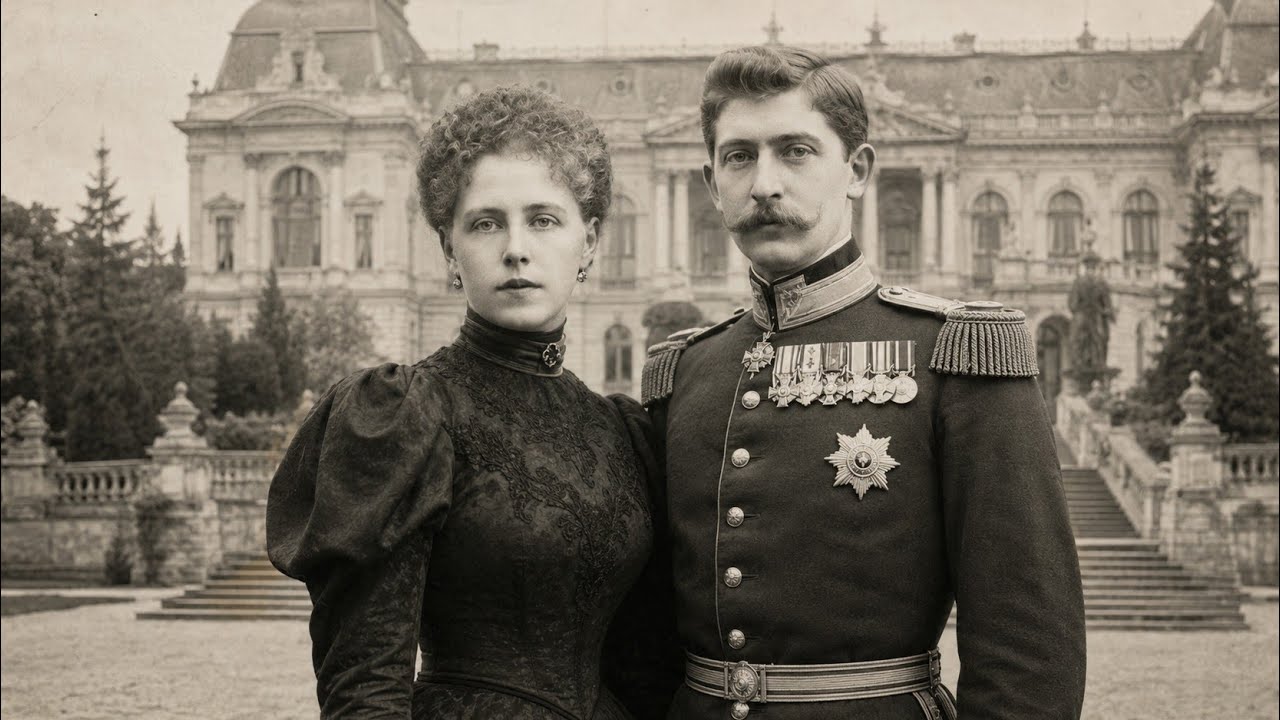
Marie was born Princess Marie of Edinburgh in 1875, granddaughter of both Queen Victoria of Britain and Tsar Alexander II of Russia. She spent her childhood moving between England, Malta, and Germany as her father’s career shifted. At seventeen, she was married to Ferdinand, crown prince of Romania, a shy, obedient man who had recently been forced to abandon a secret engagement to a Romanian poet. Marie spoke English, French, and German but no Romanian, and had never seen the country she was marrying into.
The Romanian people embraced her immediately. She learned the language, the customs, and the traditional dress, and won genuine affection from a population her husband’s court never managed to reach. The marriage itself was courteous but distant. Ferdinand remained loyal to his duties and quietly grieving for the woman he had been forbidden to marry.
Marie was adored publicly and privately alone. She bore six children, the first a son named Carol in 1893. Over the following decades, she built homes and gardens of her own design, including an Art Nouveau retreat at Pelișor, a hilltop fortress at Bran, and terraced gardens above the Black Sea at a fishing town called Balchik. These places were hers, chosen and shaped by her own taste in a life where nearly everything else had been assigned by others.
When World War I broke out, Romania stayed neutral for two years. Ferdinand hesitated, his loyalties split between his German blood and his adopted country. Marie did not hesitate. She pressed publicly and privately for Romania to join Britain, France, and Russia.
In August 1916, Ferdinand signed the declaration of war. Marie put on a Red Cross uniform and went into the hospitals herself, nursing the wounded through amputations and outbreaks of typhus. Soldiers who had never seen a queen before the war would later say they had been nursed by one. They began calling her the mother of the wounded.
The war went badly. German and Austro-Hungarian forces advanced on Bucharest from three directions. The court retreated to Iași in the northeast, the only unoccupied corner of the country. But before the retreat was completed, tragedy struck.
Marie’s youngest son, three-year-old Mircea, fell ill with typhoid. He died on November 2, 1916, at the home of friends at Buftea, with enemy troops days from the capital. There was no time for a royal funeral. The family buried him in the grounds of Cotroceni Palace and left on a train north within days.
Bucharest fell to occupation before the month was out. Mircea’s grave marker carried words preserved in more than one archive: he was the sole guardian of the home of his parents, over which the flag had ceased to fly. For two years, while his family lived in exile, a three-year-old lay alone in a garden, the only member of the House of Hohenzollern still standing watch over the palace. Romania ended the war among the victors.
In January 1919, Marie went to Paris for the peace conference, though no seat had been reserved for a queen. She dined with Clemenceau, spoke at length with Woodrow Wilson and Herbert Hoover, and used the standing she had earned through years of nursing soldiers to get the attention the professional diplomats could not. Romania left the conference with Transylvania, Bessarabia, and Bukovina, a country roughly doubled in size and population. No single person made that happen, but no single person’s presence that winter is remembered as clearly as hers.
In October 1922, at Alba Iulia in the heart of the newly won Transylvania, Marie was crowned queen. She wore a gown of Romanian folk embroidery and a diadem made entirely from gold mined in Transylvanian soil. Five of her six children stood near her. The sixth was six years in the ground at Cotroceni.
King Ferdinand died in July 1927. Marie withdrew from public life for several months, then returned to stand beside her five-year-old grandson, Michael, who had become king after her own son Carol renounced his rights to the throne over a marital scandal. In June 1930, Carol returned, had the act of succession nullified, and took the throne for himself over his own son’s head. Michael was quietly demoted to crown prince.
Carol did not exile his mother outright. He simply stopped consulting her and encouraged her, gently and then not so gently, to spend her time at Bran and Balchik, the houses farthest from Bucharest’s politics. He drove her close friend Barbu Stirbey out of the country and confiscated much of the fortune the man had built over decades. Marie spent the 1930s largely in those two homes, dressed increasingly in plain white, earning from the press the affectionate nickname the White Widow.
In the summer of 1937, at sixty-one, she fell seriously ill. The public announcement said cirrhosis of the liver; her physician privately believed it was pancreatic cancer. She was sent to a sanatorium in Italy that February, did not improve, and asked to be taken home to die in Romania. She arrived back barely strong enough to survive the journey.
On July 18, 1938, at Pelișor Castle, Marie died at twenty-two minutes to six in the evening, aged sixty-two. Her son Carol was with her, as were her daughter Elizabeth and her grandson Michael. Her youngest daughter Ileana, the one she had always been closest to, was still traveling and learned the news only when she reached the castle, too late to say goodbye. What happened next followed the instructions Marie had signed in 1933 almost to the letter.
Surgeons removed her heart. It was placed in a small silver casket, which was placed in a larger one, and carried three hundred miles to the white chapel at Balchik she had named Stella Maris. Her body was buried beside her husband at Curtea de Argeș. For two years, both halves of her stayed where she had put them.
Then, in 1940, the region containing Balchik was signed away to Bulgaria. The heart could not remain in a foreign country’s chapel. Ileana, the only one of the six children still willing to do the work, had the casket moved north to Bran and paid for a small chapel to be built inside the castle walls to receive it. A year later, she had her youngest brother’s remains lifted out of the garden at Cotroceni and moved to Bran as well.
Prince Mircea was laid to rest in the same chapel as his mother’s heart. Twenty-five years after that hurried November burial, the queen and the son she had buried in such haste were, for the first time, in the same room. It did not last. Sometime between the late 1960s and early 1970s, under the communist government, the state took the chapel apart.
The marble sarcophagus was broken open. The casket was removed to a museum storeroom in Bucharest, where it sat for roughly four decades. Mircea’s remains stayed at Bran, alone in the chapel his sister had built for the two of them together. A three-year-old, once again, keeping watch over a house that had nothing left to guard.
The body at Curtea de Argeș never moved. It was the chosen half, the heart she had deliberately sent to a place of her own making, that spent seventy-seven years being taken from one place to the next by war, by ideology, by people she had never met. She had asked to be buried in two places. She could not have known, signing that will in 1933, which half she was condemning to peace and which to exile.
On November 3, 2015, someone opened the storeroom door in Bucharest. Soldiers carried the casket out into daylight. Eight officers on horseback fell in around it. The procession moved along Calea Victoriei, past several hundred people who had come to watch it pass, draped in two flags, Romanian on one side, British on the other.
At Pelișor, the procession stopped. Her great-granddaughter, Crown Princess Margareta, carried the smaller box into the golden hall. An archduchess from the Austrian branch of the family carried the other. Together they set the casket down on a small table behind the very sofa where Marie had stopped breathing in the summer of 1938.
Since that afternoon, the casket has not traveled again. It sits on its table in the golden hall, past the reach of the next government, the next war, the next redrawn border. A small silver box behind a sofa in a room that remembers exactly where it stood the day she stopped needing it to remember anything else.
No account of that afternoon records which side of the flag was facing up.
