The photographic conservator slid her white cotton gloves on, one finger at a time, and lifted the lid of another archival box in the dimly lit storage room of the Metropolitan Museum of Art. She had spent eight years as the curator of the museum’s photography division, and over that time she had developed a particular attachment to the forgotten images that came through her hands, fragments of finished lives waiting to be noticed again. “Cartwright Collection, 1879,” she murmured, reading the faded label. The donation had arrived the previous month from the estate of Eleanor Cartwright, the last descendant of a prominent Boston mercantile family.
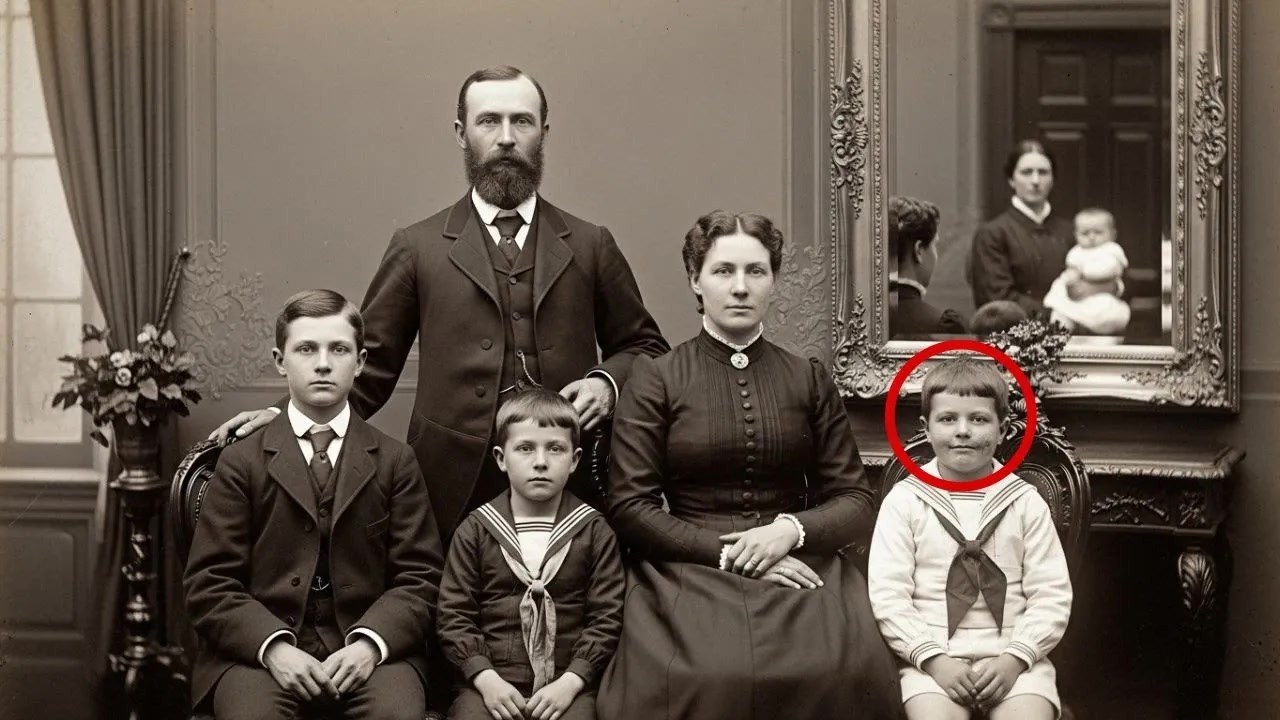
The box contained dozens of sepia-toned photographs, letters, and a leather-bound family Bible. She lifted the largest photograph, a formal family portrait in an ornate silver frame. In the low preservation lighting, the image revealed a handsome bearded man in his forties standing proudly behind a seated woman with calm features. Three children completed the scene: a solemn boy of about ten, and identical twins, perhaps five years old, dressed in matching sailor suits with bright, engaging smiles.
“The perfect Victorian family,” she remarked to her assistant Michael, who was cataloguing each item. “Exceptionally well preserved,” he agreed. “Should I scan it for the digital archive? ” She nodded, placing the image carefully on the scanner surface.
As the high-resolution image appeared on the computer screen, she leaned closer, something having caught her attention. “Can you enhance the background? The area near that ornate mirror on the wall behind them? ”
Michael adjusted the settings, zooming in on the gilt-framed mirror visible in the background of the Cartwright family’s sitting room.
As the image sharpened, her breath caught. There, reflected clearly but almost spectrally on the mirror’s surface, was a figure not present in the room: a young woman holding what appeared to be a small child. “Michael,” she whispered. “Who are they?
”
Dr. Thomas Bennett from the American history department examined the enhanced image on her computer screen, his expression shifting to puzzlement. The Cartwrights had been highly prominent in Boston society, he explained. Edward Cartwright had amassed a considerable fortune importing textiles, and his wife Rose was known for her charitable work with orphaned children.
Their social standing was impeccable. Yet, she noted, pointing to the reflection, someone had been deliberately excluded from the family portrait. The woman appeared to be in her twenties, perhaps a governess or nurse, but why was she excluded from the picture while still visible in the mirror? And more importantly, whose child was she holding?
Thomas leaned closer. The arrangement was strange. Look at how the photographer had positioned the family at an angle that would presumably hide the hallway entrance. It seemed almost deliberate, yet the reflection had captured what was meant to be concealed.
She returned to the family Bible and carefully opened its aged leather cover. Inside the front pages was a neat family record documenting births, marriages, and deaths. Edward and Rose Cartwright had married in 1868. Their eldest son, Edward Jr.
, was born in 1869. Then came a surprising date: February 12, 1874. “God blessed us with three sons born this day: Charles, Henry, and Frederick Cartwright. ” Three sons?
She looked again at the photograph showing only twins. Well, where was the third? More puzzling was the death record for Frederick Cartwright dated the same day as the birth. Perhaps the child had died, Thomas suggested.
Infant mortality was common. Then whose child was in the mirror? she wondered, studying the reflection again. And why did the woman look so sad?
Public archives in Boston revealed the first inconsistency. She found a small notice in the February 14, 1874 issue of the Boston Globe. “CARTWRIGHT. To Edward and Rose Cartwright, on February 12, four sons.
Not one infant survived. The family requests privacy during this time of mixed joy and sorrow. ” Four sons, not three, she whispered, showing Thomas the microfilm. The Bible recorded only three births with one death, but this newspaper clearly indicated four births.
Their search led them to the historical records of Massachusetts General Hospital, where Dr. Amelia Park, the archive director, found the original birth records. “Here they are,” Dr. Park said, showing them the yellowed document.
Rose Cartwright, age thirty-two, had given birth to quadruplets on February 12, 1874. Three healthy boys. One surviving male infant with a notable facial deformity, but his condition was described as poor. “Facial deformity?
” Thomas repeated. The attending physician had written: “A sharp cleft in the palate and facial asymmetry,” Dr. Park explained. In that era, such conditions were often considered shameful, especially among the upper classes.
She felt a chill. The fourth child had survived but had been omitted from the family Bible. More revealing was a private letter from the attending physician to a colleague preserved in the hospital collection. “Mrs.
Cartwright is recovering from the difficult birth of the quadruplets. Mr. Cartwright has arranged to house the fourth infant, afflicted with the unfortunate deformity, separately from his brothers. He says he cannot bear to see the Cartwright name associated with such a defect in society.
I fear for the child’s future, though Mr. C assures me he will be cared for. ”
She stared at the photograph again, and the reflection in the mirror acquired new meaning. They had not abandoned the child, she realized, but hidden him within their own home.
The Cartwright mansion still stood in Boston’s Back Bay neighborhood, now converted into luxury apartments. Historical preservation documents included the original architectural plans from 1870, showing an imposing five-story house with servants’ quarters. “Look at this,” Thomas said, pointing to a strange feature on the third floor. “This wing is connected to the main house by only one door.
It has a separate service staircase and could function almost independently. ” She studied the plans. A perfect place to hide someone you did not want visitors to see. Through the Massachusetts Historical Society, they found household account books kept by Edward’s personal secretary with meticulous precision.
The books included regular salaries for the expected staff: cook, housekeeper, gardener, and the twins’ governess, plus a monthly payment to a Mrs. Harriet Mills for private care services beginning in February 1874. “I found her! ” she announced after searching census records.
Harriet Mills, age twenty-four in 1874, was listed as a resident of the Cartwright household. She was Rose Cartwright’s second cousin from Philadelphia. What proved most revealing was a small leather journal found at the bottom of the donation box bearing Harriet’s name. Its first entry was dated February 20, 1874: “I have arrived at my cousin Rose’s home to take up my new position.
The arrangement is most peculiar. I am to care exclusively for the infant James, born with a distinguishing mark on his face. Mr. Cartwright insists the child remain separate from all visitors.
He has set aside rooms for us in the east wing and instructed that James must never leave these rooms. Rose weeps when she visits us secretly, but she cannot defy her husband. I have accepted this post out of family duty and Christian charity, but I fear I have entered a gilded prison. ”
She closed the journal gently.
They had named him James, a name appearing nowhere in the family Bible or any public record. “A child erased from history,” Thomas said quietly, “except for an accidental reflection in a mirror. ”
Tracing the photographer proved difficult until Thomas discovered a small maker’s mark on the frame. H.
Wellington, master portrait photographer, 42 Tremont Street, Boston. The Boston Athenaeum collection included the business records of Henry Wellington, a prominent society photographer of the 1870s. His appointment book for October 1879 showed an entry for the Cartwright family portrait with a special note: “Entire family, in the sitting room, afternoon light, special rate for Mr. C’s charitable donation.
”
Most revealing were Wellington’s personal diaries, where he recorded unusual sittings. On October 15, 1879, he photographed the Cartwright family. A strange tension pervaded the session. Mr.
Cartwright was extremely particular about the arrangement, insisting on a specific angle that showcased the grand salon while avoiding the east corridor. While adjusting the camera, he glimpsed a young woman with a child in that same corridor; the housekeeper hurried them away. When positioning the mirror, he made a decision he might regret professionally, but his conscience demanded it. He angled it slightly to capture that forbidden hallway.
The plate exposure had been successful, and he suspected Mr. Cartwright would not notice the reflection, so focused was he on presenting his visible family in the best light. Some truths deserved to be preserved even if hidden in plain sight. She looked up from the diary and met Thomas’s eyes.
“He did it on purpose,” she whispered. The photographer had found a way to include James and Harriet in the only family portrait ever taken. “It was a silent defiance,” Thomas agreed. “And for 120 years, no one noticed, or at least no one spoke of it.
”
The question remained: what became of James Cartwright, the child whose existence was officially unrecorded? Harriet Mills’s journal, spanning from 1874 to 1886, revealed the hidden life inside the Cartwright mansion. Her entries documented James’s growth with touching detail. April 30, 1875: “James took his first steps today, wobbling across our sitting room with a determination that brings tears to the eyes.
His face may be asymmetrical and his speech affected by his palate, but his eyes hold an undeniable intelligence. Rose visited and wept with joy, though she stayed only thirty minutes, afraid Edward would discover her absence from her charity meeting. ”
December 25, 1877: “Christmas passed again with James separated from his brothers. He watches from our window as Charles and Henry play with their new rocking horses in the garden.
I made him a small gift, a painted wooden soldier with a face like his own instead of a perfect one. He clutched it, exclaiming, ‘Like me! ’ with such wonder it nearly broke my composure. ”
The most troubling entries described the rare encounters between James and his father.
March 10, 1879: “Mr. Cartwright conducted his quarterly inspection today. He refers to our rooms as the status quo and to James as the poor thing. He examines the accounts, confirms James remains isolated from society’s view, then leaves without once looking at the child.
James asked afterward, ‘Why does Papa not love me? ’ I had no answer that would not poison his heart. ”
Harriet created a small world for James within their cramped quarters, teaching him to read and write, deriving lessons from books she persuaded the housekeeper to bring, describing the outside world he rarely saw. Rose visited whenever opportunity allowed, always in secret, bearing small gifts and maternal tenderness that must have sustained James during his long isolations.
Most affecting was Harriet’s account of the photograph day, October 15, 1879. Commotion downstairs as the photographer arrived. James watched from our stairwell as his brothers dressed in their finest clothes. “Will I be in the picture?
” he asked with such hope. I could only hold him. Later, as we glimpsed the family assembled in the sitting room, the housekeeper saw us and hurried us back to our rooms, but not before the photographer saw us. There was something in his eyes, an acknowledgment, perhaps even pity.
For a moment, I felt not invisible. Their research continued, and Harriet’s journal for December 1883 revealed a radical change. December 6, 1883: “Everything has changed. Dr.
Morrison, the specialist who has treated James’s palate over the years, confronted Mr. Cartwright, calling the boy’s deprivation of education and society a crime given his increasingly correctable condition. He threatened to inform his medical colleagues unless James was permitted a proper education. Mr.
Cartwright, always protective of his reputation, partially relented. James will attend a private school in western Massachusetts, where we will live in a country house provided by the family. We must maintain the fiction that James is my nephew, an orphan under my guardianship. Though still denied his true family name, James will at least see the world beyond these walls.
We leave next week. James oscillates between terror and delight at the prospect. ”
She traced the transition through property records, discovering that Edward Cartwright had purchased a small house near Northampton, Massachusetts, in late 1883. A local school register listed James Mills enrolled in January 1884 with Miss Harriet Mills as guardian.
He had taken her name, she noted, “the only identity society would allow him. ” School reports showed James to be an excellent student, particularly in mathematics and engineering. Despite speech difficulties from a partially repaired cleft palate, he excelled academically. The headmaster’s notes remarked on his remarkable resilience and determination despite physical challenges.
A more surprising discovery came from Rose Cartwright’s personal account book, hidden among her charitable records. She had been setting aside regular sums for “J’s education fund,” often diverted from her household allowance or jewelry budget. While Edward provided the bare minimum for their hidden son’s upkeep, Rose secretly ensured James had proper clothing, books, and ultimately university fees. “She never truly abandoned him,” Thomas noted.
“She worked within the constraints of her time and marriage to care for him as best she could. ” “A different kind of maternal love,” she agreed, “expressed through secret account books rather than embraces. ”
The most unexpected document came from an unmarked file containing correspondence between Charles Cartwright, one of the twins, and James, beginning in 1890 when they were sixteen. “My dear brother,” Charles’s first letter began.
“Mother has finally told me of your existence. I cannot describe my shock and anger to learn I have a brother hidden from me all these years. Father forbids me from contacting you, but I am no longer a child to be dictated to in matters of conscience. I write in secret with Mother’s help, hoping to know the brother I should have grown up with.
”
The correspondence revealed that Rose had finally disclosed the hidden brother to Charles after he found her weeping over a school report and photograph Harriet had sent. While Henry, the other twin, remained loyal to their father and indifferent to the family secret, Charles began a secret relationship with his unknown brother. James’s replies showed initial caution, then growing warmth. “I have always known of you both, watching from windows as you played in the garden.
Harriet has been my family, my teacher, my whole world. Yet I kept the little wooden soldiers she made to resemble us, imagining the brotherhood that might have been. Your letter feels like a miracle, an acknowledgment from one who shares my blood. ”
Through their letters, she and Thomas traced the brothers’ parallel lives.
While Charles followed their father into trade, James studied engineering at MIT, his fees secretly paid by his mother. By 1898, James Mills, as he was officially known, held patents for mechanical improvements to textile looms, ironically advancing the very industry that had built his father’s fortune. A photograph from James’s MIT graduation showed a young man with noticeable but not severe facial asymmetry. His expression was serious but proud.
Beside him stood Harriet, now in her late forties, her devotion evident in her protective stance beside her nephew. “He made himself a life,” she said softly, touching the image, “against all odds. ” “And Charles found the brother who was hidden from him,” Thomas added, “a small repair to a fractured family. ”
The most emotional document came from 1901, following Edward Cartwright’s death.
His will made no mention of James, dividing the estate among Edward Jr. , Charles, and Henry. However, another set of legal papers revealed that Charles had used his inheritance to establish a trust for the Mills family, providing financial security for James. And Rose’s diary from that period contained her most honest reflections.
April 10, 1901: “Edward is gone, and with him the terrible weight of secrecy that marked our family. Charles brought James to the house, the first time my hidden son has entered his rightful home since he was an infant. Seeing him standing in the sitting room, a mature man of twenty-seven, successful and dignified despite all we denied him. I have no right to the joy I felt embracing him, yet he gave it to me generously.
Henry refused to meet him and left the house in anger. Edward Jr. received him coldly, then retreated to his study. But Charles stood beside him.
With pride, he introduced him to the staff as my brother, James Cartwright Mills. ”
The family portrait still hung in the sitting room. James stood before it, contemplating the reflection that had been the only evidence of his existence in that house. “Harriet and I were here all along,” he said, “if anyone had only looked closely.
” There was no bitterness in his voice, only a calm statement of fact that left Rose utterly stunned. In a final attempt at restoration, Rose had another family photograph taken in 1902, this time with James standing beside Charles, and Harriet and Rose seated before them. The picture, found at the bottom of the donation box, bore a simple inscription: “The Cartwright family, finally complete. ”
Census records confirmed that Harriet lived with James and his wife Catherine after Rose’s death in 1905, until Harriet’s own death in 1919.
James founded a successful engineering firm specializing in adaptive equipment for workers with disabilities, and eventually had three children who carried the Mills-Cartwright name, acknowledging both sides of their father’s complex legacy. Comparing the two family photographs, the first with its hidden secret, the second with its open acknowledgment, she noted that the reflection in the mirror had finally become reality. Six months later, the Metropolitan Museum unveiled its new exhibition, “Hidden in Plain Sight: Concealed Stories in Victorian Photography. ” At its center hung the Cartwright family portrait in its original silver frame, now accompanied by enlarged details of the mirror reflection and the complete story of James and Harriet.
Beside it hung the 1902 photograph showing James openly integrated into his family. The exhibition traced how rigid Victorian ideals of perfection and social standing led to the concealment of disabilities, while highlighting how small acts of resistance, the photographer’s careful mirror placement, a mother’s secret financial support, a brother’s determination to reconnect, preserved the truth. On opening night, she stood beside the display, watching visitors lean in to see the reflection that had gone unnoticed for decades. “Exceptional work,” said an elderly man approaching her.
“Ms. Reynolds, I’m Robert Mills Cartwright, James’s grandson. ” Her eyes widened in surprise. “Did you bring something?
” He nodded, producing a small box from his jacket. “When your research team contacted our family, we found this among my father’s belongings. We thought it belonged with the exhibition. ”
Inside was a small, worn wooden soldier, carefully painted with an asymmetrical face.
“Harriet made this for James,” he explained. “He kept it all his life. The face she painted was not corrected or idealized. It was his true face.
In an era obsessed with hiding flaws, she taught him that his difference was simply part of his character, not something to be ashamed of. ” As they placed the small figure in the display case, Robert added quietly, “We have passed this story down in our family, but we knew nothing of the mirror reflection until you discovered it. James always said truth finds its way to light even when people try to hide it. ” She nodded, looking again at the photograph where a simple reflection had preserved two erased lives.
“Sometimes,” she replied, “it takes 120 years for someone to look closely enough. ”
The little wooden soldier stood beside the photographs, a tangible symbol of a love that transcended society’s narrow definitions of family, worth, and perfection, finally displayed for all the world to see. Emily Reed sighed as she sorted through another donation box at the Boston Historical Society. Five years as the head archivist had developed in her a sixth sense for spotting treasures among the endless stream of family possessions and forgotten keepsakes.
Rain drummed against the narrow basement office windows, forming a rhythmic backdrop to her work. “What do we have here? ” she whispered, carefully lifting a small wooden frame from beneath layers of yellowed newspapers. The photograph inside showed a little girl, perhaps six or seven years old, seated on an ornate chair.
The child wore a pristine white dress with delicate lace details, her hair carefully styled with a ribbon. Her expression was strangely calm, hands folded in her lap. Emily’s breath caught as she noticed the unnatural stillness in the child’s eyes. Having studied nineteenth-century photography extensively, she recognized the signs of post-mortem photography, pictures taken after death, a common Victorian practice for memorializing loved ones.
“Dr. Harlow will want to see this,” she said, carefully placing the photograph on her desk. She reached for the donation form, seeking provenance information. The donor, a ninety-three-year-old woman named Clara Wilson, had left only a phone number and a cryptic note: “She deserves to have her story told.
”
Emily felt a connection to the solemn child in the photograph. Something about the precise pose, the elaborate setup, and a detail barely visible at the edge of the frame suggested this was no ordinary memorial portrait. She did not yet know that this discovery would lead her on a journey into America’s past, revealing a heartbreaking story of love and sacrifice, and a family’s desperate attempt to preserve a fleeting moment. Dr.
Robert Harlow adjusted his glasses and leaned closer to the photograph under the specialized light in the restoration laboratory. Emily watched as the sixty-two-year-old historian’s expression shifted from professional curiosity to stunned recognition. “This is exceptional,” he whispered, pointing to the lower corner of the image. “Do you see that?
” Using a digital magnifier, he highlighted something small, partially obscured by the ornate chair: a child’s wooden toy horse placed as if deliberately included. “That’s not typical of post-mortem photography,” Emily noted. “They usually removed personal objects to create a more serene image. ” “Exactly,” Dr.
Harlow nodded. “Look at the girl’s pose. Most memorial photographs of that period showed the deceased as if sleeping. This child is seated upright, in a pose suggesting she is alive.
”
The rain continued against the windows as they examined other unusual aspects: the high quality of the photograph itself, the elaborate studio setup uncommon among middle-class families in the 1880s, and most strangely, a small envelope pasted to the back of the frame that they had initially overlooked. Emily carefully removed the brittle, yellowed envelope. Inside was a folded scrap of paper with faded handwriting. “Dear Alice, forgive me.
May you find her again. ” The note was signed simply with the letter “T” and dated May 18, 1884. “We need to speak with the donor,” Dr. Harlow said, his voice carrying professional urgency.
“This is not merely a memorial portrait. There is something else here. A story that has remained hidden for nearly a century and a half. ”
Emily nodded, reaching for her phone.
She was completely captivated by the mystery of the little girl Alice and the cryptic message. What tragedy had befallen this child? And why had someone gone to such lengths to create this elaborate final portrait? The nursing home where Clara Wilson resided was bright and cheerful, a stark contrast to the somber purpose of their visit.
At ninety-three, Clara’s body had grown frail, but her sharp blue eyes revealed a mind still fully alert. She sat in her armchair by the window, surrounded by framed family photographs spanning generations. “I’ve been expecting a call,” Clara said in a surprisingly strong voice. “When I donated that photograph, I knew it would eventually find the right person.
” Emily placed the photograph carefully on the table between them. “Mrs. Wilson, we found this note hidden in the frame. Can you tell us who Alice was?
”
Clara’s aged hands trembled slightly as she touched the frame. “Alice was not her real name. It was Elizabeth. Elizabeth Thornton.
She was my grandmother’s cousin, born in 1877 in Springfield, Massachusetts. ” Dr. Harlow leaned forward. “The photograph appears to be post-mortem, but there are unusual elements that don’t fit the typical memorial portraits of that era.
” “Because it wasn’t meant to be a memorial,” Clara answered, her eyes fixed on the photograph, “at least not in the way you think. It was meant to be evidence. ”
Emily and Dr. Harlow exchanged puzzled glances.
“Evidence of what? ” Emily asked gently. Clara sighed, the weight of family history evident in her voice. The Thorntons had been prominent in Springfield manufacturing.
When Elizabeth fell ill with diphtheria in 1884, her father Thomas was embroiled in a bitter business dispute with his brother James. A considerable fortune was at stake, and their father’s will stipulated that if Thomas had no living heirs by his fortieth birthday, everything would pass to James. Clara’s eyes gleamed. “Ah, Thomas turned forty on May 20, 1884.
Elizabeth, his only daughter, died on May 16. ”
The archivist’s office at the Boston Historical Society was unusually quiet the next morning as Emily spread out the documents Clara had provided: old letters, newspaper clippings from 1884, and a small leather journal belonging to Catherine Thornton, Elizabeth’s mother. “Listen to this,” Emily said, carefully turning the fragile pages of the journal. “May 16: Our angel has left us.
Thomas is inconsolable, but he insists we must protect her legacy. He has arranged for Mr. Simmons to come tomorrow. God forgive us for what we must do.
”
Dr. Harlow paced the room. Frederick Simmons was one of Boston’s most prominent photographers in the 1880s, known for his work with distinguished families. His studio would certainly have the elaborate backdrops and props seen in the photograph.
Emily continued reading: “May 17: That fateful day. Mr. S arrived with his equipment. Four hours of dreadful arrangements while our darling lay before us.
T insists that the date appear in all documents as May 22. ”
Suddenly, Clara’s explanation from yesterday made horrifying sense. Thomas Thornton, desperate to secure his daughter’s inheritance before his fortieth birthday, had commissioned an elaborate post-mortem photograph designed to make Elizabeth appear alive. The plan was to present this photograph as proof that she had lived past his birthday on May 20.
Emily realized the wooden horse was Elizabeth’s favorite toy. Catherine had included it as a small act of honesty amidst the deception. Dr. Harlow examined a newspaper clipping announcing the tragic death of Elizabeth Thornton on May 23, 1884, after a long illness.
Another article discussed the bitter dispute between the Thornton brothers, resolved amicably following the tragic events that had befallen the family. “They created an illusion of life,” Dr. Harlow said quietly, “all to fulfill the terms of a will. ” “No,” Emily corrected.
“To protect what a father believed was his daughter’s rightful inheritance. ”
The Massachusetts Archive of Historical Photography occupied the third floor of a renovated textile mill in Cambridge. As specialists in nineteenth-century photography, Emily and Dr. Harlow had arranged an appointment to review Frederick Simmons’s business records.
“His granddaughter donated his appointment books and financial ledgers in the 1950s,” explained Diane Chen, the archivist, placing several volumes on the research table. “Simmons kept meticulous records. If he photographed the Thornton family, it will be documented. ”
Emily carefully turned the pages of the 1884 appointment book, scanning the entries until she found what they were looking for.
“May 17: Thornton residence, Springfield. Special arrangement, all equipment required. Fee: $100. ” That exorbitant sum, equivalent to several months of wages for an ordinary worker, highlighted the desperation behind the commission.
More revealing was Simmons’s personal notebook, where he recorded technical details of important photographs. The May 17 entry contained a troubling note: “Most difficult subject yet. Father insistent on lifelike appearance despite condition. Mother in pitiable state.
Used wire supports and painted eyes after exposure. Ethical concerns considered, but the fee was substantial. ”
Dr. Harlow’s expression changed.
He knew exactly what Thomas Thornton intended to do with this photograph. Emily nodded. “The question is, did it work? Did Thomas succeed in claiming his daughter’s inheritance?
” Diane pulled out another archive volume, a collection of Springfield business records. “Thornton Manufacturing remained under Thomas’s full ownership until his death in 1897. His brother James left Springfield in late 1884, reportedly after a settlement. ” “So the deception succeeded,” Dr.
Harlow concluded. “Not necessarily,” Emily said, studying Simmons’s notes more closely. “Look at this last line. ‘The brother arrived during the sitting.
Witnessed the proceedings. No further communications from the family. ’” The implications were clear. James Thornton had discovered this desperate charade, but for unknown reasons, had apparently chosen not to expose it.
The Springfield Public Library archives yielded an unexpected treasure: the personal correspondence of James Thornton, preserved among the records of prominent local businesses. As Emily and Dr. Harlow examined the letters carefully, a different perspective on the family drama emerged. “This changes everything,” Emily said, reading a letter James had written to his wife on May 18, 1884.
“I went to Thomas’s house to offer condolences despite our differences. What I saw there shook me to my core. My brother, consumed by grief, was directing a photographer to make Elizabeth appear still alive. Catherine sat weeping silently in the corner, clutching a wooden horse.
When Thomas saw me, he showed no shame or guilt, only the desperate anguish of a father who had lost everything. He said, ‘Will you take from her even in death what was meant for her in life? ’ I left without a word, knowing what I must do. ”
A later letter revealed that James had voluntarily relinquished his claim to the inheritance, writing: “Some victories bring no honor.
Let Thomas keep his peace. I cannot build my future on the foundation of their tragedy. ” Dr. Harlow leaned back, deeply affected.
“So it wasn’t the photograph that secured the inheritance, but James’s compassion. ” Emily nodded, reviewing additional documents. “The legal transfer was completed on May 19, one day before Thomas turned forty. James moved to Chicago and started a new business.
But why the insistence on claiming Elizabeth died later? ” Dr. Harlow wondered. The answer came in Catherine’s journal: “May 21: James has shown unexpected mercy.
The papers are signed, but Thomas insists our story must be maintained. He says the world must never know what desperate acts grief drove us to. Perhaps he is right. Let Elizabeth rest in dignity, not as a tool in games of fortune.
”
The photograph, created as a desperate deception, had instead become a secret burden, a physical reminder of how grief could drive good people to unbelievable acts. Emily stood in the old section of Springfield Cemetery, spring sunshine warming the weathered headstones. Beside her, Clara Wilson pointed to a small angel statue marking Elizabeth Thornton’s final resting place. The inscription was simple: “Elizabeth, my beloved daughter, 1877–1884.
” “Catherine visited this grave every Sunday until her death in 1921,” Clara said. “My grandmother told me she always brought fresh flowers and a small wooden horse. ”
At the historical society, Emily and Dr. Harlow examined Catherine’s journal entries from the months following Elizabeth’s death.
The pages revealed a mother torn between loyalty to her husband and the weight of their deception. “August 12, 1884: T has thrown himself into work, expanding the factory and rarely speaking of E, but I cannot escape her. The photograph sits in his study, a frozen moment of a fabricated life mocking her true peace. Sometimes I stand before it and beg her forgiveness.
” “September 30: James sent a letter from Chicago. His kindness still humbles me. He asked for nothing but a small keepsake of E. I sent her favorite book of fairy tales against T’s wishes.
Some bonds transcend business and pride. ”
As winter arrived, Catherine’s writings grew less intense but increasingly focused on preserving Elizabeth’s true memory. She established a children’s wing at the local hospital in Elizabeth’s name, donated her daughter’s clothing to needy families, and planted a memorial garden with Elizabeth’s favorite flowers. “December 25: First Christmas without her.
T gave me a locket with Elizabeth’s photograph. Not the staged one, but one taken last summer at the lake. Her smile is real, her eyes sparkling with life. Perhaps he, too, seeks redemption.
”
The final journal entry mentioning the photograph came in March 1885. “I have removed the photograph from Thomas’s study while he is away. He will be angry, but I can no longer bear its presence. I have hidden it where he would never think to look, wrapped with a note he may never understand.
Some lies, even those born of love, are too heavy to carry forever. ”
The historical society’s conference room was filled with documents tracing the photograph’s journey after Catherine hid it in 1885. Dr. Harlow had assembled a timeline on the whiteboard connecting the scattered information.
“After hiding the photograph, Catherine never mentioned it again in her journal,” Emily explained to the small research team that had joined the project. “Thomas never referred to it in his correspondence either, suggesting either he never found it or chose not to acknowledge its rediscovery. ” Historical records showed the Thornton house in Springfield remained in the family until 1923, sold two years after Catherine’s death. An inventory of household effects listed assorted photographs and personal items donated to various family members.
Clara believed the photograph had been hidden inside a copy of the family Bible, given to Catherine’s niece, Frances. “Frances moved to Boston in the 1930s,” Dr. Harlow continued, “bringing the Bible with her, and unknowingly, the hidden photograph. ” The most surprising discovery came from the diary of Frances’s daughter, dated 1952.
She had found something strange while cleaning her mother’s bookshelf: a beautiful old photograph hidden inside her grandfather’s Bible. A photograph of a little girl in white, looking so peaceful. Her mother seemed disturbed by the photograph and only said it was poor Elizabeth, and some stories were best left in the past. She asked her to put it away and never mention it again.
“But the photograph remained hidden until Clara found it while settling her mother’s estate last year,” Emily noted, completing the final link. “Three generations kept the secret without fully understanding what they were protecting. ” One of the young researchers raised her hand. “But why did Clara decide to donate it now, after all this time?
” “I asked her that,” Emily answered. “She said secrets only have power in the dark. After 140 years, Elizabeth deserved to come into the light, not as a tool in a family dispute, but as a child who was deeply loved. ”
Silence filled the room as they contemplated the photograph’s journey from desperate deception to protected family secret to historical artifact.
Each transformation had been shaped by love and shame, and ultimately, the desire for truth. The Boston Museum of American History buzzed with excitement as visitors gathered for the opening of the new exhibition “Death’s Memorial,” highlighting Victorian America’s relationship with death and remembrance. At the exhibition’s center, Elizabeth Thornton’s photograph was displayed carefully in a climate-controlled glass case. Emily stood nearby watching people approach the display.
The museum had worked closely with the historical society to present the photograph’s context, not as a rare masterpiece or a macabre spectacle, but as a testament to the complex emotions surrounding death, family, and inheritance in the nineteenth century. “We debated whether to include it at all,” Dr. Harlow admitted, joining Emily. “Some board members worried it might seem exploitative.
” “Clara convinced them,” Emily replied. “She said, ‘Elizabeth’s story is not about death, but about how far a family would go to protect what they believed was her due. ’” The exhibition included excerpts from Catherine’s journal, James’s letters, and Simmons’s photographic notes, presenting multiple perspectives on the events of May 1884. The display was completed by a small wooden horse, similar to the one visible in the photograph.
A middle-aged woman approached Emily, her eyes tearful after reading the exhibition text. “My great-grandmother lost three children to diphtheria in the 1880s. There are no photographs of them. I always wondered why she couldn’t speak of them, but now I understand.
Some griefs are too deep for words. ” Throughout the day, Emily watched visitors’ reactions: parents pulling their children close, older visitors nodding in profound understanding, students taking notes for school projects on Victorian customs or family law. That evening, after the museum had closed, Clara visited the exhibition in her wheelchair, accompanied by Emily. The elderly woman sat silently before Elizabeth’s photograph, then finally spoke.
“I think Catherine would have been pleased. The truth didn’t destroy her family’s legacy. It humanized it. ” As they prepared to leave, Clara placed in Emily’s hand a small, worn wooden horse.
“Elizabeth’s toy,” she said simply. “The original. It belongs with her now. ”
A year later, Emily stood in Springfield Cemetery once more.
This time she was accompanied by Dr. Harlow and a small group of historians and descendants of both Thomas and James Thornton’s families. They had gathered for a special ceremony, the culmination of their research project. The museum exhibition had traveled to twelve cities, bringing Elizabeth’s story to more than 200,000 visitors.
Historians had published papers examining the intersection of Victorian mourning practices, inheritance law, and photography. Most significantly, distant cousins from both branches of the Thornton family had reconnected after generations of separation. “For decades, the photograph represented a family divided by grief and money,” Emily said, addressing the assembled group. “Today, it represents a family reunited through understanding and empathy.
” A new plaque was unveiled beside Elizabeth’s headstone, shedding light on her short life and enduring legacy. The plaque concluded with words from Catherine’s journal: “Let the next generation remember not when or how she left us, but that she was deeply loved every day she lived. ”
Later, as autumn leaves fell on the cemetery, Emily sat alone at the grave, reflecting on the journey that had begun with a single photograph in a donation box. The photograph would soon be returned to the museum’s permanent collection, but its impact would continue through the relationships it had helped restore and the conversations it had sparked about how we remember those we have lost.
Emily placed the small wooden horse, now professionally preserved, at the base of the headstone. The object that Catherine had placed as a silent act of honesty amidst deception had returned to Elizabeth, a journey that had taken 140 years. As Emily walked back through the cemetery gates, she remembered Clara’s words from their last meeting: “History is not just the recording of facts, but understanding why people made their choices, especially in their darkest moments. That is how we honor them, not by judging them, but by remembering their humanity.
”
Elizabeth Thornton, who had briefly been a pawn in a family conflict, had finally become simply what she had always been: a beloved child, at true peace.
