On a dark road in west Houston, a white Honda Civic sat at the end of a dead-end lane known to locals as Lovers Lane. Inside the car were two young people who had been on a date. Outside, someone who was not a police officer had convinced them to get out. The man had a rope.
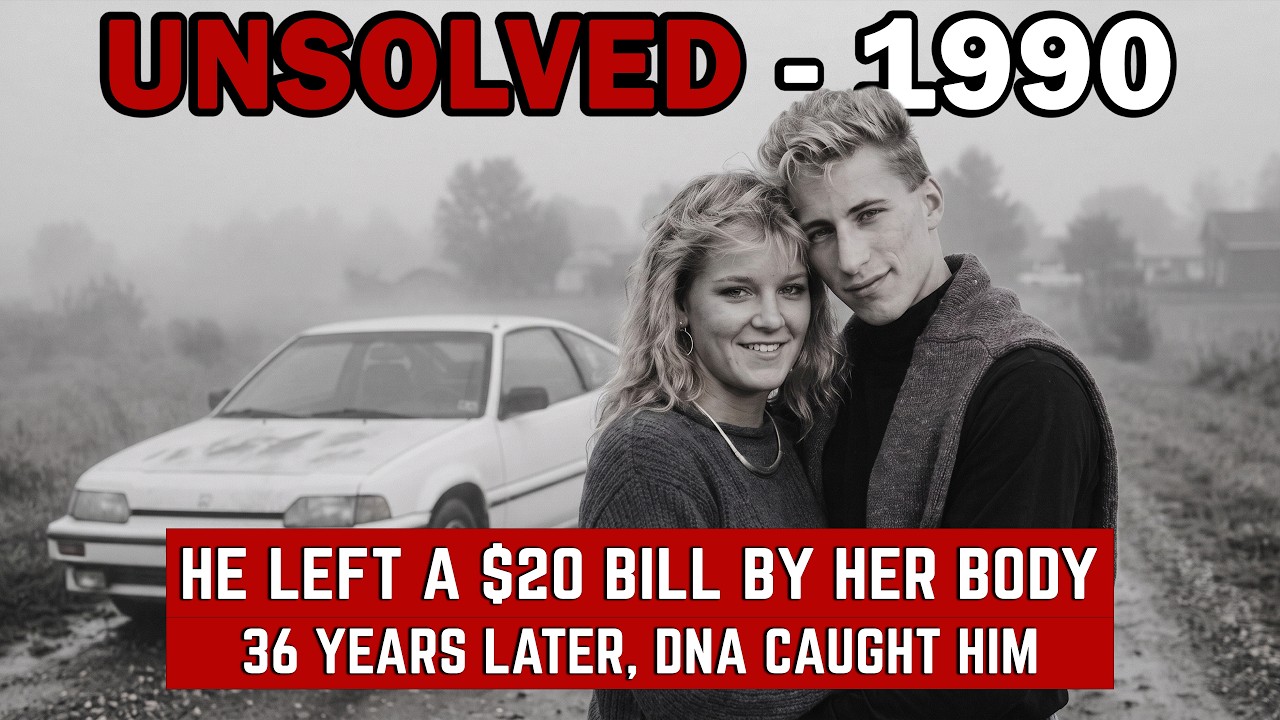
He had come prepared. What he did next would take more than three decades to answer for. Sheryl Henry was twenty-two years old. She had just started a full-time job she loved, and her sister Shane knew with certainty that something was wrong when Sheryl did not show up for work.
Sheryl never missed a day. She and Shane had put a deposit down on an apartment together. They were picking out furniture. Their mother was helping them.
Before all of that, Sheryl had traveled across Europe. She drove with her windows down, listening to AC/DC at full volume. She was, in every direction that mattered, moving forward in her life. Her sister once watched her and said, “There she goes again.
I’ll wait—she already did it. ”
Andy Atkinson was twenty-one. Born in Fayetteville, North Carolina, he was a country boy, raised on dirt roads and rope swings over rivers, the kind of kid who made everything look easy. He had moved to Houston against his mother Ann’s wishes after an emotional breakup, searching for a fresh start.
Ann had a feeling she could not name. She did not want him to go there. Within weeks of arriving in the city, he found work at a Gold’s Gym. He called Ann and told her he had met someone.
She said his voice sounded excited. They had known each other only a few weeks, in that early, electric stage where everything is still new. On the night of August 22, 1990, they went to Bayou Mama’s on Westheimer, a nightclub. It was a Thursday, one of hundreds of ordinary summer Thursdays in Houston.
Shane went with them, then got tired around 11 p. m. and went home. The plan was for Sheryl and Andy to stop by their friend Gretchen’s apartment afterward.
Gretchen waited. They never came. No one had dark thoughts yet. Shane filed a missing persons report at midday, more as a precaution than out of panic, because Sheryl had just started her job.
She was, under no circumstances, the type to miss an appointment. On the morning of August 23, a security guard on a routine patrol spotted a white Honda Civic parked at the end of a remote dead-end road near Enclave Parkway, an area locals called Lovers Lane. It was undeveloped land in 1990, dark after a certain hour, with dense trees on both sides of the road. The car had not moved for hours.
He walked toward it. The window was slightly open. On the passenger-side floor lay a purse, still there, untouched by anyone. A woman does not leave her purse by choice.
He reported it immediately. Police checked the license plate. It matched the missing persons report. Shane, her father Robert, and her mother Barbara rushed to the scene.
Andy’s blood was smeared on the door handle and pooled on the side panel. On Sheryl’s side, the sun visor had been torn from the ceiling, pulled with force. She had grabbed onto anything she could hold. Search dogs found her first.
In that moment, before anyone knew a name, before anyone grasped the full picture of what had happened, the lives of both families split permanently into before and after that phone call. The dogs led investigators to the trees. They found Sheryl in a wooded area near the dead end. She had been hidden under wooden boards.
She had been raped. Her hands were tied behind her back. Her throat had been cut three times. Three.
The cause of the three wounds, according to the medical examiner, was that she kept moving. She kept resisting. Her body refused to stop after the first attempt or the second. Her attacker had to return to her, deliberately and calmly, to do it again, and then again.
This man stood over a bound woman who was still fighting, and he went back to her twice. That is not loss of control. That is a choice, made with full awareness, repeated with full intent. Andy was found about 100 yards away, tied to a tree.
The wound to his throat was so deep it nearly severed his head. He had been positioned deliberately to face away from Sheryl, forced into a posture of total helplessness. He could hear everything. He could do nothing.
That positioning was not accidental. The killer chose it. Then, after both were dead, the killer did not flee. He placed a $20 bill near Sheryl’s body, deliberately.
He arranged Andy’s golf clubs and golf balls on the ground, lined up like arrows pointing in a specific direction. Then he left. The twenty dollars was not a robbery gesture. It was a message.
The golf clubs were not scattered in panic. They were arranged. This man knelt in the darkness beside what he had done and organized the crime scene the way he wanted it to be found. He came with rope.
He knew the location. He stayed to arrange the scene. He was controlled enough, satisfied enough, to treat the crime scene as his own signature. Investigators understood that immediately.
They were not looking for someone who had committed violence in a panic. They were looking for someone who had been preparing for this for a long time. What they did not know, and could not yet know, was that this man’s name was already in county files, one mile from where they stood. In May 1988, a man named Floyd William Burrow was arrested in Harris County for impersonating a security officer.
He claimed to be a sergeant with the Department of Defense. He drove a vehicle equipped with emergency lights and police equipment, a car designed to look like an authority vehicle from the outside. During booking, he gave investigators his work address. That address was one mile from the location that would later be known as Lovers Lane.
One mile, two years before the murders. His name was in Harris County files. His proximity to that specific stretch of road was documented by law enforcement. No one connected the dots for 36 years.
This was not a small error investigators could have easily corrected. This was a man who handed them his geographic location himself. A predator who impersonated a man of the law, the very method he would later use to approach two people and disarm them on a dark road, and his work address placed him one mile from the future crime scene. That information remained locked in a file in Harris County for nearly four decades.
The sentence in the 1988 impersonation case was one year of probation. He violated the terms of probation. He served nine months in prison. The court ordered him not to possess a firearm.
Keep that in mind. Two months later, in December 1988, he was arrested again. This time for carrying a weapon—a blue steel pistol. He went to trial.
He was convicted. The court took the weapon as evidence. Then, after the conviction and the case being closed, the court returned the blue steel pistol to Floyd William Burrow. He had a prior order not to possess a firearm after the impersonation charge.
Then he was later convicted in a separate weapons case, and the court still returned his gun. That specific weapon, the blue steel pistol, would later be identified by a sexual assault victim in June 1990, who matched the description of the gun her attacker used against her. The system convicted him, took his gun, and gave it back. He used it in his next attack.
The woman he assaulted in June 1990, whose testimony identified the weapon, whose DNA would ultimately help close the circle around Burrow, was not just physical evidence. She was a human being who survived a horrific experience, who came forward to testify to investigators, who sat with a forensic artist 18 years later when they asked her to. She is the third victim in this case, and she deserves to be called that. July 1990, the third arrest.
Impersonating a security officer, again. He was arrested, charged, then released on bail pending trial. He was out on bail when he sexually assaulted a woman in northwest Houston on June 20, 1990. He was out on bail when he killed Sheryl Henry and Andy Atkinson on August 22 and 23, 1990.
This escalation in crimes was not random. Each crime was bolder than the last. May 1988, impersonation, arrested, released. December 1988, illegal weapon, convicted, gun returned.
July 1990, impersonation again, arrested, released on bail. June 1990, sexual assault. August 1990, two murders. This was a man who tested the system repeatedly, found it willing to release him, and escalated his crimes accordingly.
He learned that impersonating authority, whether real or fake, protected him. He was right, until he was not. From the crime scene, investigators collected the killer’s DNA. They had the rope, the evidence of crime scene staging, and a behavioral profile clear enough to tell them this person had done this before or had been planning it for a long time.
What they did not have was a name to match the DNA to. CODIS, the national DNA database, was not fully operational then. Forensic testing could only confirm or exclude a suspect already in front of you. A search was impossible because there was nothing to search against.
The sample was packaged and carefully preserved, then placed in storage. Perfect evidence, completely useless, waiting for infrastructure that did not yet exist. Detective Billy Belk led the investigation from the beginning and worked it the way it deserved. Press conferences, anniversary appeals, interviewing more than 100 suspects over the years, examining every alibi, following every lead.
He took out the case file every August 23 and read it from the beginning, looking for anything he might have missed. He did this for 17 years before he was forced to retire. The case was still open when he left. What Belk did not have was the name Burrow, because Burrow’s name never appeared.
Not in reports, not in field searches, not during 17 years and more than a hundred investigated suspects. In 2001, a blackmail letter arrived. Someone wrote to investigators claiming they could identify the killer for $100,000. Investigators sat on that information for about three years before telling the family.
Not weeks—years. Robert Henry, Sheryl’s father, found out long after the fact. He still remembered the distinctive handwriting, the capital A open at the top. The letter led nowhere.
But the decision to hide it from a grieving family for three years was not coincidence or oversight. Someone made that decision. No explanation was ever given. Then in 2007, that sample had its first real contact with the world outside the evidence locker.
CODIS recorded a match between two cases. The DNA from the Lovers Lane murders matched the DNA from the June 1990 assault. Two crimes, one profile. For investigators, this was the first confirmation in 17 years that they were looking for a single man, not a group, not a ghost, not just a theory.
A specific person whose DNA was present at both crime scenes. What CODIS could not tell them was his name. The June 1990 assault remained unsolved. Its DNA was not linked to any identity.
They had the thread, but they could not pull it. The families were told a development had occurred. Then the years kept passing. 2008, 2009, 2010.
The thread stayed there, taut and nameless, for 18 more years. Shane Craig was nineteen when Sheryl was killed. She was supposed to move into that apartment with her. Instead, she ended up moving home to care for their mother.
She was twenty when she stood at her sister’s grave on the first anniversary, looked into the camera, and said clearly that the killers were still free and that was unacceptable. Over the next 35 years: newspaper ads with Sheryl’s photo, not once but repeatedly; regular calls to the Houston Police cold case unit; yes to every interview, every anniversary, every documentary request; yes to ABC 13 in 2025. She told Sheryl’s story until it reached the one person who needed to hear it. That is 35 years of refusing to let the world move on.
Shane could do that. She was in Houston. She was visible. She could make noise.
Not everyone had that. Tim Goodwin was in North Carolina. He grew up with Andy like a brother, and when the crime happened, he was sure, the way young people are sure about such things, that it would be solved within months. He named his son Tucker Andrew after Andy and watched that boy grow up in a world where the killer was still free.
By 2020, when the district attorney’s office indicated they were close, Tim was mature enough to know what “close” meant from a system that had been saying variations of that for 30 years. That closeness never materialized. He says he lost faith. He says it slowly.
But even Tim, 800 miles away and out of patience, knew more about this investigation than Andy’s own mother. Ann Fowler, Andy’s mother, his only child. She still visits the family cemetery in Fayetteville. Garland Sr.
is buried beside Andy now. She keeps his photos. She thinks about grandchildren she never had. When asked what she thinks about every day, she said, “I just think about wishing he was here with me and we were at the beach having a good time, him married with kids, and me having grandchildren to play with.
”
Over 36 years, the Houston Police Department never called her once. Not after the 2007 DNA match, not after the 2008 composite sketches, not after the 2025 tip, not after the 2026 arrest. Tim Goodwin said so in the ABC documentary without hesitation. He did not think they had ever contacted her.
Ann Fowler confirmed it herself. “They never called me. Not once. Not even a single phone call.
” Andy was her only child. The department responsible for finding his killer could not find the time over three and a half decades to make one phone call to his mother. In late 2025, a Houston police sergeant working the Lovers Lane file received a tip. The identity of the tipster was never revealed.
Whether the ABC 13 documentary finally reached them, or a conscience had been weighing on them for a long time, nobody knows. But the name they gave was Floyd William Burrow. Over 35 years, across more than 100 investigated suspects, that name had never been mentioned in connection with this case. Not once.
The sergeant searched criminal databases and found a 1996 Houston Police report about a sexual assault in which Burrow was the named suspect. He had claimed the encounter was consensual. A Harris County grand jury believed him. They declined to indict.
He was released. That 1996 DNA was never entered into CODIS at the time. Not in 1996, not in 2007 when investigators compared the Lovers Lane DNA against every available database and found only a case-to-case match with no name attached. The 1996 DNA stayed out of the system for 29 years.
When investigators finally uploaded it in 2025, it matched immediately. Sheryl Henry’s DNA from the autopsy and the June 1990 assault file showed the same result. Had that DNA been entered when it should have been, during a case with a named suspect, a 2007 search might have returned his name. The families might have had answers 18 years earlier.
A grand jury’s decision to believe Floyd Burrow over his victims may have cost both families nearly two more decades. But here is what no other media coverage got right. The tip revealed his identity, and science confirmed it—and that science did not happen overnight. In 2020, five years before the tip, five years before the arrest, the Houston Police quietly contracted with a private lab called Othram.
Othram specializes in forensic genetic genealogy, the same science that identified the Golden State Killer. Instead of searching for a suspect already in a database, family trees are built from public genealogy records, ancestry sites, historical records, working backward from distant genetic relatives until the branches narrow to a single person—a half-brother, a second cousin, someone who shares enough DNA to identify a family line, and from that line, a name. Othram applied forensic-grade genome sequencing to the original crime scene evidence from 1990. They built a comprehensive DNA profile.
They handed it to the FBI’s forensic genetic genealogy team. That team worked for years, manually and methodically, building trees and eliminating branches. They arrived at Floyd William Burrow. The anonymous tip and the five-year genealogy trail pointed to the same man.
One identified him. The other proved it. On March 25, 2026, Houston police investigators and FBI agents traveled to Lincoln, Nebraska. They knocked on the door of a 64-year-old man who had quietly left Houston less than two years earlier.
They asked him about Sheryl Henry. He said he had never known her. How do you control two people at once on a dark road at night? You do not overpower them.
You do not need to. You make them believe you have the right to tell them what to do. Then you watch them comply because they have been taught their whole lives that this is what good people do. Floyd William Burrow created that moment, and he did it more than once.
Over three decades in a city he knew well, he refined a method that turned the most basic human instinct—trusting authority, following instructions, staying safe—into a mechanism for harm. He grew up in Houston. He knew the west side. He knew which dead-end roads went dark after 10 p.
m. , which stretches of undeveloped land had no foot traffic, which roads people used and which they avoided. Lovers Lane was not a discovery. It was a choice.
The equipment he built. From evidence recovered during his 1996 arrest: badges from local law enforcement and the US Marshals, a driver’s license with his photo and a different name, emergency light bars and police radios, and a car that looked from the outside like it carried authority. This was not improvised. This was professional equipment, maintained and updated over the years.
When the court sentenced him after the 1988 charge, it ordered him not to wear a Navy uniform. That tells you exactly how elaborate his performance had become by then. In 1988, he claimed to be a Department of Defense sergeant driving an emergency-equipped vehicle. In 1990, he claimed to be a deputy sheriff in two separate jurisdictions and told at least one woman he worked as a security guard.
In 1996, he pulled over a driver on the Southwest Freeway and offered not to issue a ticket in exchange for $100. Three separate decades, the same performance, evolving each time. The district attorney confirmed the impersonation practice spanned the 1980s, 1990s, and 2000s. August 22, 1990.
Burrow was 28 years old and out on bail for a May impersonation charge. He drove his police-style vehicle in west Houston. He spotted Andy’s white Honda Civic parked at the end of a remote dead-end road. He turned on his lights.
He walked to the window. He told two people who had no reason to doubt him that he was police and they needed to get out of the car. Sheryl Henry and Andy Atkinson, two people on a date doing nothing wrong, who had never feared a police officer, did exactly what they had been taught since childhood. They got out of the car.
The cruelty of this method is precise. It does not begin with force. It begins with trust. It exploits the instinct good people carry: cooperate with authority and you will be fine, and uses it as a weapon against those most vulnerable to it.
Burrow understood this instinct better than almost anyone. He studied it. He practiced on it. He made it his profession.
When investigators sat across from him in Lincoln 36 years later, with his DNA, his criminal record, and 35 years of documents, they asked him about Sheryl Henry. He said he never knew her. No remorse, no silence, no lawyer’s refusal—just a lie. The same performance again, in front of the people who had spent their careers trying to reach him.
He had been performing for so long that even at the end, sitting before the evidence of everything he had done, he could not stop. He had been sentenced to 20 years in prison in 1995, served just over three years before parole in 1999. Then he blended back into ordinary life in Houston, owned property in New Caney until 2020, drove the same streets those families had traveled. Then he moved quietly to Nebraska less than two years before they came for him.
He thought distance would be protection. He was wrong. Lincoln, Nebraska, March 25, 2026. An ordinary street.
Houston police investigators and FBI agents knocked on a door. A 64-year-old man opened it. His rights were read. He was led away into an ordinary morning in a city that did not know what had just happened on one of its streets.
Thirty-six years of ordinary mornings, his ordinary mornings, ended in a single moment. March 26, the press conference. District Attorney Sean Teague announced murder charges in Criminal Court 160. He said what needed to be said.
They believed there were other victims. Anyone this man stopped, or approached while impersonating an officer over three decades, should contact investigators. The two murders of Sheryl and Andy might be just the visible part of his criminal history. Floyd William Burrow was arrested in Lincoln, Nebraska, on Wednesday evening and charged with capital murder in the deaths of Sheryl Henry and Andy Atkinson.
He was being extradited to Texas to face these terrible crimes. “I want to be very clear to the public, and most importantly to the families. This is an incredible achievement. But it is not the finish line.
To the investigators and prosecutors across agencies and decades who never gave up on Sheryl and Andy’s case, who spent 36 years chasing leads and facing dead ends, the frustrations and emotions you all had to deal with—a historic chapter has been closed. But the work cannot and will not stop now. ”
In the front row sat Billy Belk, the detective who worked the case for 17 years, who read the file every August 23, who was forced to retire with the case still open, who told Shane Craig year after year the case would be solved even when she started to lose hope of believing him. Shane was in that room.
She did not come to celebrate. What was there to celebrate? Sheryl was still gone. She came to witness.
To say, in the only language left to her, that her sister was never just a file. She wiped away silent tears, the tears of someone who had been holding them back for far too long. “Today is the day we have waited for with heavy hearts. Our sister was taken from our family in a way no one should ever experience.
”
April 28, 2026. Burrow was resisting extradition. A court hearing was scheduled for April 30. The process of returning him to Texas was moving forward.
He was days away from being sent back to the city where he had taken two lives and lived freely for 30 years afterward. He was found unconscious in his cell at the Lancaster County Jail in Nebraska. He had died by suicide, apparently. There would be no trial, no courtroom, no defendant’s seat, no sentence read aloud in a room witnessed by both families.
There would be no moment when the full accounting of what he did entered the public record clearly, his face and name attached. He chose the manner of his own death. The same control, the same deliberateness, the same refusal to face consequences one last time, in a jail cell when he realized those consequences had finally arrived. Francesca Del Russo, Andy’s half-sister, said it plainly.
She spoke with Andy Atkinson’s half-sister, who says Burrow’s death is frustrating. She had hoped he would get the death penalty or life in prison, but now she feels justice has been taken from them. It really stirs up emotions. Francesca Del Russo says Floyd Burrow’s suicide brings frustration, depriving her half-brother Andy Atkinson and Sheryl Henry of justice.
Andy and Sheryl did not get a choice in how their lives ended. They could not choose that. He got to choose how his life ended. Two families left that March press conference without the trial they had waited 36 years for, without a courtroom, without a verdict.
What they had was a name, a case file closed by death, an investigation not complete. Prosecutor Samantha Knecht said clearly after Burrow’s death that he could not erase what he did. His death did not close the investigation. Since the arrest warrant became public, new victims had come forward.
Women who had stayed silent for decades finally had a name to attach to what was done to them. There is a connected case in Louisiana already being worked. The FBI’s call for information remains open. Forensic genetic genealogy does not stop at a suspect’s death.
The DNA profile exists. The family trees used to find him exist. If there are other crime scenes carrying his profile, that science will find them. What this case proved is that preserved evidence is not static.
The DNA investigators collected in 1990 with the tools of their era, carefully preserved without certainty of what they were saving it for, survived 36 years in a locker and still told the truth. The science that read it in 2020 did not exist in 1990. But the evidence existed. It kept waiting.
The people who refused to stop are what made the difference. Billy Belk, who read the file every August 23 for 17 years. Samantha Knecht, who kept working the case after Burrow’s death. Shane Craig, who agreed to appear before every camera until the right person heard her story.
Tim Goodwin, who named his son after a cousin he could not stop thinking about. One anonymous caller who finally picked up the phone. The Othram scientists who spent five years tracing family trees backward to find a man whose name was in no database. None of them had to do it.
Each one chose to. What this case also proved, and cannot be left unmentioned, is that the system had Floyd William Burrow’s name in 1988, one mile from the crime scene, arrested twice for the same predatory pattern and released both times. His weapon was returned to him after a conviction. His 1996 DNA sample stayed out of CODIS for 29 years.
Andy’s mother never received a call. Each of those decisions was made by someone in an office, their file open on the desk in front of them. None of it can be undone, but it can be named plainly, without dressing it up as bad luck, because naming it is the only honest thing left for the people who lived with the consequences. Sheryl Henry was twenty-two.
She had just started a job she loved. She put a deposit on an apartment with her sister. She drove with her windows down. She brought joy to every room she entered.
When her throat was cut the first time, she kept resisting. She forced him to come back. She fought with everything she had. Andy Atkinson was twenty-one.
He moved to a city he had never lived in to start over, and called his mother to tell her he had met someone. She said his voice was full of excitement. He was a country boy who loved rope swings over rivers and thought he had plenty of time to get his life together. They had known each other only a few weeks.
They deserved to live for decades. After 36 years, their names are spoken not as a cold case, not as a file number, not as a tragedy for consumption, but as people. Someone who knew what happened finally made one phone call. It took 36 years.
That was enough.
