On the evening of January 15th, 1893, a carriage stood two blocks from the Astor mansion on Fifth Avenue, its wheels silent, its occupants hidden behind glass. Inside sat William and Katherine Burden, dressed for a ball they had not been invited to attend. Through the windows they could see light pouring from every window of the Astor house, could hear music faint and elegant, could watch footmen in white gloves checking names against a handwritten list as carriages lined the street and deposited women in furs and men in silk top hats, everyone moving with the ease of people who knew they were expected. Katherine reached for the door handle.
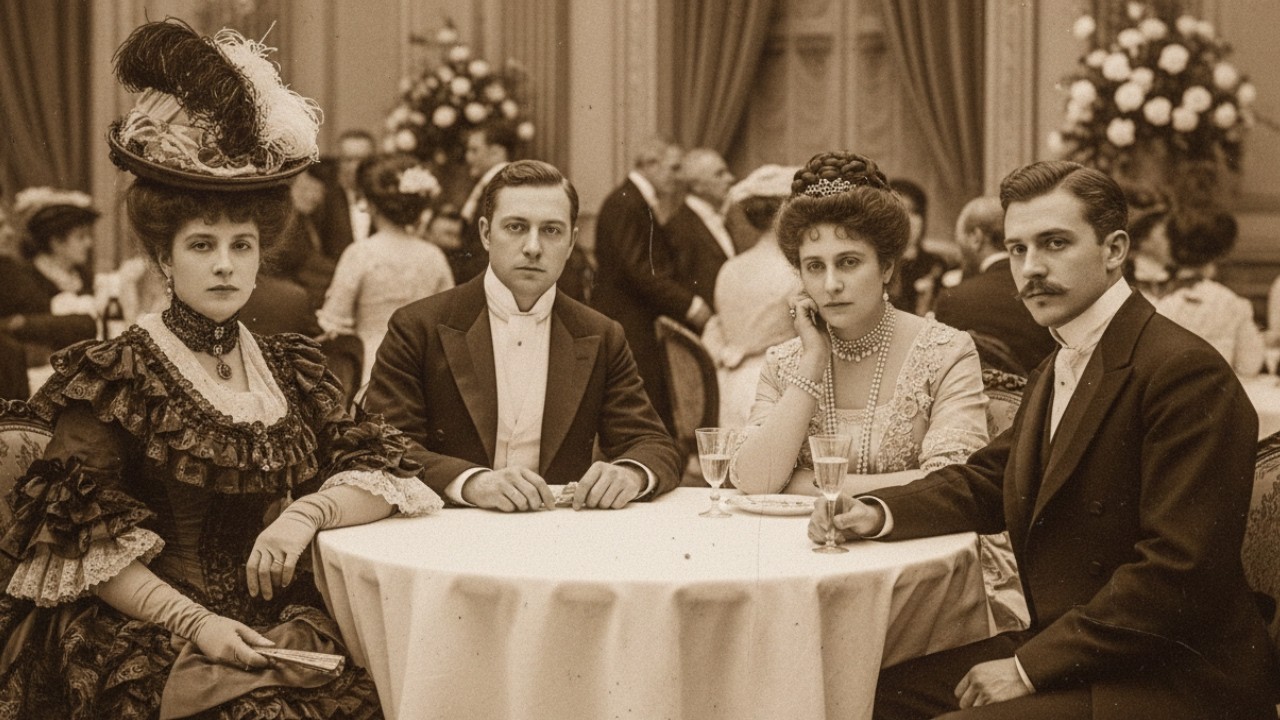
William caught her wrist. He said nothing, but his expression told her everything. If they walked to that door and were refused entry, the humiliation would be reported in every newspaper by morning. If they were admitted out of pity, it would be worse.
Pity was the currency of the defeated. They sat in the carriage for twenty minutes, watching shadows move behind the curtains. Finally William told the driver to take them home. They rode north in silence.
The Burden mansion was blazing with electric light when they arrived—a monument to everything they had tried to become. Katherine walked upstairs without speaking, removed her jewelry piece by piece, placed it in a velvet-lined box, and looked at herself in the mirror. She saw a woman dressed for a party that did not exist. The next morning the newspapers published the guest list.
Four hundred and thirteen names, printed in alphabetical order. The Burdens were not among them. The mansion had risen on Fifth Avenue between 52nd and 53rd streets during the coldest months of 1891 and 1892, twelve stories of French limestone climbing toward a sky that seemed perpetually gray with coal smoke and ambition. Katherine had chosen the location herself, pacing the sidewalk in a fur coat while contractors argued about foundation depth.
She wanted the house to sit exactly where Mrs. Astor’s carriage would pass on the way to the opera. She wanted every window to gleam. She wanted people to stop and stare and ask who lived inside.
Three thousand electric bulbs illuminated the facade at night, making the mansion glow like a theater against the darkness. It was the first fully electrified private residence north of 42nd Street. Pedestrians gathered on the opposite sidewalk to watch the lights flicker on at dusk. Newspapers sent photographers.
The New York Herald called it a palace. The Tribune called it a monument to industry. But the women who controlled the guest lists never mentioned it in conversation at all. Inside were forty-two rooms, eleven bathrooms, and a ballroom large enough to hold three hundred guests.
The ceilings were painted with scenes from mythology. The floors were inlaid with walnut and ebony in geometric patterns that took craftsmen seven months to complete. Every door handle was cast in bronze. Every window was framed in silk curtains woven in Lyon and shipped across the Atlantic in wooden crates marked fragile.
There were eleven bathrooms, a ballroom with chandeliers that cast rainbows across the polished floor, and a staff of twenty-three, including a French chef, two footmen, and a butler who had once worked for the Vanderbilts. William Burden had earned fifty million dollars in railroads before his fortieth birthday. At thirty-seven he controlled eighteen hundred miles of track stretching from Albany to Cleveland. His private rail car had leather seats imported from Vienna and a toilet lined in silver.
He ate oysters in Chicago and slept in silk sheets as the countryside blurred past his window. By 1890 he had accumulated more wealth than the combined fortunes of fifty colonial merchants. He had bought railroads. He had bought politicians.
He believed in the logic of capitalism—that everything had a price, that a Senate seat could be purchased with campaign contributions, that a favorable newspaper article cost the price of advertising revenue, and that surely a place in the social register could be acquired with enough marble and enough lights and enough champagne. But he and Katherine did not understand the rules of the game they were playing. In the world of Mrs. Astor and Ward McAllister, wealth was common.
What mattered was lineage, manners, and the invisible codes that separated those who belonged from those who merely wished they did. The Burdens had money, but they had worked for it. William’s father had been a freight clerk. Katherine’s mother had taken in sewing.
They had climbed from the middle class on the strength of risk and rail stock, and every syllable they spoke betrayed their origins. Katherine believed the house would be her passport. She imagined hosting a Christmas gala with champagne fountains and orchestras playing Strauss. She imagined Mrs.
Astor standing in her ballroom, a gloved hand resting on the marble mantelpiece, nodding with approval. She imagined her daughter, Margaret, dancing with the sons of old Knickerbocker families under chandeliers. The mansion was finished in October of 1892. Katherine stood in the empty ballroom and wept with joy.
William hired the staff, ordered champagne from Reims and caviar from Russia, had invitations printed on cream-colored cardstock with their names embossed in gold. And then they waited. Katherine checked the mail every morning, searching for the heavy envelope with Mrs. Astor’s seal.
Weeks passed. The winter social season began. Balls were announced in the society pages. Names were published in neat columns—the Astors, the Livingstons, the Schermerhorns.
The Burdens were never mentioned. Katherine told herself it was an oversight, that perhaps the invitations had been lost in the mail, that perhaps Mrs. Astor’s secretary had made an error. She sent flowers.
She made donations to charities that Mrs. Astor supported. She attended the opera and sat in a box three tiers below where the real families gathered, hoping someone would glance down and see her diamonds and wonder who she was. No one wondered.
No one looked. The silence was absolute. By December Katherine stopped pretending. The ballroom remained empty.
The chef prepared elaborate dinners for an audience of two. The electric lights blazed every night, but no carriages stopped outside. The mansion had become a mausoleum for a dream that had died before it could breathe. Ward McAllister, Mrs.
Astor’s chief advisor, had explained the system to a reporter in 1888. The Four Hundred, he said, represented everyone in New York who felt at ease in a ballroom. Everyone else, no matter how wealthy, was uncomfortable, awkward, out of place. It was not about money.
It was about something deeper and more permanent. The criteria were invisible but rigid: old families with Dutch or English roots who had arrived before the Revolution, fortunes built on land not labor, manners learned in childhood not acquired through etiquette books, the right schools, the right churches, the right way of pronouncing certain words. A woman could own fifty gowns and a diamond necklace worth twenty thousand dollars, but if her father had worked with his hands, she would never be accepted. The old families did not hate the Burdens.
They simply did not see them. In the hierarchy of Gilded Age New York, invisibility was the cruelest punishment. It meant you did not exist. Your mansion, your money, your electric lights were irrelevant.
You were a ghost in your own city. Katherine understood this in the carriage that night, watching Mrs. Astor’s windows from a distance. The realization settled over her like frost.
She would never belong. If wealth could not purchase belonging, then what was it for? By the spring of 1895 Katherine had abandoned New York. If American society refused to acknowledge her, she would create a new strategy.
She would send Margaret, now nineteen, to London for the season and arrange a marriage into the British aristocracy. A title would do what marble and electric lights could not. It would erase the shame of being new money and give the family something that even Mrs. Astor could not purchase.
Margaret had been raised inside the Fifth Avenue mansion like a prisoner in a gilded cage, educated by tutors and trained in accomplishments that had no outlet. She spoke French. She played the piano. She had read Shakespeare and memorized the correct way to address a duchess.
But she had never attended a ball in her own city. She had no friends among the daughters of old families. She was beautiful and intelligent and completely isolated. Katherine presented the plan as an adventure—London, Paris, the European season, princes and lords and men with bloodlines that stretched back to the Crusades.
She would dance at court. She would be presented to the queen. And if everything went according to plan, she would return to New York as Lady Something, immune to the social exile that had destroyed her mother. William financed the expedition with the same efficiency he applied to railroad acquisitions.
He rented a townhouse in Mayfair for the season. He hired a London-based social secretary who specialized in introducing American heiresses to impoverished aristocrats. He opened accounts at dressmakers on Bond Street and jewelers in Hatton Garden. Margaret would arrive in London with a wardrobe worth thirty thousand dollars and a dowry that would be announced discreetly to anyone who asked: one million dollars.
In 1895 that sum could feed five thousand factory families for a year. A laborer in New York earned an average of five hundred dollars annually, working twelve-hour days in conditions that broke bodies and minds. Margaret’s dowry represented two thousand years of labor for a single man. It was exactly what the English aristocracy wanted.
Matchmakers and social secretaries used words like alliance and suitability and mutual advantage, but everyone understood the arithmetic: British lords had estates and titles but no cash; American heiresses had cash but no status. The exchange was money for legitimacy, dollars for respect. Margaret sailed for England in April of 1895 aboard the Cunard liner Campania, traveling with her mother, two maids, and eleven steamer trunks containing gowns, furs, and jewelry selected to dazzle a continent. The London season was a military campaign.
Margaret attended seventy-three events in twelve weeks—garden parties, musical halls, dinners where twenty courses were served on gold-rimmed china. She curtsied to dowagers and smiled at younger sons and danced with men whose names appeared in Debrett’s Peerage. By June three men had expressed interest. One was the younger son of a Scottish earl, charming but penniless.
Another was a baronet with an estate in Yorkshire and debts that exceeded fifteen thousand pounds. The third was Viscount Ashford, thirty-two years old, heir to a crumbling manor house in Gloucestershire and a title that dated to the seventeenth century. Ashford needed money desperately. His father had gambled away the family fortune on horses and bad investments.
The estate required constant repairs. The roof leaked. The tenant farmers had not been paid in months. He was elegant, well-mannered, and utterly indifferent to Margaret as a human being.
He saw her as a financial instrument. She saw him as an escape route from obscurity. The engagement was announced in The Times of London on July 9th, 1895. The New York newspapers reprinted the story with varying degrees of enthusiasm.
The Herald celebrated it as a triumph of American vitality over European decay. The Tribune published the details of the dowry with barely concealed disgust, noting that one million dollars could have endowed a university or built a public library. The society pages controlled by the old families mentioned the engagement in a single sentence at the bottom of a column, as if it were a minor transaction unworthy of attention. The wedding was planned for September at St.
George’s Church in Hanover Square. Catherine ordered a gown from Worth in Paris—ivory satin with a train twelve feet long and a veil embroidered with silver thread. Two hundred guests attended, most of whom Margaret had met only once. Viscount Ashford’s family attended out of duty, their expressions carefully neutral.
They were selling their son and everyone in the church knew it. The ceremony lasted thirty minutes. Margaret spoke her vows in a clear voice that betrayed nothing. Ashford slipped a gold ring onto her finger, inherited from his grandmother, the last piece of family jewelry that had not been sold.
They walked down the aisle to Mendelssohn, and Catherine wept with something that resembled joy. What she felt was relief—that the plan had worked, that the million dollars had purchased what it was supposed to, that for once someone had said yes. By October Margaret and Viscount Ashford were living in Gloucestershire in a house that smelled of mildew and old fires. The million-dollar dowry was being used to repair the roof, pay the debts, and keep the estate from collapsing entirely.
Margaret wrote letters to her mother describing the countryside, the rain, the cold that seeped into her bones. She did not mention whether she was happy. Catherine chose to believe silence meant contentment. Back in New York, the Burdens waited for the validation they had purchased.
Surely now, with a viscountess in the family, Mrs. Astor would reconsider. Surely now the invitations would arrive. Catherine redecorated the ballroom and hired new staff and prepared for the season with renewed hope.
The house glowed with three thousand electric bulbs. The champagne was chilling. The musicians were rehearsing. But the invitations still did not come.
A title in England meant nothing to the families who controlled Fifth Avenue. They had won a battle in Europe and lost the war at home. Across Fifth Avenue from the Burden mansion, in a limestone fortress built by old Knickerbocker money, lived Eleanor Van Rensselaer. Her family had owned land in Manhattan when it was still called New Amsterdam.
Her grandfather had signed the Constitution. She had been invited to every ball Mrs. Astor had hosted for the past twenty years. Her fortune came from oil—not the kind her husband had drilled or refined, but the kind discovered on land her family had owned since 1650 when workers found crude beneath a farm in Pennsylvania that had belonged to the Van Rensselaers for two centuries.
The rights were leased to Standard Oil. Royalty checks arrived monthly, each one worth more than most families earned in a decade. Eleanor had not worked for this money. She had simply inherited the right piece of dirt at the right moment in history.
In her world, wealth was never supposed to be discussed. It was vulgar to mention money, vulgar to display it too obviously, vulgar to act as though it mattered. Eleanor had mastered this performance. She spent lavishly but quietly, donated to charities but never allowed her name to appear in the newspapers, hosted dinners where the china was priceless and the conversation carefully controlled.
By 1893 she had decided that charity work would be her battlefield. She joined the board of the Metropolitan Museum of Art, donating fifty thousand dollars for a new wing dedicated to European paintings. She funded scholarships at the New York Public Library. She organized galas where tickets cost one hundred dollars and proceeds went to hospitals that served the poor.
This was philanthropy as warfare. Every donation was a territorial claim. Every gala was an opportunity to reinforce the boundaries between insiders and outsiders. The guest lists for Eleanor’s charity events were as exclusive as Mrs.
Astor’s balls. New money families were invited to donate but never to attend. They could write checks, but they could not walk through the door. The Burdens tried to buy their way in.
William donated ten thousand dollars to the museum, expecting at minimum an acknowledgement. The museum sent a form letter thanking him for his generosity. His name was not added to the donor wall. Catherine purchased an entire table at Eleanor’s hospital gala, paying eight hundred dollars for seats she would never occupy.
The tickets were accepted. A thank-you note arrived on heavy cardstock. But the Burdens were not invited to the event itself. Their money was welcome.
They were not. This was the genius of the system. Old money families had learned to monetize exclusion, creating institutions that required wealth to sustain but were controlled by bloodline. Museums needed donors.
Hospitals needed funding. Opera houses needed patrons. But the boards that governed these institutions were closed circles, passed down through families like inheritances. You could give a million dollars to the Met, but if your grandfather had not attended Yale and your mother was not a Livingston or a Stuyvesant, you would never sit on the board.
Eleanor had been raised to see society as a fortress under siege. The new money families were barbarians at the gate, armed with checkbooks and crude ambition. For every old family there were ten new fortunes rising from railroads, steel, oil, finance. If the gates were opened even slightly, the flood would be uncontrollable.
Standards would erode. Bloodlines would be diluted. So the gates remained closed. The old families formed alliances through marriage, binding their children to cousins and second cousins to keep the wealth concentrated.
They controlled access to schools, clubs, churches. They decided who was mentioned in the society pages and who was ignored. At a Metropolitan Opera opening in 1894, Eleanor arrived in a gown of black velvet with a diamond necklace that had belonged to her grandmother and took her seat in a box on the grand tier, surrounded by women whose families had owned Manhattan when it was farmland. Two tiers below, Katherine Burden sat in a rented box, wearing sapphires and a gown from Paris.
She looked up at the grand tier, hoping for eye contact, a nod, any acknowledgement that she existed. Eleanor looked past her as if she were invisible. This was how wars were fought in ballrooms—not with weapons, but with silence. Not with proclamations, but with absence.
The cruelest violence was indifference. By 1897, gossip columns had become weapons sharper than any court summons. William Randolph Hearst had purchased the New York Journal in 1895 for $180,000 and immediately declared war on respectability. He wanted readers, millions of them, and he understood that the path to mass circulation was not through careful reporting but through sensation, scandal, and the surgical exposure of private humiliation.
His editors discovered that society gossip sold papers faster than political analysis. Every stumble, every social rejection, every embarrassing detail of a new money family’s desperate climb provided entertainment for people whose lives contained no ballrooms or mansions. By 1897 the Journal was printing 900,000 copies daily, more than any newspaper in America. Advertising revenue exceeded two million dollars annually.
Gossip had become an industry. The Burdens were ideal targets—wealthy enough to be interesting, but powerless enough to be mocked without consequence. Columnists described Katherine’s gowns in excruciating detail, noting when the fabric was too shiny or the bodice cut too low or the jewelry too large. They quoted her mangled French.
They described her accent as grating, her laugh as too loud, her manners as rehearsed and artificial. One column, published in March of 1897, detailed Katherine’s attempt to host a musical at the Fifth Avenue mansion. She had hired a soprano from the Metropolitan Opera to perform arias in the ballroom. Invitations had been sent to two hundred people.
Seventeen attended, most of them relatives or business associates of William who came out of obligation. The article was titled “The Concert No One Came To” and was reprinted in four other papers within a week. Katherine became a joke—the woman who built a palace no one visited, the woman who sang to empty chairs. William tried to respond the way he responded to all threats, with money.
He purchased advertising space in the Journal, hoping to pressure Hearst into softening the coverage. It backfired. The next gossip column mentioned the advertising deal explicitly, noting that even William Burden’s railroad fortune could not buy him dignity. The mockery intensified.
In 1898 the Journal began publishing illustrated society gossip, cartoons that exaggerated features and amplified humiliation. Katherine appeared in several drawings, always depicted with an oversized hat and a desperate expression, standing outside a closed door or peering through a window at a party she could not attend. Strangers pointed and whispered when she walked down Fifth Avenue. She became famous for being rejected.
Other new money families were being dissected in print as well. An industrialist’s wife was mocked for mispronouncing the name of a French wine. A steel baron’s daughter was ridiculed for wearing a gown that resembled a stage costume. In 1899, a copper mining heiress named Beatrice Callaway attempted to host a debutante ball for her daughter at the Waldorf Astoria.
She spent thirty thousand dollars on flowers, champagne, and an orchestra brought from Vienna. The guest list included three hundred names, carefully curated to include the sons and daughters of old families. One hundred and forty people attended. The World published a photograph of the ballroom half empty with a caption that read, “When money cannot fill the room.
” Beatrice sued the paper for libel. The trial lasted three weeks. The orchestra conductor described playing to empty tables. Beatrice lost the case and was ordered to pay the World’s legal fees.
The judgment was two thousand dollars. The humiliation was incalculable. Katherine stopped reading the papers. She instructed her staff to hide them.
But she could not hide from the consequences. Invitations stopped arriving even from second-tier families who had previously tolerated her presence. Her donations to charity were accepted but not acknowledged. She had become toxic, a name associated with failure and desperation.
By 1900 she rarely left the mansion, spending her days in the ballroom, alone, standing in the center of the polished floor where she had once imagined three hundred guests dancing. The chandeliers sparkled above her. The mirrors reflected infinite versions of her solitude. The house had become her prison, and the newspapers were her jailers.
The marriage, built on ambition rather than affection, had been unraveling for years. William and Katherine had never loved each other in any conventional sense. They had formed an alliance: he provided the money, she provided the social strategy. But by 1900 it was clear the goal was impossible.
The mansion stood empty. Margaret was exiled in England, married to a viscount who barely spoke to her. The newspapers mocked them relentlessly. And the fortune that had seemed limitless was beginning to fracture.
The Panic of 1893 had been a warning. Stock markets collapsed, banks failed, railroads went bankrupt. William had survived through leverage and ruthlessness, but the recovery was fragile. His railroad holdings were worth half what they had been at their peak.
Dividends shrank. Creditors began circling. The mansion, which had cost four million dollars to build, now cost three hundred thousand dollars annually to maintain. Fifty servants required salaries.
Coal for heating cost eight thousand dollars each winter. The electric lighting system required a full-time engineer. When Katherine asked for money to redecorate the drawing room, William told her they could not afford it. In April of 1901 Katherine discovered that William had mortgaged the mansion without telling her.
The amount was eight hundred thousand dollars, borrowed from a private bank at seven percent interest, secured against the property itself. If William defaulted, they would lose the house. She confronted him in his study. He told her the truth with a bluntness that felt like violence.
They were nearly broke. The railroad dividends had collapsed. The mansion was unsellable at any price that would cover the debt. The only reason they still lived there was because the bank had not yet foreclosed.
Katherine filed for legal separation in June of 1901. Her legal argument was novel and vicious. She claimed that William had humiliated her publicly by failing to provide the social status he had promised when they married. She argued that the mortgage was a form of theft, that the mansion was as much hers as his, and that his financial mismanagement had damaged her reputation irreparably.
The trial began in September and became an immediate sensation. Katherine testified for six hours describing her attempts to enter society, the rejections, the mockery, the endless humiliation. She wept on the witness stand. She read aloud from letters she had written to Margaret, letters filled with loneliness and desperation.
The testimony revealed financial details that shocked even the reporters. The railroad holdings were worth twelve million dollars, down from a peak of thirty million in 1890. The mansion was appraised at 2. 8 million, but no buyer could be found at that price.
The mortgage payments were sixty thousand dollars annually. William’s liquid assets totaled less than four hundred thousand dollars. He owed two hundred thousand dollars to investors in a failed railway venture. He had borrowed against his stock holdings.
He had sold family jewelry without telling Katherine. The man who had earned fifty million dollars before his fortieth birthday was now, at fifty-three, teetering on the edge of insolvency. The trial lasted seven weeks. The judge ruled in Katherine’s favor on a technicality, granting her a legal separation and awarding her an annual stipend of twenty thousand dollars to be paid from William’s remaining assets.
The ruling was narrow and unsatisfying. Katherine had won the case but lost the war. The separation made her a public scandal. Old families whispered that she was grasping and vindictive.
New families saw her as a cautionary tale. No one invited her anywhere. William moved out of the mansion and into a suite at the Manhattan Club. Katherine remained in the house with a skeleton staff of twelve servants, down from fifty.
The ballroom was closed to save on heating costs. The electric lights were turned off except in the rooms she occupied. The palace had become a tomb. Across town, in a brownstone on Madison Avenue, James Caldwell’s own Gilded Age palace was failing.
His fortune came from steel—mills he owned across Pennsylvania and Ohio that by 1895 employed twelve thousand men and produced eight hundred thousand tons of steel annually. The profits were staggering, nearly six million dollars a year. He had used that money to build a palace on 57th Street that rivaled the Burden mansion in scale and exceeded it in ostentation: sixteen bathrooms, a two-story conservatory filled with orchids imported from Brazil, a ballroom with a ceiling painted to resemble the Sistine Chapel, an aesthetic choice so garish that even William Burden had privately mocked it. The house required a permanent staff of fifty-two people—a head butler, two sous chefs, eight footmen, twelve housemaids, six kitchen staff, groundskeepers, laundresses, a full-time electrician, a plumber on retainer.
The annual operating cost was four hundred twenty thousand dollars. James had built the palace in 1894 at the peak of his wealth and confidence, believing like William Burden that scale would translate to status. His wife Lydia shared Katherine’s obsession with acceptance, spending her days planning for a social life that never materialized, ordering gowns from Paris and jewelry from Cartier, hiring a French chef and a German music master. But no one came.
The rejection was less dramatic than the Burdens’ but more insidious. The Caldwells were not mocked in the newspapers. They were simply ignored. Invitations arrived for second-tier events—charity auctions and museum fundraisers where their money was welcome but their presence was tolerated rather than desired.
They were allowed to donate, never to belong. By 1900 the house had become a burden James could barely afford. The steel industry was consolidating, larger companies buying out smaller competitors. The Panic of 1893 had damaged his capital reserves.
Dividends were shrinking. Maintenance costs were rising. Winter was the worst season—the house required twenty tons of coal each month to heat, delivered in wagons that arrived at the servants’ entrance and unloaded into a basement bunker. The coal cost $1,600 each winter just for fuel.
The furnaces ran day and night, but the upper floors remained cold. Lydia wore furs indoors, and servants complained of chilblains and respiratory infections from the coal dust. James began closing rooms to save money. The conservatory was shut down first; the orchids died within a month.
Then the guest bedrooms, then the music room where Lydia had once imagined hosting salon evenings. By 1901 they were living in eight rooms of a house designed for eighty people. The staff was reduced to twenty. The ballroom, which had hosted exactly three events in seven years, was closed permanently.
Lydia descended into a depression her doctors could not name and could not cure. She spent her days in bed, curtains drawn, refusing to see visitors who never arrived. She took laudanum for her nerves, morphine for headaches that seemed to never end. Her maid reported that she wept frequently, sometimes for hours, though she could not explain why.
James had mortgaged the house twice, borrowing against the only asset he still controlled. The total debt was 1. 2 million dollars secured against a property that was worth less every year. In 1902 he received an offer to sell his steel company to J.
P. Morgan’s newly formed United States Steel Corporation. The price was eight million dollars—less than half what the company had been worth at its peak, but more than James could expect from any other buyer. He accepted.
The deal closed in April. James walked away with four million dollars in cash after paying debts and settling with investors. It should have been enough. But the house consumed it with terrifying speed—mortgage payments, staff salaries, repairs, coal, food.
By 1904 the cash reserves were below two million dollars. By 1906 they were under one million. James tried to sell the mansion. He listed it with brokers who promised discretion, asking price two and a half million dollars—a loss of nearly a million from the construction cost—but no offers came.
The market for oversized private palaces had collapsed. Wealthy families were building smaller, more manageable homes. The fashion was shifting toward restraint. A sixteen-bathroom house with a faux Sistine Chapel ceiling was no longer aspirational.
It was absurd. The house sat empty, unsold, a monument to miscalculation. James and Lydia moved to a smaller residence on Park Avenue, taking twelve servants and leaving the rest to maintain a building that no one visited. James developed insomnia, waking at three in the morning with his mind racing through calculations: how much coal remained, how many months until the mortgage payment was due, whether he could rent out floors to tenants, though the idea of strangers in his palace felt like admitting defeat.
He lost weight. His hands shook when he signed checks. Lydia stopped leaving her bedroom, dismissed her maid, took her meals alone, and wrote letters to no one, filling pages with thoughts she would never send. In one letter, discovered after her death, she described the house as a prison built with her husband’s money and her own vanity.
She wrote that she had mistaken luxury for happiness and discovered too late that they were not the same thing. By 1907 the house was costing more to maintain than James earned in dividends from his remaining investments. He stopped paying the full staff. Rooms were left uncleaned.
Leaks went unrepaired. The furnaces were lit only in the rooms they occupied. The rest of the palace grew cold and damp, mold creeping across wallpaper that had once cost fifty dollars per roll. The house had become too expensive to heat, too expensive to staff, too expensive to love.
By 1905 the Burdens had become invisible, not through death or departure, but through a process more subtle and more complete. Society had simply stopped acknowledging their existence. Newspapers no longer mentioned Katherine’s name. The society pages that once mocked her attempts at grandeur now ignored her entirely.
She was neither successful enough to admire nor failing dramatically enough to ridicule. She was nothing. Katherine remained in the Fifth Avenue mansion, living on the twenty-thousand-dollar annual stipend the court had awarded her—enough to maintain a skeleton staff and heat a few rooms, but not enough to restore the house to its original splendor. She lived in four rooms on the second floor, surrounded by furniture that had once symbolized ambition and now represented only loss.
William had moved to Newport, renting a cottage near the ocean where he spent his days walking along the cliffs and his evenings drinking whiskey alone. He had sold the last of his railroad holdings in 1903, converting his stake to cash before the final collapse. The sale netted him two million dollars, enough to live comfortably if modestly. But comfort was not what he had wanted.
He had wanted power, recognition, a legacy. Instead he had a bank account and a reputation as a man who had built an empire and then lost it through arrogance and miscalculation. Margaret remained in England, trapped in a marriage that had become intolerable. Viscount Ashford had spent the million-dollar dowry repairing his estate and paying his father’s debts, and now treated Margaret as an inconvenience.
They lived in separate wings of the manor house. He took a mistress, a widow from the neighboring estate, and made no effort to hide the affair. Margaret wrote letters to her mother describing her loneliness, but never asking to come home. There was no home to return to.
Eleanor Van Rensselaer watched this process with a mixture of satisfaction and unease. She had been part of the defense, one of the gatekeepers who had ensured that the Burdens and families like them were never admitted. But by 1908 she was beginning to question what she had defended. The Four Hundred still existed, but they seemed smaller, less significant.
The Progressive Era was rewriting the rules of wealth and power. Income taxes were being proposed. Antitrust legislation was breaking up monopolies. The old families still controlled Fifth Avenue, but Fifth Avenue no longer controlled America.
At a dinner at the Astor mansion in 1906, Eleanor sat next to a woman she barely knew, a philanthropist who had made her fortune in publishing. The woman asked if Eleanor was happy. The question was so direct, so inappropriate by the standards of their world, that Eleanor did not know how to answer. She said yes, of course, out of reflex.
But later, alone in her carriage, she wondered if the answer was true. In 1908, the notice appeared in the New York Times on a Tuesday in April. A public auction was to be held at the former residence of William and Katherine Burden, Fifth Avenue between 52nd and 53rd streets. All contents to be sold—furniture, artwork, fixtures, carpets, chandeliers, decorative items.
The bank that held the mortgage had initiated foreclosure proceedings in January. The house would be sold to satisfy the debt. The contents had to be liquidated first. Katherine was allowed to keep her personal belongings and a small selection of furniture.
She moved to a small apartment on Lexington Avenue, taking three trunks and a maid. The auction attracted a crowd larger than any party Katherine had ever imagined hosting. Dealers came from Boston and Philadelphia. Collectors arrived in private rail cars.
Curiosity seekers crowded the sidewalk. The house that had been designed to hold three hundred guests at a ball now held four hundred bidders packed into the ballroom. The auctioneer, Theodore Hastings, stood on a raised platform and began with professional detachment. Lot number one: a set of twelve dining chairs, rosewood with silk upholstery, original purchase price six hundred dollars.
The bidding opened at one hundred, sold for one hundred forty. The chairs had been custom-made in Paris. Katherine had chosen the fabric herself, pale blue silk that matched the wallpaper in the dining room. They had been used perhaps twenty times in sixteen years.
They sold for less than a quarter of their original cost. Lot after lot, the contents of the mansion were sold. A chandelier from the ballroom, three thousand crystals hand-cut in Bohemia, original cost eight thousand dollars, sold for two thousand. A Persian carpet from the drawing room, purchased for four thousand, sold for nine hundred.
Paintings in gilded frames, mirrors that reflected nothing now, tables that had held champagne glasses and hors d’oeuvres for parties that never happened. The Burdens had spent approximately six hundred thousand dollars furnishing the mansion. The auction, which lasted two days, generated total sales of ninety-three thousand dollars. Eighty-five percent of the value had evaporated.
A marble statue of Venus, imported from Italy at a cost of twelve thousand dollars, failed to attract a single bid. It was too large, too impractical, too specific to the mansion it had been designed for. Eleanor Van Rensselaer sent her secretary to purchase a small writing desk that had belonged in the library. The secretary paid sixty dollars for a piece that had cost two hundred fifty.
Eleanor kept the desk in her own home for years, though she never mentioned where it had come from. Other old money families sent representatives as well, purchasing items at bargain prices, furniture and artwork that would furnish their own mansions and summer estates. The auction redistributed the wealth that the Burdens had concentrated into a single palace. The mansion itself sold three months later for 1.
8 million dollars, less than half the construction cost. The buyer was a real estate developer who planned to demolish the building and construct an apartment complex on the site. The twelve-story palace would be reduced to rubble. James Caldwell watched the Burden auction with a sense of dread.
His own financial situation was deteriorating. The steel fortune was gone. The house on 57th Street was mortgaged beyond recovery. In 1910 the Caldwell auction took place, following the same pattern with even more devastating losses.
The house had been furnished with nearly eight hundred thousand dollars worth of artwork, furniture, and fixtures. The auction generated sixty-two thousand dollars in sales. Ninety-two percent of the value was lost. Lydia died three weeks after the auction in a rented apartment on Madison Avenue.
The doctors called it heart failure. Her family knew it was despair. She was fifty-three years old. Her funeral was attended by seventeen people, none of them from the families she had tried so desperately to join.
James survived her by less than a year, developing pneumonia in the winter of 1911 and dying in a hospital room that overlooked the East River. His estate, once valued at over ten million dollars, was worth four hundred thousand at the time of his death. His children inherited the remainder and moved to California, where no one knew their name or their history. Katherine Burden lived for eight more years after the auction, though lived is perhaps too strong a word for what she did.
She existed, moving from Lexington Avenue to a boarding house on the Upper West Side, then to a residential hotel in Brooklyn that catered to widows and spinsters who had fallen from better circumstances. She suffered from headaches that no doctor could diagnose or treat. She lost weight until her clothes hung loose on her frame. She took morphine daily, prescribed for pain but functioning as escape.
Margaret never returned from England. She wrote letters occasionally, brief and formal, describing the weather and the estate and nothing of substance. She had produced two children, a son and a daughter, both raised by nannies in the English tradition. Viscount Ashford died in 1907, thrown from a horse during a hunt.
Margaret inherited the title and the estate, which was still mortgaged and still crumbling. She lived alone in the manor house, a viscountess in name but a prisoner in fact. William died in 1912 in a Newport hotel room overlooking the ocean, found by a maid who had come to deliver breakfast. He had suffered a stroke in the night.
The death certificate listed the cause as cerebral hemorrhage. The obituary in the New York Times was three paragraphs long, mentioning his railroad career and his fortune, but not his social ambitions or his failures. Katherine attended his funeral, one of fourteen mourners in a ceremony that lasted twenty minutes. She stood by the grave and felt nothing.
By 1914 Katherine was living on the remainder of her court-awarded stipend, which had been invested poorly and had shrunk to less than twelve thousand dollars annually. She wore the same three dresses in rotation. She had no staff, no maid, no one to assist her except the hotel employees who brought her meals and changed her linens. She died in March of 1916, alone in her hotel room, from an overdose of morphine that may or may not have been accidental.
The hotel manager found her the next morning, lying in bed with an empty bottle on the nightstand. The death certificate listed the cause as respiratory failure. The newspapers did not mention her passing. She was buried next to William in a cemetery in Newport, a place neither of them had ever called home.
The headstone, paid for by Margaret, who did not attend the funeral, read simply: Catherine Lowell Burden, 1856 to 1916. Margaret herself died in 1923 in the manor house in Gloucestershire of influenza during the epidemic that swept Europe. Her children inherited the title and the estate and the debts. They sold the property in 1927, using the proceeds to pay mortgages and settle with creditors.
The manor was converted to a school. The dowry that William Burden had paid to secure his daughter’s title ultimately funded the education of children whose parents had never heard of the Burden name. James Caldwell’s children sold the remaining assets and moved west, changing their name to distance themselves from the scandal of the auctions and their father’s collapse. Within a generation, the Caldwell fortune was forgotten.
By 1915 the old families had quietly rewritten history to exclude their challengers. There were no public declarations, no parades, no monuments to their triumph. They simply continued to exist, maintaining their grip on the institutions and social structures that defined New York’s upper echelon. Eleanor Van Rensselaer was sixty-two, still sitting on the boards of the Metropolitan Museum and the New York Public Library, still attending Mrs.
Astor’s annual ball, though Mrs. Astor herself was declining, her memory failing, her grip on society loosening. The old families adapted by shifting their strategies. They stopped building palaces and started funding universities, endowing museums and libraries and hospitals, rebranding their wealth as civic virtue.
The Rockefellers, the Carnegies, the Morgans—families that had been excluded from the Four Hundred in their early years—had created their own aristocracy, based not on bloodline but on institutional power. Mrs. Astor died in 1918. Her funeral was attended by hundreds, a final gathering of the Four Hundred and the families who had orbited them for decades.
Eleanor sat in the front pew and watched the coffin being carried out of the church. After the funeral she walked through Central Park alone, thinking about the families she had helped exclude, the Burdens, the Caldwells, dozens of others whose names she had forgotten but whose desperation she remembered. She had believed she was defending something valuable, a standard of civilization and refinement. But looking back, she wondered if all she had defended was the right to say no.
The war had been won, but the prize felt hollow. The old families still controlled the ballrooms, but the ballrooms no longer controlled the world. Eleanor withdrew from society in the years following Mrs. Astor’s death.
She resigned from two of her charitable boards, stopped hosting dinners, spent more time at her country estate. Her husband had died in 1917. Her sons were occupied with their own families and careers. By 1920 the Four Hundred as a social institution had effectively dissolved.
The term was still used in newspapers, but it referred to a nostalgic memory rather than a functioning reality. In 1925 Eleanor donated her family’s estate to the state of New York to be converted into a public park. It was an act of philanthropy, but it also felt like surrender. The land that her family had owned for two hundred fifty years would now belong to everyone.
The fortress would become a commons. The gates would be opened permanently. She died in 1928 at the age of seventy-five in her townhouse on Fifth Avenue. Her obituary praised her charitable work and her contributions to the city’s cultural institutions.
It did not mention the Burdens or the Caldwells or any of the families she had helped exclude. The war had been won so completely that its losers had been erased from history. There is a photograph that survives from 1892. It shows the Burden mansion shortly after completion, lit by three thousand electric bulbs glowing against the twilight sky.
Twelve stories of French limestone, windows catching the last light of day, a palace that seems to promise everything. What the photograph cannot show is the emptiness inside. The ballroom that never filled. The chandeliers that illuminated nothing.
The dream that died before it could breathe. The Burden mansion was demolished in 1909. The site is now occupied by an office building, anonymous and unremarkable. The Caldwell house came down in 1912.
A hotel stands in its place. The physical structures that represented these families’ ambitions have been erased as completely as their reputations. The electric lights went dark. The orchestras stopped playing.
The champagne went flat. And in the end, there was no applause—just silence, and the echo of a question that has no answer. What cannot be purchased is what we need most.
And what we need most, we must find within ourselves.
