At 5:26 on the evening of December 16, 1985, a black Lincoln Town Car pulled to the curb in front of Sparks Steak House on East 46th Street in Midtown Manhattan. The holiday shopping crowd was still thick on the sidewalks. The driver cut the engine, and his boss reached for the door handle. Neither man made it ten steps.
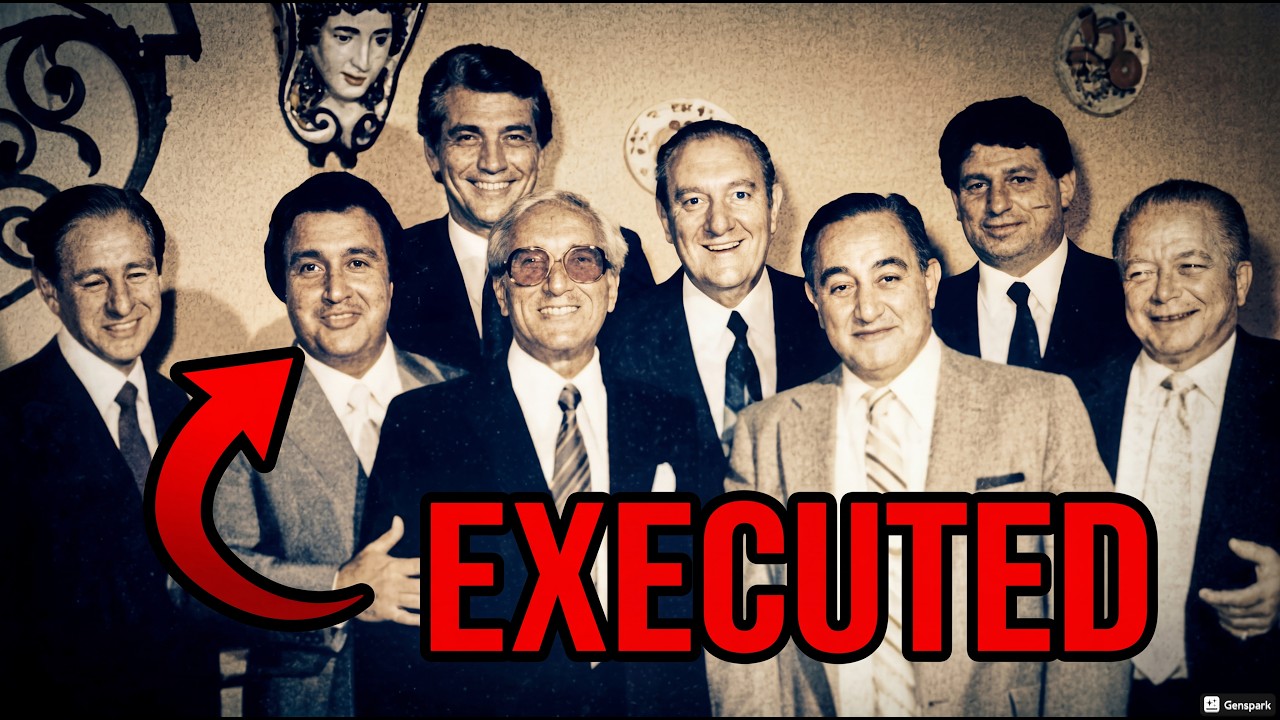
Men in beige trench coats and fur hats emerged from the crowd as if they had materialized from the concrete. Semi-automatic pistols came up without hesitation. The boss took multiple rounds before hitting the pavement. The driver stepped out from behind the wheel and was met with six bullets to the head and chest.
He dropped into the street, never reaching for his waistband. An off-duty nurse knelt beside him, but there was nothing she could do. Police later found $6,300 in cash in his coat pocket. He was not armed.
The entire operation lasted under thirty seconds. Across the street, two men sat parked in a dark sedan, watching the bodies on the pavement. One of them would become the new boss of America’s most powerful crime family before the week was out. The man in the street was Thomas Bilotti, forty-five years old, born and raised in Staten Island.
He was five-foot-seven and built like a fire hydrant, with a thick neck, stubby hands, and a crude, abrasive manner that endeared him to almost no one. He wore a toupee that FBI agents described as gleaming like a soaked cat, with the color slightly off. He had no charm, no humor, and no patience. He was loyal to exactly one man on the face of the earth.
He had held the title of underboss of the Gambino crime family for exactly fourteen days. The killing at Sparks Steak House is usually remembered as the assassination of Paul Castellano. Castellano was the boss. Castellano was the target.
Castellano was the story. Bilotti is treated as the afterthought, the footnote, the driver who happened to be in the wrong car at the wrong time. But that is not the whole picture. Bilotti was not collateral damage.
His promotion was the spark that lit the fuse. Without Thomas Bilotti becoming underboss on December 2nd, 1985, the Sparks assassination may never have happened. Bilotti was born on March 23rd, 1940, in Staten Island, the middle of three brothers in an Italian immigrant family. His older brother James worked as a bodyguard for Frank Sinatra.
His younger brother Joseph followed him directly into the Gambino crime family. The three boys grew up in South Beach, a working-class waterfront neighborhood where the Gambino family had deep roots. In that insular world, young men gravitated naturally toward the men who had money and commanded respect. Tommy Bilotti was one of those young men.
As a teenager, he was known as tough, not strategic tough, but physically tough in a way that made people uncomfortable. He fell in with the crew of John D’Alessio, a Gambino capo who ran illegal gambling and other rackets across Staten Island. D’Alessio’s brother Alexander, known as the Ox, controlled the Staten Island waterfront, and Tommy served as his chauffeur and bodyguard. The waterfront was money.
The waterfront was power. Being trusted to protect and transport a man who controlled that territory meant Bilotti was inside the circle before he was twenty-five. He built his reputation the old-fashioned way. He hit people.
In April 1970, Bilotti and a childhood friend were arrested in Jamesburg, New Jersey after a shooting in which a teenager was struck in the back of the head by birdshot pellets. Police, already on alert because of riots at the local high school, caught the two men throwing away their firearms as they fled. A grand jury indicted them only on illegal weapons possession. The shooting charge did not stick.
That kind of outcome would define Bilotti’s relationship with the justice system for the rest of his life. Through all of it, one relationship was quietly becoming the most important one he would ever have: his connection to a Gambino capo named Paul Castellano. Castellano and Bilotti were not natural partners. Castellano was everything Bilotti was not.
Born in Bensonhurst, Brooklyn, the brother-in-law of Carlo Gambino himself, Castellano was a businessman, a thinker, a man who read financial reports and preferred meeting with lawyers over sitting in social clubs. He wore conservative suits and thought of himself as a corporate executive who happened to run one of the most ruthless criminal organizations in American history. And Bilotti, blunt and abrasive, became his most trusted man in the world. Why?
Because Bilotti did not want anything for himself. Every man around Castellano had an angle, an ambition, a hungry look in his eye. Bilotti just wanted to serve. He drove Castellano everywhere.
He stood outside restaurants while meetings happened inside. He guarded the mansion Castellano built on Todt Hill in Staten Island, the highest point in New York City. Bilotti lived just a few minutes away, always close, always available, always loyal. FBI agents who surveilled Castellano for years described Bilotti as a pitbull with shoes on.
He was not a strategist. He was muscle with a driver’s license and an unconditional attachment to one man. When Carlo Gambino died in October 1976, he passed the family to Castellano rather than to underboss Aniello Della Croce, a respected street guy and killer beloved by every captain. The decision shocked everyone.
Peace was maintained through a deal: Castellano kept Della Croce as underboss and allowed him to continue running his Manhattan crews his way. For nine years, the arrangement held, but it was always fragile. The family operated in two distinct spheres: Castellano’s white-collar world of construction and corporate corruption, and Della Croce’s blue-collar world of hijackings, gambling, and violence. As Castellano’s man, Bilotti was despised by the other side for exactly that reason.
In a family where respect was the entire currency of life, he had none from the people who mattered most. But he had the one thing they could not take away: Castellano’s ear. By 1985, the pressure on Castellano was extraordinary. He was one of several mob bosses indicted in March on racketeering charges in what would become the Mafia Commission trial.
In July, he faced additional indictment on loan-sharking and tax evasion charges. In November, he was named in connection with a stolen car ring. He was managing a massive criminal enterprise while preparing for multiple federal trials that could put him away for life. And Della Croce was dying.
The underboss had been suffering from cancer for months. He was the glue keeping the peace between Castellano’s faction and the angry, restless capos who wanted more power. One of those capos was John Gotti, forty-five years old, powerfully built, impeccably dressed, running the Bergen Hunt & Fish Club in Ozone Park, Queens. He was charismatic and aggressive, and he had been loyal to Della Croce for years.
Della Croce was his mentor and protector, the man who had kept Castellano from crushing Gotti’s crew on multiple occasions. The tension over Gotti’s crew and their drug dealings had been building for two years. On December 2nd, 1985, Della Croce died of cancer at his home in Staten Island. He was seventy-one.
What Castellano did next was one of the most catastrophic miscalculations in the history of American organized crime. He did not go to the wake, citing his legal situation. In a world built on loyalty and ceremony, failing to appear for your underboss’s wake was an insult of the highest order. Della Croce’s men were furious.
Gotti took it as a personal attack. Then Castellano made his second mistake. He named Thomas Bilotti as the new underboss. Not Gotti.
Not Frank DeCicco. Not any of the veterans who had bled for the family for decades. The driver. The pitbull.
The man with no standing among the capos, no diplomatic skill, no independent reputation beyond his proximity to one person. Captains who had worked for the Gambinos for thirty years were being told that a chauffeur had been elevated above all of them. At the same moment, whispers circulated that Castellano intended to dismantle Gotti’s crew entirely. This was not just an insult.
This was a threat. Gotti and Salvatore Gravano, who had been meeting quietly with Frank DeCicco and others for months, understood it as exactly that. Bilotti’s promotion turned the discussion into a plan. The original plan involved a Gambino associate named Joe Watts, who had grown up with the Bilottis in South Beach.
Watts would lure Bilotti to his house under the pretense of a paint job. Gravano would be waiting inside and shoot him as he walked through. DeCicco would then approach Castellano separately and drive him into a second ambush. But the plan changed when DeCicco arranged a meeting at Sparks Steak House for December 16th, ostensibly about a garbage route dispute.
When he tipped Gotti that both Castellano and Bilotti would be attending together, Gotti made a decision: one location, one night, one coordinated team. Gotti assembled eleven men. Four designated shooters: Salvatore Scala, John Carneglia, Vincent Artuso, and Edward Lino. Backup shooters included Anthony Rampino, Dominic Pizzonia, and Angelo Ruggiero.
The shooters wore beige trench coats and fur hats. Each man was armed. Each man had a walkie-talkie. The afternoon before, in a park on the Lower East Side, Gotti and Gravano gathered the entire team, distributed weapons, and for the first time told the shooters the names of their targets.
Gotti and Gravano parked nearby on Third Avenue, positioned to observe and serve as final backup. At 5:16, Bilotti pulled the Lincoln up to the curb in front of Sparks. He was driving, as always. He was always the driver.
Castellano sat in the passenger seat. Gravano confirmed both men visually and radioed the team to move. Castellano opened his door first. The shooters closed in immediately.
He was struck multiple times. John Carneglia is believed to have delivered the final shot to his head. Castellano collapsed to the sidewalk. Tommy Bilotti stepped out from the driver’s side.
Police believe it was Anthony Rampino who put six bullets into him, head and chest. He went down into the street. The nurse knelt over him and found nothing. He was gone before the ambulance arrived.
He had been underboss for fourteen days. He left behind ten children. The youngest was a six-week-old baby. His wife suffered a nervous breakdown and a miscarriage in the weeks after his death.
His loan-sharking book, built over twenty years, was handed directly to Joe Watts as a reward. There was concern inside the Gotti organization about Bilotti’s brother, Joseph. Joe Watts lobbied Gotti to have him killed. Gravano talked Gotti out of it.
He met Joe Bilotti at a diner and told him directly that it was business, not personal. Joe Bilotti accepted it. He kept his mouth shut and lived. He outlived John Gotti, who died of throat cancer in federal prison in June 2002, serving a life sentence.
On January 15th, 1986, at a meeting of twenty Gambino capos, Gotti was officially acclaimed as the new boss. Frank DeCicco was named underboss. The entire leadership of the family had changed in less than a month. Thomas Bilotti was buried at the Moravian Cemetery in New Dorp, Staten Island.
Paul Castellano is buried fifty yards away. They shared a neighborhood in life. They share a graveyard in death. The Catholic Archdiocese refused to grant Castellano a Catholic funeral, citing the nature of his life and death.
The mob had its own rights and its own silences.
