In 1949, a New York businessman named Samuel Wurtzel sat down in a barber’s chair in Richmond, Virginia, and learned that the first commercial television station in the American South was about to begin broadcasting there. No one in the city was selling television sets. Within weeks, Wurtzel had sold his import-export business, moved his wife and two sons south, and rented the front half of a tire shop on West Broad Street to start selling televisions to a city that had never owned them. He named the store Wards, an acronym built from his family’s initials, because he suspected Virginians would struggle to pronounce Wurtzel.
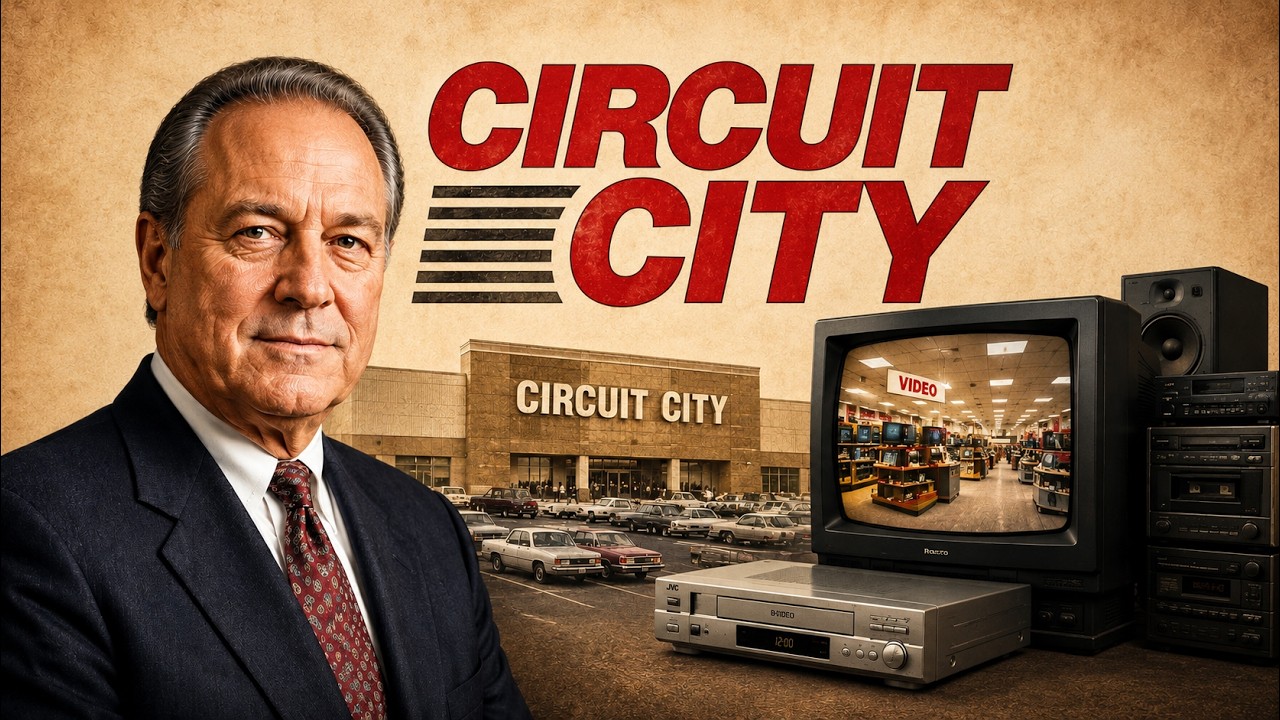
From that borrowed storefront would grow a company that at its peak operated more than 700 stores, employed over 60,000 people, and generated $12. 5 billion in annual revenue. On March 8, 2009, the last Circuit City store in America locked its doors for good. Thirty-four thousand people lost their jobs, and the brand name sold at auction for $14 million.
Wurtzel was born in Seabright, New Jersey, in 1907. He studied accounting in New York, married Ruth Mann in 1932, and raised two sons, Alan and David. He was a bookkeeper, not an engineer, a man who understood numbers and customers in equal measure. The future in 1949 was television, a technology few American homes possessed and fewer still understood.
When Wurtzel’s barber mentioned the coming Richmond station, Wurtzel saw a city about to fall in love with a product it could not yet buy. He targeted working-class families other retailers ignored, offering installment plans that let a household bring a television home before they could afford it in full. By 1959, Wards had four locations and annual sales of about $1 million. In December 1961, Wurtzel took the company public.
The capital funded further expansion, and by the end of the decade, Wards was a chain scattered across the Eastern Seaboard and the South, some of its stores profitable, many of them not. In 1970, Wurtzel stepped aside as president, and his older son Alan came home to take over. Alan was a Yale-trained lawyer who had clerked for a federal appeals court judge in Washington. He had never planned to spend his life selling televisions, but by 1972, at age 39, he was president and chief executive.
The company he inherited was a mess. His first move was to stop growing and start pruning. He shut down unprofitable locations, sold off weak acquisitions, and spent two years building a long-range plan. He was analytical and disciplined, and by his own later admission, terrified of running his father’s company into the ground.
The most important decision in Circuit City’s history happened almost by accident. In 1973, the company bought a building in Richmond for a new distribution center and corporate offices. When it was ready, there was extra room. Rather than let it sit empty, Alan Wurtzel carved out a section of the warehouse and opened a no-frills discount showroom he called Wards Loading Dock.
It opened on May 1, 1975, and customers responded immediately and overwhelmingly. They did not come in just to buy a television and leave. They wandered the aisles, compared products, touched the equipment, and spent entire afternoons surrounded by the latest technology. Wurtzel recognized what he had created.
He expanded the format, and in 1978 renamed the concept Circuit City Superstore, with the first stores opening in North Carolina on June 22 of that year. The electronic superstore, the format that would later spawn Best Buy and an entire generation of big box imitators, was born in the leftover space of a Richmond warehouse. The 1980s belonged to Circuit City. By 1984, the company had changed its name from Wards to Circuit City Stores Incorporated and listed on the New York Stock Exchange under the ticker symbol CC.
That same year, Samuel Wurtzel stepped down as chairman and Alan succeeded him. In 1985, Circuit City entered the Los Angeles market, and those new stores introduced the element that would define the company’s physical identity for two decades: the red tower entrance, a massive protruding structure designed to be visible from the sprawling commercial boulevards of Southern California. In 1988, the design evolved into the plug, a structure literally shaped like an electrical plug, the most recognizable piece of retail architecture in American electronics. In 1986, Alan Wurtzel handed the chief executive position to Richard Sharp, an electrical engineer and computer scientist who had founded his own software company at 27.
Sharp understood systems and data, and he applied that engineering mind to inventory management, sales floor layout, and the computerized systems that tracked performance in real time. The results were staggering. From 1983 to 1987, Circuit City delivered the highest return to investors of any company on the New York Stock Exchange. For any 15-year period between 1965 and 1995, it was the best-performing Fortune 500 company in America.
Under Sharp, revenues grew from $175 million to $10. 6 billion, and the store count rose from 69 to more than 600. At its peak in the late 1990s and early 2000s, Circuit City was an American institution. The stores themselves were a kind of secular cathedral of consumer technology, a place families went to browse, to dream, and to spend an afternoon imagining what their living rooms could become.
The heart of the Circuit City experience was the sales floor. The company used a guided loop layout it called the racetrack, moving customers deliberately through departments. The sales people, stationed along that path, were the weapon no competitor could match. Many were factory-trained by manufacturers, sent to facilities run by Sony, Pioneer, Mitsubishi, and Bose to learn the products from the inside out.
They worked on commission, which gave them a financial stake in every interaction, and the best ones stayed for decades, building an expertise no hourly replacement could replicate. The company’s slogan, “Welcome to Circuit City, where service is state-of-the-art,” was an operational commitment the company kept for roughly 20 years. But at the apex, the seed of the fall was already visible. In late 1988, Circuit City had an opportunity to purchase Best Buy, a growing Minneapolis competitor, for $30 million.
Sharp rejected the offer, believing Circuit City could simply open a store in Best Buy’s home market and crush the smaller rival. The company Circuit City refused to buy for $30 million would, within a decade, become the company that buried it. In 1997, Circuit City also partnered with an entertainment law firm to develop DIVX, a disposable DVD format. Customers would buy a disc for about $4.
50, play it on a special player connected to a phone line, and have 48 hours to watch it before the disc locked itself through encryption. It was one of the most expensive product failures of the 1990s. Players cost roughly double the price of a standard DVD player, required a phone line that tracked viewing habits, and enthusiasts loathed it. The format launched just as DVD was gaining momentum, and by June 1999, barely a year after national rollout, Circuit City shut it down.
The company took a $114 million after-tax charge, with total losses estimated at approximately $337 million. Alongside the DIVX disaster, Sharp had quietly built something remarkable. In 1993, Circuit City opened CarMax, a used car superstore applying the company’s core principles: no-haggle pricing, massive selection, and a transparent customer experience. CarMax would eventually become the largest used car retailer in the United States, the single most innovative thing Circuit City ever created, and the company would give it away.
Sharp retired as CEO in 2000. His replacement, W. Allen McCollough, was a manager of processes, not a merchant, and the decisions he made dismantled the competitive machine the Wurtzels and Sharp had spent 50 years building. First, he ordered Circuit City to exit the appliance business entirely, a category that accounted for 10 to 15 percent of revenue, just before the American housing boom sent appliance sales through the roof.
Second, in October 2002, he spun off CarMax as an independent public company, releasing Circuit City’s most successful innovation. Third, and most fatally, he dismantled the commissioned sales force. On February 5, 2003, Circuit City closed every store until noon and informed sales employees that commissions were eliminated in favor of flat hourly wages. Roughly 3,900 of the highest-paid, most experienced sales people were laid off, saving an estimated $130 million per year.
Best Buy had abandoned commissions in 1989, but Best Buy had built its identity around self-service and low prices. Circuit City’s brand was constructed on the promise that the person helping you understood the product and had a financial incentive to earn your satisfaction. Removing commissions did not transform Circuit City into Best Buy. It transformed it into a worse version of Best Buy.
What followed was a cascade of self-inflicted wounds. McCollough stepped down in 2006, replaced by Philip Schoonover, a former Best Buy executive. On March 28, 2007, Schoonover terminated 3,400 of the company’s most experienced in-store employees in a single morning. The public statement said these workers were earning well above market rates and would be replaced by lower-paid hires.
Workers were called into morning meetings, told they were being let go, and escorted from the building before lunch. The reaction was national and ferocious. Sales dropped within weeks. By the 2007 holiday season, same-store sales had cratered by nearly 12 percent.
The stock, which closed at roughly $19 on the day of the layoffs, plummeted to about $4 by year’s end. In November 2007, the company reported a $207 million quarterly loss, and Schoonover was forced out that same month. The 2008 financial crisis delivered the killing blow. Circuit City had spent hundreds of millions on stock buybacks instead of investing in store renovations, e-commerce, or cash reserves.
When credit markets froze, suppliers demanded upfront payment. The shelves went bare. On November 10, 2008, Circuit City filed for Chapter 11 bankruptcy protection, reporting 567 remaining stores and roughly 46,000 employees. No buyer materialized.
In January 2009, a court approved full liquidation. On March 8, 2009, the last Circuit City in America turned off its lights. The brand name, trademarks, and customer lists were sold for $14 million. The buildings remain standing in hundreds of suburbs, the triangular protrusion where the red plug entrance once stood now a fossil pressed into the landscape.
CarMax, the business Circuit City invented and released, still operates from Richmond, generating over $25 billion in annual revenue with no Circuit City branding anywhere. Samuel Wurtzel died in 1985 and never saw the name Circuit City replace the family acronym he had chosen. Alan Wurtzel sold his stock in 2000 and left the company in 2001, watching from outside as his successors dismantled what he had built. In 2012, he published a book titled From Good to Great to Gone.
Rick Sharp, co-founder of CarMax, retired from its board in 2007, was diagnosed with early-onset Alzheimer’s disease, and died in 2014 at age 67. Circuit City did not lose to Best Buy. It fired every advantage it had, stripped away the commissioned expertise, abandoned appliances, gave away CarMax, and spent hundreds of millions on a disposable DVD format nobody wanted, then stood in the empty showroom wondering why the customers had left.
