The photograph shows a family of five in the great processing hall at Ellis Island, New York Harbor, 1905. Tens of thousands of arrivals passed through that year, and the hall around them holds the organized chaos of their movement. The father is a compact man in his early forties, his coat brushed clean despite its worn state, his hat in one hand and his youngest child’s shoulder in the other. His face carries something that is not quite a smile and not quite relief—the expression of a man who has survived long enough to arrive and is not yet ready to believe it.
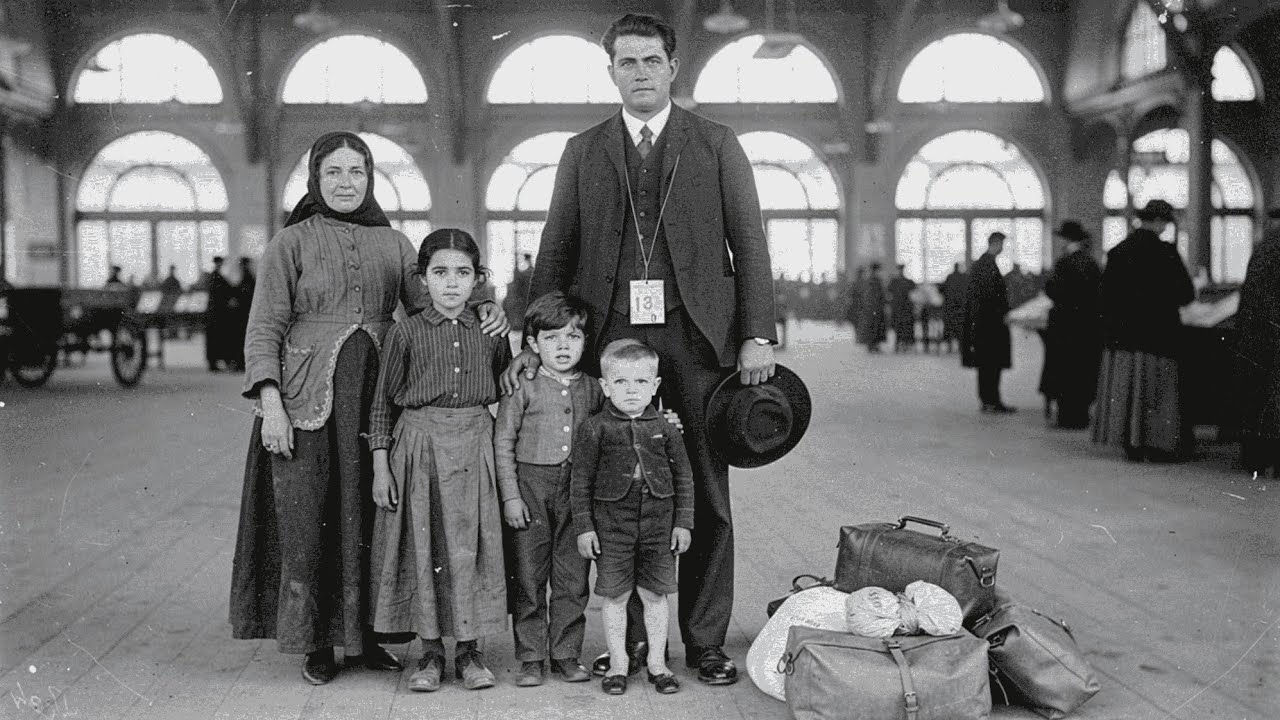
His wife stands beside him, her dark hair covered, her eyes steady on the camera. Three children, a boy of fifteen, a girl of twelve, another boy of eight, stand with the particular stillness of children who have been told not to move and have learned not to argue. They are the Goldberger family. They have traveled from Kishinev in the Russian Empire to Hamburg, to Liverpool, to New York Harbor—six weeks of travel—and now they are about to become Americans.
Everything about the image appears straightforward: a family at the beginning of a new life, carrying whatever they managed to pull out of the old one. But there is a detail on the father’s left wrist. A cord, loosely tied, holds a small paper card—the Ellis Island manifest tag assigned to every arriving immigrant for processing. The number printed on it reads SS Patricia, manifest 847, sheet 12, line six.
A processing number. An administrative label. The kind of thing removed and discarded within hours of arrival. It should mean nothing.
When Dr. Sara Weiss placed this photograph on her research monitor in the spring of 2023 and traced that manifest number through archives spanning three countries and two languages, she found a history that the Goldberger family—who became the Goldman family within a year of the photograph—had carried across an ocean and buried so completely that their own great-grandchildren did not know it existed. The story begins not at Ellis Island in 1905, but in Kishinev in the Russian Empire in 1903. Sara Weiss had spent sixteen years as a historian of Jewish immigration at New York University.
Her work focused on the period between 1880 and 1924, the great wave of Eastern European Jewish immigration that brought approximately two million people through the ports of New York, Philadelphia, Baltimore, and Boston over four decades. She was not a sentimental historian. She had read enough manifests and death records to develop the clinical detachment the work required—testimonies of pogrom survivors, letters home from sweatshops on the Lower East Side, naturalization records of people who had arrived with nothing and built something. But she had never lost the habit that had drawn her to the work in the first place: looking closely, not accepting the surface reading of a document or photograph when that surface might conceal something.
The Ellis Island photograph had come to her through the YIVO Institute for Jewish Research in New York, where she was consulting on a digitization project. YIVO, established in Vilnius in 1925 and relocated to New York after the Holocaust, held one of the most significant collections of documentary material on Eastern European Jewish life and immigration anywhere in the world. Among its holdings were thousands of photographs from the immigration era, many donated over decades by descendants. The Goldberger photograph had been donated in 1978 by a woman named Helen Goldman, who noted only that her husband’s family appeared in it on the day they arrived in America.
She had added one sentence: “My husband never spoke about what happened before they came. I always felt there was more to the story. ”
Sara had seen such notes before. The generation of Jewish immigrants who arrived between 1900 and 1924 was, as a pattern, not a generation that talked.
What they had survived in Europe—the pogroms, the violence, the systematic persecution of the Tsarist regime—was something many had sealed behind the act of crossing the Atlantic. America was the new life. The old life stayed where it was left. She had placed the photograph on her monitor during a routine cataloging session and was preparing to record standard metadata—date, location, provenance, physical condition—when her eye went to the father’s left wrist.
At maximum resolution, the manifest tag was clearly visible: a paper card approximately three by two inches, a cord tied through a hole punched in the upper corner and looped around the wrist. Standard Ellis Island procedure. Every arriving immigrant received one, assigned from the ship’s manifest at disembarkation and used to match the individual to their registry entry during inspection. What made Sara stop was not the tag itself, but the number on it.
SS Patricia, manifest 847, sheet 12, line six. The SS Patricia was a Hamburg America Line vessel she had encountered in separate research. She remembered it because the Patricia’s 1905 manifest had been flagged in a National Archives database as containing an unusual annotation—a handwritten notation by an Ellis Island inspector that was not standard processing language. She pulled up the database, found the manifest, and went to sheet 12, line six.
The annotation read, in the careful handwriting of an Ellis Island processing inspector: “Prior detention noted. Hamburg record attached. Approved for entry. See supplementary file.
”
Prior detention. Hamburg record. Sara requested the supplementary file through the National Archives immigrant record system. The request took eleven days to process.
When the digital file arrived, it contained fourteen pages of documents in three languages—German, Russian, and Yiddish—with English translations attached by a later archivist. Together they told the story of the six weeks the Goldberger family had spent in Hamburg before boarding the SS Patricia, and of the three months that Isaac Goldberger had spent in a Russian Imperial prison before that. Between 1850 and 1934, the Hamburg America Line and the Hamburg Port Authority operated a complex of facilities on Veddel Island in Hamburg Harbor known as the Auswandererhallen—the emigrant halls. They functioned as a transit processing center for the hundreds of thousands of Eastern European immigrants passing through Hamburg on their way to North America.
The facilities included dormitories, dining halls, medical inspection rooms, and administrative offices where immigrant documents were reviewed. Most immigrants passed through in a matter of days. But for those whose documents raised questions, who failed initial medical inspections, or who were flagged by Russian Imperial authorities as persons of interest, the stay could extend for weeks or months while their cases were reviewed. The Goldberger file from the Hamburg records showed that Isaac, Rivka, and their three children had arrived at the Auswandererhallen on March 12, 1905.
They were held until April 24—six weeks—while Isaac’s Russian Imperial documents were reviewed. The reason for the extended hold was documented in a German-language administrative notation: “Subject has prior criminal record under Russian Imperial law. Clearance pending. ”
Sara then needed the Russian Imperial record.
This was significantly harder. Russian Imperial administrative archives from the late nineteenth and early twentieth centuries were fragmented, partially destroyed, and scattered across multiple national and regional archives in the former Soviet states. But a significant collection of records relating to the Kishinev district had been microfilmed in the 1970s by the Mormon Genealogical Society and was accessible through the Family History Library in Salt Lake City. Sara contacted Dr.
Yaacov Stern at the Hebrew University of Jerusalem, who specialized in Russian Imperial Jewish records. She sent him the relevant details: family name, given name, Kishinev district, date range 1903 to 1905. He found the record in nine days. Isaac Goldberger had been arrested in Kishinev on May 3, 1903—two days after the start of the Kishinev pogrom.
He had been held in the Kishinev district prison for ninety-three days and released on August 4, 1903. His charge, as recorded in the Russian Imperial prison register, was “incitement to civil disorder. ”
He had been imprisoned for surviving a pogrom. To understand what Isaac Goldberger survived and what that prison record meant, one must understand Kishinev in April and May of 1903.
The Kishinev pogrom began on April 19, 1903, Easter Sunday, in what is now Chișinău, the capital of present-day Moldova. At the time it was the capital of the Bessarabia Governorate of the Russian Empire—a city of approximately 110,000 people, roughly 50,000 of them Jewish. The pogrom had been building for months, incited by a local anti-Semitic newspaper called the Bessarabets, owned by Pavelachi Krushevan, whose blood libel accusations and inflammatory editorials had created an atmosphere of authorized hatred. Evidence later emerged that at least some officials in the Russian Imperial government, including Interior Minister Vyacheslav von Plehve, had been aware of and in some ways facilitated the violence by ensuring that police and military response was delayed.
Over two days, April 19 and 20, 1903, mobs moved through the Jewish neighborhoods of Kishinev. Forty-nine Jews were murdered. More than five hundred were injured. Over seven hundred homes were destroyed or damaged.
Six hundred businesses were looted. An estimated two thousand families were left homeless. The Russian Imperial response was not to arrest the perpetrators. It was to arrest the survivors.
In the weeks following the violence, authorities arrested dozens of Jewish men on charges of incitement, disorder, and resistance—charges constructed from nothing, a legal mechanism for incarcerating people who had survived an organized massacre and in some cases defended themselves or their neighbors. Isaac Goldberger was one of these men. The prison register entry gave no details of what Isaac had done or been accused of doing. It said only “incitement to civil disorder” and listed ninety-three days of detention.
But the context—arrest two days after the start of the pogrom, in the same district—made the meaning unmistakable. He had been imprisoned by the same government that had permitted the pogrom. When he was released in August 1903, whatever remained of his life in Kishinev was in ruins. What happened to the Goldberger family in the twenty months between Isaac’s release and their arrival at the Hamburg Auswandererhallen was not fully documented in any single source.
Sara reconstructed it from fragments. The Hamburg record included a document Isaac had submitted as part of his emigration application: a sworn statement in Yiddish, translated into German by a Hamburg official, attesting to his reasons for emigration. Most of it was standard emigration language—poverty, lack of prospects, desire for a better life for his children. But one paragraph had clearly been written from something closer to the bone.
Sara read the translation slowly. “I cannot remain in a place where the law protects those who destroy and imprisons those who survive. I have three children who have seen things that no child should see. I wish for them to live in a country where the law is the same for everyone.
I have been told that such a country exists. I am taking my family there. ”
It was not rhetoric. It was a statement of fact from a man who had watched his city burn, been imprisoned by his own government for the crime of being Jewish and alive, and spent twenty months finding a way out.
The Hamburg record showed that the Goldbergers had traveled from Kishinev to Odessa, from Odessa to the Austro-Hungarian border, through Galicia, through Vienna, and finally to Hamburg—a journey on foot, by cart, and by rail that took three months and cost Isaac everything he had been able to save and borrow since his release. The Auswandererhallen held them for six additional weeks while German authorities reviewed the Russian prison record. Six more weeks of waiting in dormitory bunks in Hamburg Harbor after everything they had already endured. Then, finally, clearance.
The SS Patricia departed Hamburg on May 8, 1905. The manifest tag tied to Isaac’s wrist for inspection at Ellis Island bore the number assigned to his family at Hamburg departure: SS Patricia, manifest 847, sheet 12, line six. Sara also examined what the manifest revealed about the family’s circumstances on arrival. Under “amount of money,” Isaac had declared eleven dollars for a family of five in the largest and most expensive city in the United States.
Eleven dollars and whatever they had packed into the bags visible at their feet in the photograph. Under “who are you going to join,” the manifest listed a brother-in-law named Mendel Katz at an address on Orchard Street on the Lower East Side—a tenement in the densest urban neighborhood in the world, where immigrant families stacked into apartments designed for a fraction of their number. Under “occupation,” Isaac had written “tailor. ” He had arrived with his trade, his family, eleven dollars, a prison record from a government that no longer had jurisdiction over him, and a manifest number tied to his wrist that was about to be removed and discarded as he stepped through the final inspection gate into America.
The photograph had caught him in that specific moment—the last moment when the number was still there, the last moment before the past, at least officially, was left behind. Tracing the Goldberger family forward from 1905 took Sara three months. The family had become Goldman within a year of arrival—a name change made not at Ellis Island, as popular myth suggested, but at the naturalization office when Isaac formally applied for American citizenship in 1906. The change was deliberate and thoroughly documented.
Isaac Goldman signed his naturalization papers himself, and the signature was steady and clear. The family lived on Orchard Street initially, then moved to the Bronx in 1912 as Isaac’s tailoring business established itself. The 1910 and 1920 censuses showed a prosperous, growing household: the three original children plus two more born in New York; Isaac listed as a self-employed tailor; the older children already in the American workforce. By 1920, Samuel Goldman was working as a bookkeeper.
Rachel Goldman had married. David Goldman, the eight-year-old in the Ellis Island photograph, was in high school. David Goldman became a lawyer. He married in 1930 and had two children.
His son, Michael, married Helen, the woman who would donate the photograph to YIVO in 1978. Michael Goldman died in 1991. His father David, the boy in the photograph, had died in 1987. The story had died with them, or nearly.
Sara tracked Michael and Helen’s children and found a daughter, Diana Goldman, fifty-eight years old, an architect living in Brooklyn. In a genealogical note submitted to a Jewish family history organization, Diana had mentioned she was trying to learn more about the family’s immigration from Russia, “but there are almost no records and my father never talked about it. ”
Sara called her on a Wednesday afternoon. “My name is Dr.
Sara Weiss,” she said. “I’m a historian at NYU. I’ve been researching your family’s immigration history, and I think I’ve found what you’ve been looking for. I need to warn you.
It’s a great deal more than most people expect to find. ”
Diana drove to Sara’s office the following Saturday morning. She brought her adult daughter, Maya, who had come from Boston for the occasion. Sara had printed everything: the manifest, the Hamburg record, Isaac’s sworn statement in Yiddish and its German translation, Yaacov Stern’s report on the Kishinev prison register entry, a timeline showing where the family had been at each stage of their journey, and the photograph enlarged to double size, the manifest tag on Isaac’s wrist clearly visible.
She walked Diana through all of it in order. She had learned over sixteen years that the order mattered—you had to give people the foundation before you gave them the weight of what the foundation carried. When she reached the Kishinev pogrom, Diana said nothing. She picked up the page with the historical facts—the dates, the number killed, the number injured, the number left homeless—and read it carefully.
When she reached Isaac’s sworn statement in Hamburg, Diana put it down and was quiet for a moment. “He wrote this,” she said. “His handwriting,” Sara confirmed. “The original is in the Hamburg State Archive.
What you’re holding is a photographic reproduction. ”
Diana read it again. When she looked up, her eyes were wet. “I cannot remain in a place where the law protects those who destroy and imprisons those who survive.
” She read it aloud quietly, as if testing whether the words meant what they appeared to mean. “He was imprisoned for surviving. ”
“For ninety-three days? ”
“Yes.
”
Maya, who had been listening without speaking, said, “Does anyone know what happened to the people who were killed in Kishinev? The forty-nine people? ”
Sara slid a printed page across the table—a partial list, compiled from various sources, of the documented victims of the Kishinev pogrom. The list was not complete; many names had been lost.
But it was what existed. Diana scanned the list and stopped. Among the documented dead of the Kishinev pogrom of 1903 was a woman named Chana Goldberger, age thirty-four. Diana looked at Sara.
“That’s his sister,” Sara said quietly. “The archival record shows Isaac had an older sister named Chana who had been living on the same street in Kishinev. I cross-referenced the name. The ages match.
The location matches. ”
Diana set the list down very carefully. They sat in silence for a moment that felt longer than it was. “He lost his sister,” Diana said finally.
“He was imprisoned for ninety-three days. He spent almost two years getting his family out. He arrived with eleven dollars and three children who had watched their city burn. ” She looked at the enlarged photograph—her great-great-grandfather holding his youngest son’s shoulder, the manifest tag on his wrist, his face carrying that expression that was not quite a smile and not quite relief.
“And he never said a word about any of it. ”
Sara nodded. “He built a life,” Diana said. “He built a business.
He raised children who became lawyers and bookkeepers. He changed his name and he moved forward and he never looked back. ” She picked up the photograph. “I used to think that was a kind of erasure.
Of who they were before. Now I think it was something else. ” She looked at Isaac’s face for a long time. “I think it was a choice.
He chose to give his children a life that didn’t have what happened in it. He chose to give them forward instead of back. And he did that by carrying all of it alone. ”
Sara published the Goldberger–Goldman case study in the American Jewish History Journal in the autumn of 2023.
The paper, titled “The Manifest Number: Tracing the Hidden History of a Kishinev Pogrom Survivor Through the Ellis Island Immigration Record,” was accompanied by reproductions of all key documents and the Ellis Island photograph. The response reached far beyond the academic community. YIVO shared the paper on its digital platforms, and within days it had been read by thousands of people with personal connections to Eastern European Jewish immigration. Emails arrived from across the country and from Israel—from people with similar photographs, similar gaps, similar family silences they had never been able to explain.
The pattern Sara had documented in the Goldman case was not unusual. The generation of Jewish immigrants who arrived from Eastern Europe between 1881 and 1924 had largely chosen, as a generation, not to transmit the full weight of what they had survived. The reasons were practical as well as emotional. America demanded forward motion, and backward-looking grief was, in the economic and social environment of the immigrant community, a luxury few could afford.
The silence was not denial. It was a strategy for survival of a different kind. DNA genealogy and the digitization of immigration records had begun, in the previous decade, to break through those silences systematically—manifest numbers, Hamburg records, Russian Imperial prison registers, pogrom victim lists. Sources that had once required specialist knowledge and access to physical archives in multiple countries were now accessible to anyone with patience and an internet connection.
The silences that had lasted three or four generations were beginning, one family at a time, to open. Diana Goldman donated Isaac’s Yiddish sworn statement—the Hamburg document in which he wrote about the country where the law was the same for everyone—to the YIVO Institute. It was displayed in the reading room alongside the Ellis Island photograph, with a wall panel describing the chain of documents the number on his wrist had unlocked. Diana and Maya visited YIVO three months after the paper’s publication to see the display in person.
They stood before the photograph for a long time. Maya had brought something—a small prayer book she had found in her grandmother Helen’s personal effects. The pages were very old, handled so many times they had gone soft. On the inside cover, in Yiddish letters Maya had had translated, was an inscription: “To my son Isaac, that he may carry this with him wherever God sends him.
From your mother, Chana Goldberger Sr. , Kishinev, 1902. ”
Chana. Isaac’s mother had the same name as the sister he had lost.
The prayer book had been in America since 1905. Isaac Goldman had carried it across the Atlantic in whatever bag he brought, kept it through the Orchard Street years and the Bronx years and the building of a business and the raising of children who became lawyers, passed it without explanation to his son David, who passed it without explanation to his own family, until it ended up in a box of personal effects in Brooklyn, waiting for someone to understand what it meant. He had brought one thing with him from Kishinev that he kept for the rest of his life—not the name, not the language, not the stories about what had happened. A prayer book from his mother, in the handwriting of the world he had left.
The manifest number on his wrist had been discarded within hours of arrival. He carried the prayer book until he died. It is now in the YIVO Institute’s permanent collection, case seven, shelf three, the immigration gallery. The Ellis Island photograph hangs beside it.
Isaac Goldberger—Isaac Goldman—stands with his family in the processing hall, his youngest son’s shoulder under one hand, his hat in the other, his manifest tag on his wrist, the number clearly visible. He looks like a man arriving at the beginning. He was a man who had survived the end of everything he had known, brought his family through the wreckage and across an ocean, stood in that hall, and said nothing about any of it—and gave his children, and their children, and their children, the forward he had chosen.
