In August 1943, Dwight Eisenhower had to decide what to do about George Patton. Word had reached his headquarters within days that Patton, during the Sicily campaign, had visited field hospitals and struck two soldiers suffering from combat fatigue, calling them cowards in front of witnesses who reported what they saw. By autumn the story had reached the American press. Members of Congress were openly questioning whether Patton had any business wearing the uniform at all.
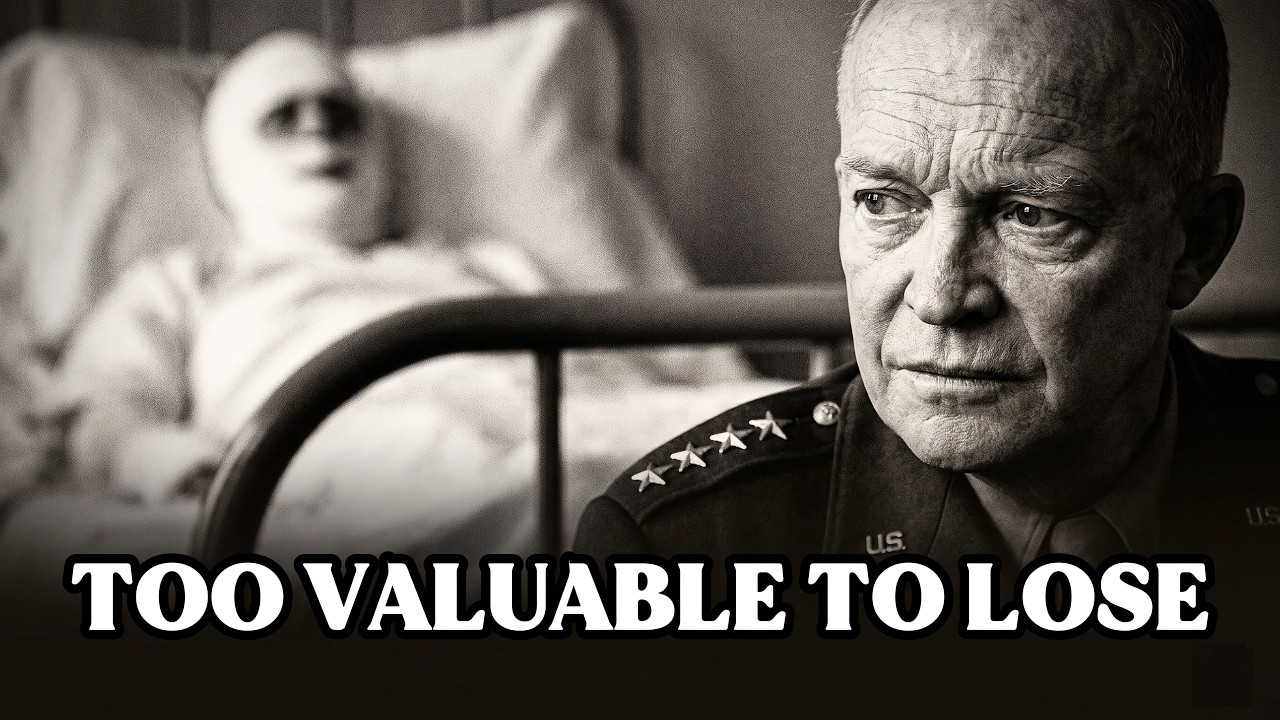
Eisenhower faced a real choice, and many of his own officers gave him the obvious advice: relieve Patton of his command and end the controversy decisively. He chose a different path. Patton’s advance through Sicily had exceeded what the planners believed possible, and the coming invasion of France needed exactly the kind of relentless, aggressive leadership Patton had spent his career cultivating. Eisenhower demanded a formal apology to the soldiers and medical staff involved, and he kept Patton in command.
But before that decision, in 1943, he had already written to General George Marshall about the problem named Patton. He chose his words with the care of a man who understood the weight they would eventually carry. Patton possessed qualities, Eisenhower wrote, that the army could not afford to lose—unless the man himself found a way to undermine them first. It was not a compliment, and not exactly a warning either.
It read as a judgment delivered in secret to the one superior who could have ended Patton’s career entirely. The letter drew attention to something that would define the relationship between the two men for the next two years. Eisenhower needed Patton. He also, by his own admission, did not entirely trust him.
That first decision in Sicily set a pattern neither man named openly at the time, though it repeated through the rest of the war. In public, Eisenhower defended Patton without reservation, praising his tactical brilliance whenever politicians or the press raised questions about his fitness for command. In private, his correspondence with Marshall and other superiors sounded different. He described Patton not as a trusted subordinate but as a valuable asset requiring careful, continuous supervision.
Patton himself seemed to notice none of this. His letters to Eisenhower through 1944 remained informal, addressing him by his first name, filled with an easy assumption of a friendship that had existed before the war and would presumably outlast it. He had no idea that Eisenhower’s private assessment of him had settled into something closer to risk management than personal trust. The tactical side of the arrangement kept proving itself.
Patton’s Third Army swept across France that summer, broke the siege of the defenders at Bastogne in the harsh winter of 1944, and crossed the Rhine into Germany itself. Every achievement was real. And every one of them, without exception, arrived carrying a new controversy that required Eisenhower’s personal intervention to manage. The pattern held for the rest of the war precisely because both halves of it kept proving true at the same time.
Germany surrendered in May 1945. Patton, by his own account, expected a command commensurate with his record. Instead he got Bavaria—a military administration, a governing post rather than any field assignment, a position designed for diplomacy rather than the aggressiveness that had built his reputation. Eisenhower’s reasoning was practical more than personal.
The occupation required restraint, and restraint had never been among Patton’s known qualities. That September, Patton made public statements about former Nazi Party members still working in the local Bavarian government, comparing the situation to ordinary American party politics. The result was a genuine scandal almost immediately. On September 28, 1945, Eisenhower summoned Patton to his headquarters in Frankfurt.
After a tense exchange, Eisenhower offered what he carefully framed as a “suggestion” rather than an “order”: command of the newly formed Fifteenth Army, a headquarters created specifically to compile the official written history of the war in Europe. The position carried Patton’s rank. It carried none of Patton’s actual authority. Patton’s first instinct was to submit his resignation from service on the spot.
He did not. He understood the assignment for exactly what it was and said so plainly in private correspondence afterward. It was exile, wrapped in the language of a new posting. December 9, 1945.
Patton was on a hunting trip near Mannheim. Returning by car to Heidelberg, his military vehicle collided with an army truck at low speed—never expected to produce serious injury. Patton was thrown forward against the partition between the front and rear seats. The impact fractured and dislocated the vertebrae of his neck, leaving him almost immediately without function below the neck.
He never lost consciousness. He was rushed to the 130th Field Hospital in Heidelberg, where surgeons stabilized his condition without being able to offer real hope of recovery. Eisenhower learned of the accident within hours. He himself was still a short drive from the hospital.
What is documented with certainty is that he arranged a military transport plane to bring Beatrice Patton across the Atlantic as quickly as wartime logistics could manage, accompanied by a prominent American neurosurgeon pulled directly off a train to catch the flight. Beatrice arrived at her husband’s side by noon the next day and stayed there for most of the eleven days that followed. Lieutenant General Geoffrey Keyes, commander of the Seventh Army and one of Patton’s closest personal friends, hurried down from Frankfurt as well. What no surviving record confirms, and none directly denies, is whether Eisenhower himself made that short trip to see the man he had spent two years alternately protecting and managing.
No widely documented account places him beside Patton’s bed during those eleven days. If a visit happened quietly and went unrecorded, it left a remarkably small trace in the correspondence and diaries that survive from everyone who was actually there. Patton died on December 21, 1945, when a blood clot that had formed in his paralyzed body reached his heart. Eisenhower’s public statement afterward praised him without reservation, describing him as essential to the achievement of victory in Europe.
In its own way, it was the same voice that had defended Patton publicly for two uninterrupted years. The private voice—the one that had written to Marshall about qualities the army could not afford to lose unless the man destroyed them himself—had by that time fallen silent in a way historians still argue about. Some see the absence as political calculation: a supreme commander already thinking carefully, in the first weeks of peace, about which associations might complicate what would come later in his public life. Others see simple exhaustion.
Two years of managing a brilliant and difficult subordinate had finally drained whatever personal warmth had once existed beneath the professional relationship. Still others point to the most obvious explanation available. Eisenhower carried the burden of an entire occupied theater on his own desk that December. Patton, however famous, was one name among many demanding his limited hours.
None of these explanations can be confirmed against the historical record. None can be entirely ruled out either. What can be stated plainly is the sequence itself, presented without interpretation. In 1943, Eisenhower told Marshall that Patton possessed qualities too valuable to lose—provided Patton did not destroy them himself.
For two years, Eisenhower defended that judgment publicly while managing its risks privately. A pattern that lasted until the victory in Europe and began to fade the moment the war that made Patton indispensable was over. In September 1945, the balance of power shifted. Patton lost the only kind of command that had ever mattered to him.
In December, paralyzed and fully conscious for eleven days, he waited in a hospital bed in Heidelberg for a visit no surviving record confirms ever happened. Eisenhower went on toward the presidency. Patton was buried, at his own request, among the soldiers of the army he had led. Between those two facts lies nothing but the documented sequence.
Whatever meaning one chooses to read into the space separating an assessment made in 1943 and a silence recorded—or simply left unrecorded—in 1945 is a matter of interpretation. The sequence itself does not change.
