The call came from the Federal Housing Administration, and it changed the shape of the country. Beginning in the 1930s, federal appraisers literally drew red lines on maps around neighborhoods they deemed too risky for mortgage lending, and the primary factor that made a neighborhood risky in their eyes was the presence of Black residents. A neighborhood with even a small number of Black families was routinely denied federal mortgage insurance. This meant that Black Americans were systematically excluded from the suburban homeownership boom that was about to transform America.
The GI Bill was technically race-neutral, but in practice, Black veterans were denied the same access to low-interest home loans that white veterans received. Levittown itself explicitly prohibited the sale of homes to Black families. William Levitt personally defended this policy, arguing that he could be solving a housing problem or he could be solving a racial problem, but he could not do both. The result was a massive government-subsidized transfer of wealth to white families.
White veterans moved to the suburbs, bought homes that appreciated in value, built equity, and passed that wealth onto their children. Black families were locked out of this process entirely. They were confined to urban neighborhoods where home values stagnated or declined, where landlords had little incentive to maintain properties, and where the tax base shrank as white families fled to the suburbs. Historians call this pattern white flight, and it had profound consequences for the physical shape of American housing.
The suburbs were designed to be spacious, green, and exclusive. Big lots, big houses, big lawns. All of this served a dual purpose. It provided the physical comfort buyers wanted, but it also maintained economic barriers that kept poor families and families of color out.
Zoning laws reinforced this exclusion. Many suburban communities adopted minimum lot sizes and minimum square footage requirements that made it illegal to build small, affordable homes. If your town required every house to sit on a half-acre lot and contain at least 1,800 square feet, that effectively priced out anyone who could not afford that kind of home. These zoning codes were not always explicitly racial, but their intent and their effect were clear.
They were designed to maintain the character of the neighborhood, which was a polite way of saying they were designed to keep certain people out. And those zoning codes are still on the books in many communities today. By the 1980s, the stage was set for the most dramatic expansion of the American home. Incomes were rising.
Interest rates, after peaking at punishing levels in the early part of the decade, began to fall. Deregulation of the banking industry made credit easier to obtain. And the culture of bigger is better was in full swing. This was the era of Ronald Reagan, of conspicuous consumption, of Wall Street excess and unapologetic materialism.
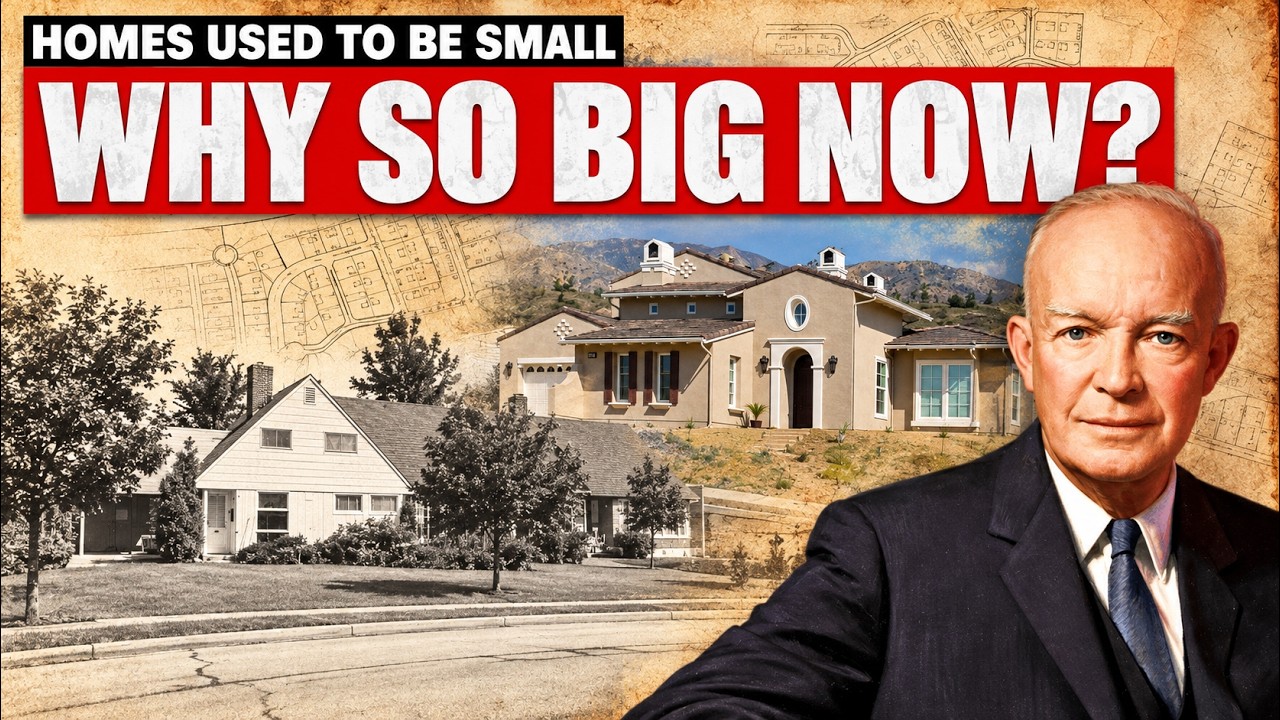
And it showed in the houses. The average new American home crossed 2,000 square feet for the first time in the early 1990s, reaching about 2,080. And then it just kept going. By 2000, it was 2,266.
By 2014, it had peaked at around 2,657 square feet. Homes were not just getting bigger, they were getting absurd. Two-story foyers, grand staircases, three-car garages, master bathrooms with soaking tubs and separate shower enclosures, walk-in closets the size of bedrooms, media rooms, wine cellars, home gyms, rooms that existed purely to be impressive with no clear functional purpose. This was the age of the McMansion.
The term itself, coined sometime in the 1980s, was deliberately mocking. It combined the fast-food connotations of McDonald’s with the grandeur of a mansion. The implication was clear. These houses were cheap, mass-produced imitations of genuine luxury.
And that characterization was largely accurate. McMansions were built quickly and cheaply, often using vinyl siding, engineered wood, and other cost-cutting materials. They featured a jumble of architectural styles, rooflines that went in every direction, and interiors that prioritized size over quality. They were designed to look expensive from the outside while being relatively affordable to build.
The whole point was to give middle-class families the feeling of living in a mansion, even if the craftsmanship did not hold up to scrutiny. And people loved them. They could not get enough. Television fueled the frenzy.
Shows glamorized enormous, lavishly decorated homes. Viewers who watched celebrities lounging in palatial estates wanted a piece of that for themselves. Real estate shows turned house hunting into entertainment. And the message was always the same.
Bigger was better. More was more. The house of your dreams was always just one more bedroom, one more bathroom, one more bonus room away. The financial industry was more than happy to accommodate this appetite.
Through the 1990s and 2000s, mortgage lending standards were loosened to the point of absurdity. Adjustable-rate mortgages allowed buyers to start with low monthly payments that would balloon later. No-documentation loans let people borrow money without proving they could actually afford to pay it back. Subprime lenders targeted borrowers with poor credit histories, packaging those risky loans into complex financial instruments and selling them to investors who did not understand what they were buying.
The entire system was built on the assumption that home prices would always go up. And for a while, they did. Between 1997 and 2006, the median American home price nearly doubled. People were not just buying homes to live in.
They were buying them as investments, flipping them for quick profits, taking out home equity lines of credit to fund renovations that would make the house even bigger and more valuable. The home had become a financial instrument, and its size was directly correlated with its perceived value. Bigger house, bigger investment, bigger return. And then the whole thing collapsed.
The 2008 financial crisis was at its core a housing crisis. When the subprime mortgage market imploded, it took the entire global financial system with it. Home prices crashed. Millions of Americans found themselves underwater, owing more on their mortgages than their homes were worth.
Foreclosures swept across the country like a plague. Entire subdivisions of brand-new McMansions sat empty, their windows dark, their lawns growing wild. Some developments were never even finished. You could drive through parts of Nevada, Florida, and Arizona, and see block after block of half-built houses, skeletal frames standing in the desert sun, monuments to a dream that had gone badly wrong.
The crash forced a national reckoning with the idea of the American home. For the first time in decades, people began seriously questioning whether bigger was actually better. The McMansion, which had been the aspirational ideal for a generation, suddenly looked like a liability. Those enormous houses were expensive to heat, expensive to cool, expensive to maintain, and nearly impossible to sell in a depressed market.
Their property taxes were crushing. Their utility bills were astronomical. And the neighborhoods they sat in, those sprawling suburban developments miles from the nearest grocery store, suddenly felt isolating and unsustainable. Out of that wreckage, something unexpected emerged.
The tiny house movement. The idea of living in a very small space was not entirely new. Henry David Thoreau had built his famous cabin at Walden Pond back in 1845, and various countercultural movements had experimented with minimalist living over the decades. But the modern tiny house movement, which gained significant momentum after the 2008 crash, was different.
It was a direct rejection of the bigger is better philosophy that had dominated American housing for half a century. Tiny houses, typically defined as dwellings under 400 square feet, appealed to people who were disillusioned with the financial burden of conventional homeownership. They were cheap to build, often costing between $30,000 and $60,000. They were energy efficient.
They could be placed on small lots or even on trailers, making them mobile. And they came with a lifestyle philosophy attached. Living small meant consuming less, accumulating less debt, and focusing on experiences rather than possessions. Television adapted quickly, producing shows that celebrated the tiny house lifestyle with the same enthusiasm it had once lavished on McMansions.
But here is the reality check. The tiny house movement, for all its cultural visibility, never actually transformed American housing in any meaningful statistical way. The vast majority of Americans did not want to live in 400 square feet. What did happen, though, was a genuine shift in the trajectory of home sizes.
After peaking in the mid-2010s, the average new American home began to shrink. In 2015, the average stood at around 2,467 square feet. By 2024, it had dropped to about 2,146 square feet. That is a decline of over 300 square feet in less than a decade.
The reasons for this decline are not romantic. They are economic. Construction costs have risen dramatically, driven by labor shortages, supply chain disruptions, and the rising cost of materials like lumber and concrete. Land prices in desirable areas have soared, and interest rates, after hovering near historic lows for over a decade, climbed sharply in 2022 and 2023, making mortgages significantly more expensive.
Builders responded by building smaller homes to keep prices within reach of buyers whose purchasing power was shrinking. There is also a generational shift happening. Millennials and Generation Z, who are now the primary home-buying demographics, have different priorities than their parents and grandparents. Many of them watched their parents struggle through the 2008 crash.
They saw homes go from symbols of security to sources of financial ruin. They are more skeptical of the idea that a bigger house equals a better life. Surveys consistently show that younger buyers prioritize location, walkability, and proximity to amenities over raw square footage. They would rather have a smaller home in a vibrant neighborhood than a McMansion in a car-dependent suburb 40 minutes from the nearest coffee shop.
But the infrastructure of bigness is still firmly in place. Zoning codes in thousands of American communities still mandate minimum lot sizes and minimum home sizes that prevent the construction of smaller, more affordable housing. Single-family zoning, which restricts areas to standalone houses and prohibits duplexes, triplexes, and apartment buildings, covers roughly 75 percent of the residential land in most American cities. This is one of the primary drivers of the housing affordability crisis.
When you make it illegal to build anything smaller than a certain size on a certain amount of land, you guarantee that housing will be expensive. Some cities are starting to push back. Minneapolis made national headlines in 2018 when it became the first major American city to effectively end single-family zoning, allowing duplexes and triplexes to be built in any residential neighborhood. Oregon followed with a statewide reform in 2019.
California has passed a series of laws aimed at increasing housing density, including measures that allow homeowners to build accessory dwelling units, essentially small secondary homes in their backyards. These are baby steps, but they represent a meaningful crack in the foundation of the bigger is better consensus. And there is a fascinating irony buried in all of this. The very thing that made American homes so big, cheap suburban land enabled by highways and subsidized mortgages, is now making them harder to sustain.
Sprawl requires enormous investment in roads, sewers, water systems, and emergency services. Low-density suburbs generate far less tax revenue per acre than compact urban neighborhoods. But they require just as much infrastructure. Study after study has shown that many suburban communities are essentially running a fiscal deficit, spending more on services than they collect in property taxes.
They survive only because new development keeps generating revenue, a model that some urban planners have compared to a Ponzi scheme. When the growth stops, the bills come due. And in an era of rising infrastructure costs and tightening municipal budgets, a lot of those sprawling suburbs are starting to feel the squeeze. It is worth pausing here to consider just how unusual the American obsession with large homes really is.
Compared to the rest of the world, American houses are enormous. The average new home in the United Kingdom is about 818 square feet. In Germany, it is around 1,050. Japan, despite its reputation for efficiency and innovation, averages roughly 1,023 square feet per new dwelling.
Even Australia, which is the only country that rivals America in home size, still comes in somewhat smaller on a per-person basis. The American appetite for residential space is genuinely exceptional. And it is worth asking whether it reflects actual needs or culturally manufactured desires. The honest answer is probably both.
Americans do have more stuff than people in most other countries. They have bigger cars, more appliances, more recreational equipment. The culture of consumption that drives the American economy also drives the American home. But there’s also a feedback loop at work.
The houses are big because the culture tells you they should be big. And the culture tells you they should be big because the houses are big. Developers build what sells, and what sells is what people have been conditioned to want. Breaking that cycle is extraordinarily difficult, especially when it is reinforced by financial incentives.
Larger homes generally appreciate faster in value. They have lower cost per square foot to build. And the mortgage interest deduction, one of the largest tax subsidies in the federal budget, rewards homeowners for borrowing more money, which naturally favors larger, more expensive homes. There is another dimension to this story that often gets overlooked, and that is the role of the home as a substitute for public infrastructure.
In many other developed countries, citizens have access to robust public parks, community centers, public swimming pools, libraries, and other shared amenities. These spaces absorb many of the functions that American homes are expected to serve on their own. When you have a great public park nearby, you do not need a massive backyard. When your neighborhood has a community pool, you do not need to build one in your yard.
When public transit is reliable, you do not need a three-car garage. But America, by and large, chose a different model. Instead of investing in shared public spaces, it invested in private domestic ones. The suburbs were built around the car, not the pedestrian.
Public transit was neglected or actively dismantled. Parks and community facilities were underfunded. And so the American home had to become everything. The park, the gym, the entertainment center, the workspace, the gathering place.
Is it any wonder that it kept getting bigger? It had to. It was doing the work of an entire community. The pandemic of 2020 threw all of this into sharp relief.
When millions of Americans were suddenly forced to work from home, their houses had to accommodate functions they were never designed for. Kitchen tables became offices. Bedrooms became classrooms. Garages became gyms.
People who had been perfectly content in their 1,200-square-foot apartments suddenly felt suffocated. The demand for larger homes surged, especially in suburban and rural areas. People fled dense urban centers in search of more space, more privacy, more room to breathe. Home prices spiked.
Bidding wars erupted. And builders, sensing an opportunity, ramped up construction. But this surge was short-lived. As interest rates rose and the initial panic subsided, the market cooled, and builders facing rising costs and shrinking demand began building smaller again.
The pandemic did not reverse the long-term trend towards smaller homes. If anything, it was a brief interruption, a temporary spike driven by extraordinary circumstances before the underlying economic reality reasserted itself. So where does all of this leave us? The American home is at a crossroads.
For the first time in nearly a century, the long march toward bigger houses has stalled and possibly reversed. Economic pressures are real. Cultural attitudes are shifting, and the environmental consequences of sprawling suburban development, from carbon emissions to habitat destruction to water usage, are becoming harder to ignore. The era of the McMansion, of the 3,000-square-foot starter home, of the two-story foyer and the three-car garage may genuinely be drawing to a close.
But do not expect the transition to be smooth or painless. The infrastructure of bigness is deeply embedded in American law, American finance, and American identity. Zoning codes favor large lots. Tax policy rewards big mortgages.
Cultural narratives still equate homeownership with success and square footage with status. Changing all of that requires not just economic adjustment, but a fundamental rethinking of what the American dream actually looks like. Is it a five-bedroom house on a half-acre lot in a suburb 30 miles from downtown? Or is it something smaller, something more walkable, something more connected to community and less dependent on the car and the credit card?
The answer will probably depend on who you ask, but the numbers suggest that for a growing number of Americans, the dream is getting smaller. And that might not be such a bad thing. In 1950, a family of four shared 983 square feet and considered themselves lucky. They had a roof over their heads, a yard for the kids to play in, and a monthly payment they could actually afford.
They did not need a media room or a wine cellar or a three-car garage. They needed a home. And maybe after decades of chasing ever larger houses that we could barely afford, filled with stuff we did not really need, in neighborhoods designed for cars rather than people, maybe the most radical thing Americans can do is remember what a home is actually for. Not a status symbol, not an investment vehicle, not a warehouse for consumer goods.
Just a place to live. A place to be together. A place that is enough.
