On the morning of Friday, May 21st, 2021, Dick Johnson, the chief executive of Foot Locker, opened an earnings call with analysts and reported a quarter that had beaten Wall Street’s estimates by a wide margin. Then he announced that one of the company’s own chains would be shut down. Foot Action, where a generation of teenagers had gone looking for the newest sneakers, would be wound down over the next two years. The name that had once stood in malls across America was being retired.
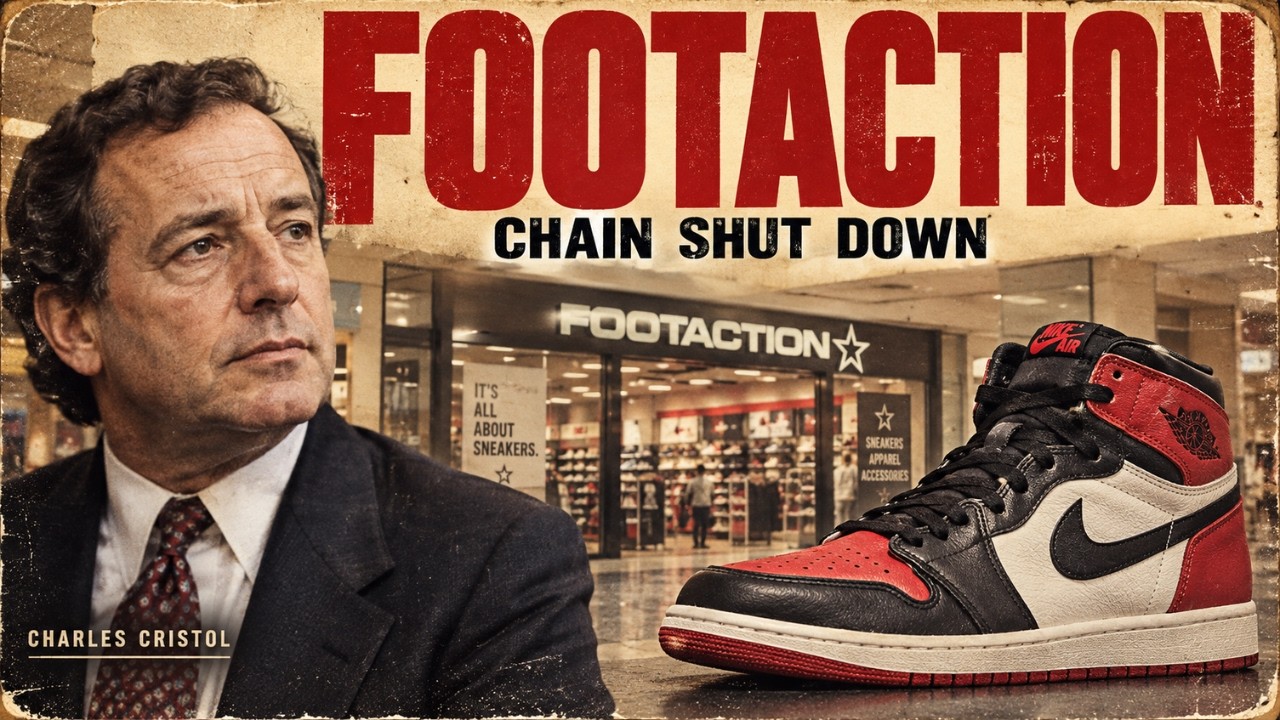
The story did not begin in a boardroom. It began with a single shoe store in Wichita Falls, Texas, in the middle of the 1970s. There, a businessman named Charles Crystal, working with several partners, opened a store and gave it a name built for motion: Foot Action. The timing mattered.
Through the late 1970s, running had become a national habit, and sneakers had become something people wore to school, to work, and on weekends. By the 1980s, that shift had turned into a boom. In 1985, Nike put a young basketball player’s name on a shoe, and the Air Jordan turned a piece of sports equipment into something teenagers saved for, waited for, and protected. A year later, a rap group from Queens recorded a song about their Adidas.
Sneakers had become culture, and culture needed a place to be sold. The enclosed shopping mall was that place. Foot Action followed the malls. From that first store in Wichita Falls, the company spread outward, with its base settling in the Dallas area.
It stayed privately owned the entire time. By the start of the 1990s, the business that began as a single store had become a chain of 128. That kind of growth drew attention. In 1991, it drew the attention of the Melville Corporation, a retail giant based in Rye, New York, that owned drugstores, discount clothing chains, and toy stores.
Shoes were where Melville had started, and shoes were still part of what it did. Melville bought Foot Action, and Charles Crystal stepped down as chief executive. Melville did not buy Foot Action to leave it alone. Within months, the company took another chain it already owned, a group of athletic shoe stores called Fan Club, and changed the signs.
129 Fan Club stores became Foot Action stores almost overnight. The chain from Wichita Falls more than doubled in size without opening a single new location. The result was the third largest athletic shoe specialty chain in the United States. In 1996, Melville made a decision that tied two of its stories together.
Tom McCann, the shoe chain Melville had run since 1922, was finished. Melville closed the chain for good, and 76 of its stores were converted into Foot Action. One generation of American shoe stores was handing its storefronts to the next. That same year, Melville broke itself apart.
It sold or spun off nearly everything it owned except its drugstores and renamed itself CVS. Its shoe businesses were packaged into a new company called Footstar, which began trading on the New York Stock Exchange in October 1996. Footstar had two halves. One was Meldisco, which ran the shoe departments inside discount stores.
The other was Foot Action. Foot Action knew exactly who it was selling to. The chain aimed at shoppers between the ages of 12 and 24. By the late 1990s, it was bringing in more than $500 million a year.
The new stores were bigger, built for walls of shoes and racks of clothing. Inside, the chain sold more than sneakers. It sold an attitude. Its goal was being first with the most current, innovative, and exclusive street-inspired footwear and apparel.
For a teenager in the late 1990s, walking into a Foot Action was walking into the culture of the moment. By the spring of 2000, the chain had reached its peak. Foot Action operated 552 stores spread across 44 states, Puerto Rico, and the Caribbean. Most sat inside enclosed regional malls, where the foot traffic was heaviest.
From the outside, it looked like a company with nothing to fear. But Foot Action did not own itself. It was only one half of Footstar, and it was not the larger half. Most of Footstar’s money came from Meldisco.
And almost all of Meldisco’s business lived inside the shoe departments of a single retailer: Kmart. Whatever happened to Kmart would happen to Footstar. And whatever happened to Footstar would happen to Foot Action. On January 22nd, 2002, that partner collapsed.
Kmart filed for Chapter 11 bankruptcy, the largest retail bankruptcy in American history up to that point. In March, Kmart received court approval to close 283 stores. The shoe departments inside them had generated more than $116 million in sales for Footstar the year before. More closings followed.
Over the course of its reorganization, Kmart shut roughly 600 stores, and Meldisco lost an estimated $300 million in revenue. Foot Action was already shrinking, too. During 2001, it opened just three new stores and closed 33. By the end of 2002, it was down to 459.
The chain that had been opening stores at a furious pace only a few years earlier was now pulling back. Then the second blow landed, and this one came from inside. On November 13th, 2002, Footstar announced that its own management had found discrepancies in the company’s accounts payable. Within weeks, five class action lawsuits had been filed by shareholders.
An internal investigation began, overseen by the board’s audit committee. In September of 2003, the preliminary findings arrived. The errors reached back to 1997. The stock fell 20% in a single day, and Mickey Robinson, the man who had led Footstar since the day it was born, was out.
When the full accounting was done, the errors had wiped $46 million from Footstar’s reported earnings, and the investigation itself had cost more than $15 million in fees. By the end of 2003, Footstar was wounded on two fronts. Its biggest customer had shrunk, and its own books could not be trusted. It needed money, and it needed it quickly.
On Tuesday, March 2nd, 2004, Footstar and most of its subsidiaries filed for Chapter 11 bankruptcy in federal court in the Southern District of New York. Foot Action was the part of Footstar that outsiders actually wanted. It had hundreds of mall leases, a young customer base, and strong relationships with the brands that controlled the most sought-after sneakers. In a bankruptcy, assets like that are not protected.
They are sold to raise money for creditors. The first offer came from the obvious buyer. Foot Locker, headquartered on West 34th Street in Manhattan, was the largest athletic shoe retailer in the world. Foot Action had been one of its rivals in malls across America for more than two decades.
Foot Locker signed an agreement to buy about 350 Foot Action stores for $160 million in cash. Other bidders came forward, and the sale became a contest. Foot Locker raised its offer and then raised it again. When the bidding ended, it had agreed to pay $225 million in cash.
On April 21st, 2004, the bankruptcy court approved the sale. Foot Locker said it would keep operating most of the stores under the Foot Action name. Foot Action had survived. The company that owned it had fallen apart around it, and still the name on the storefronts did not change.
Its rival had become its owner. For the first few years, the arrangement seemed to work. Foot Locker kept the Foot Action name on the storefronts and kept the stores open. By early 2007, the count had grown to 373.
Under its new owner, Foot Action was expanding again. The logic was simple. Foot Locker already had Foot Locker, Lady Foot Locker, Kids Foot Locker, and Champs Sports. Each one was supposed to serve a different customer.
Foot Action was meant to be the one with an edge: the store for young shoppers in the cities who cared less about team jerseys and more about what was on everyone’s feet that week. Then the economy broke. The financial crisis of 2008 hit shopping malls hard. Foot Action entered 2009 with 335 stores, opened none that year, and closed 16.
By the start of 2013, it was down to 283. The search for what made Foot Action different had begun. The most ambitious answer came in 2014, and it came from Michael Jordan’s brand. On the morning of February 1st, 2014, a new store opened on West 34th Street in Manhattan, a short walk from Madison Square Garden and only a few blocks from Foot Locker’s own headquarters.
It was called Flight 23, and it was the first store in North America to sell nothing but Jordan Brand products. Jordan Brand had built it in partnership with Foot Action. For a while, Flight 23 gave Foot Action exactly what it had been searching for: a reason to exist that its sister chains did not have. But Flight 23 also changed what Foot Action was.
Over the decade, the chain moved away from the boutique feeling it had built its name on and toward performance basketball. And performance basketball was already Foot Locker’s territory. Foot Locker had its own Jordan and Nike basketball concept called House of Hoops. Now, both chains owned by the same company were selling Jordan’s shoes to the same young basketball fans, often in the same malls.
That was the problem nobody inside the company could fully solve. In the malls where Foot Locker had bought Foot Action, it already had a Foot Locker. Often, there was a Champs Sports too. A teenager looking for the newest Jordans could walk past three storefronts with three different names, and every one of them was owned by the same company on West 34th Street.
When Foot Action and Foot Locker were rivals, that overlap had been competition. Now, it was a cost. Still, Foot Action kept going. By the start of 2020, it had 245 stores.
On paper, it was a stable chain. Inside Foot Locker, the questions were getting louder. If Foot Action sold the same shoes to the same customers in the same malls as the company’s other stores, what exactly was it for? In March of 2020, the shopping malls of America went dark.
As the coronavirus spread, stores across the country locked their doors. For a retailer built almost entirely inside enclosed malls, it was the hardest test imaginable. When the doors began to reopen, the business looked different. Shoppers had grown used to buying from their phones.
Inside Foot Locker’s headquarters, executives had a rare chance to look at every one of their stores with fresh eyes. Foot Locker had a name for that kind of look. It called it a banner review. Quietly that same year, Foot Locker ran an experiment in Los Angeles and New York, the two cities where Foot Action’s urban identity had always been strongest.
The company took a handful of Foot Action stores and changed the signs. The shoes inside were largely the same. The locations were the same. The customers walking past were the same.
Only the name over the door was different. Now the stores said Foot Locker. Then Foot Locker watched the numbers. The results were clear.
The converted stores became more productive under the Foot Locker name than they had been as Foot Action. Across the chain, Foot Action’s profitability and productivity were running below the average for Foot Locker stores as a whole. The experiment answered the question that had hung over Foot Action since the day Foot Locker bought it. Foot Action had not failed because people stopped wanting sneakers.
Sneakers had never been more popular. It had not failed because it lost its customers. Its customers were still there. It was failing a test that only its owner could set.
Was the Foot Action name worth more than the Foot Locker name on the same storefront? The answer was no. On that Friday morning in May 2021, Dick Johnson told the analysts that the company had made the strategic decision to wind down the Foot Action banner over the next two years. Roughly a third of Foot Action’s 231 stores, the best performers, would be converted into Foot Locker, Champs Sports, or Kids Foot Locker.
Most of the rest would close as their leases ran out. When the floor opened for questions, the first analyst asked about Foot Action. Johnson’s answer was the clearest explanation Foot Locker ever gave. 85% of Foot Action stores, he said, were located near another one of the company’s banners.
The stores overlapped. The customers overlapped. He named the stores where the company had tested the change the year before: one on Whittier Boulevard in the Los Angeles area, one on Broadway in downtown Los Angeles, and one at Gotham Plaza in Harlem. When those Foot Action stores became Foot Locker stores, they had become more productive.
There was no farewell sale announced for Foot Action and no closing ceremony. The end came the way most endings come inside a large corporation, one decision at a time. In the final three months of 2021 alone, Foot Locker closed 120 Foot Action stores. 45 of them were converted to other banners.
The other 75 were simply gone. The annual report that followed recorded a $2 million writedown on the Foot Action trade name itself. The stores and the website were closing. By the beginning of 2022, footaction.
com was gone, too. There is no public record of exactly where the last Foot Action store stood or the date its gates came down for the last time. No press release marked it. The chain did not end with a single final day.
It ended in hundreds of small ones in malls across the country until there were none left. 46 years after it began, Foot Action had been taken apart by the company that had paid $225 million to save it. Its stores had become someone else’s stores. Its customers had been handed to its sister chains.
And its name, the thing that once drew teenagers into malls across America, had been written down as a line in an annual report. Foot Action was not the only thing left behind. Footstar, the company that had sold it, never recovered. It emerged from bankruptcy in February of 2006, but by then it was a shadow of the business Melville had created.
Foot Action was gone. Just for Feet was gone. What remained was almost entirely one thing: the shoe departments inside Kmart. When that agreement expired at the end of 2008, Kmart bought back the remaining inventory for about $55 million.
On March 5th, 2009, Footstar’s board adopted a plan to dissolve the company. The shoe empire that had started with a handful of Melville stores more than a century earlier ended as a parcel of real estate waiting for a buyer. At Foot Locker, Foot Action turned out to be the beginning of something rather than the end. East Bay, one of the iconic concepts named on the morning of the Foot Action announcement, was closed in 2022.
Lady Foot Locker was retired as well. In March of 2023, Foot Locker announced it would close roughly 400 of its mall stores by 2026 and push toward larger stores outside of malls. The company’s chief commercial officer explained plainly that the company had too much overlap between its banners. The smaller ones, he said, were adding complexity and diluting profitability.
Foot Action was now one name in a list. But the pattern was not finished yet. On May 15th, 2025, Dick’s Sporting Goods announced that it had agreed to buy Foot Locker. The price was about $2.
4 billion for the company’s shares, about $2. 5 billion including its debt. The deal closed on September 8th, 2025. On the day the deal closed, Dick’s published the list of brands it would continue to operate.
Foot Locker, Kids Foot Locker, Champs Sports, WSS, and Atmos. Foot Action was not on the list. Neither was East Bay or Lady Foot Locker. The names that Foot Locker had retired were not part of what Dick’s paid for.
They had already been folded into the brands that remained, the way Foot Action stores had been folded into Foot Lockers. Within a year, Dick’s cut its expectations for Foot Locker. It said the stores it had just bought might see sales fall by as much as 2% in 2026 instead of growing. Shareholders filed a class action lawsuit alleging that Dick’s had misled investors about the problems inside Foot Locker.
Those claims are allegations and have not been decided by any court. Seen from the beginning, the story of Foot Action is a chain of handoffs. In 1996, Melville closed Tom McCann and turned 76 of its stores into Foot Action. One American shoe chain gave up its storefronts so another could grow.
Twenty-five years later, Foot Locker closed Foot Action and turned the best of its stores into Foot Locker. Four years after that, Foot Locker itself was absorbed into Dick’s. Each time the storefront survived. Each time the name over the door changed.
And each time, the company doing the closing believed it was the one that would last. Being rescued is not the same as surviving. In 2004, Foot Action was saved from a collapse it did nothing to cause. It kept its name, its stores, and its customers.
But it was saved by a competitor, and a competitor has its own reasons for buying you. For 17 years, those reasons were good enough. Then they were not. The most dangerous rival is sometimes the one under your own roof.
Foot Action spent its early decades competing against Foot Locker in malls across America, and it held its own. It never lost that fight in the open. It lost it inside the family, in a test it did not know it was taking, decided by an owner who could see both sets of numbers. And a name is only worth what someone believes it is worth.
In 1976, Charles Crystal put the words Foot Action over a single store in Wichita Falls. For a generation of teenagers, that word meant the place where the newest sneakers were. In 2022, the same word appeared in an annual report as an intangible asset written down because the stores and the website were closing. Somewhere tonight, in a closet or a garage, there is still a shoe box with that name printed on its side.
It had survived the fall of its owner. It could not survive being one name too many.
