Nine graves lie beneath the moss-draped oaks of Colonial Park Cemetery in Savannah, Georgia, and the city’s most prominent families have never once acknowledged them. Each headstone bears the name of a wealthy planter who died between 1851 and 1855, all of them under circumstances eerily alike: sudden paralysis, then what physicians of the day called a merciful death. But in 1923, when the cemetery underwent renovation, laborers made a discovery so horrifying that officials promptly sealed it from the public record. Inside those nine coffins, the wooden lids bore ragged gouges dug by fingernails, and the bodies lay twisted in attitudes of desperate struggle.
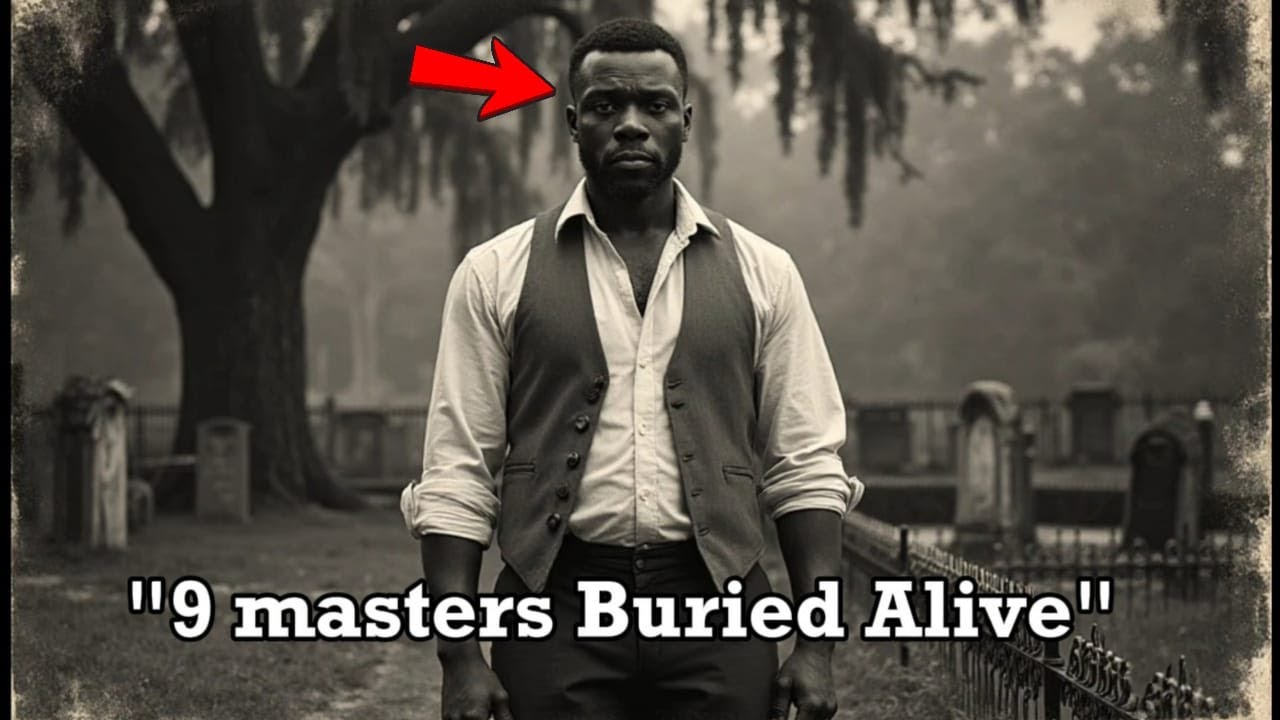
What the workers found next would haunt Savannah’s upper crust for generations. Beneath the cemetery’s oldest magnolia tree, a leather-bound journal surfaced, written in the careful script of a man named Solomon Greavves. Its pages contained the confession of a healer turned executioner, a slave who spent four years carrying out a calculated revenge that began with the screams of his family and ended with nine of Savannah’s wealthiest men buried alive. The journal’s first entry, dated March 15th, 1851, contained only one line, but it explained everything: Today, I watched my wife and children burn, and I did nothing to stop it.
Savannah in the 1850s was a jewel of the South, white-columned mansions lining the banks of the Savannah River, fortunes built on cotton and rice creating dynasties who believed themselves untouchable. Its medical community, though small, commanded enormous respect among the elite. The planters and merchants who could afford private physicians relied on them for their frequent fevers, their mysterious weaknesses, and the sudden paralytic illnesses that seemed curiously to plague the city’s wealthiest households. Dr.
Ilas Abernathy had established his practice on Broughton Street in 1846 and quickly earned a reputation among the gentry for his innovative treatments. His success owed much to his assistant, a slave named Solomon Greavves, whose knowledge of medicinal plants and chemical compounds bordered on the uncanny. Purchased specifically for Abernathy’s practice after word spread of his healing skill, Solomon had inherited generations of botanical wisdom from his family. On plantations across Georgia, his people had survived on roots and leaves and barks while the masters turned to imported remedies from Europe.
Solomon was no typical field hand. Tall, with sharp eyes that cataloged everything around him, he had been educated alongside the children of a former master in ways the law would soon forbid. He could read and write, knew the Latin names of herbs, and moved with a precision that impressed even Abernathy. The doctor relied on him for complex preparations, and Savannah’s elite, at first indifferent to his presence, came to request him by name for his calm bedside manner and his uncanny understanding of illness.
But before he became the quiet shadow in Abernathy’s clinic, Solomon had lived a different life. For thirty-two years he belonged to the Mercer plantation, fifteen miles outside Savannah, where he had married a woman named Celia and raised three children: Marcus, Samuel, and Grace. His skills had earned him rare trust. He treated slaves and even the Mercer family during the fevers that swept the quarters, saving lives with remedies drawn from both Africa and Europe, combining his botanical knowledge with observation of the white physicians who occasionally visited.
That fragile stability ended in March 1851, when Edmund Mercer, burdened by gambling debts, was forced to sell portions of his property. Among the losses were Celia and the children, destined for separate plantations across Georgia and beyond. Such fragmentation of families was common, justified by planters as business necessity, but it destroyed lives as surely as any plague. Solomon begged Edmund Mercer for mercy, offering to serve without wages for years if only his family could remain together.
He even proposed being hired out to other planters seasonally to generate income. But creditors demanded immediate payment, and Mercer refused every plea. The sale was scheduled for March 14th at the Savannah slave market. Nothing would alter that fate.
That morning dawned heavy with humidity as storm clouds gathered over the river. Solomon had spent the night memorizing every line of his wife’s face, every sound of his children breathing. Celia, his wife of fifteen years, steeled herself with quiet dignity, preparing the little ones for the inevitable. Eight-year-old Marcus was curious and bright, already echoing his father’s thirst for knowledge.
Six-year-old Samuel was gentle, happiest when gathering herbs with Solomon in the woods. Four-year-old Grace clung to her mother, sensing with a child’s intuition that something terrible was about to unfold. When the traders arrived, Solomon watched helplessly as his family was herded into a wagon with other captives. Their tears mingled with desperate promises whispered into the humid air, lies meant only to soften unbearable pain.
The true nightmare struck halfway into Savannah. The wagon hit a rut and lurched violently. Celia was thrown to the ground, striking her head against a stone. Blood spilled onto the mud as she lay dazed and shackled.
Solomon lunged toward her. But the traders, anxious only to deliver their human cargo intact, made a decision that carved itself into his soul. They declared her a loss and left her lying in the road. Solomon’s screams filled the trees as he was forced onward, his wife’s body receding into the distance.
At the market, the cruelty deepened. Marcus was sold to a rice planter from Glynn County, where children waited in swamp water among alligators. Samuel went to a cotton grower in central Georgia known for working slaves to death in relentless heat. Grace, too young for fieldwork, was sold to a wealthy family in New Orleans as a house servant.
Each transaction severed another piece of Solomon’s heart. Outwardly he kept a mask of resignation, knowing any resistance would bring the lash. But something within him shattered. The healer who once preserved life now harbored something darker.
Dr. Abernathy, ignorant of Solomon’s loss, purchased him that same day, paying a high price for his reputation as a healer. As Solomon was led from the market to his new master’s home, he cast one last glance back at the stalls where his children had been scattered like livestock. A cold patience settled inside him.
He would wait, he would learn, and one day those responsible would pay. That evening, alone in the narrow quarters above Abernathy’s practice, Solomon opened a small leather journal he had smuggled through every torment. By candlelight, his careful script marked the beginning of a campaign that would shake Savannah’s foundations. Today, I watched my wife and children burn, and I did nothing to stop it.
But I remember every face, every voice that left as my world ended. They think I am broken, but I have learned patience. The months that followed blurred into routine. Solomon prepared treatments, mixed tonics, and tended patients with the same calm grace as before.
But behind the mask he listened, studied, and began compiling secrets about the very men who had profited from his family’s destruction. In Abernathy’s medical library he discovered texts on compounds that could mimic death. He experimented with toxins from exotic plants grown in the greenhouse of Professor Nathaniel Krenshaw at the Savannah College of Medicine. The knowledge came slowly, but with each passing week his quiet ledger of vengeance grew.
By late 1852, Solomon had marked his first target: Colonel Harrison Telfair, a rice planter who had not only bid on Solomon’s children but joked aloud about their breeding potential. The colonel suffered from gout and visited Abernathy’s office regularly for relief. It was during one of these visits that Solomon decided to step fully across the line from healer to executioner. Colonel Telfair arrived at Dr.
Abernathy’s office one day, limping heavily and complaining that his gout had become unbearable. Stout and red-faced, the colonel carried with him the arrogance of a man who believed himself untouchable. Dr. Abernathy was busy attending another patient and instructed Solomon to begin Telfair’s treatment.
The timing could not have been more perfect. With hands steady from years of mixing medicines, Solomon measured out the colonel’s usual tonic. But this time he added precisely calculated drops of the paralytic compound he had perfected through months of experimentation. When Telfair swallowed the mixture, he chuckled through his pain, remarking that Solomon was the only one in the city who truly understood how to ease his suffering.
Minutes later, the colonel’s words slurred. His limbs stiffened, his eyes darting with a confusion that soon ripened into terror. Solomon leaned close, his voice calm and deliberate. Do you remember the auction, Colonel?
March 14th, 1851. You laughed as my children were sold. You said they would fetch fine breeding stock. I am Solomon Greavves, and today you pay for that day.
The colonel tried to cry out, but no sound came. His body, locked in paralysis, betrayed him utterly. Solomon explained in the same soothing tone he once used to comfort patients that the medicine did not kill instantly. It only froze every muscle while leaving the mind awake.
Soon Abernathy would pronounce him dead of heart failure, and the next day he would be buried in Colonial Park Cemetery. But you, Colonel, Solomon whispered, will not die until you are beneath the soil. You will hear the dirt fall on your coffin. You will feel the air grow thinner, and you will have hours to remember what you did to my children.
By the time Dr. Abernathy entered, Solomon was standing solemnly beside what appeared to be a lifeless body. His heart gave out suddenly, Solomon said softly. Abernathy confirmed it.
The death, though abrupt, seemed consistent with Telfair’s failing health. The colonel was buried the next afternoon, with Savannah’s gentry weeping at his funeral. Solomon stood quietly in the section reserved for slaves, watching as earth thudded onto the coffin. His thoughts were cold, not triumphant.
Justice had been served, but only the first measure. In his journal that night, he wrote: One down, eight remain. Justice is patient, but it always comes. Weeks passed with no suspicion.
Abernathy spoke of the case to other physicians as an example of sudden cardiac arrest. Meanwhile Solomon refined his compound, testing it on animals to ensure its effects lasted long enough to guarantee awareness beneath the soil. But the weight of his first act bore heavily on his nights. Sleep came fitfully.
He saw in his imagination the colonel’s eyes staring up from the coffin, wide with realization. Not guilt, not fear of God, just the raw terror of being sealed alive. By spring of 1853, Solomon turned his attention to Judge Richard Calhoun, a gray-haired jurist whose rulings had defended the legality of separating slave families. Calhoun suffered from debilitating migraines and visited Abernathy frequently.
It was during one such visit in April that Solomon administered the compound in a slightly higher dosage than intended. The judge’s collapse came faster, his eyes rolling back, his rigidity so pronounced that Abernathy furrowed his brow during the examination. Strange, the doctor murmured. His muscles are unusually stiff for a stroke victim.
He bent closer, noticing the wide, almost pleading stare in the corpse’s eyes. For a terrible moment Solomon feared discovery. But Abernathy, lacking the forensic knowledge that later generations would develop, dismissed it as the agony of a severe attack. Judge Calhoun was buried beside Colonel Telfair in Colonial Park, two rows apart.
Solomon attended again, quiet, watchful, adding another entry to his journal that night. The judge has joined the colonel. They feel now what my wife felt when she lay bleeding on the roadside. What my children felt as strangers dragged them away.
It was at this funeral that Solomon noticed something unsettling. Standing among the crowd was a young man with sharp features and a leather notebook. He wrote quickly as he observed, his eyes flicking from face to face, studying the graves. Solomon would later learn his name: Thomas Grimshaw, a journalist for the Savannah Republican, who had begun investigating what he called the prominent deaths, a string of sudden and unexplained fatalities among the city’s ruling class.
By May, Solomon’s plan required him to move more swiftly. Abernathy announced he was considering a junior partner, Dr. Timothy Henderson, a newly trained physician from Philadelphia. Henderson had studied the newest methods of post-mortem analysis, and his presence would bring dangerous scrutiny.
Solomon realized he must accelerate his mission. Instead of spacing his acts over years, he would need to finish within months. His third target was Captain William Dandridge, a shipping magnate who had transported enslaved people up and down the coast. Solomon learned through whispers among the slave community that Dandridge was hosting a dinner party for Savannah’s shipping elite on May 20th.
Through connections in the kitchens, Solomon arranged to assist with serving the meal. The captain’s dining room glittered with candlelight and crystal as men toasted to profits from cotton and human cargo alike. Solomon moved silently among them, listening. They spoke of families torn apart with the same detachment they used for shipping schedules.
During dessert, Solomon prepared the captain’s brandy-soaked cake with a hidden measure of his compound. Dandridge ate heartily, praising the flavor. Within half an hour, dizziness struck. Laughing it off as too much wine, he excused himself to his study.
Solomon watched from the doorway as the toxin seized him in his leather chair. But fate betrayed him. The captain’s sudden collapse caused panic among the guests. Dr.
Samuel Pedigrew, one of the diners, examined the body and frowned. This is peculiar, he muttered. Not a stroke, not apoplexy. The rigidity is unnatural, almost as if he were poisoned.
The word swept through the room like fire. By dawn, news of the suspicious death had spread through Savannah. Grimshaw, the journalist, arrived quickly, questioning servants and recording every detail. He learned that Solomon had been present, marking the first time a name connected directly to multiple deaths.
Solomon sensed the net drawing closer, yet six names still filled his journal. He knew now he must take greater risks. He devised a plan for June, when six prominent traders were scheduled to meet at the offices of Henderson and Associates to finalize contracts for an expansion of the trade. This time Solomon would not strike one by one.
He would attempt to paralyze them all at once. Working nights in a shed behind the clinic, he distilled his compound into a concentrated form. He planned to release it into the gas lighting system of the office, so that when the lamps were lit, the poison would seep into the air. The men would freeze in place, their eyes wide with realization, trapped together at their mahogany table.
Solomon imagined moving among them calmly, explaining who he was and why their fate had come. On June 15th, 1853, he waited in the alley behind Henderson and Associates as the lamps flickered to life inside. Within thirty minutes, silence fell. Solomon entered through a rear door, and the sight that greeted him was everything he had imagined.
Six men sat rigid, their eyes the only living parts of them, following his movements with dawning horror. Solomon walked slowly around the table, whispering to each one by name, recounting the auction, the laughter, the destruction of his family. Their terror, reflected in their unblinking gazes, was his justice. But as he turned to leave, footsteps echoed in the corridor.
The door opened. Standing there was Thomas Grimshaw, his notebook in hand, his face pale with shock. So it’s true, he whispered. You’ve been killing Savannah’s masters.
Solomon did not deny it. His calmness was unsettling, the same composure he had shown mixing medicines in Abernathy’s office. They destroyed my family, he said evenly. Sold my children, left my wife to die by the roadside.
They profited from our suffering. Tonight they know what helplessness feels like. Grimshaw glanced at the victims, then back at Solomon. They’re alive, aren’t they?
I see it in their eyes. Whatever you gave them, it made them corpses with minds still awake. Solomon nodded once. They will hear every word spoken over them, feel every hand preparing them for burial.
They will suffocate in the dark, just as my family suffocated under their cruelty. For a long moment the journalist said nothing. The scratch of his pen against paper was the only sound in the room. He was recording, preserving, even as his conscience warred within him.
I can’t let you keep doing this, he whispered finally. But I also can’t pretend not to understand why. The conversation was cut short by voices in the hall. Other men were arriving, constables perhaps, or late associates.
The moment was ending. There’s a back stairway, Grimshaw said suddenly. You can still escape. I could hold this off and give you hours.
But Solomon shook his head. His voice was steady, resolved. No, my work is done. Let them see.
Let them know that even slaves have limits to what they will endure in silence. The door burst open, city constables pouring into the room with pistols drawn. They froze at the sight before them: six prominent men locked in grotesque stillness around the table, and a lone slave standing calmly in the center. Solomon did not resist.
He confessed immediately, explaining the toxin, the planning, the names. His words were recorded on the spot. The trial of Solomon Greavves became the most sensational case Savannah had ever witnessed. The courthouse overflowed with citizens, planters, merchants, wives clutching their handkerchiefs, and slaves forced to attend as a cautionary lesson.
The prosecution, led by District Attorney Charles Rutledge, presented it as simple murder: a slave who had killed nine masters, a threat to the very order of Southern society. The defense, reluctantly assigned to attorney Benjamin Crawford, could not deny Solomon’s guilt. Instead, he painted a portrait of the system itself: the auction block, the splitting of families, the indifference of men who saw human beings as assets to be liquidated. Crawford did not excuse Solomon’s crimes, but argued they were born from a society that left him no other justice.
Solomon himself took the stand. Calm, articulate, he recounted the wagon ride, Celia’s head striking stone, his children sold to strangers. The courtroom sat in stunned silence as he described, with the precision of a physician, how he had transformed knowledge meant to heal into tools of vengeance. In a just world, he said, my family would never have been destroyed.
But in this world, I created my own justice. The most shocking testimony came from the six survivors of the Henderson meeting. They had been saved only because the constables discovered them before burial. Each described the unspeakable terror of lying motionless while their deaths were declared.
One planter’s voice shook as he told how he heard his wife weep over him, powerless even to blink in response. Another said, If Solomon wished to show us the meaning of fear, he succeeded beyond imagination. The courtroom gasped when it was revealed that the earlier victims, Colonel Telfair, Judge Calhoun, and Captain Dandridge, had been buried alive. The city reeled.
Families whispered fears that their own departed relatives might have suffered the same fate. Requests for exhumations flooded the churches. Physicians began urgently debating new methods for detecting toxins, inadvertently advancing the field of forensic medicine. Newspapers across the South reprinted Grimshaw’s accounts, mingling horror with fascination.
Slaveholders read them with unease. If a man like Solomon, trusted, educated, even beloved by patients, could harbor such vengeance, what storms might be brewing in the minds of countless others forced into bondage? The jury deliberated less than an hour. Guilty on all counts.
The sentence: death by hanging. On October 15th, 1853, a crowd of over two thousand gathered in Wright Square to witness Savannah’s most infamous execution. Solomon walked calmly to the gallows, his posture tall, his face serene. Grimshaw stood in the front, notebook ready.
When asked for final words, Solomon spoke with the same measured certainty that had marked his entire ordeal. I die knowing nine men felt what my children felt when they were torn away. That knowledge is enough. But remember, this system creates men like me.
Others will come. Even the most patient soul has limits. The trapdoor fell. His body swung lifeless in the autumn air.
He was buried in an unmarked grave outside the city, denied consecrated ground as the law required for executed criminals. But Solomon’s journal, confiscated as evidence, did not vanish. Grimshaw, who had copied its pages during the trial, later buried the original beneath a magnolia tree in Colonial Park Cemetery, near the very men Solomon had condemned. In his own memoir, written decades later, Grimshaw explained: I could not destroy the record of such methodical revenge, but neither could I let it inspire others.
I buried it so that one day perhaps a different age might understand. In 1923, when renovations disturbed the cemetery, workers found the journal along with the telltale coffins scored with desperate scratches. Officials sealed the findings, citing fear of unrest, but the story lingered in whispers too terrible to forget, too haunting to deny. Solomon’s revenge changed more than nine families.
Across the South, laws tightened to forbid slaves from education, medicine, or chemistry, for fear others might follow his path. Yet his story spread in secret among the enslaved, proof that resistance, even solitary, even terrible, was possible. Historians later debated his legacy. Was he a monster, or a man driven to vengeance by cruelty beyond endurance?
Was he justice incarnate, or proof that violence only begets violence? The truth lay, as always, somewhere between. What cannot be debated is this: nine men of Savannah’s ruling class, who once laughed at the breaking of families, died with that laughter strangled in their throats. And one man, a healer turned avenger, ensured they carried their terror with them into the earth.
The oaks of Colonial Park still whisper his name. Beneath their shade, the past is not buried. It waits.
