Grace Kelly had met her prince before, in a way that felt less like a fairy tale and more like a photograph that had gone slightly wrong. On the morning of May 6, 1955, she was meant to be the picture of Hollywood composure, a movie star posing in the Prince’s Palace of Monaco for a magazine layout. Instead, France had chosen that day to go on strike. The power in her hotel flickered and died, leaving her unable to dry her hair or press the dress she had carefully selected.
A minor car accident on the way made matters worse. She arrived at the palace with damp hair and a hurriedly assembled outfit, only to learn that Prince Rainier III was late. So she wandered the palace and its private animal garden, practicing her mandatory curtsy while she waited. The first meeting staggered through every awkward, human stumble that the glossy retellings would later sand away.
Yet the spark caught anyway. A long, secret correspondence followed, and by Christmas of 1955, Rainier traveled to Philadelphia to meet Grace’s family and ask for her hand. The ring he gave her then was not the enormous diamond that would become famous. It was an elegant eternity band, alternating rubies and diamonds, a quiet piece that mirrored the red and white of the Monacan flag.
The press often credited Cartier with the design, though no archival receipt has ever firmly confirmed it. Before long, that modest ruby band was replaced by a true statement piece: a platinum Cartier creation set with two slender baguette diamonds on the sides and a breathtaking 10. 48-carat emerald-cut diamond at the center. Why the change?
A famous story insists that Grace’s studio planned to use a fake diamond for her upcoming film High Society, and Rainier bought a real, massive stone to save face. But the Cartier archives neither confirm nor deny the tale, and the true reason remains a puzzle. A friend of Grace, Judith Balaban Quine, offered another version: the ruby ring was only a temporary token of friendship, and Grace always knew a proper, far grander engagement ring was being made for her. Whatever Rainier’s actual motive, the stunning Cartier ring became a star in its own right.
In one scene from High Society, Bing Crosby’s character jokes about the size of the stone, and Grace playfully polishes it with a cushion. Once filming wrapped, she packed her life away. On April 4, 1956, Grace boarded the ship Constitution in New York, bound for Monaco, the huge diamond clearly sparkling on her finger as she left a massive part of her life behind. She was at the peak of her career, having recently won an Oscar for The Country Girl.
Now she gave up acting entirely, refusing future Hollywood roles, for her new status and royal duties made continuing her film career practically impossible. In mid-April, Monaco held two grand ceremonies, one civil and one religious. Her iconic wedding dress, made of ivory peau de soie and Brussels lace, was a farewell gift from MGM studios. Tens of millions watched the broadcast around the world as the Hollywood star stepped gracefully away from the spotlight to embrace her new life as Princess of Monaco, a journey that began with two very different but equally significant rings.
Back in the bitter years just after the Second World War, another engagement had to be negotiated around far grimmer constraints. When Prince Philip and Princess Elizabeth were secretly betrothed at Balmoral in the summer of 1946, Philip was a naval officer without great personal wealth to spend on a lavish ring. His mother, Princess Alice, stepped in. She gave her son a diamond and aquamarine tiara that she had received as a wedding gift decades earlier from the Russian imperial family.
The diamonds carefully extracted from that piece were used to craft the classic platinum ring for his bride. Philip took a personal hand in the ring’s design, adding a romantic touch that made it all the more meaningful. From the beginning, the ring carried deep history through his mother’s tiara and its connection to the Romanovs. Over the long years on Elizabeth’s finger, it gained an entirely new layer of meaning, eventually becoming one of the central symbols of their enduring love story.
Decades later, another young prince found a way to weave his own mother’s memory into his proposal. In October 2010, Prince William traveled to Kenya for a holiday with Catherine Middleton. He brought with him the famous engagement ring bearing a 12-carat Ceylon sapphire, which had belonged to his late mother, Diana, Princess of Wales. He confessed during the official engagement interview that he had carried the ring around in his travel bag for about three weeks before finally proposing, terrified the entire time that he might lose it.
There was another charming detail to the proposal. William asked Catherine to marry him first, and only afterward went to her father, Michael Middleton, to ask for his blessing. He admitted, with a joke, that he was afraid Michael would say no if he asked beforehand. Given the supportive, strong marriage William and Catherine built over the years, it seemed that the beautiful sapphire had finally found a genuinely happy story.
While Prince William nervously carried that priceless legacy through Kenya in the autumn of 2010, his cousin Zara was living a very different, equally special proposal just two months later. Zara Phillips had met rugby player Mike Tindall in Australia during the 2003 Rugby World Cup. After Mike was dropped from the team for a semi-final match, his teammates decided to take him out for a drink to lift his spirits. Zara happened to be in that same group.
They began talking, became friends, and the relationship gradually grew serious. Fast forward to December 2010. A royal proposal, one might assume, should happen in an exceptional location with a rehearsed speech and a carefully planned surprise. Not for Mike.
He proposed at home. Zara was simply sitting on the sofa watching television. Mike later admitted he had been pacing upstairs, trying to gather his courage and find a moment when she suspected nothing. Finally, he came downstairs, walked toward her, and dropped to one knee.
Zara was so surprised by the ordinary setting that she laughed at first, but of course, she eventually said yes. The ring Mike presented was beautiful but practical: a single brilliant-cut diamond set on a split platinum band decorated with smaller pave diamonds. Its low profile made it far more wearable than the usual massive royal rings. It was often said that Mike requested this low design specifically because Zara was a professional horsewoman and needed a ring she could wear comfortably.
Zara and Mike married in July 2011. They now have three children and have never tried to present their marriage as a glamorous, perfect fairy tale. Instead, they always speak of it as an ongoing, realistic partnership in which maintaining a sense of humor is essential. Another royal cousin had an entirely different, equally unexpected experience.
When Princess Eugenie’s fiancé knelt beside a beautiful lake, he was completely without a ring. Eugenie had first met Jack Brooksbank in 2010 at the Swiss ski resort of Verbier. Over the next seven years, their relationship grew steadily. They managed long distances when Eugenie worked in New York, built their careers, and blended smoothly into each other’s families.
Both knew they were heading toward marriage, so the proposal was only a matter of time. In January 2018, the couple was traveling in Nicaragua. Late one evening, they found themselves beside a beautiful lake with a dormant volcano in the background. The sunset cast a stunning, almost surreal light across the water.
In that scenic moment, Jack finally asked Eugenie to marry him. One might think that after seven years together, with the wedding clearly approaching, the proposal would hardly be a surprise. Yet when the moment actually came before the vivid sunset, Eugenie was completely taken aback. She later admitted it was an absolute surprise that brought tears of pure joy.
But here was the detail that made the story endlessly interesting. When Jack knelt, there was no ring in a velvet box waiting to slip onto her finger. He had already found and purchased the magnificent center stone, but he deliberately did not commission the setting. He wanted Eugenie to participate fully in the creative process, to design the final piece together when they returned home.
Some might feel this unusual approach stole a bit of traditional romance or the classic surprise. But there was something deeply thoughtful about it. After all, she would be the one wearing this ring every day for the rest of her life. Choosing its design together, especially when it was not a traditional diamond but a highly unique piece, added a special charm and intimacy.
The gemstone Jack chose was certainly not traditional. He selected a rare padparadscha sapphire, a name derived from a Sinhalese word describing the delicate color of a lotus flower, a bewitching, glowing blend of pink and orange. Together, the couple designed a beautiful halo of pink diamonds surrounding the oval stone, giving it a soft, classic character. The real magic lay in the reason behind Jack’s choice.
During their engagement interview, he explained that the padparadscha sapphire changed color beautifully depending on the light and the angle from which one looked at it, and he gently noted that this vibrant, changing nature reminded him of Eugenie herself. While Eugenie’s ring was chosen to reflect her lively personality, other royal grooms looked to their future kingdoms for inspiration. In September 2000, Sydney was buzzing with the electric energy of the Olympic Games. Mary Donaldson, an Australian advertising executive, went out for an ordinary evening with a friend at a bar called Slip Inn.
There, she met a polite young European who introduced himself simply as Fred. They shook hands and immediately fell into an easy, friendly conversation. After only about half an hour, someone quietly approached her and told her that the friendly young man she had been talking to was actually the Crown Prince of Denmark. That bar encounter ignited a love story that had to cross continents.
For about two years, Mary and Frederik carried on a difficult long-distance relationship. Eventually, Mary made the big decision to move to Europe, starting to learn a new, very difficult language and gradually preparing for a completely different reality. In late summer 2003, Frederik took Mary on a romantic trip to Rome. He had already planned everything.
In a quiet, secluded moment in the Eternal City, the Crown Prince knelt. He asked for her hand in English, the language of their first conversations, and as he later joked, he firmly told her she absolutely did not have the right to say no. Fortunately, she had no desire to. How to encapsulate such an enormous transformation in a piece of jewelry?
How to express that a young woman from the other side of the world was stepping into the role of future Queen of Denmark? Frederik found the perfect answer. He presented Mary with a ring featuring an emerald-cut diamond at the center flanked by beautiful red diamonds on both sides. White and red, exactly the colors of the Dannebrog, the Danish national flag.
It was a reminder of the identity of the man proposing, a royal heir asking her not only to be his wife but to adopt and serve his country alongside him. The ring became far more than a splendid accessory. It was a visual passport, a prominent symbol of Mary’s complete transformation into her new royal life. As a lovely addition, Mary later modified the ring by adding additional diamonds beside the rubies to represent their four children, allowing the piece to grow along with their family.
In the spring of 1999, the bright atmosphere of the Feria de Abril in Seville was the backdrop for an unexpected royal love story. Máxima Zorreguieta, a vibrant Argentine working in New York, met a Dutch man named Alexander through mutual friends. At first, she did not even realize he was the Prince of Orange, only thinking he behaved oddly by avoiding standing in front of her camera. But a genuine spark of love began to grow between them.
Back in their home countries, they spent long hours talking on the phone. Máxima later admitted she almost forgot what he looked like and was extremely nervous before their next meeting in New York. When she sat down with her parents to tell them that her new boyfriend Alexander was in fact the future King of the Netherlands, they sincerely thought she was joking or had lost her mind entirely. The bright, lively atmosphere of Spain, where their feelings first blossomed, set the stage for a completely different, thoroughly Dutch frame for the actual proposal.
Move forward to a cold afternoon on January 19, 2001. Willem-Alexander invited Máxima to go ice skating on the frozen pond near Huis ten Bosch Palace in The Hague, wanting her to experience an authentic Dutch tradition. After about two and a half hours on the ice, Máxima was freezing and just waiting for a warm cup of hot chocolate. Instead, Willem-Alexander trudged across the frozen ground in his skating boots to fetch a hidden bouquet of red roses and a bottle of champagne.
He asked for her hand in English, careful to ensure she understood every word he said. She agreed immediately, later saying she had wanted to scream with joy. The memory remained so special to them that twenty years later, in 2021, the King and Queen returned to the same frozen pond to take a photograph at the very spot where their engagement began. When Willem-Alexander placed the ring on her finger, he revealed a strikingly rare gem.
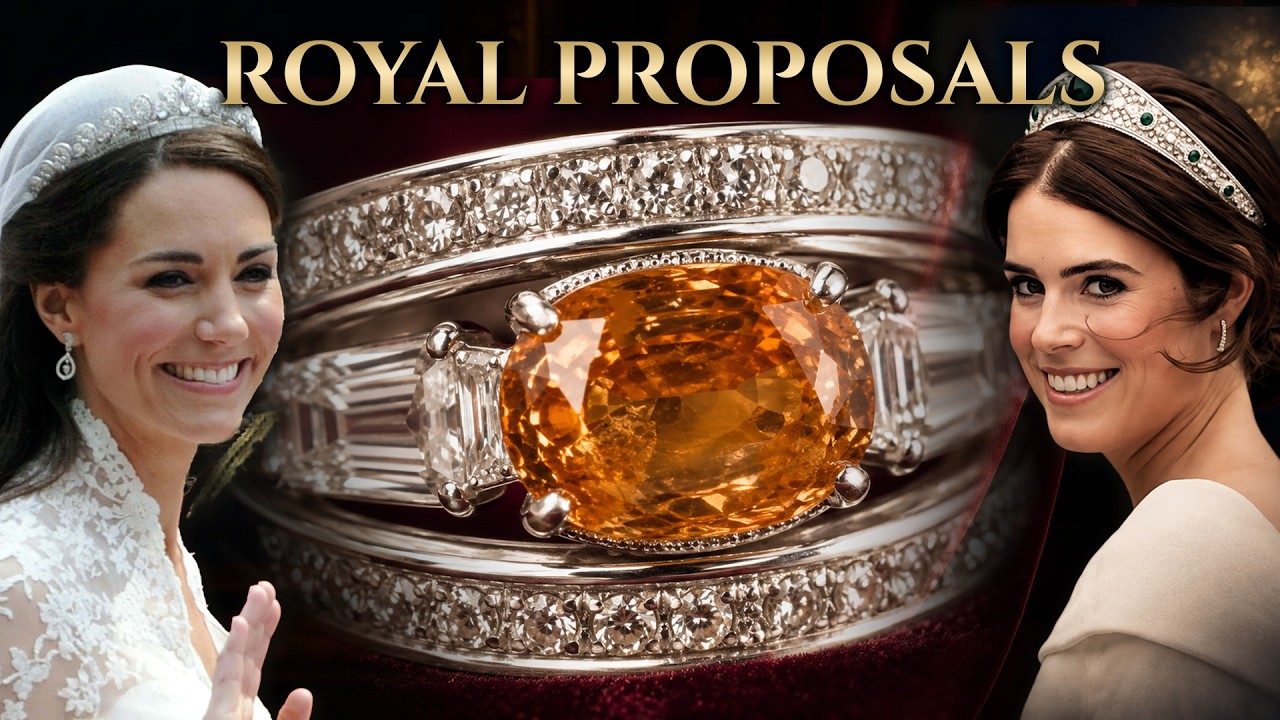
The platinum ring featured two emerald-cut diamonds on the sides with a band pavé-set with brilliant-cut diamonds. But the centerpiece was a stunning oval orange diamond. Just like Mary’s ring in Denmark, this choice brilliantly combined personal elegance with deep national significance. The vibrant orange was the undisputed symbol of the House of Orange-Nassau and the national identity of the Netherlands.
It was a perfect harmony between a rare personal jewel and an absolute national symbol, captured brilliantly in a single breathtaking stone. Some couples navigated the complexities of royal expectations quickly, while others had to prove their commitment over many long years. In 2001, Crown Princess Victoria of Sweden met Daniel Westling. He was not a foreign prince or a wealthy aristocrat.
He was a personal trainer and owner of a gym from the small, quiet town of Ovanåker. Naturally, the public and the press were deeply skeptical. People openly wondered whether an ordinary man from a local gym could really take on the role of the future queen’s husband. Why did they wait nearly eight long years before finally announcing their engagement?
Daniel himself honestly admitted that he simply needed time. He had to completely change his life, step away from his work, and deeply understand royal protocol, the history of the state, and his future supportive role. Rushing it would have been naïve. When the right moment finally arrived, Daniel planned a quiet, perfect proposal.
On a crisp, sunny winter day in early 2009, walking through the tranquil gardens of Drottningholm Palace with the snow crunching beneath their boots, he asked Victoria to marry him. Her reply was an enthusiastic yes. Daniel presented Victoria with a classic ring set with a round brilliant-cut diamond in white gold. It closely resembled the ring her father had given Queen Silvia in 1976, another round diamond ring, said to have been made with a stone that once belonged to Princess Sibylla.
Whether Daniel intended the similarity is unknown, but the two rings created a beautiful visual link between mother and daughter. Everything seemed like a flawless winter fairy tale, but behind that beautiful image hid a serious and frightening ordeal. Just one year before their wedding, Daniel’s health deteriorated due to a congenital condition, and he had to undergo a kidney transplant. His father, Olle, bravely stepped forward as the donor.
Through all the worry, hospital stays, and difficult recovery, Victoria was constantly by his side, proving their bond went far beyond the glitter of royal palaces. Their magnificent wedding in June 2010 silenced whatever critics remained, but the unforgettable moment came later, during the evening banquet. In his speech, Daniel shared a deeply intimate story with the guests. He recalled a time when Victoria had to leave for an official overseas tour lasting exactly 30 days.
Instead of getting adequate sleep before her exhausting journey, the Crown Princess stayed up all night. She sat at her desk and wrote out, by hand, 30 separate letters so Daniel would have a new letter from her to open on every single day they were apart. It was a quiet, invisible gesture that expressed true love and devotion far more than any royal title, historical crown, or carat weight of a diamond ring. Now there was Norway, a story that truly spanned generations, where one ring connected two women who had to overcome great obstacles to find their place.
Harald and Sonja met in the summer of 1959 at a party hosted by mutual friends. She did not belong to the aristocracy. Her father was in the clothing trade, and Sonja herself was studying dressmaking and design. In a modern European monarchy, this would surprise no one today, but in the early 1960s, a royal heir was still very much expected to marry a suitable princess.
They kept their relationship a secret for several years. Sonja later shared that the uncertainty was extremely heavy. She could not appear publicly beside the man she loved, and she had no idea whether they would ever be allowed to marry. Harald, for his part, absolutely refused to consider finding a more suitable bride.
The wait lasted nine years. Eventually, he told his father, King Olav, that he would marry no one but Sonja. If the marriage did not happen, Harald would remain a bachelor. For a small dynasty with only one male heir, this meant a real threat to the direct line of succession.
From the monarchy’s point of view, the move may not have been the most prudent. But in this story, Harald’s steadfast commitment to his principles was what mattered. He did not give up on the woman he loved, even though the resistance lasted nearly a decade. In 1968, permission was finally granted.
Harald presented Sonja with his late mother’s engagement ring, that of Crown Princess Märtha. It had a very unique antique design, made of warm yellow gold, set with diamonds and two vibrant rubies shaped like delicate crescents. Thirty-two years later, that same ring played its role again when history repeated itself with Harald and Sonja’s son. In 1999, Crown Prince Haakon fell for a young woman named Mette-Marit.
She was not of aristocratic origin, had a rebellious past, and was already the mother of a young son named Marius. The couple immediately faced an unprecedented wave of press pressure, but Mette-Marit did not hide. Just three days before the royal wedding, she came out to face the press herself, publicly admitting the mistakes of her youth and asking for the chance to start anew. Haakon sat beside her the entire time, holding her hand.
And the same ring with the ruby crescents sparkled on Mette-Marit’s finger. Haakon had given her the family heirloom that his father had once given his mother. Today, amid the serious controversy surrounding Mette-Marit and her eldest son, this story is inevitably viewed differently than it was in 2000. But at the time, King Harald and Queen Sonja supported their son’s decision, welcoming not only the woman he loved but also the child who was part of her life.
No one can know for certain how much their own experience influenced them. Still, it is hard not to see a connection. After waiting nine years for the right to marry each other, they were perhaps especially reluctant to deny their son that very same freedom of choice. Sometimes the most striking statements are not made with historic diamonds but with something entirely unexpected.
In July 2026, a modern royal engagement offered a completely different perspective on what a proposal could look like. Sam Chatto, the grandson of Princess Margaret and nephew of Queen Elizabeth II, announced his engagement to Eleanor Eksarho. They first met while studying at the University of Edinburgh, and their relationship blossomed naturally in a very creative environment. Both are professional artists.
Eleanor expresses herself through painting and film, while Sam is a dedicated potter working primarily with porcelain. When one thinks of an extended member of the British royal family proposing, a person whose family history is linked to the most famous royal jewel collections and prestigious auctions in the world, what kind of ring comes to mind? A classic sapphire? A large brilliant-cut diamond?
Sam chose something else entirely. In the black-and-white photograph they shared to announce their happy news, there were no dazzling stones or heavy metal settings. Instead, there was a purely sculptural form: two elegantly intertwined branches. Sam had carved this ring from porcelain with his own hands, shaping it specifically for Eleanor.
After so much time admiring huge sapphires, historic rubies, and vibrant orange diamonds, seeing this fragile, intimate object was a beautiful and refreshing contrast. Porcelain is a brittle material after all, hard but inherently vulnerable. Realistically, it is not a ring one could safely wear during everyday tasks, and Sam would likely present Eleanor with a more durable ring for daily wear later. But using a delicate ring shaped precisely by hand for the proposal moment itself was an incredibly romantic gesture.
It requires careful, gentle handling, which seemed a natural and vivid metaphor for love itself. Behind every gemstone, behind every band of gold or platinum or porcelain, were real people making their way through life. Someone waited nine long years for the right to marry. Someone crossed an ocean to begin a new chapter.
Someone anxiously hid a legendary heirloom in a travel bag. And someone shaped his tenderness directly into clay. In the end, the true value of an engagement ring is not measured by carat weight, nor determined by the records of luxury jewelry catalogs. Its true value is simply what one person wanted to say to another in that quiet, vulnerable moment of asking to share the rest of their lives together.
And sometimes that beautiful language of love speaks far louder than any words.
