The fire that destroyed the original Breakers was not, in the end, a catastrophe. It was an opportunity. And Cornelius Vanderbilt II, with the systematic intelligence he applied to everything else, treated it as one. He summoned Richard Morris Hunt, the same architect who had built Marble House for his sister-in-law Alva, the same Hunt who had spent thirty years absorbing the architectural ambitions of the French and Italian Renaissance, and gave him instructions that were, in their way, the mirror image of Alva’s.
Where Alva had wanted provocation, Cornelius wanted permanence. He did not want the largest house in Newport, though the house he commissioned would be that. He did not want the most ornamented house, though it would be that too. He wanted a house that would stand in a hundred years as evidence that the Vanderbilt family had been here, that they had built something worthy of the fortune they had inherited and the civilization they believed themselves to be sustaining.
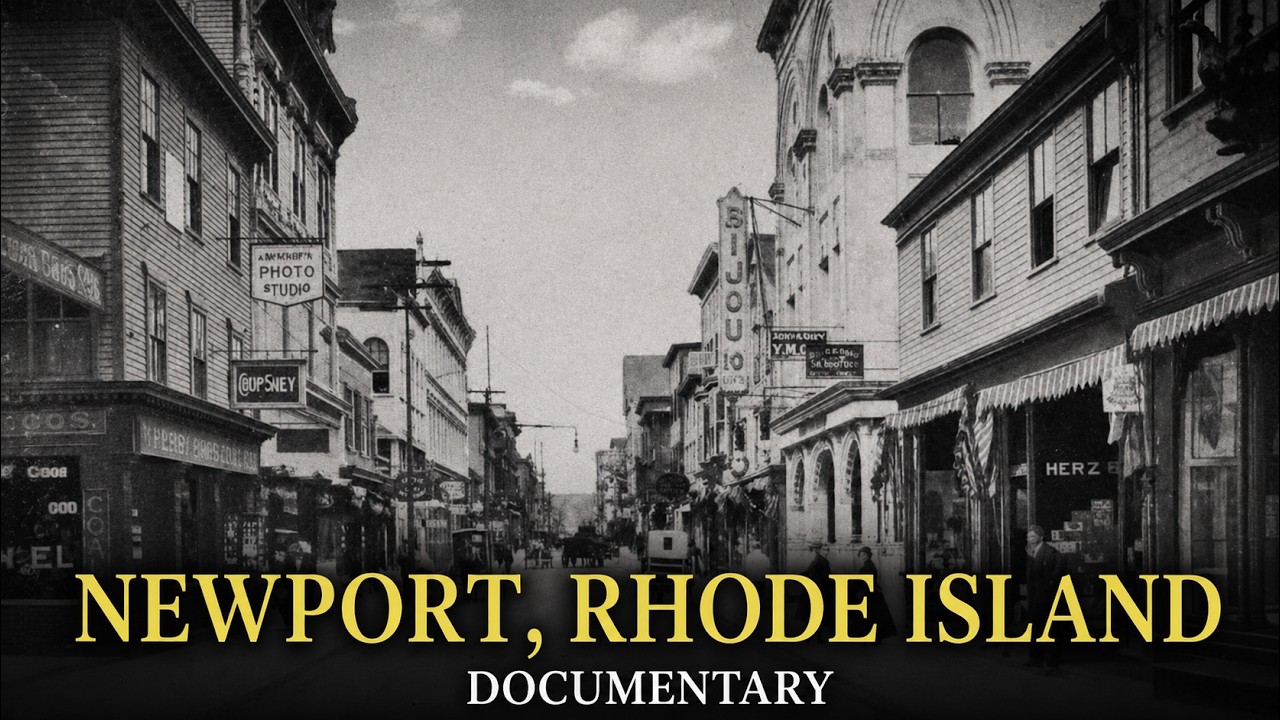
By the summer of 1899, Newport, Rhode Island contained more private wealth per square mile than any place on Earth. Not by reputation, not by estimate, but by the raw mathematics of assessed value, of marble shipped from quarries in Vermont and Siena, of silver services locked in pantries no visitor ever saw. A single street, four miles long, held houses that cost more to run for a single month than a factory foreman earned in twenty years. Today those houses are museums.
The families that built them are gone. And the world that made them necessary lasted from the first stone laid to the last butler dismissed, less than a single human lifetime. That world was not built in a generation. Newport’s rise was slower, stranger, and far older than the mansions that now define it.
The town sits at the southern tip of Aquidneck Island, where Narragansett Bay opens into the Atlantic. By any navigational measure, it is one of the most fortunate harbor positions on the eastern seaboard. The water is deep enough for ocean-going vessels. The bay provides shelter from the open sea.
And the prevailing southwest winds off the water keep the summer air cool when the rest of the American northeast swelters. No one planned this. It was simply geography, the kind of geography that in the seventeenth century was indistinguishable from destiny. The town was founded in 1639 by a small group of religious dissenters who had fled the doctrinal rigidity of the Massachusetts Bay Colony.
Their leader was William Coddington, a merchant and former magistrate from Boston who had grown impatient with the colony’s intolerance. Coddington arrived on Aquidneck Island with eighteen families and a founding principle that was, by the standards of the time, extraordinary: that the settlement would tolerate all religious beliefs. Newport was, before it was anything else, an experiment in openness. That principle drew people, and the harbor kept them.
By the early 1700s, Newport had become one of the five most prosperous trading ports in colonial North America, standing alongside Boston, New York, Philadelphia, and Charlestown in the hierarchy of Atlantic commerce. Newport merchants traded in horses and cheese, in timber and whale oil, in the fine spermaceti candles that the town’s chandleries produced and sold across the Atlantic world. A visitor arriving by sea in 1720 would have counted dozens of vessels in the harbor, seen the steeples of Trinity Church and the Seventh Day Baptist Meeting House rising above the rooflines, and heard a waterfront alive with commerce. But that prosperity rested on a foundation the merchants preferred not to discuss in polite company.
By 1730, Newport had become the most important slave trading port of departure in North America. Not Charleston, not New York. Newport. The mechanism was the triangular trade, and Newport’s role in it was specific and lucrative.
Local distilleries produced rum from Caribbean molasses. That rum was shipped to West Africa and exchanged for enslaved people. Those people were transported to the sugar plantations of the Caribbean, and the resulting molasses was shipped back to Newport to make more rum. The circuit was self-reinforcing and, for the men who ran it, enormously profitable.
By 1769, Newport operated twenty-two distilleries and was, by volume, the rum capital of the world. The names of the merchant families who built their fortunes in this trade are still legible on Newport today. Malbone, Bannister, Wanton, Brenton, Redwood. These names appear on the town’s historic homes, its streets, its institutions.
The Redwood Library, founded in 1747 and still operating as the oldest lending library in continuous use in the United States, was endowed by Abraham Redwood, a merchant whose wealth derived substantially from the slave trade and from the Caribbean plantation system it served. The library is a handsome building. The books inside it are real. Neither fact changes the other.
Picture Newport on a summer morning in 1760. The harbor is dense with ships, brigs and sloops and schooners, their masts a forest against the water. The waterfront smells of salt and tar and the sweet, sharp odor of fermenting molasses drifting from the distillery yards. On Thames Street, the counting houses of the merchant families stand shoulder to shoulder, their ledgers recording transactions that span three continents.
Above the waterfront, on the rising ground of Bellevue and Spring Street, the merchants have built themselves fine houses, Georgian mansions of brick and clapboard, some with gardens overlooking the bay. The town has nine thousand people, making it larger than Baltimore, larger than Albany, a genuine city by the measure of its time. And then, in 1776, the British arrived. The occupation lasted three years.
British and Hessian forces commandeered homes, burned wharves for fuel, tore apart fences and outbuildings for timber through the winter. The fortifications they constructed along the harbor’s edge disrupted trade that had taken a century to build. Loyalist merchants fled. Patriot merchants followed when the British made commerce impossible.
Ships stopped coming. The distilleries went quiet. When French and American forces finally reclaimed the town in 1779, they found a waterfront in ruins and a population that had collapsed from nine thousand to fewer than four thousand people, with more than two hundred buildings standing empty or destroyed. Newport did not recover quickly.
The merchant families who had made it prosperous were gone, their fortunes dispersed or spent. The harbor, stripped of the trade networks that had sustained it, found no replacement economy. For the better part of the next half century, Newport was a quiet, graceful, and slowly decaying backwater, a town whose architecture remembered a prosperity that showed no signs of returning. The next chapter of Newport’s story begins not with industry or trade, but with something far simpler: heat, and the desire of very wealthy people to escape it.
The revival came from the American South, specifically from the low country plantations of Georgia and South Carolina, whose owners had spent decades looking for somewhere to go in July and August that would not kill them. Southern summers brought heat, humidity, and disease. Yellow fever moved through the coastal cities of Savannah and Charleston with seasonal regularity. Malaria was endemic in the rice plantation districts, where standing water in the fields bred the mosquitoes that carried it.
Wealthy planters had always understood that leaving, moving the family north for the summer months, was not merely a comfort but a medical calculation. The question was where to go. By the 1830s, an answer was circulating in the parlors of Savannah and Charleston: Newport, Rhode Island. Cool ocean air.
Clean water. A harbor town with fine old houses. And crucially, no yellow fever. George Jones, a planter from Savannah, arrived in Newport in 1839 and purchased land on the high ground south of the old colonial town.
He was not the first Southerner to summer there, but he was among the first to do something permanent with the impulse. Jones built a cottage, the word already beginning its long career of deliberate understatement, on what would become Bellevue Avenue, the address that within fifty years would be the most expensive stretch of real estate in the United States. His house was modest by the standards of what followed. It had a garden, a view of the ocean, and a veranda wide enough for the long, slow evenings that were the point of the exercise.
Other Southern families followed. The Pringles and the Allstons, the Haywards and the Izards. Names from the Carolina low country that appeared in Newport’s hotel registers and then in its deed books as the decade turned. They brought their household servants with them, along with the social rituals of plantation life: the long dinner, the formal call, the careful hierarchy of who visited whom and in what order.
By the late 1840s, the summer colony had critical mass, and the critical mass had a geography. Bellevue Avenue ran south from the old town toward the ocean cliffs, lined with the new cottages of families whose wealth came from cotton and rice and the labor of enslaved people. The northern money arrived a few years behind the southern. Wealthy New York and Boston families, merchants, bankers, lawyers of the established Protestant upper class, discovered Newport through the same mechanism that has always spread fashionable destinations: the endorsement of people whose taste was considered worth following.
Henry James’s family summered there in the 1850s and 1860s, and James would later call Newport the one place in America that had managed to produce something like a genuine leisure class. Longfellow came. The historian George Bancroft came and built a garden that became one of the most celebrated in New England. The railroad reached the island in the 1860s, a branch line from Providence that reduced the journey from New York to a matter of hours.
And the summer colony doubled. Then doubled again. The atmosphere of these early decades was, by the standards of what followed, restrained, even pastoral. The cottages of the 1840s and 1850s were genuinely modest: wood-frame houses with porches and gardens designed by architects like Richard Upjohn and Alexander Jackson Davis in the Italianate and Gothic Revival styles fashionable for country retreats.
The social rituals were elaborate but not yet theatrical. Morning carriage rides along Bellevue Avenue. Afternoon bathing at Second Beach. Small dinner parties of twelve or sixteen where the talk was of books and politics and the relative merits of various European watering places.
The Newport Casino, founded in 1880, provided a venue for tennis, then a new game imported from England, and for the informal afternoon gatherings that were the social currency of the season. Enter Caroline Schermerhorn Astor. Mrs. Astor had a cottage in Newport called Beechwood, sitting on Bellevue Avenue with the quiet confidence of old money.
A large but not excessive house, its gardens maintained with the kind of effortful understatement that only significant wealth can sustain. Mrs. Astor had been summering in Newport since the 1870s, and she brought to the exercise the same organizational intelligence she applied to New York society: the careful management of who was admitted, who was excluded, and on what terms the boundary between the two was maintained. Her instrument was a man named Ward McAllister, a Georgia-born social impresario who had spent years cultivating the right connections in both New York and Newport and had arrived at a theory of American society that was, in its way, a work of considerable ingenuity.
McAllister believed that the great threat to American upper-class life was not poverty but contamination, the infiltration of new money into the social spaces that old money had built. His solution was taxonomy. He divided the summer colony into the “nobs,” meaning families of established social position, and the “swells,” meaning people who were rich but whose money was too recent and too visible to qualify. The distinction was not always obvious to outsiders.
It was never unclear to McAllister. Together, Mrs. Astor and McAllister constructed the mechanism that would govern Newport society for the next twenty years. At its center was her ballroom on Fifth Avenue in New York, which held, by McAllister’s calculation, approximately four hundred people.
This number became, in 1892, the basis of a list, the Four Hundred, the people who mattered in American society, that McAllister provided to The New York Times with the kind of studied casualness that guaranteed it would be printed in full. The list was a declaration of war dressed as a social register. Its criteria were specific: three generations of wealth, no commerce in the trades, the right churches, the right schools, the right addresses in both the city and Newport. What the list could not account for, what no list ever can, was money of a sufficient size to make the criteria irrelevant.
And by 1880, that money existed. It had been made in railroads and steel and the vast industrial machinery of post-Civil War America. And it was held by families whose names were not on Ward McAllister’s list and who had decided, with the particular determination of people accustomed to getting what they wanted, that this was a situation requiring correction. The most consequential of these families for Newport, for American society, for the history of what a house could be made to mean, was a family from Staten Island whose patriarch had started his working life at eleven years old ferrying passengers across New York Harbor in a small boat and who had died in 1877 leaving an estate of roughly $100 million.
The Vanderbilts were coming to Newport. And Newport, whatever Ward McAllister might prefer, was not going to be the same. Cornelius Vanderbilt was born in 1794 on Staten Island, the son of a farmer who supplemented his income ferrying goods across New York Harbor. At eleven, Vanderbilt borrowed $100 from his mother, bought a small sailing vessel, and began carrying passengers between Staten Island and Manhattan.
He charged eighteen cents a crossing. He had almost no formal education, a temper contemporaries described as volcanic, and a competitive instinct he made no effort to conceal. What he had in quantities that bordered on the inhuman was an understanding of how transportation networks generate wealth and a willingness to work those networks until they broke, or until he owned them. By 1846, Vanderbilt had built a shipping empire spanning the Atlantic and Pacific coasts, with a fleet of steamships bearing his name and his methods: lower prices, faster service, systematic elimination of any competitor who could not match both.
He was called the Commodore, a title he had not earned in any official capacity but that stuck because no other word seemed adequate. He consolidated the New York and Harlem, the Hudson River, and the New York Central lines into a single system connecting New York City to Chicago, controlling the most important freight corridor in the industrializing nation. He died in January 1877, leaving approximately $100 million, more than the entire annual budget of the United States federal government. He left nearly all of it to his son, William Henry, who doubled it in eight years.
William Henry’s children inherited a fortune so large that its existence created a problem. Not a financial problem. A social one. The Vanderbilt money was new by the standards Ward McAllister had carefully codified.
And it was industrial, precisely the kind of money Caroline Astor’s taxonomy had been designed to exclude. His grandchildren wanted what the Astor name represented. Not just wealth, but legitimacy. Not just houses, but the right houses, on the right street, acknowledged by the right people.
The person who decided to do something about this was not a Vanderbilt by birth. Alva Erskine Smith was born in Mobile, Alabama, in 1853, the daughter of a cotton merchant whose fortune had been diminished by the Civil War. She had grown up with the memory of wealth rather than wealth itself, which gave her an unusually clear understanding of exactly what money was for. In 1875, she married William Kissam Vanderbilt and found herself in possession of one of the largest fortunes in the United States, and no social position whatsoever.
This was not a situation Alva intended to maintain. She hired Richard Morris Hunt, the first American architect trained at the École des Beaux-Arts in Paris, to design a house on Fifth Avenue. Completed in 1882 at a cost of $3 million, the petit château announced in the clearest possible architectural language that the Vanderbilts had arrived. Mrs.
Astor noticed. She did not call. On March 26, 1883, Alva hosted a costume ball that drew 1,200 guests and consumed a reported $250,000. Ladies had commissioned costumes from Worth in Paris.
Guests performed choreographed dances rehearsed for weeks. Alva had pointedly not invited Caroline Astor’s daughter, Carrie, who had been rehearsing one of those dances. To secure her daughter’s invitation, Mrs. Astor was required to call on Alva, to leave her card, to acknowledge in the only language that mattered that the Vanderbilts existed.
The boundary McAllister had spent a decade constructing was, from that evening, permanently breached. Newport was next. In 1888, Alva summoned Hunt and gave him her instructions: a house on Bellevue Avenue, built of the finest materials without significant regard for cost, designed, in words she reportedly used, to make the Astor cottage look like a farmhouse. Hunt knew exactly which building could accomplish this: the Petit Trianon at Versailles, a pavilion of white marble, symmetrical and severe, its perfect proportions functioning as a kind of provocation.
He would make it larger. He would make it American. Five hundred thousand cubic feet of marble arrived from Vermont, from Siena, from Algeria. Thirty-three Italian craftsmen were imported for the decorative stonework.
The gold room was sheathed in gilded bronze and fitted with mirrors that multiplied its dimensions into something closer to a hall of state than a domestic entertainment space. The dining room, paneled in dark oak and hung with tapestries, seated thirty-six. Marble House was completed in 1892 at a reported cost of $11 million, approximately $330 million today. William Kissam gave it to Alva as a birthday present.
It was used for six weeks a year. Keep that number in mind. It will come back again and again, in house after house, until the arithmetic begins to feel less like extravagance and more like a collective madness that an entire class of people agreed, for approximately thirty years, to call civilization. Alva Vanderbilt had made her point.
The question in the summer of 1892 was who would answer it. The answer came from her brother-in-law. Cornelius Vanderbilt II was, by temperament and inclination, everything Alva was not. Where she was combative and theatrical, he was reserved and methodical.
Where she spent money as a form of argument, he spent it as a form of duty, the duty of a man who had inherited the largest private fortune in America and understood, with the sober Calvinist conscience that had somehow survived intact through three generations of stupendous wealth, that the stewardship of that fortune was a serious obligation. He ran the New York Central Railroad with the attention to detail of a man who genuinely cared how the trains ran. He gave substantial sums to Columbia University, to St. Luke’s Hospital, to the Young Men’s Christian Association.
He taught Sunday school. And he owned, on Bellevue Avenue in Newport, a large wooden house called The Breakers, purchased from the tobacco heir Pierre Lorillard in 1885, that had just, in November of that year, burned to the ground. Hunt designed a seventy-room Italian Renaissance palazzo of brick, limestone, Caen stone, and steel. The steel was structural, a fireproof skeleton that ran through the entire building, making it in 1893 among the most technologically advanced private residences in the world.
The exterior was modeled on the sixteenth-century palaces of Genoa and Turin: rusticated stonework on the lower floors, arched windows on the piano nobile, a roofline of carved limestone balustrades. The proportions were those of a building designed to be approached from a distance, across a forecourt, with the sense that you were arriving somewhere that had been here for centuries and intended to remain for centuries more. The Great Hall rose forty-five feet from a mosaic floor of cipollino marble to a painted ceiling. Its walls were faced with Caen stone.
Its columns were of red Numidian marble quarried in Algeria. Its dimensions, fifty-eight feet long and thirty-five feet wide, were those of a room designed not for conversation but for the apprehension of scale. You did not enter the Great Hall of The Breakers and feel at home. You entered it and felt the specific calibrated sensation of being made small by something that had been built at considerable expense precisely to make you feel that way.
The dining room seated thirty-four at a table of carved mahogany beneath a ceiling of gilded plaster work, between walls of dark red Numidian marble. Its two massive overmantels were of alabaster and marble, their carved figures designed by the sculptor Carl Bitter. The chandeliers were of rock crystal. The silver service produced by Tiffany and Company weighed several hundred pounds.
The room was used at most for six weeks of formal dinners each summer. For the remaining forty-six weeks of the year, it sat in darkness, the silver locked in the pantry vault, the chandeliers draped in cloth. The morning room was sheathed in panels of carved and gilded limewood imported from France, with ceiling paintings by Paul César Helleu. The billiard room had walls of green African marble and a ceiling of tooled leather.
The library was paneled in walnut and fitted with a fireplace of carved breccia marble. Every room had a fireplace. Every fireplace had a different marble. The house contained, by one count, marble from seven countries on four continents.
The kitchens occupied an entire wing of the basement, equipped with the most advanced culinary technology of the 1890s: ranges fired by both coal and gas, a rotisserie powered by a clockwork mechanism, a pastry kitchen separate from the main kitchen, cold storage rooms maintained by an early refrigeration system. The kitchen staff alone numbered twelve. The total household staff for The Breakers when the family was in residence was sixty-five people. Sixty-five people to run a house for six weeks a year.
Construction was completed in 1895. The reported cost was $7 million, roughly $263 million today. Hunt did not live to see it finished. He died in July 1895, two months before the house was formally occupied for the first time.
Cornelius Vanderbilt II attended the funeral and was said to have wept. He had lost, he told a friend, the only architect who had ever truly understood what he was trying to build. What Cornelius was trying to build was, in the most literal sense, the apex. After The Breakers, there was nowhere architecturally to go.
You could build differently, and the families who came after would. But you could not build more completely, more permanently, more deliberately. The Breakers was the argument that the Vanderbilt fortune deserved to be taken seriously, made in the only language that argument could be made: stone, marble, and the labor of sixty craftsmen working for two years on a house that its owner would use for six weeks and then leave to the servants and the silence of the Rhode Island winter. The other families on Bellevue Avenue understood the message.
They had no intention of being left behind. Picture Bellevue Avenue on a July afternoon in 1896. The avenue is a mile and a half of crushed gravel, wide enough for two carriages to pass in comfort, lined on both sides with properties whose gates open onto drives that curve through lawns maintained by armies of groundkeepers. The Breakers sits behind its iron fence at the eastern edge of the avenue, its limestone facade catching the afternoon light from the ocean.
Marble House is two blocks south, its white Vermont marble almost painful in the direct sun, its bronze entry gates, imported from Paris, fitted with the ornamental W of the Vanderbilt monogram, closed against the road. Ochre Court, completed in 1892 for Ogden Goelet to Hunt’s designs, presents its Gothic Revival towers to the avenue with the aggressive confidence of a family that has recently discovered it can afford Gothic towers. Belcourt Castle, which Oliver Hazard Perry Belmont has just finished building to Hunt’s plans on the southern end of the avenue, is still being landscaped, its sixty rooms not yet fully furnished. Walk north along the avenue that afternoon and you would have passed, in the space of a mile, more accumulated private wealth than existed in most American states.
A dozen houses. A dozen fortunes. And the season was just beginning. Something else was happening on Bellevue Avenue that July, though it would not be visible in any architectural survey or social register.
Two of the women who had built, commissioned, or inherited the houses along that mile of gravel were in the process of dismantling, each in her own way, the social architecture that had made the avenue possible. One of them was about to host the most expensive party Newport had ever seen. The other was about to do something that Newport society considered, at the time, considerably more shocking than any party. Teresa Fair, known as Tessie, arrived in Newport in the early 1890s as the wife of Herman Oelrichs, a shipping magnate, and the daughter of James Graham Fair, an Irish immigrant who had discovered Nevada’s Comstock silver lode and extracted from it a fortune of over $300 million.
She was beautiful, sociable, and determined to be the greatest hostess Newport had ever produced. Not one of the greatest. The greatest. She commissioned Stanford White, partner in McKim, Mead, and White, designer of Madison Square Garden and the Washington Square Arch, to build her a house on Bellevue Avenue.
Her model was the Grand Trianon at Versailles: low, horizontal, opened to the landscape by arched loggias that dissolved the boundary between interior and exterior. White stretched its facade to 150 feet, centered it on the largest private ballroom in Newport, and at the entrance designed a staircase in the shape of a heart, two curved arms rising from a single landing to meet at the top. You descended it to be seen. Everyone understood this.
Rosecliff was completed in 1902 at a cost of two and a half million dollars. The Newport season ran eight weeks, from late June to late August. It was not a schedule but a liturgy, a sequence of prescribed rituals, each with its correct time and its correct costume, from which deviation was possible only at the cost of the kind of talk that could follow a family for a generation. Women changed clothes four to six times a day.
Morning dress, carriage dress, tea dress, dinner dress, ball gown. Each a different statement in a performance that required both rehearsal and wardrobe. The day began late, around ten, with the carriages out by eleven for the morning drive along Bellevue Avenue, a slow procession calibrated for observation rather than transportation. Tea at four was theater.
Dinner at seven or eight ran to ten courses, served by footmen in livery with a different wine for each course and a seating chart deployed by the hostess with the precision of a diplomat drafting a treaty. Entertaining at Newport’s level cost an estimated $200,000 per month. A respectable hostess gave six formal dinners of sixty guests and two balls of six hundred every season, minimum. The parties that exceeded these expectations entered legend.
Alva Vanderbilt’s 1895 costume ball drew a thousand guests to Marble House under electric lights, still a novelty. Tessie Oelrichs’ Bal Blanc of 1904 filled Rosecliff with seven hundred guests in white, the ballroom lit against the August night while the orchestra played until three in the morning. Harry Lehr and Mamie Fish hosted a dinner that same year at which the guest of honor was a dog, seated at the table, wearing a $15,000 diamond collar, served a specially prepared stew. The evening cost $50,000.
The invisible army that made all of this possible rose at four in the morning. The Breakers required sixty-five servants. Marble House ran on fifty. Rosecliff on forty-five.
The ratio of servants to family members ran routinely to ten or fifteen to one. They lived in attic rooms absorbing the summer heat while the family occupied the principal rooms below, cooled by the ocean breezes the architects had designed the houses to capture. Their working day ran from before dawn until well past midnight on ball nights. The architecture had been designed to make them invisible: service staircases running parallel to the main staircases through a shadow building that shared the same cubic footage but none of the vocabulary.
Being noticed by the family was a form of failure. The job was to maintain the conditions in which effortlessness seemed possible. And effortlessness, by definition, leaves no visible labor behind it. The season lasted eight weeks.
Then the families left. The Holland covers went on the furniture, the silver went in the vault, and the servants rattled around in seventy rooms designed for hundreds, maintaining a readiness for the following July that no one, in some of these houses, would ever require again. In October 1913, the United States began collecting a permanent income tax. The initial rates were modest: 1 percent on incomes above $3,000, rising to 7 percent above $500,000.
The principle they established was not modest. For the first time in peacetime, the federal government had asserted a permanent structural claim on private income. The mathematics of great wealth had changed. Not catastrophically.
Not yet. Caroline Astor had died in 1908. Ward McAllister had preceded her by fourteen years. The Four Hundred had become, by 1913, a gentle joke, something that had once been powerful and was now simply old.
The automobile had arrived on Bellevue Avenue by 1900, and its effects were more than mechanical. The carriage parade, that slow ritualized procession that had been the morning performance of social position for thirty years, could not survive cars. The avenue that had been a stage became a road. Then, in the summer of 1914, Europe went to war.
The European guests who had been expected did not come. The German guests, and there had always been German guests, given the transatlantic commercial connections of families like the Oelrichses, whose fortune derived from North German Lloyd, became overnight socially impossible. Lavish display acquired a new kind of critic, colder and harder to dismiss than the progressive newspapers that had denounced Newport for thirty years. The men dying in the trenches of northern France were dying to protect a civilization that Newport represented.
The juxtaposition was not lost on anyone. America’s entry into the war in April 1917 produced something more consequential than changed mood. Factory wages rose. The industrial plants of New England and the Mid-Atlantic, running double shifts to supply the expeditionary forces, offered domestic workers alternatives that had not existed before: wages matching household service, work that did not require invisibility or deference or the service staircase.
Some took them. The houses contracted. Sixty-five servants became fifty, then forty. The reduction invisible in the rooms that mattered, but felt in the back stairs and the kitchen quarters, where the work that once had been divided among many now fell to fewer.
Alva Vanderbilt had already read the room. She had divorced William Kissam in 1895, something simply not done, married Oliver Belmont, and when Belmont died in 1908, redirected the force she had applied for thirty years toward women’s suffrage. She held suffrage conferences at Marble House. She had china printed with “Votes for Women” and served it at Newport dinners where, a decade earlier, conversation had been confined carefully to the surface of things.
She co-founded the National Women’s Party and poured her fortune into the movement with the same systematic intensity she had once poured into costume balls. The cage she had built on Bellevue Avenue, she simply walked out of. The cage remained. Most of the other women stayed inside.
By 1920, the contours of what was coming were visible to anyone willing to look. The income tax was no longer modest. Wartime rates had pushed the top marginal rate to 77 percent on incomes above $1 million. The servant economy was contracting and would not recover.
The social authority that had made Newport the only possible destination for a certain class of American wealth had been diluted by the automobile, by Palm Beach, by the French Riviera, by the deaths of the people, Mrs. Astor, McAllister, Hunt, Belmont, who had built and enforced its rules. The houses were still there. The marble had not moved.
But the world that had required them was already, in the most important ways, gone. The crash came on a Thursday, October 24, 1929. The Dow Jones Industrial Average had peaked at 381 points in September. By its bottom in July 1932, it had lost 89 percent.
The fortunes concentrated in Newport had been built on railroads, coal, and the banking houses that financed the industrial expansion of the previous half century. These were precisely the sectors the Depression hit first and hardest. The New York Central’s revenues collapsed as freight volumes fell. The coal industry that had built The Elms entered structural decline.
The banking instruments in which surplus wealth had been parked called their loans and marked assets to a market moving in one direction only. Consider the mathematics of keeping The Breakers open. Property taxes on an estate of that size ran to tens of thousands annually. Utilities added thousands more.
The maintenance of the structure, repointing limestone, regilding plasterwork, replacing aging plumbing, did not reduce in proportion to reduced circumstances. Marble does not become cheaper to maintain when the stock market falls. And the remaining servants still required wages, room, and board regardless of what the Dow had done the previous week. Alice Gwynne Vanderbilt had owned The Breakers since her husband’s death in 1899.
By 1929, she was eighty-one, having outlived Cornelius II, four of her seven children, and most of the social world that had given the house its meaning. She died in 1934 and left The Breakers to her daughter Gladys, the Countess Széchenyi, the only child with genuine attachment to the house. Gladys kept it. This decision, which looked at the time like sentiment or stubbornness, would prove the most consequential act of architectural preservation in Newport’s history.
Other houses did not survive. Between 1929 and 1945, more than forty Newport estates were demolished, sold for taxes, abandoned to vandalism, or left to decay until demolition became cheaper than repair. Ochre Court was sold to the Sisters of Mercy and became a Catholic college, a fortunate outcome, the building preserved if repurposed. The Reef was vandalized, set on fire, and demolished.
Its site became a lawn. Some of the grandest properties were taken down simply because the land was worth more without the building than with it. Tessie Oelrichs had not lived to see the worst of it, dying in 1926 before the crash, but the decline had already found her. The fortune was diminished, the social world gone.
Multiple accounts from her final years describe the same thing: Tessie hosting dinners at Rosecliff for guests who were not there. The invitations sent, the table set by a kitchen staff working from habit or loyalty, the flowers arranged, the crystal out, the chairs empty. By 1940, Bellevue Avenue on an October afternoon looked like a street from which something large had recently departed. The houses were still there, the marble and limestone, the iron fences, the gardens grown slightly wild.
But the animation that had given them their meaning was gone. The occasional caretaker. The occasional descendant come to assess the roof. The wind off Narragansett Bay moving through rooms built for a population they would never again contain.
The furniture was under white sheets. In 1945, Katherine and George Warren founded the Preservation Society of Newport County. Their timing was not accidental. The demolitions of the previous fifteen years had made visible what another decade might complete: that the houses of Bellevue Avenue, left to the logic of their own economics, would follow the wrecking ball.
The land was worth more without the building. The math was straightforward and, left to itself, devastating. Public tours of The Breakers began in 1948. Among the guides for those first tours was the Countess Széchenyi, the former Gladys Vanderbilt, who had grown up in the house, who had walked its great hall as a child when the chandeliers were lit and sixty-five servants maintained the conditions under which effortlessness seemed possible.
She walked the same hall now with paying visitors. The cipollino marble floor was the same. The forty-five-foot ceiling was the same. The people moving through the room were different.
The society saved The Elms from demolition in 1962, when the Berwind heirs had accepted a developer’s bid to subdivide the property. A public campaign raised the funds to purchase it instead. Marble House followed in 1963, Rosecliff in 1971, The Breakers itself in 1972. The society now stewards eleven historic properties, seven of them National Historic Landmarks.
The mansions are today the centerpiece of Rhode Island’s tourism economy, drawing more than a million visitors a year. HBO’s The Gilded Age filmed extensively at The Elms, Marble House, and Château-sur-Mer. The heart staircase at Rosecliff has been descended by actors playing characters whose world was already gone when the camera first recorded it. The families are gone.
Alva outlived most of her enemies and died in 1933, having spent her final decades on suffrage rather than society. Tessie left no children. The Vanderbilt name survives in philanthropies and university buildings. The Astor line dispersed across two continents.
What remains is the marble. Bellevue Avenue on a morning in October, when the tourists have thinned and the ocean light comes low and flat off the water, looks very nearly as it was designed to look. The limestone facade of The Breakers catches the light the way Hunt intended. The white marble of Marble House is still almost painful in direct sun.
The iron fences and the carriage gates and the long lawns running to the cliff walk, all of it still there, still in the proportions its architects calculated, still performing the argument it was built to make. The argument was about permanence. The families lasted one generation in these houses. The fortunes lasted somewhat longer.
The civilization they believed themselves to be sustaining did not survive the First World War intact and was unrecognizable by the second. The marble lasted. It was always going to last. That was the point.
In certain light at a certain hour, the houses of Bellevue Avenue look almost exactly like what they were designed to be: evidence that something remarkable happened here, that for a brief and extravagant moment a small number of families built themselves a world of marble and silver and sixty-five servants, used it for six weeks a year, and left it behind with the furniture under white sheets as if they intended to return. They did not return. The houses are still there.
