On the morning of August 9th, 1969, the housekeeper at 10050 Cielo Drive arrived for work and called the police. Inside the house, Sharon Tate lay dead. She had been stabbed sixteen times. She was twenty-six years old, eight and a half months pregnant, and two weeks from her due date.
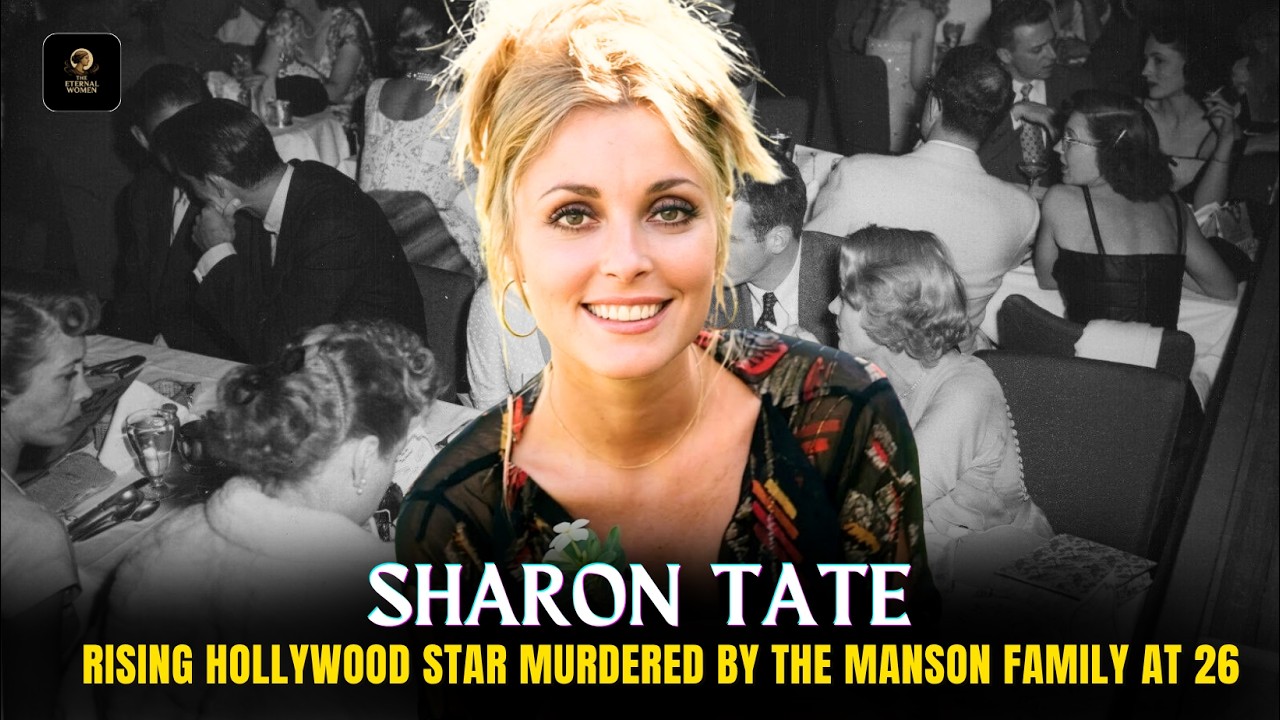
Her unborn son died with her. She had never met the man who sent the killers. She almost certainly did not know his name. She had nothing to do with the grudge that brought them to her door.
The house had previously been rented by a music producer who had rejected Charles Manson’s demo tape. Sharon Tate was simply the woman who happened to be living there. She was a rising American actress, nominated for a Golden Globe, star of one of the highest-grossing films of 1967. She was building carefully and seriously, the kind of Hollywood career that takes a decade to construct and a lifetime to fulfill.
The question of why this happened to her, and why the world has spent fifty years talking about the man who ordered it instead of the woman who deserves so much more, is the question at the center of her story. Sharon Marie Tate was born on January 24th, 1943, in Dallas, Texas. Her father, Colonel Paul James Tate, was a career officer in the United States Army Intelligence Corps. Her mother, Doris Willett Tate, was a woman of considerable strength and warmth, who would in the decades after Sharon’s death become one of the most powerful victims’ rights advocates in California history.
Sharon was the eldest of three daughters, followed by Patty and then Debra, a close-knit sisterhood that would sustain all three of them through what was to come. Her father’s military career meant that Sharon’s childhood was defined by movement: Dallas, San Francisco, Verona, Italy, Fort MacArthur in California, Tacoma, Washington. Each posting brought a new base, a new school, a new community to enter and learn and then leave. For many children, that rootlessness is difficult.
For Sharon, it produced something different. She developed an unusual ease with new people and new situations. She could walk into a room of strangers and make friends almost immediately. She was warm in the specific way that people who have had to rely on personal charm for connection become, and she was genuinely interested in the people she met.
Good at listening, good at making people feel seen. This warmth was not a performance. People who knew her in her early Hollywood years, before she had any real career to protect, described her in the same terms as people who knew her at the height of her fame. The warmth didn’t arrive with success, and it didn’t depend on it.
It was simply who she was. She was also, from a very young age, strikingly beautiful. At six months old she was named Miss Tiny Tot of Dallas, a local beauty pageant distinction that establishes a pattern that would run through her entire life. Sharon Tate’s appearance was noticed by the world before she could walk.
She would spend the rest of her life navigating what that meant, being seen primarily through the lens of her beauty, fighting to be recognized for what she could do rather than simply for how she looked. This tension between her appearance and her ambition is one of the central tensions of her professional life. She was aware of how her looks were used by casting directors, by publicists, by the entire machinery of Hollywood that packaged female actors and sold them primarily as objects of visual pleasure. She chafed against it.
She wanted, consistently and with increasing clarity, to be taken seriously as an actress. Not as a beautiful actress. As an actress. When the family was stationed in Verona, Italy, in the late 1950s, Sharon attended Vicenza American High School.
She was elected homecoming queen. The family returned to the United States when her father was reassigned, eventually settling in the Tacoma, Washington area in 1961, when Sharon was eighteen. A family friend introduced her to Richard Beymer, an actor who had recently appeared in West Side Story, and who immediately recognized something in Sharon beyond her appearance. He encouraged her to pursue acting.
He introduced her to his agent. He believed, before the industry did, that she had something real to offer. Her parents were initially reluctant. Her father was protective in the way that army officers can be, invested in his daughter’s safety, and the uncertainty of a Hollywood career seemed alarming to him.
But Sharon was determined, and eventually the family supported her. She moved to Los Angeles at nineteen, with a face that stopped people on the street, a warmth that made directors immediately comfortable with her, and a work ethic, perhaps the product of a childhood spent continuously proving herself in new environments, that impressed every professional she encountered. What she did not have was a guarantee. She went to work anyway.
The Sharon Tate story that most people know begins with Valley of the Dolls in 1967, with Roman Polanski, or with the murder. The years before that, the quiet, unglamorous, determined early years of her career, are almost never discussed. They deserve to be, because what those years reveal is not a beautiful woman waiting to be discovered, but a disciplined and serious professional building something methodically. She took small parts.
She appeared in television commercials. In 1962 she was cast in a recurring role on The Beverly Hillbillies, playing Janet Trego, a secretary, in multiple episodes across the 1963 to 1965 seasons. It was not prestigious work. But she showed up for it consistently and did it well.
She was also taking acting classes seriously, working with coaches, studying technique. She was not content to rest on her appearance and let the camera do the work. People who taught her describe someone who listened carefully, asked intelligent questions, came to every session prepared, and left having added something to her understanding of the work. The mid-1960s brought more substantial opportunities.
She was cast in small roles in The Americanization of Emily in 1964 and The Sandpiper in 1965, mainstream productions that gave her proximity to serious actors and directors. In 1965 she traveled to London for Eye of the Devil, a British psychological thriller directed by J. Lee Thompson, starring David Niven and Deborah Kerr. It was her first significant feature film role.
She held her own on screen against established actors. The film was not a commercial success, but Sharon did not need it to be. She needed the experience, the credit, and the introduction to European filmmaking, which she received. It was during the production of Eye of the Devil that she met Roman Polanski.
She was twenty-two. He was thirty-one. Whatever one thinks of who Polanski became in the decades after 1969, what the people around them at the time consistently described was a relationship of genuine mutual love and intellectual respect. Sharon was not drawn to his fame; she was building her own.
She was drawn to his mind, his seriousness, his way of seeing the world. He was drawn to her warmth, her intelligence, her particular quality of being fully present in every room she entered. Their professional collaboration produced The Fearless Vampire Killers in 1967, a horror comedy that cast Sharon as the Rabbi’s daughter, a role that allowed her to be simultaneously funny, vulnerable, and physically expressive. She was good.
The film showed a range that her earlier work had only hinted at. In 1967, Sharon Tate was cast in Valley of the Dolls, the film adaptation of Jacqueline Susann’s best-selling novel about three young women navigating the film and theater industries in New York. The film co-starred Patty Duke and Barbara Parkins and was directed by Mark Robson. Sharon played Jennifer North, a woman of extraordinary beauty and very limited professional options, whose body is her primary currency in an industry that values it and little else.
There is a particular irony in the role, and Sharon was aware of it. Jennifer North was a woman seen for her beauty and almost nothing else, consumed by an industry that loved her face and cared nothing for the person wearing it. Playing that character while being that person, while trying to establish herself as a serious actress in an industry that kept reaching for her image rather than her talent, required a self-awareness that the film’s more celebrated performances did not demand in the same way. She was nominated for a Golden Globe Award as New Star of the Year Actress.
She did not win. But the nomination confirmed what the people around her already knew: this was someone who could act. The film was a commercial success, one of the highest-grossing films of 1967. Sharon’s face was on magazine covers.
She was being written about in the press in the way that signals genuine Hollywood attention. On January 20th, 1968, Sharon Tate and Roman Polanski were married in London. She was twenty-four. He was thirty-four.
The ceremony was small, but the guest list was notable, friends from both the British and American film worlds who understood that this was not simply a celebrity marriage but a union of two genuinely serious artistic personalities. The photographs show a woman who looked by every external measure exactly as happy as she was. In the final eighteen months of her life, Sharon Tate was not a fading star or a woman in retreat. She was a working actress with genuine momentum.
In 1968 she starred in The Wrecking Crew, a Dean Martin spy comedy in which she played Freya Carlson, a clumsy secret agent whose physical comedy demonstrated the genuine comic talent she possessed. She was funny, precisely, technically, committedly funny. The film was a commercial success. Dean Martin liked her.
She was also living the kind of social life that characterized a particular stratum of 1960s Los Angeles. The parties at Cielo Drive were frequented by directors, actors, writers, musicians, the creative community of Hollywood at its most culturally alive. Sharon was at the center of it. Not because she was performing centrality, but because she was genuinely magnetic, the person at the party who made everyone else feel more interesting and more welcome than they had felt before she arrived.
Roman Polanski was not always in Los Angeles during this period, and there were extended periods when Sharon was at Cielo Drive without him. She managed this with the self-sufficiency of someone who had grown up constantly adapting to new environments. She had friends. She worked.
She made a life that was full and rich even in his absence. In early 1969, while two months pregnant, she filmed 12 + 1, an Italian comedy produced in Italy and France. She was working while pregnant, on location abroad, in a language not her own, without her husband nearby. She completed the film.
It was the last work she would ever do. She came back to Los Angeles. She came back to Cielo Drive. She prepared the house for the baby.
She rested. She read. She spent time with the friends she loved: Jay Sebring, Abigail Folger, Wojciech Frykowski. She called her parents.
The baby was due August 26th, 1969. Paul Richard Polanski, named for her father. She was two weeks away. She had everything ahead of her: a child, a husband, a career building toward something, a circle of friends who would have done anything for her.
She had plans. And she was happy. The house at 10050 Cielo Drive was not chosen by Sharon and Roman for any sinister reason. It was a rented property in the hills above Beverly Hills that suited their needs.
What they did not know, what most people do not know because the information only became relevant after the murders, is that the house had previously been rented by Terry Melcher, the music producer and son of Doris Day. And Terry Melcher was someone Charles Manson knew. Someone Manson had auditioned for, had played his music for, had hoped to impress, had believed might give him the recording career he was convinced was coming. Melcher had declined to sign Manson.
He had found the music interesting but not commercially viable. He had moved out of Cielo Drive before the murders. Manson sent his followers to that house not because of Sharon Tate, not because of Roman Polanski, not because of any of the people who died there. He sent them there because of the address.
The house at 10050 Cielo Drive was associated in his mind with the music industry that had rejected him, with the world of success and recognition he believed he deserved and had been denied. Sharon Tate was murdered because she was renting a house that Charles Manson associated with someone else. The randomness of it, the complete terrible inexplicable randomness of it, is perhaps the most difficult part of the entire story to hold. On the night of August 8th, 1969, Manson gave instructions to Charles “Tex” Watson, Susan Atkins, Patricia Krenwinkel, and Linda Kasabian.
He told Watson to go to the house at Cielo Drive and kill everyone there, to do it as gruesomely as possible, to make it look frightening. The instruction was not about Sharon Tate. It was about fear and territory and the escalating madness of a cult leader who had convinced himself and his followers that a race war was coming, a war he called Helter Skelter, borrowed from a Beatles song, and who was trying to use violence to accelerate it. Linda Kasabian drove the group to Cielo Drive but did not enter the house.
She was present. She was terrified. She would later describe herself as frozen, unable to intervene, watching what happened from the periphery, and carrying the weight of it for the rest of her life. The details of what happened inside the house in the early hours of August 9th are documented in the trial record, in the testimony of Susan Atkins, in the subsequent forensic investigation, and in Vincent Bugliosi’s definitive account, Helter Skelter.
They are deeply disturbing. What the verified record tells us is this: Steven Parent, eighteen years old, a friend of the house’s caretaker who had been visiting that night, was shot and killed in his car as he was leaving the property. He was the first to die. He had nothing to do with Manson or with any of the circumstances that had brought the killers to Cielo Drive.
He was eighteen years old and in the wrong place. Inside the house, Tex Watson, Susan Atkins, and Patricia Krenwinkel killed Jay Sebring, Wojciech Frykowski, and Abigail Folger. Each of them fought. Frykowski and Folger managed to get outside before being killed on the lawn.
The violence was extreme and sustained. Sharon Tate was eight and a half months pregnant. According to the testimony at trial, she begged for her life and for the life of her baby. Susan Atkins later described in testimony that was subsequently partially recanted Sharon pleading, saying she just wanted to have her baby.
It is documented that she said this. The response she received was no mercy. Sharon Tate suffered sixteen stab wounds. The official cause of death, according to county coroner Dr.
Thomas Noguchi, was massive hemorrhage from the stab wounds. She was twenty-six years old. The baby boy she had named Paul Richard Polanski died with her. Their bodies were discovered the following morning by Tate’s housekeeper, Winifred Chapman, who arrived for work and immediately called the police.
Roman Polanski was in London when the call came. He was thirty-five years old. He would not return to the house. He would carry the grief and the guilt, the specific, irrational guilt of a person who was not there when they should have been, for the rest of his life.
Sharon’s parents, Colonel Paul Tate and Doris Tate, were notified. Charles Manson was born on November 12th, 1934, in Cincinnati, Ohio. He spent most of his childhood and adolescence in juvenile detention facilities, and then in federal prison, convicted of crimes ranging from forgery to pimping to armed robbery. By the time he was released from Terminal Island Federal Penitentiary in March 1967, he had spent more than half of his thirty-two years incarcerated.
What happened next, the founding of the Manson family, the settling at Spahn Ranch, the development of the Helter Skelter ideology, the murders, has been documented exhaustively. Charles Manson was not a figure of mystery or dark charisma. He was a manipulative, deeply disturbed man who had developed in those institutions a very specific skill: the ability to identify vulnerable people and exploit them. The young women who formed the core of his family were young people, many from difficult backgrounds, systematically manipulated through a combination of drugs, isolation, sleep deprivation, sexual exploitation, and the particular techniques of coercive control that cult leaders have always used.
He was arrested in October 1969, initially on unrelated charges at Spahn Ranch, and the investigation that followed eventually connected him and his followers to the Tate murders and to the murders of Leno and Rosemary LaBianca the following night. He was tried, convicted, and sentenced to death, a sentence commuted to life imprisonment when California briefly abolished the death penalty in 1972. He died in prison on November 19th, 2017, at the age of eighty-three, having been denied parole twelve times. He never expressed genuine remorse.
He played the role of the dangerous mystic until the end because it was the role that kept people paying attention to him. He does not deserve much more of this story’s time. Sharon Tate does. The story of what happened after Sharon Tate’s murder is, in significant part, the story of her mother Doris Tate.
And it is a story that deserves to be told fully, because Doris Tate’s response to her daughter’s death was one of the most consequential individual acts of advocacy in the history of California criminal law. Doris was fifty-two years old when Sharon was killed. She was a military wife, a woman who had spent her adult life being resilient, being practical, subordinating her own needs to the requirements of her husband’s career and her children’s well-being. She was the kind of woman who got things done without making a production of it.
The murder of her eldest daughter did not break her. It mobilized her. Colonel Paul Tate dealt with his grief differently. He reportedly went undercover in some capacity, growing his hair and beard and moving through the hippie communities of California, trying to understand how such a thing had been possible.
Whether the accounts of this are fully accurate or somewhat mythologized is difficult to determine now. What is clear is that Paul Tate was a man dealing with an unbearable loss through action, through the military intelligence instincts that had defined his professional life. Doris channeled her grief differently. She organized it.
She directed it outward. She began attending parole hearings for the Manson family members. The first time she appeared at a hearing for Leslie Van Houten in the late 1970s was a watershed moment. The parole board was not accustomed to having victims’ family members present, articulate, and prepared.
Doris was all three. She sat in that hearing room and made the case with documented specificity for why the person seeking parole should not receive it, not from a place of pure vengeance, but from a place of carefully argued principle. She told the board who Sharon was. She described what had been lost.
She made the abstract concrete. She attended hearing after hearing, year after year, for Van Houten, for Krenwinkel, for Watson, for the others. She became a formidable presence in California’s criminal justice system. She was not hysterical.
She was not easily dismissed. She was organized, factual, consistent, and relentless in a way that commanded respect even from people who might have preferred that she simply go away. In 1982, she was instrumental in the passage of Proposition 8 in California, the Victims’ Bill of Rights, which formalized the right of crime victims and their families to participate in criminal proceedings, to be present, to be heard, to have their experience taken into account. Before Proposition 8, victims were largely invisible in the processes that dealt with the crimes committed against them.
After it, they had a legally recognized place. That change has affected thousands of cases in the decades since. Doris did this starting from the kitchen table of her own grief, working through the specific loss of the specific person she loved most, building something that extended far beyond her own family. She also spoke publicly, consistently, and without sentimentality about who Sharon was as a person, not just who she was as a victim.
She gave interviews. She participated in documentaries. She remembered Sharon out loud, her warmth, her humor, her ambition, the baby she never got to meet. She refused to let the public memory of her daughter be entirely determined by the manner of her death.
Doris Tate died of a brain tumor on July 10th, 1992. She was sixty-eight years old. She had spent twenty-three years fighting for her daughter and for the rights of every crime victim in California. Sharon’s father, Colonel Paul Tate, lived until 2005.
He was eighty years old. He was buried with military honors. Sharon’s sister Debra has continued the family’s advocacy work in the decades since both parents’ deaths, attending parole hearings, speaking publicly about Sharon, working with victims’ rights organizations with the same commitment that Doris modeled. None of the convicted Manson family members have been released.
Patricia Krenwinkel, Leslie Van Houten, and Charles Watson remain incarcerated in California. Susan Atkins died of brain cancer in prison on September 24th, 2009. Charles Manson himself died in Corcoran State Prison on November 19th, 2017, at age eighty-three. He had been denied parole twelve times.
He never expressed genuine remorse. The criminal justice system, by keeping him alive for forty-eight years after the murders, gave him attention in abundance. Sharon got none of that time. She got twenty-six years and eight months.
She got the pregnancy and the dinner at El Coyote and the warm August night and the drive home. She got plans she didn’t get to keep. Sharon Marie Tate had been acting professionally for approximately seven years, from the early Beverly Hillbillies appearances through Eye of the Devil, The Fearless Vampire Killers, Valley of the Dolls, The Wrecking Crew, and 12 + 1. In those seven years she had moved from decorative supporting roles to a Golden Globe nomination to lead parts in international co-productions.
She was not at the peak of her career. She was in the early stages of it. People who worked with her consistently described an actress who was far more serious about her craft than the public understood. She studied.
She prepared. She asked directors and co-stars intelligent questions about the work. She read widely. Roman Polanski later described her as a voracious reader, someone who consumed books with the same appetite she brought to films.
She was interested in ideas, in psychology, in the work of understanding human beings that both reading and acting require. She was also, by every account from the people who knew her personally, one of the warmest human beings in her professional circle. Jay Sebring, who had been her boyfriend before Roman Polanski and who died beside her on that August night, had remained one of her closest friends after the romantic relationship ended. Their continued friendship was testament to something real about who she was: the ability to love people without needing to possess them, to remain present for someone even after the nature of the relationship had changed.
Jay Sebring was one of the most prominent hair stylists in Hollywood, a man with his own career and his own significant social circle. That sustained friendship, the continuation of love beyond romance, without resentment or competition, tells you something essential about both of them, and something specific about Sharon’s capacity to love people in the fullest, most generous sense. Abigail Folger, also murdered that night, was a close friend who had spoken about Sharon with deep affection, about her openness, her lack of judgement, the specific quality of her company that made people feel more comfortable than they had felt before entering the room. Abigail was a Folger coffee heiress who had moved away from the privilege of her background toward volunteer work in the poverty programs of Los Angeles, a woman genuinely searching for meaning.
She found real friendship with Sharon. And she died beside her. Sharon Tate was eight and a half months pregnant. The baby, a boy who would have been named Paul Richard Polanski, was due on August 26th, 1969, seventeen days after his mother was killed.
He died with his mother in the house on Cielo Drive. There is a profound and particular grief in his story: the grief of a life that was not allowed to begin. She was going to give birth and call her parents and her friends and hold the baby and begin the particular, profound, exhausting, transcendent chapter of life that new motherhood opens. She was going to join Roman in London when she was able to travel.
She was going to make more films. The dramatic roles she was building toward were coming. She was going to become, in the fullness of time, the actress that the people who worked with her already knew she was capable of being. None of that happened.
Because Charles Manson, who had never met her and did not know her name, sent three people to a house associated with someone else. And she happened to be there. There is no meaning in that. There is no lesson and no redemption arc and no satisfying narrative shape to reach for.
It is simply the worst kind of random, the kind that arrives without warning, without logic, without any relationship to who you are or what you deserve or what you have coming. Sharon Marie Tate deserved to be alive. She deserved to meet her son. She deserved the career she was building and the life she was living and every single morning of the future she was planning.
She was twenty-six years old. She was warm and funny and serious and beautiful and devoted and curious and still in the early morning of everything she was going to be. The world is genuinely, irreducibly, permanently poorer for not having had more of her in it. The people who died in that house are not supporting characters in the story of the man who killed them.
They are the main characters. They are the ones whose lives were interrupted. They are the ones whose futures were foreclosed. They are the ones who had plans, who had friends, who had babies coming, who had films they were going to make and things they were going to do and conversations they were going to have with people they loved.
What Doris Tate understood, what she spent twenty-three years trying to make the legal system and the public understand, was that the people who die in crimes deserve to be remembered for who they were, not for how they died. That is what Sharon Tate deserves from history.
