The night air over the Queens docks carried the smell of salt and diesel, and inside the warehouse it was worse—gasoline, sawdust, and the animal reek of fear. Twelve men stood around a table covered in maps and diagrams, some in robes, some in work clothes. In the corner, stacked like firewood, stood crates of dynamite, enough to level a city block, enough to kill hundreds of children on a Sunday morning. Bumpy Johnson watched them through a crack in the crates, a ghost in a tailored suit.
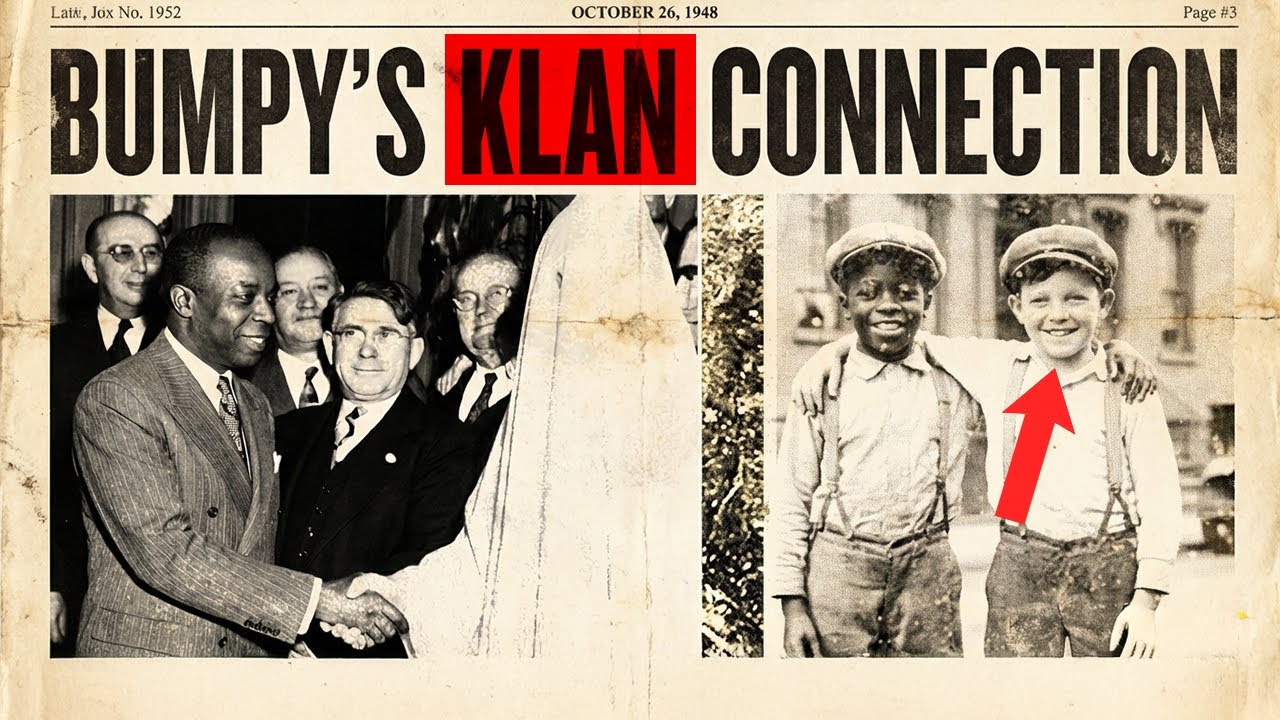
He had come unarmed, on the word of a man who wore a clan ring on his finger, into a room full of men who would hang him from a lamppost if they caught him. He was looking for the driver, the man who knew where the explosives were hidden. He was looking for a way to stop a bombing that would turn a Harlem community center into an inferno. Then the lights flickered.
A door slammed shut behind him, the heavy metal clang echoing like a gunshot. The men at the table froze. Guns were drawn, twelve barrels pointed into the darkness. Elias Vance, the grand dragon of the New Jersey chapter of the Ku Klux Klan, looked directly at the shadows where Bumpy was hiding.
A slow, cruel smile spread across his face. “Gentlemen,” Vance said, his voice dripping with malice, “it seems we have a guest. The guest of honor, I promised you. ”
Bumpy’s heart stopped.
The setup was real. Vance had played the long game, used Bumpy’s savior complex to lure him into a slaughterhouse. There was no way out, no exit, just twelve men with guns and a grand dragon who had finally cashed in his chips. Bumpy stepped into the light, raising his hands.
The men gasped. They recognized him instantly—the prize, the devil himself. “Well, well,” Vance said, walking toward him, pulling a heavy revolver from his belt. “Bumpy Johnson.
You really are arrogant, aren’t you? You thought a few cigarettes in prison made us brothers? You thought you could trust me? ”
He cocked the hammer and pressed the cold steel against Bumpy’s forehead.
“Any last words, boy? ”
The room went silent. The trigger finger tightened. And in that split second, Bumpy Johnson realized that for the first time in his life, he had miscalculated.
The king of Harlem was about to die in a dusty warehouse in Queens, executed by the one man he thought he understood. Or so it seemed. Because Bumpy noticed something. Vance’s other hand—the one hidden from the other clansmen—was making a signal.
A signal from the prison yard. A signal that meant duck. Bumpy dropped. He didn’t think.
He let his knees buckle and threw his body weight forward and down, collapsing toward the dirty concrete floor just as the deafening roar of a . 45 caliber round split the air. The bullet screamed over his head and buried itself in the chest of the clansman standing directly behind him, a man holding a sawed-off shotgun. The room exploded into chaos.
The execution had turned into a mutiny in the span of a heartbeat. Vance didn’t stop firing. He spun with a speed that belied his age, fanning the hammer of his revolver. Two more men dropped.
These weren’t random shots—they were precision strikes against the young Turks, the radical upstarts who had challenged his leadership and planned the bombing. Bumpy scrambled under the heavy oak table as the other men returned fire, wood splintering above him. The warehouse, silent seconds ago, was now a strobe-lit hellscape of muzzle flashes and screaming men. It wasn’t a rescue mission.
It was a purge. Vance hadn’t brought Bumpy there to save the community center. He had brought him there to act as the ultimate distraction—using the devil of Harlem as bait to gather all his internal enemies in one room so he could slaughter them. Bumpy realized the game instantly.
He wasn’t a partner. He was a prop. But props don’t fight back, and Bumpy Johnson was no prop. He saw a Luger pistol slide across the floor, dropped by one of the fallen men.
He rolled out from under the table, snatched the weapon, and joined the fray. He wasn’t fighting for Vance. He was fighting for the exit. “The lights!
” Bumpy shouted, his voice cutting through the din. Vance, reloading behind a stack of crates, understood. He fired at the hanging bulb in the center of the room. The warehouse plunged into total darkness, save for the moonlight filtering through the high windows.
Now it was a knife fight in a closet. This was Bumpy’s element—Danamora all over again. He moved through the shadows, hearing breathing to his left. A shape lunged.
Bumpy sidestepped, grabbed the man’s arm, and used his own momentum to drive him into a steel pillar. The man crumbled. Bumpy didn’t shoot unless he had to—gunshots gave away your position. “Vance,” Bumpy hissed into the blackness.
“The back door’s blocked. ”
Vance’s voice came from the right, followed by a grunt of exertion and the sound of a body hitting the floor. “They have a truck parked against it. We have to go out the front.
”
“The front is a kill zone. ”
“It’s the only way, boy. Unless you want to burn. ”
One of the surviving clansmen had knocked over a kerosene lantern in the panic.
The dry, dusty wood of the warehouse floor caught fire instantly. The flames licked up the crates of dynamite. The timer on their survival had just started ticking. The fire provided light, but it also promised oblivion.
Bumpy saw Vance across the room, pinned down by two men with rifles, out of ammo, clicking an empty gun. Vance looked at him. For the second time in their lives, the black gangster held the white supremacist’s life in his hands. Bumpy could have turned and run.
He could have let the flames take Elias Vance and the secrets he held. It would have been poetic justice. But Bumpy needed the network. He needed the guarantee that the bombing was off.
He raised the Luger, took a breath to steady his aim amidst the rising smoke, and fired two shots. The men pinning Vance dropped. Vance looked at Bumpy, eyes wide. He didn’t say thank you.
He just nodded and scrambled toward the main bay doors. Bumpy followed, the heat searing their backs. They hit the heavy sliding doors together, heaving with everything they had. The metal groaned and slid open just enough for them to squeeze through.
They tumbled out onto the cool, damp wood of the pier, gasping for air. Inside, the fire roared. Seconds later, a concussive blast shook the ground beneath them. The first crate of dynamite had cooked off.
The shockwave blew the windows out of the warehouse, showering the dock in glass and burning debris. Bumpy picked himself up, brushing ash off his suit. He looked at Vance, who was leaning against a pylon, bleeding from a graze on his shoulder, laughing. It was a manic, terrifying sound.
“We got them,” Vance said. “Every single one of them. The brotherhood is clean again. ”
Bumpy walked over to him, the Luger still in his hand.
He didn’t laugh. “You used me, Elias. You used me to clean your house. ”
Vance stopped laughing.
He straightened up, wincing. “I did what I had to do, just like you would. I stopped the bombing, didn’t I? Harlem sleeps safe tonight.
”
“And you’re the king of the ashes,” Bumpy said before Vance could answer. Headlights swept across the pier. Junie’s car screeched to a halt. The back door flew open, and Junie jumped out, shotgun in hand, ready to fire at the first white face he saw.
He leveled the barrel at Vance. “Boss, get down! ” Junie screamed. “No!
” Bumpy barked. “Stand down, Junie. ”
Junie looked confused, looking between the burning warehouse, his boss covered in soot, and the white man bleeding next to him. “Boss, that’s the deacon.
That’s him. ”
“I know who he is,” Bumpy said. He turned to Vance. “Get in.
”
Vance bristled. “I ain’t getting in a car with you people. ”
Bumpy stepped in close, his face inches from Vance’s. “Look behind you, Elias.
” Sirens wailed in the distance. The NYPD was coming. The fire department was coming. “You stay here, you answer for twelve bodies and a pile of dynamite.
You get in the car, you live to hate another day. ”
Vance spat blood onto the dock. He looked at the sirens, then at the car. He swallowed his pride, opened the door, and slid into the back seat of the Cadillac.
Bumpy got in beside him. “Drive, Junie. Slow and steady. ”
The ride back to the city was surreal.
In the front, Junie was sweating bullets, driving the most dangerous car in New York. In the back, the King of Harlem and the Grand Dragon of New Jersey sat in silence, illuminated by the passing streetlights. They smelled like smoke, gunpowder, and sweat—two men who stood on opposite ends of the American nightmare, bound together by the only religion they both truly practiced: power. Vance broke the silence first.
“You’re a fool, Johnson. You saved a man who would hang you from a tree if the wind changed. ”
Bumpy lit a cigarette, his hand steady. “I didn’t save you, Elias.
I saved an asset. There’s a difference. ”
“An asset? ” Vance scoffed.
“Is that what I am? ”
“The men inside that warehouse were fanatics. You can’t do business with fanatics. They’d burn down the store to prove a point.
You’re a businessman. You’re a monster, Elias, make no mistake. But you’re a monster who understands arithmetic. ”
Vance stared out the window.
“What now? You think we’re friends? ”
“We aren’t friends,” Bumpy said coldly. “We are co-conspirators, and that’s a stronger bond.
You have a problem, Elias. You just killed twelve of your own men. When the rest of your organization finds out…”
“They won’t find out,” Vance interrupted. “The story is simple.
Black radicals set a trap. They bombed the meeting. I’m the sole survivor. The hero who barely escaped.
”
Bumpy smiled. It was a shark’s smile. “That’s a good story. But stories need proof.
And I’m the only witness. ”
Vance stiffened. He realized the trap he was in. If Bumpy whispered the real story—that Vance had executed his own men to keep power—Vance wouldn’t just be out of the clan.
He’d be hunted by them. “So what’s the price? ” Vance asked. “Money?
”
“I don’t want your money,” Bumpy said. “I want peace. The trucks you run through Harlem—the guns, the drugs. From now on, they don’t stop.
They don’t sell. They pass through. You keep your poison out of my well. And if I ever hear a whisper of a clan rally, a cross burning, or a threat within ten miles of 110th Street, I release the truth.
I tell the world how the deacon killed his flock. ”
Vance clenched his jaw. He looked at Bumpy with pure hatred, but beneath the hate there was resignation. He had won the battle for his leadership, but lost the war for his soul.
He belonged to Bumpy Johnson now. “Deal,” Vance whispered. Bumpy tapped Junie on the shoulder. “Pull over here.
” They were on a quiet street in Midtown, neutral ground. Vance opened the door and stepped out onto the pavement, looking small and ragged without his robes and his position. “One day,” Vance said, leaning back into the window, “this truce breaks. And I won’t miss next time.
”
“Get home, Elias,” Bumpy said. “And try to wash the blood off your hands. It stains. ”
The Cadillac pulled away, leaving the Grand Dragon standing alone under a streetlamp.
Junie drove for a few blocks in silence before he finally spoke. “Boss, did we just let the devil go? ”
Bumpy looked at his reflection in the dark window. “Sometimes, Junie, you have to keep the devil on a leash so he can bite the other demons.
”
—
To understand how the King of Harlem came to be riding through the night in a car with a grand dragon of the Ku Klux Klan, you have to go back ten years, to a concrete hell called Dannemora. The racial segregation inside those walls was absolute and brutal. The white gangs ran the yard, the black gangs held the mess hall, and the guards played them against each other like dogs in a pit. It was in that pressure cooker that Bumpy Johnson first met Elias Vance.
At the time, Vance wasn’t a grand dragon. He was just a hate-filled kid from the backwoods, serving time for manslaughter, with a swastika carved into the frame of his bunk and a heart full of venom. Their first interaction was exactly what you would expect: violence. Vance and two of his Aryan brothers cornered Bumpy in the laundry room.
They had shivs made from sharpened toothbrushes. They thought they had the numbers. They thought they had the advantage. They were wrong.
Bumpy Johnson didn’t just fight—he dismantled. He moved with the precision of a boxer and the ruthlessness of a predator. Within thirty seconds, two men were on the floor, bleeding and broken. That left Vance.
Bumpy had him pinned against a steam pipe, a blade pressed against his jugular. Vance spat in Bumpy’s face, hurling every racial slur in his vocabulary, waiting for the death blow. He wanted to die a martyr for his twisted cause. But Bumpy didn’t cut.
He paused. He looked into Vance’s eyes and saw something others missed. He didn’t see just a racist. He saw a soldier—a man utterly fearless, completely committed to his tribe, willing to die for a code, even if that code was evil.
Bumpy respected conviction, even when it came from the enemy. In a move that confused everyone, Bumpy lowered the blade. “You fight good,” Bumpy said, his voice calm amidst the steam and the blood. “But you fight stupid.
You’re dying for men who would leave you behind. ”
He let Vance go. He turned his back on an enemy who wanted him dead. It was the ultimate power move—a statement: I am so superior to you that I don’t even need to kill you.
That moment planted a seed in Elias Vance’s brain. It didn’t cure his racism—hate runs deep—but it created a crack in his worldview, a begrudging, confused respect. Over the next three years, a strange dynamic formed. They didn’t sit together.
They didn’t talk. But when a riot broke out in the mess hall and a rival gang tried to shank Vance from behind, Bumpy threw a tray that knocked the attacker out. When the guards tried to frame Bumpy for contraband, Vance, who worked in the warden’s office, accidentally lost the paperwork. It wasn’t friendship.
It was a transactional truce between two warlords stuck in the same cage—the recognition that in a world of sheep, the wolves sometimes nod to each other. By 1938, Bumpy was out, and Vance was out. Bumpy was the king of Harlem. Vance had risen through the ranks of the hate groups to become a major player in the underground arms trade, using the Klan’s network to move explosives and weapons across state lines.
They existed in different universes, destined never to cross paths again—until the threat arrived. The summer of 1938 wasn’t just hot; it was political. The German American Bund was holding rallies at Madison Square Garden. The atmosphere in New York was poisonous.
Emboldened by the rise of fascism, a rogue faction of the Klan decided that burning crosses in Jersey wasn’t enough. They wanted to make a statement in New York City. They wanted to hit Harlem. Intelligence reached Bumpy’s ears that a massive attack was being planned.
Not a march, not a protest—a bombing. They planned to level a community center on 135th Street on a Sunday morning. The goal was mass casualties. The goal was to break the spirit of the black community.
Bumpy’s network was good, but it wasn’t omniscient. He knew the attack was coming, but he didn’t know when, and he didn’t know who was carrying the payload. The NYPD was useless—half of them sympathized with the attackers. The politicians were looking the other way.
Bumpy was on an island. He needed inside information. He needed a source within the belly of the beast. He needed the one man on earth who hated him but respected him.
He needed Elias Vance. That was the truth behind the rumor that had swept through Harlem like wildfire. The whispers had started in the back of pool halls, murmured between puffs of cigarette smoke in the jazz clubs: Bumpy is talking to them. Talking to who?
The Klan. The initial reaction was laughter—Bumpy Johnson breaking bread with the Ku Klux Klan was like saying the Pope was making deals with the devil. But the whispers didn’t stop. They grew louder, gained specific details.
A black sedan with New Jersey plates parked in an alley behind Bumpy’s favorite diner. A white man in a trench coat with cold blue eyes and a scar running down his cheek, seen shaking Bumpy’s hand. A man known to the FBI as Elias “the Deacon” Vance, grand dragon of the New Jersey chapter of the KKK. The neighborhood began to feel a strange, creeping unease—the cognitive dissonance of seeing your savior shaking hands with your executioner.
Bumpy arranged the sit-down through a series of intermediaries. When Vance stepped out of the car, the tension was palpable. Bumpy’s bodyguards had their hands on their guns, sweating, looking at this man who wore a clan ring on his finger openly in the middle of Harlem. It was a desecration.
It was an insult. Vance looked older, harder. The scar on his cheek had faded, but the ice in his eyes hadn’t. He looked around the alley, sneering at the decay, sneering at the black faces watching him from the shadows.
He hated this place. He hated these people. But when his eyes locked on Bumpy Johnson, the sneer vanished. He nodded—a barely perceptible tilt of the head.
“You’re a long way from the woods, Elias,” Bumpy said, leaning against a brick wall, lighting a cigarette. “And you’re playing with fire, Johnson,” Vance replied, his voice a gravelly drawl. “My boys find out I’m here, I’m dead. Your boys find out I’m here, I’m dead.
We’re a couple of ghosts talking in a graveyard. ”
“I hear your boys are planning a barbecue,” Bumpy said, cutting to the chase. “Sunday morning, 135th Street. ”
Vance didn’t deny it.
He pulled a flask from his coat, took a swig, and wiped his mouth. “There’s talk. New leadership. Young Turks.
They want to make a splash. They think the old ways are too slow. ”
“I need names, Elias. I need the location of the explosives.
”
Vance laughed—a dry, humorless sound. “You ask a lot. You ask me to betray my race, my brotherhood. Why would I do that?
”
“Because you didn’t cut my throat ten years ago. ”
“That debt is paid, Bumpy. ”
Bumpy took a step closer. The bodyguards flinched.
“I’m not asking you to betray your race. I’m asking you to be smart. You’re a businessman now, Elias. You run guns.
You run numbers in Jersey. These young Turks wanting to blow up churches—they bring heat. They bring the feds. A bombing like that brings the National Guard down on everyone.
It shuts down your operation. It shuts down mine. It’s bad for business. ”
It was a masterstroke of manipulation.
Bumpy knew Vance didn’t care about black lives. He cared about profit and self-preservation. Bumpy was framing the prevention of a massacre not as a moral act, but as a business decision—speaking Vance’s language. Vance stared at him for a long time, the gears turning.
Finally, he spat on the ground. “I can’t stop it. The order came from the top. The explosives are already in the city.
They’re moving them tonight. ”
“Where? ”
“I don’t know the stash house. Only the driver knows.
And the driver is a fanatic. He’d blow himself up before he talked to you. ”
“Then bring me the driver,” Bumpy said. Vance shook his head.
“Can’t do it. ” He paused, looking Bumpy up and down. “But I can get you in the room with him tonight. We’re holding a meet—a final planning session in Queens, a warehouse by the docks.
”
The implication hung in the air like smoke. Vance was inviting Bumpy Johnson—a black man, the archenemy of their ideology—into a secret Klan meeting. It was a suicide mission. It had to be a trap.
“You want me to walk into a room full of hooded men with guns? ” Bumpy asked, his eyebrows raised. “If you want to stop the bomb, that’s where the bomb is. I can get you in the back door.
I can buy you five minutes. After that, you’re on your own. ”
Bumpy’s lieutenants stepped forward. “Boss, no,” one of them whispered urgently.
“He’s setting you up. They’re going to lynch you. You walk in there, you never walk out. ” It was the only logical conclusion: Vance gets Bumpy to walk into a kill box, becomes a hero to the Klan for killing the King of Harlem, and solves all his problems.
Bumpy looked at his men. He saw the fear. He saw the doubt. Then he looked at Vance, looking for that same flicker of soldier’s honor he had seen in the prison laundry room.
“What time? ” Bumpy asked. “Midnight. Come alone.
No guns. If they smell a setup, they blow the warehouse and everyone in it. ”
“Done,” Bumpy said, as Vance’s car peeled out of the alley. The silence that followed was terrifying.
Bumpy Johnson had just agreed to walk unarmed into a KKK stronghold based on the word of a white supremacist. The neighborhood talk turned from confusion to anger. They said Bumpy had lost his mind. They said he had finally made a deal with the devil he couldn’t hustle his way out of.
They didn’t know the plan. They didn’t know that Bumpy Johnson never walked anywhere without an ace up his sleeve. But as midnight approached, the tension in the car ride to Queens was unbearable. Bumpy sat in the back, silent, watching the city lights blur past.
His driver, a loyal soldier named Junie, kept looking in the rearview mirror, eyes wide with panic. “Boss, turn around,” Junie pleaded. “Please, this ain’t right. That man hates us.
He hates you. ”
“He hates me, Junie,” Bumpy said softly. “But he loves money, and he loves being alive. Keep driving.
”
—
The bombing never happened. The community center on 135th Street held its Sunday service, filled with families who had no idea how close they had come to incineration. The newspapers reported a tragic gas explosion in a Queens warehouse that claimed the lives of twelve men. Elias Vance was cited as a survivor, a tragic figure who mourned his lost brothers.
In the years that followed, the relationship remained a ghost story, but the effects were real. While other black neighborhoods were terrorized by organized white hate groups, Harlem remained strangely insulated from that specific brand of violence. When the Klan marched in DC, they didn’t march in Harlem. When cross burnings spiked in the forties, Harlem was dark.
The friendship wasn’t about affection—it was a cold war deterrent. Bumpy Johnson had turned the head of the KKK into his personal border guard. But there is a final twist to the story, one that Bumpy took to his grave. Three years later, in 1941, Elias Vance was found dead in a motel room in New Jersey.
The official report said heart attack, but the rumor on the street was different. The rumor was that Vance had started to slip—drinking, talking about making a move on Harlem again, trying to break the leash Bumpy had put on him. When the police found Vance’s body, there was no sign of foul play. No bullet wounds.
No poison. But on the nightstand, next to his cold body, there was a single strange object. It wasn’t a weapon. It wasn’t a clan hood.
It was a chess piece: a black knight. Bumpy Johnson never claimed responsibility. He never spoke Vance’s name again. But in the underworld, the message was clear.
The checkmate had finally been delivered. The friendship was over because the asset had become a liability. And in Bumpy Johnson’s world, liabilities are liquidated. To this day, if you go to the old barbershops in Harlem and ask about the time Bumpy made friends with the Klan, the old-timers will laugh.
They’ll tell you it’s a myth. They’ll tell you no black man could ever have that kind of power over a grand dragon. But then they’ll get quiet. They’ll look around to make sure no one is listening.
And they’ll whisper: let me tell you why the crosses never burned on 125th Street. Because the devil didn’t run Harlem. Bumpy Johnson did.
And even the devil knew when to duck.
