László Löwenstein was born on June 26, 1904, in the small town of Ružomberok, then part of the Kingdom of Hungary, to German-speaking Jewish parents. His father Alois was a chief bookkeeper at a textile mill and a lieutenant in the Austrian Army Reserve; his mother Elvira died shortly after giving birth to her third son under circumstances that remain murky. The official death certificate cited blood poisoning, but rumors of intentional poisoning persisted for years. Alois remarried quickly, choosing Elvira’s best friend Melanie Klein as his new wife.
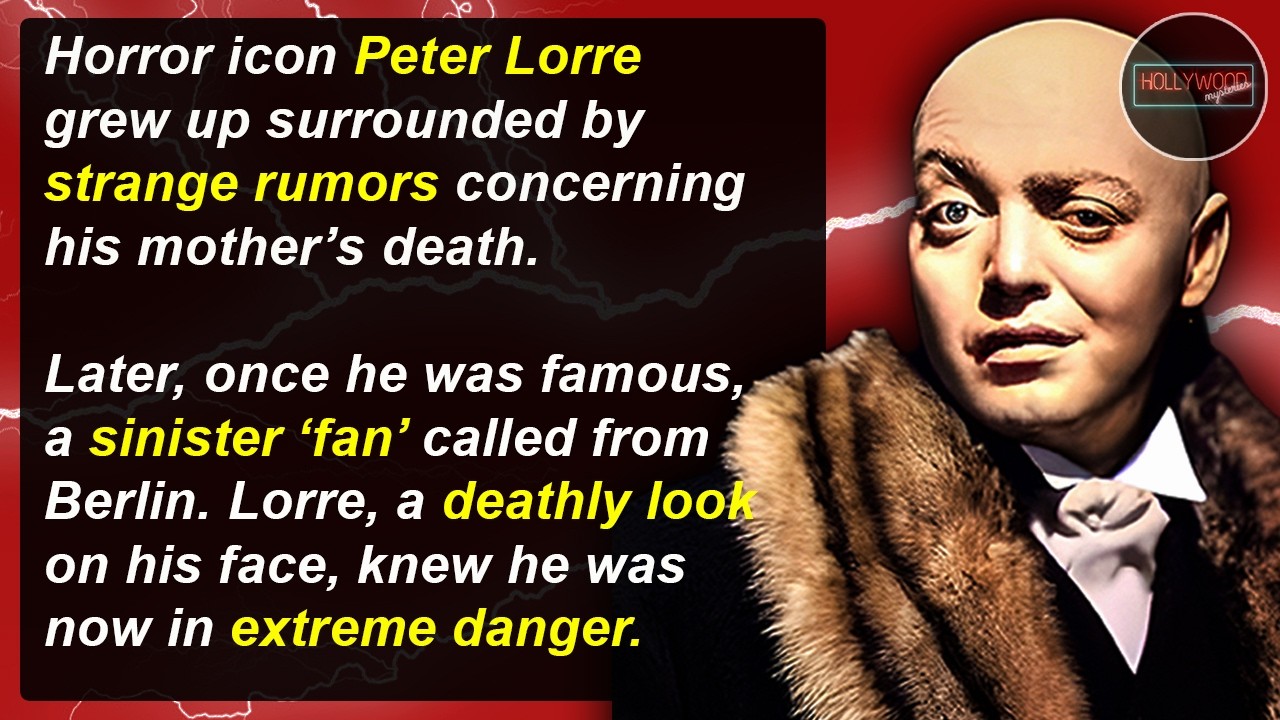
For young Peter, the stepmother proved a harsh presence, prone to violent beatings that drove him to hide under the bed. The suspicion that she may have poisoned his mother would shadow the family for decades. Fearing the outbreak of a larger European conflict, Alois moved the family to Vienna in 1913, where they endured the hardships of the First World War. After the war, Peter attended a business academy and graduated at the top of his class in 1921.
But numbers and ledgers held no appeal for him; acting did. He later described the pull toward the stage as a disease, and by his own account he did not deliberately choose acting but simply followed a subconscious urge. He left home and descended into poverty in Vienna, sleeping on park benches, suffering from scurvy, and once admitting to robbery to satisfy his hunger. A gallbladder operation and the morphine prescribed for the pain planted a seed that would grow into a lifelong addiction.
After stints in Breslau, Zurich, and Berlin, he found work with Bertolt Brecht, appearing in both Man Equals Man and Happy End. He also met actress Celi Lovski, who would become his first wife. But it was director Fritz Lang who changed his life. Lang cast him as the child murderer Hans Beckert in the 1931 film M.
Lang envisioned Lőrincz for the role while writing the script and required no audition. The production was brutal: Lang had him throw himself down a flight of stairs twelve times, and when the court scenes ran from eight in the morning until the following dawn, Lőrincz fainted mid-shot. Lang used the footage anyway. The actor’s performance earned lavish praise; Lang called it one of the finest in film history.
The role made him famous but also trapped him. He reportedly received more than three hundred offers to play similar psychopaths, most of which he declined in an effort to escape typecasting. When the Nazis took power in Germany in 1933, Lőrincz, as a Jewish man, was in grave danger. He fled first to Vienna, then to Czechoslovakia, and finally to Paris, where he shared a cramped filthy room with other refugees while waiting for a work permit.
His morphine addiction worsened. In 1934, Ivor Montagu, associate producer on Alfred Hitchcock’s The Man Who Knew Too Much, suggested Lőrincz for the film, and Hitchcock summoned him to London. Knowing almost no English, Lőrincz concealed the fact by laughing loudly at the end of Hitchcock’s stories, convincing the director he understood everything. He learned most of his dialogue phonetically.
Critics praised his performance as a masterclass in understated menace, and the film became a hit. Harry Cohn of Columbia Pictures invited Lőrincz to Hollywood. To ease the visa process, he married Lovski, with whom he had already been living for five years. His first American film, Mad Love in 1935, cast him as the deranged surgeon Dr.
Gogol, a performance that made him a sensation and solidified his reputation as a screen villain. He then played Raskolnikov in an adaptation of Crime and Punishment, but Columbia’s offer of a five-year contract at a thousand dollars a week did not hold him. He returned to England to star in Hitchcock’s Secret Agent, where tension with his co-star John Gielgud, a classically trained Shakespearean, proved unavoidable. Hitchcock reportedly nicknamed Lőrincz the Walking Overcoat because he rehearsed in a long overcoat regardless of the season.
Back in America, he signed with Twentieth Century Fox and took a role he would come to despise: Mr. Moto, a Japanese detective spy. Between 1937 and 1939 he made eight such films, growing frustrated with what he called a childish role. A shoulder injury during a stunt on Mr.
Moto Takes a Vacation sent him back into a morphine spiral. He needed the money for debts and rehabilitation, but he openly mocked the character, once wearing a badge at a lunch for Japanese officials that read Boycott Japanese Goods. The war and rising anti-Japanese sentiment eventually ended the series, much to his relief. He turned down the lead in Son of Frankenstein, tired of horror roles, but the typecasting would not release him.
In 1941, John Huston cast him as Joel Cairo in The Maltese Falcon. Huston saw in Lőrincz a combination of braininess and innocence, someone always thinking one thing and saying another. The film became one of the most iconic Hollywood movies ever made, and the role became the pinnacle of his American career. He formed a close friendship with Humphrey Bogart, who reportedly needed encouragement to marry Lauren Bacall; Lőrincz reportedly told him that five good years were better than none.
Cartoonists at Warner Brothers used him as visual inspiration for Gomez Addams in The New Yorker. He followed with a small but memorable turn as Ugarte in Casablanca, the black-market dealer who hands Rick the letters of transit shortly before being arrested. His screen time was brief, but his presence sharpened the film’s atmosphere of danger and shifting loyalties. Over the following years he appeared with Sydney Greenstreet in seven more films, a pairing known as Little Pete and Big Sid.
He played a doctor in Frank Capra’s Arsenic and Old Lace and gave a deeply unnerving performance in The Beast with Five Fingers, where his expressive eyes carried much of the terror. Yet beneath the Hollywood success ran darker currents. His marriage to Lovski ended in 1945, though she continued to serve as his publicist, manager, secretary, financial planner, nurse, and confidant. He remarried quickly, this time to German actress Karen Verne, fourteen years his junior.
His friendship with Bertolt Brecht, now exiled in California, drew the attention of Jack Warner, who placed him on a gray list as a possible communist sympathizer. When the House Un-American Activities Committee investigated alleged communist infiltration in Hollywood, Lőrincz was summoned to testify. Warner appeared as a friendly witness. Asked to name anyone suspicious he had met since arriving in the United States, Lőrincz reportedly provided a list of every single person he had encountered in the country.
His career at Warner Brothers collapsed. He filed for bankruptcy after an unsuccessful attempt to launch his own production company, divorced Verne after barely four years, and shifted to radio and stage work, where his distinctive voice served him well. In 1951 he made his only directorial effort, a film titled The Lost One in its German release. The story follows a German scientist who, during the war, murders his fiancée after discovering she leaked secrets to the Allies, and later, after the war, works under an alias as a doctor for displaced persons until guilt overwhelms him.
It was a deeply personal exploration of guilt and redemption, rooted in his own experiences. German audiences of the 1950s wanted to move past the Nazi era, and the film struggled to find viewers, though it later gained a reputation as a dark and impressive piece of cinema. In 1954 he became the first actor to portray a James Bond villain, playing Le Chiffre in a live television adaptation of Casino Royale. The death scene became a comical disaster when the director failed to switch cameras, leaving millions of viewers watching the supposedly dead Lőrincz rise and quietly walk off set.
He worked with Roger Corman on several low-budget films, including Tales of Terror and The Raven, where he clashed with Jack Nicholson over his habit of ad-libbing dialogue. His health declined steadily. The morphine decades had taken their toll, and after recovering from addiction he gained nearly a hundred pounds, worsening his high blood pressure. In 1960 he collapsed on a film set; attending doctors, overzealous and mistaken, concluded he had only an hour to live and suggested bloodletting.
An incision revived him. He had suffered blood clots. Peter Lorre, as he was now known, died on March 23, 1964, in Los Angeles from a stroke. He was fifty-nine.
He had been scheduled to attend a divorce hearing from his third wife that day. His ashes were interred at Hollywood Forever Cemetery, where Vincent Price delivered the eulogy. Shortly before his death, he had wondered aloud about his career, noting that he had mostly played killers but that audiences loved him anyway. After his death, an actor named Eugene Weingand, who resembled him and had once tried to legally change his name to Peter Lorre, claimed to be his son and traded on the resemblance in small roles.
Even in death, Lorre could not escape the uncanny. His final film, The Patsy, was released after his passing and offered a modestly positive note to a career that had seen extraordinary heights and painful lows.
