In the storage rooms of the Hungarian Natural History Museum in Budapest, an unlabeled wooden crate sat for decades, one anonymous box among thousands. When a researcher slid it off its shelf in 2018 and lifted the lid, inside lay a human skeleton. The skull had been split open in multiple places. The hands were sliced through.
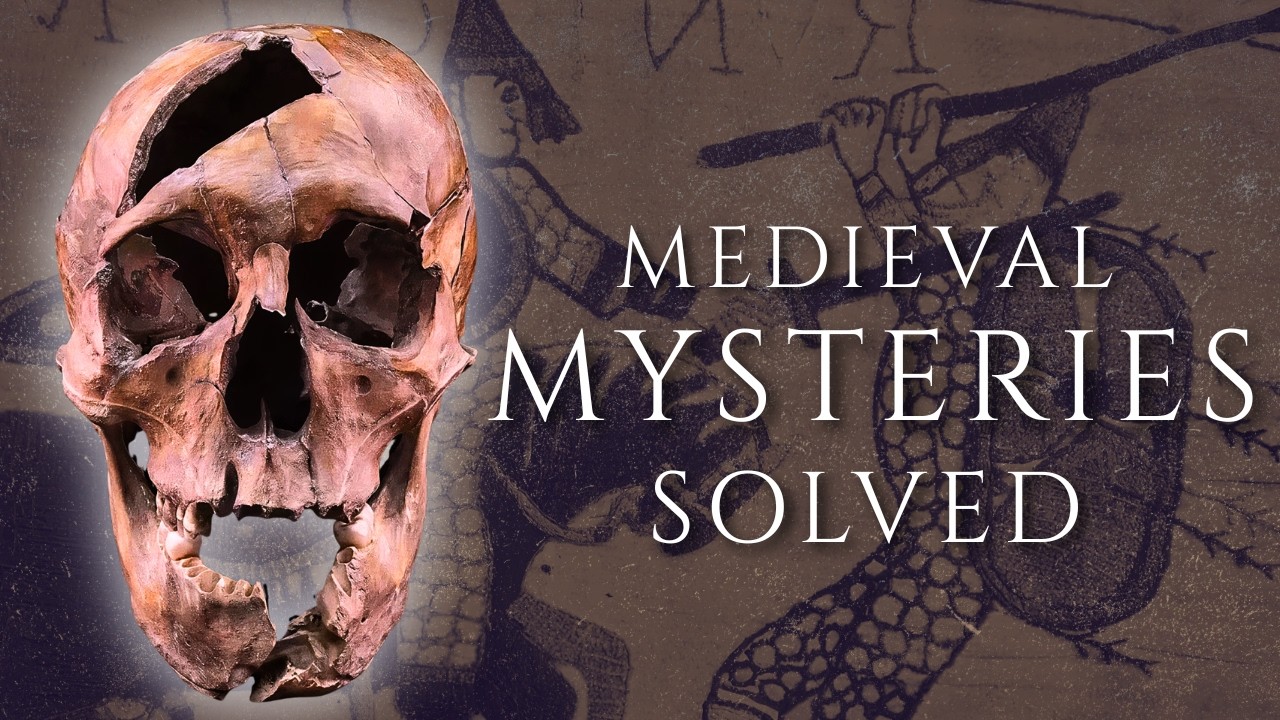
The forearms carried long gouges where blades had gone down to the bone. The museum had assumed for seventy years that these bones were lost in the Second World War when so much of Budapest burned. They had been sitting in that box the whole time. The man in the box was a prince.
His name was Béla, Duke of Macsó, grandson of a king of Hungary and great-grandson of a Byzantine emperor. In November of 1272, he walked into a convent on an island in the Danube and was hacked apart by men he knew personally. Modern forensic science finally identified him, confirming one of the most complete reconstructions of a medieval murder ever produced. The island sat in the middle of the river between Buda and Pest, and in the thirteenth century it was one of the holiest places in the Hungarian kingdom.
That was largely because of one woman, King Béla IV, who had promised God that if the kingdom survived the Mongol invasion, he would give his newborn daughter to the church. The kingdom survived barely, and the king kept his word. The girl Margaret was placed in a Dominican convent built specifically for her on that island, and she grew up to become one of the most extreme ascetics of her century, wearing a hair shirt, doing the filthiest work in the convent by choice, and essentially starving and working herself to death by January of 1270, dead at twenty-eight. The murdered prince was her nephew.
His mother was Anna, daughter of King Béla IV, and his father was Rostislav Mikhailovich, a prince of the Rurikid dynasty out of Kievan Rus who had lost his own inheritance in the east when the Mongols came through and rebuilt his career at the Hungarian court. Born around 1245, Béla inherited the Duchy of Macsó when his father and older brother died. He held a wide stretch of the southern frontier. He was rich, young, and by blood one of the most senior males of the royal house outside the direct line.
In a stable kingdom that makes you a valuable cousin. In an unstable one, it makes you a target. Hungary in 1272 was about as unstable as a kingdom could get without formally falling apart. King Béla IV and his own eldest son had fallen into open armed conflict, splitting the kingdom into two camps that fought actual battles against each other.
When the old king died in 1270, Béla of Macsó’s mother fled the country with a chunk of the royal treasury to the court of her son-in-law in Bohemia. Her son stayed, made his peace with his uncle King Stephen V, and kept his southern lands. In August of 1272, Stephen died at only about thirty-three, weeks after one of his own barons kidnapped his ten-year-old son and heir and handed the boy around like a bargaining chip. The crown landed on the head of a child, and the great baronial families immediately started tearing at each other for control of the boy, the treasury, the offices, everything.
The most dangerous man in that court was Henrik Kőszegi, head of a family that had spent a generation clawing its way to power. He had already killed at least one major political rival with his own hands in an earlier round of the game. Duke Béla of Macsó was an obstacle, a grown man of royal blood in his late twenties with his own territory and his own claim to influence over the child king. In November of 1272, the court gathered on the island at the Dominican convent where Saint Margaret had lived.
Church ground, holy ground, the one place in the kingdom where politics was supposed to pause. A council was called, and Béla came to it apparently without armor and without any expectation of violence. That detail is not a guess, because seven and a half centuries later his skeleton would tell us just how unprotected he was. Somewhere in that meeting in front of witnesses, Henrik Kőszegi and his men drew their weapons and went at the duke.
The chronicles are brief about it, but they agree on the essentials. Béla was cut down inside the convent precinct, and his killers did not stop when he fell. They kept cutting. Two of the women in that convent were his own close kin, his sister Margaret, a nun on the island, and his cousin Elizabeth, a royal princess in the community.
The sources have them with the other sisters gathering up the remains of their kinsman from the ground of their own holy house and burying him in the sacristy of the convent church. Nobody was ever punished for the murder. Henrik Kőszegi kept his offices and went on scheming until he died in battle during yet another round of civil war in 1274. The kingdom slid into decades of anarchy under the child king, who grew up surrounded by murderers and was himself murdered in 1290.
The Árpád dynasty, the house that had ruled Hungary since before the year 1000, went extinct in the male line within a generation. Béla of Macsó had been one of its last spare branches, and they burned him off. Then the story goes quiet for centuries. The island convent carried on until the Ottoman Wars reached Buda in the 1520s and 1530s, when the nuns gathered what they could carry and abandoned the island for good.
The buildings collapsed into ruin and finally into grass. In April of 1915, in the middle of the First World War, an excavation opened up the area of the old sacristy and found three graves. One of them held the skeleton of a young man covered in cut marks. The anthropologist Lajos Bartucz of Budapest University spent years with the skeleton and counted twenty-three separate cut marks, arguing these were the bones of Béla, Duke of Macsó.
He concluded the blows came from multiple directions at once, meaning multiple attackers, and that some of the damage looked like it was inflicted after the man was already down. Mutilation carried past the point of death. Then the Second World War came to Budapest. The city was besieged and shattered, collections were scattered, and the skeleton disappeared from the record.
For decades, everyone who cared about the case assumed the duke had been destroyed a second time. He had simply been mislaid. Once the pieces were reunited, a large team of researchers from across Europe got to work, and their results came out in the journal Forensic Science International Genetics. The team documented twenty-six separate injuries from bladed weapons, all inflicted around the moment of death, none showing any healing.
Nine strikes landed on his skull, seventeen more across the rest of his body. The cuts were deep and clean, and the pattern told the analysts the duke was wearing no armor at all. The geometry of the wounds mapped to three men, one attacker directly in front and two more at his flanks, a coordinated assault. His hand and forearm bones carried classic defensive wounds, the cuts you get when a person throws their arms up and tries to catch sword blades with their bare hands.
One researcher physically acted out the fight on a model skeleton to track the sequence. It opened with strikes to the head and upper body from the front, Béla got his arms up, took the defensive wounds, the men at his flanks landed the incapacitating blows that dropped him, and once he was on the ground, the attackers leaned in and delivered repeated strikes to his head and face until it was over and then passed the point where it was over. As one researcher put it, there were far more serious injuries than would ever be necessary to kill somebody. The concentration of blows to the face signaled personal hatred, a killer who knows the victim and wants to erase him.
The identification itself came from the genetics. From the petrous bone, the dense pyramid of bone behind the ear that preserves DNA better than almost anything else in the body, the team recovered enough genetic material to place this man precisely in the web of European royalty. His Y chromosome belonged to a lineage carried by the Rurikid dynasty of Kievan Rus, his father’s line confirmed. His mitochondrial DNA traced toward the Black Sea and Byzantine Anatolia, just what you would expect through his grandmother, the emperor’s daughter.
The genome-wide comparison delivered the clincher, a measurable family relationship to King Béla III of Hungary at exactly the genetic distance you would predict for the documented family tree. Right bloodlines on both sides, right degree of kinship, right age at death, right height, right wounds, right grave in the right room. The man in the unlabeled box was Béla, Duke of Macsó. He is now one of only two members of the entire Árpád dynasty whose bones have been genetically verified.
The science filled in the living man, too. Genetic markers suggested dark, possibly curly hair and light brown eyes. Strontium isotopes locked into his teeth showed he was not raised around Buda but in the southern lands along the Sava River, his father’s frontier territory, before being sent north to court in adolescence. Over a thousand microscopic food particles came out of his dental calculus, heavy animal protein and plenty of freshwater fish from the great rivers.
A facial reconstruction was made from the skull, so after seven centuries, you can look this man in the face, a face his killers spent the last moments of the attack trying to remove from the world. His estates were carved up after the murder and handed out among the factions at court. His branch of the dynasty ended with him. For six hundred years, the only monument he had was a paragraph in the chronicles.
Now he has a face, a verified name, a mapped murder, and a formal scientific publication that sounds in its dry way like an indictment of Henrik Kőszegi filed 750 years past the statute of limitations. The nuns who gathered him off the floor would probably appreciate that somebody finally wrote it all down properly. The Kőszegis wanted him erased. He has a park.
Margaret Island in Budapest is reached by bridge now, and the ruins of the convent sit in the middle of the park. The sacristy area, where the diggers of 1915 found the hacked skeleton, is a patch of grass and stone foundations that most visitors cross in ten seconds on the way to the fountain or the ice cream stand. Nothing marks the exact place.
Runners loop past it all day, overground where a saint’s community once knelt to gather a butchered prince into a sheet.
