Dr. Emily Chen adjusted the high-resolution scanner for what felt like the hundredth time that week, her eyes tired from examining faded photographs in the dim lighting of the historical archive center in Boston, Massachusetts. It was late October 2023, and she had been working on a project to digitize photographs from early twentieth-century New England families, hoping to preserve these fragile images before time rendered them completely unreadable. Most of the photographs were predictable.
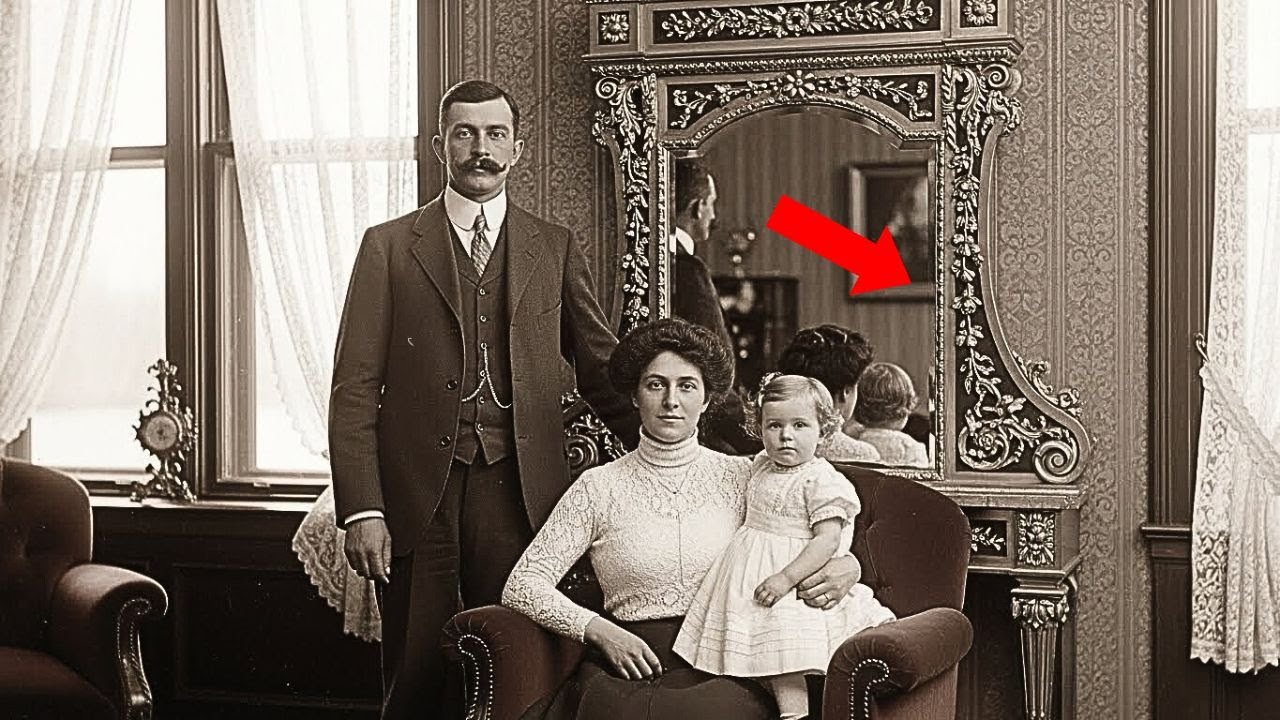
Stern-faced families in their Sunday best, children posed rigidly beside their parents, couples standing formally in front of painted backdrops. The early 1900s had been a time when photography was still relatively expensive, and families treated portrait sessions with the utmost seriousness. But this particular photograph was different in a way Emily couldn’t immediately articulate. The image showed a family of three in what appeared to be an elegantly furnished living room.
The father stood on the left, a man in his early thirties with dark hair and a thick mustache, wearing a three-piece suit with a watch chain visible across his vest. The mother sat in an upholstered chair covered in burgundy velvet, a woman perhaps in her late twenties, wearing a high-necked white blouse with delicate lace and a long dark skirt. Her hair was pulled back in the Gibson girl style popular at the turn of the century. In her arms rested an infant, perhaps four or five months old, wearing a white gown that cascaded over the mother’s lap.
The baby’s face was turned slightly toward the camera, eyes wide with infant curiosity. But what caught Emily’s attention was the background. Behind the family stood a magnificent Victorian mirror with an ornate gilded frame, its surface reflecting portions of the room. The mirror was large, nearly reaching from floor to ceiling, and its presence added depth and elegance to the composition.
The photograph had come from an estate sale in Salem, part of a collection belonging to a family with the surname Kowalsski. According to the documentation, the photo was dated September 1903 and had been taken in the family’s home. This was unusual. Home photography required expensive equipment and considerable skill.
Emily carefully placed the photograph on the scanner bed and initiated the high-resolution scan. The machine hummed to life, its light bar moving slowly across the image. As she waited, she had no idea that what the scanner was about to reveal would consume the next six months of her life. The scanning process took nearly forty minutes.
Emily made herself tea in the small kitchenette, the familiar ritual helping her stay alert after hours of detailed work. When she returned to her desk, the digital image was fully loaded on her screen, rendered in extraordinary detail that revealed textures invisible to the naked eye. She began her systematic examination, zooming in on different sections. The wallpaper pattern became clear, an intricate damask design popular in affluent homes.
The furniture showed quality craftsmanship. A bookshelf held leather-bound volumes, and she could make out some titles in English and what appeared to be Polish. Emily zoomed in on the parents’ faces. The father had serious dark eyes and strong features.
The mother’s expression was gentle but tired, shadows visible under her eyes, suggesting sleepless nights with an infant. Her wedding ring caught the light, and she wore a simple cross at her collar. Then Emily turned her attention to the background, specifically to the ornate mirror. She zoomed in on its gilded frame first, admiring the craftsmanship, carved flowers, and scroll work that would have been expensive.
The mirror’s surface showed reflections of the room. A window with lace curtains, a portion of the opposite wall, some furniture. But as Emily increased the magnification on the mirror’s reflection, she noticed something that made her pause. In the left portion of the mirror, barely visible in the original photograph but now clear in the high-resolution scan, was the reflection of a figure.
A woman. Emily’s breath caught. She zoomed in further, her heart beginning to race. The reflected figure was young, perhaps in her early twenties, with dark hair pulled back.
She appeared to be standing in a doorway or corner of the room, positioned where she wouldn’t be visible in the direct composition of the photograph, but the mirror had captured her presence. Emily checked the direct photograph again. There was no fourth person visible, just the father, mother, and baby. Yet the mirror clearly showed someone else in the room, someone the photographer either hadn’t noticed or had deliberately excluded from the frame.
Emily spent the next hour examining every detail of the mysterious reflection. The woman in the mirror wore simple clothing, a dark dress with long sleeves, her hair styled plainly. Her posture suggested she was trying to remain inconspicuous, standing back from the main scene, perhaps unaware that the mirror would betray her presence. The positioning was odd.
Professional photographers of that era were meticulous about controlling their compositions. They would have checked the mirror’s reflection to avoid unwanted elements. Yet this woman appeared clearly in the reflection, suggesting either the photographer’s carelessness or the woman’s last-second movement into the frame. Emily zoomed in on the woman’s face in the reflection.
Though the image was small and the mirror created some distortion, she could make out features. A young face, perhaps bearing some resemblance to the mother in the photograph. Sisters, possibly. She pulled up her database and began searching for the Kowalsski family.
The estate sale documentation listed Kowalsski family, Salem, Massachusetts, circa 1903, but provided no first names. Salem had a significant Polish immigrant community in the early 1900s, and Kowalsski was a common surname. Emily started with city directories from 1903. She found three Kowalsski families in Salem, but without additional information, she couldn’t narrow it down.
She needed more context about Polish immigration to Massachusetts during that period. She spent the evening researching Polish immigration patterns. The early 1900s saw massive waves of Eastern European immigration to the United States, driven by poverty, political oppression, and religious persecution. Many Poles fled the partitioned Poland, controlled by Russia, Prussia, and Austria-Hungary.
They arrived at ports like Boston and New York, often with little money and no English, seeking work in factories and mills. But immigration laws were tightening. The Chinese Exclusion Act of 1882 had set a precedent for restricting immigration based on nationality. By 1903, new regulations required immigrants to prove they weren’t anarchists, criminals, or likely to become public charges.
Those who couldn’t meet these requirements were deported. Emily wondered: Could the woman in the mirror have been someone who entered the country illegally? Someone hiding from immigration authorities? The next morning, Emily called her colleague James, a genealogist who specialized in New England family histories.
She explained what she’d found. The family portrait, the mysterious figure in the mirror, the possibility of hidden immigration. “James, I need help tracking down this family. Kowalsski, Salem, 1903.
There were three families with that name in the city directory, but I need to know which one this photograph belongs to. Do you have any other details? Occupations? Addresses?
Anything? ”
Emily examined the photograph again, looking for clues. The house was well furnished, suggesting middle-class means. The books on the shelf included some in Polish.
The father’s suit was quality but not luxurious. And there was an infant, so she was looking for a Kowalsski family that had a baby around 1903. “Let me search baptismal records,” James said. “Polish immigrants were typically Catholic.
If they had a baby baptized, there should be a church record. ”
Two days later, James called back with results. “I found them. Antony and Maria Kowalsski.
Antony worked as a foreman in a textile mill. Maria had been a seamstress before marriage. They had a daughter, Zophia, baptized at St. Joseph’s Catholic Church in August 1903.
That matches your timeline. ”
“Just the three of them? ” Emily asked. “According to immigration records, yes.
Antony arrived in 1899, Maria in 1900. They married in Salem in 1901. The baptismal record lists only Antony and Maria’s parents. No other family members mentioned.
”
But if only three people were officially documented, who was the woman in the mirror? Emily asked James to search for any other Kowalsskis who might have arrived around the same time, particularly single women. After another day of research, he found something interesting. “There’s a notation in the St.
Joseph’s Parish records from 1902. A woman named Helena arrived in Salem, listed as visiting family. The record is vague, but it mentions she was from the same region of Poland as Antony and Maria. ”
“Helena,” Emily repeated.
“Could she have been Maria’s sister? ”
“Possibly. But here’s the strange part. There’s no immigration record for anyone named Helena Kowalsski entering through Boston or New York in 1902.
I checked passenger manifests, immigration processing records, everything. She doesn’t appear. ”
Emily felt a chill run through her. No official record of entry.
A vague parish notation about visiting family. And a mysterious woman appearing only in a mirror’s reflection, hidden from the direct photograph. Emily needed more information. She contacted the Salem Historical Society, asking if they had any records or documents related to the Kowalsski family.
A week later, she received an email from a society volunteer named Margaret. “We have a small collection of Kowalsski family papers donated in 1978, mostly in Polish, never fully translated. Would you like to examine them? ”
Emily drove to Salem the next day.
The historical society occupied a beautiful old building near the waterfront, and Margaret greeted her warmly, leading her to a small research room. On the table sat a cardboard box containing the Kowalsski papers: letters, documents, a few photographs, and what appeared to be a diary. Emily carefully examined each item. Most of the letters were in Polish, written in elegant script that suggested education and care.
She photographed each page, planning to have them translated. But one document was in English: a letter dated November 1903, addressed to someone named Babsia, grandmother, Emily learned later. The letter was from Maria, describing life in America. “Dearest Babsia, we are well.
Zophia grows stronger each day. Antony works hard at the mill, and we have enough to eat and warm clothes for winter. The photograph I sent shows our little family. I hope it reached you safely and gives you comfort to see us prospering in this new land.
”
Emily’s pulse quickened. The photograph mentioned in the letter: Could it be the one with the mirror reflection? If Maria had sent it to her grandmother in Poland, it would explain why the photograph was taken at home rather than in a studio, and why it seemed intended to show their living conditions and prosperity. But the letter said nothing about a fourth person.
Nothing about Helena or any sister. Emily continued searching through the papers. Near the bottom of the box, she found a small diary bound in worn leather. The entries were in Polish, dated from 1902 to 1904.
Emily photographed every page, her hands trembling with anticipation. She needed a translator. Through her university contacts, she found Dr. Anna Nowak, a professor of Polish language and literature, who agreed to translate the diary entries.
A week later, Anna sent Emily the translated pages with a note. “This is an extraordinary document. The writer describes living in hiding, caring for her sister’s child, and the constant fear of discovery. You should read this carefully.
”
Emily opened Anna’s translation with trembling hands. The diary belonged to Helena, Maria’s younger sister. The first entry, dated March 1902, described her arrival in America. “I have arrived safely, though not through the proper channels.
The crossing was terrible, hidden in the cargo hold of a ship, paying everything I had to men who promised safe passage. Maria and Anton met me at the docks in the dark of night. They have risked everything to help me, and I am grateful beyond words, but I am also terrified. If the authorities discover me, we could all be deported.
”
Subsequent entries revealed Helena’s story. She had fled Poland after her fiancé, a political activist, was arrested by Russian authorities. Helena had been present at a meeting of Polish independence supporters, and when the police raided it, she barely escaped. Her name was on a list of suspected revolutionaries.
Returning home would mean imprisonment or worse. “I must stay hidden,” Helena wrote in April 1902. “I cannot work, cannot be seen in public, cannot register with any authorities. Maria worries constantly that neighbors will discover me.
I live like a ghost in their attic room, coming down only when the curtains are drawn and the doors are locked. I read, I sew, I pray. It is a small life, but it is life, which is more than I would have in Poland. ”
When Zophia was born in August 1903, Helena’s role changed.
“The baby came early and Maria struggled with the birth. She is weak now, and the doctor says she must rest for many weeks. Anton works long hours at the mill and cannot stay home to help. So I have become Zophia’s nurse, caring for her day and night.
It is dangerous if anyone sees me through a window, if anyone asks questions, but the baby needs care, and I am the only one who can provide it. I love this child as if she were my own. She is the daughter I may never have, the family I thought I had lost forever. ”
The entries from September 1903 described the photograph.
“Maria wanted to send a photograph to Babsia to show that we are well and prospering. A photographer came to the house, a Polish man from Boston who does work for immigrant families. He set up his equipment in the parlor. I knew I should stay in my room, but I wanted to see Zophia, to be near her during this important moment.
I stood in the doorway, just out of the camera’s view. Or so I thought. I did not realize the mirror would capture my reflection. ”
Emily continued reading Helena’s diary, piecing together the full story of her hidden life.
The entries revealed a woman of intelligence and courage, trapped by circumstances beyond her control. She described long days alone in the attic, reading borrowed books, sewing clothes for Zophia, listening to the sounds of the household and the city beyond, always fearful of discovery. “Sometimes I hear immigration agents in the neighborhood,” Helena wrote in December 1903. “They go door to door checking papers, looking for people like me.
When this happens, Anton hides me in a space behind the chimney barely large enough to sit. I stay there for hours, hardly breathing, until Maria comes to tell me it is safe. Each time I wonder if this will be the day they find me, the day our little family is destroyed. ”
Despite the constant fear, Helena’s entries also showed moments of joy, particularly related to Zophia.
“Today the baby smiled at me for the first time. Maria says it was only gas, but I know better. Zophia knows me, recognizes my voice, reaches for me when she cries. I am her secret aunt, her hidden guardian.
She will never remember these early months when I cared for her, never know the sacrifices Maria and Antony make to keep me safe, but I will remember. Every moment is precious. ”
The diary also revealed the emotional toll of hiding. Helena wrote about loneliness, about missing her life in Poland despite the danger, about wondering if she would ever be able to live openly again.
“I am 23 years old and I have no future. I cannot marry, cannot work, cannot have children of my own. This attic room is my world. Some days I feel like I am suffocating, like the walls are closing in.
But then I hold Zophia and I remember why I must stay hidden, why I must survive. For her, for Maria and Anton, who risk everything for me, for the hope that someday, perhaps, things will change. ”
Emily was moved by Helena’s words, by the quiet courage of a woman who had sacrificed her freedom to survive, who had turned her confinement into service to her family. She wondered what had eventually happened to Helena.
Did she remain hidden for years? Did she ever gain legal status? Did she survive? She called James and asked him to search death records, marriage records, any documentation that might show Helena’s fate.
While she waited for his response, Emily continued examining the other materials in the Kowalsski family papers, looking for clues about Helena’s later life. Among the papers, Emily found letters exchanged between Maria and her grandmother in Poland, all written between 1903 and 1906. The letters were careful, never mentioning Helena directly, but containing coded references that Emily now understood. “Our special guest remains well and continues to help with the household duties.
We are grateful for her presence, though we wish the circumstances were different. ”
In a letter from 1905, Maria wrote, “The situation we discussed has found a resolution. Papers have been obtained, and our guest may now move more freely, though we remain cautious. Antony says the new immigration laws may provide opportunities we did not have before, but we must be patient.
”
Papers obtained. Emily wondered what this meant. Had they managed to secure documentation for Helena somehow? The early 1900s immigration system was chaotic, and there were ways to obtain papers through various means, some legal, some not.
James called with information that confirmed Helena’s survival. “I found a marriage record. Helena Kowalsski married a man named Stefan Novak in 1907 in Salem. The record lists her as arriving in 1905, which is obviously incorrect since we know she was there in 1902.
But this might be when she obtained official papers and could claim a legal entry date. ”
“Did she have children? ” Emily asked. “Yes.
Three daughters, all born in Salem between 1908 and 1914. I found her in the 1920 census living with Stefan and their children. Occupation listed as seamstress. She died in 1956 at age 77.
”
Emily felt a wave of relief. Helena had survived, had eventually been able to live openly, had married, and had children. The woman hidden in the mirror’s reflection had found her way to a full life. But Emily wanted to know more.
She asked James to search for Helena’s descendants, hoping to find someone who might have family stories or documents. After several days of research, James found a granddaughter named Sophie living in Boston. Emily contacted Sophie, explaining about the photograph and the diary. Sophie was astonished.
“I knew my grandmother Helena had immigrated from Poland, but the family story was always vague about when and how she arrived. She never talked about her early years in America. This explains so much. ”
They arranged to meet, and Sophie brought a box of family materials her mother had saved: photographs of Helena from later in life, her naturalization certificate from 1920, and a letter Helena had written to her daughters in 1950, near the end of her life, describing her journey to America and her years in hiding.
Emily sat in her office with Sophie, carefully reading Helena’s 1950 letter, written in Polish but translated by Sophie’s mother. The letter provided Helena’s own account of those difficult years. “My dear daughters, I write this now because I am old and want you to know the truth of how I came to America and how your father and I met. When I was 21, I fled Poland because I would have been arrested for attending political meetings with my fiancé, who was taken by the Russian police.
I came to America illegally, hidden on a ship, and lived for three years in my sister Maria’s attic, seeing daylight only through a small window. Those were the hardest years of my life, but also years that taught me the meaning of family. Maria and Antony risked their safety and their future to hide me. When their daughter Zophia was born, I became her nurse and her secret aunt.
I loved that child with all my heart, and caring for her gave purpose to my days of hiding. “In 1905, Anton learned of a man who could provide immigration papers for people in situations like mine. It was expensive and not entirely legal, but it allowed me to emerge from hiding and claim I had arrived that year. Two years later, I met your father, Stefan, at the Polish church.
He knew my story. I could not build a life with him based on lies, and he loved me anyway. “I tell you this so you understand the sacrifices people make for family, for freedom, for the chance at a better life. I was illegal for three years, hidden and afraid.
But Maria and Antony never wavered in protecting me. When you hear people speak harshly of immigrants, of people who come here outside the law, remember that sometimes the law is cruel and sometimes survival requires courage that breaks rules. “I’ve lived in America for 48 years now, legally for the last 45. I raised you three girls.
I worked as a seamstress. I became a citizen. But I never forgot those three years in the attic, or the family who kept me safe, or the baby girl who gave me purpose. Your cousin Zophia is now a grown woman with children of her own, and she still doesn’t know that the visiting aunt who cared for her as an infant was living illegally in her parents’ home.
Perhaps someday I will tell her. Perhaps this letter will tell you both after I’m gone. ”
Sophie wiped her eyes. “I never knew any of this.
My grandmother was the kindest woman, always helping new immigrants at our church, always welcoming people regardless of their status. Now I understand why. ”
Emily asked if Sophie had any photographs of Helena from later in life. Sophie opened her box and pulled out several images: Helena as a young bride in 1907, standing beside Stefan with a shy smile; Helena in the 1920s with her three daughters; Helena as an elderly woman in the 1950s, surrounded by grandchildren.
In each photograph, Emily could see the same face she’d first noticed in the mirror’s reflection: older, happier, no longer hidden, but unmistakably the same woman. Six months after discovering the photograph, Emily stood in an exhibition hall at the Boston Immigration Museum, watching visitors examine the 1903 family portrait that had revealed Helena’s hidden presence. The exhibition, titled “Shadows and Reflections: Hidden Stories of Immigration,” had drawn significant attention, not just for the remarkable photograph but for what it represented about the immigrant experience in early twentieth-century America. The photograph was displayed prominently, with the mirror’s reflection enlarged beside it so visitors could clearly see Helena’s ghostly figure.
Text panels explained the Kowalsski family story, Helena’s flight from political persecution, her three years in hiding, and her eventual emergence into a full life. Her diary entries were featured, along with photographs from throughout her life and excerpts from her 1950 letter to her daughters. Sophie stood nearby with her family, children and grandchildren of Helena, representing four generations descended from the woman who had once lived like a ghost in an attic room. One of Sophie’s granddaughters, a high school student, stared intently at the mirror reflection.
“That’s really her? ” she asked. “That’s great-great-grandmother Helena? ”
“That’s her,” Sophie confirmed.
“Hidden from the camera but captured by the mirror. She thought no one would ever know she was there, but the mirror told her story anyway. ”
A journalist from National Public Radio approached Emily for an interview. “Dr.
Chen, this photograph has attracted national attention. What do you think makes it so compelling? ”
Emily looked at the image. Antony and Maria posing formally with baby Zophia, trying to project prosperity and normalcy for the family back home, while in the mirror’s reflection lurked the secret they were protecting.
Helena, the sister who existed in their lives but not in any official record. “I think it resonates because it reminds us that immigration has never been simple or straightforward,” Emily said. “We have this idea that there’s a right way and a wrong way to come to America, legal and illegal, documented and undocumented. But stories like Helena’s show how complicated reality is.
She fled persecution, arrived without papers because that was her only option for survival, and lived in hiding for three years. Was she illegal? Yes. Was she also a political refugee deserving of asylum?
Also yes. Was she a criminal? No. She was a woman caring for her infant niece while her sister recovered from childbirth, contributing to her family, waiting for a chance to emerge safely.
”
The journalist nodded, recording the conversation. “And the mirror reflection. What does that symbolize to you? ”
“I think it symbolizes all the hidden stories in American immigration history,” Emily replied.
“All the people who lived in shadows, who contributed to their communities without official recognition, who were loved and protected by their families despite their status. Helena’s reflection is literally a shadow presence—there but not there, visible only when you know where to look. How many other stories like hers exist in old photographs and family attics, in unread letters and untranslated diaries? How many immigrants lived hidden lives, their contributions forgotten because they existed outside official records?
”
Over the following weeks, the exhibition attracted visitors from across the country, many of them immigrants or descendants of immigrants who saw their own family stories reflected in Helena’s experience. Some shared their own stories of relatives who had entered the country irregularly, who had hidden from authorities, who had eventually found paths to legal status and built American lives. One elderly woman told Emily about her grandmother, who had arrived from Ireland in the 1920s using her deceased cousin’s papers, living under a false identity for thirty years before the truth emerged. A middle-aged man described his father’s journey from Mexico, crossing the border illegally in the 1960s, working for decades without documents before gaining status through an amnesty program.
A young woman talked about her mother, brought to the United States as a child without papers, who only learned of her status when she tried to apply for college. Each story was different, but all shared common threads: fear of discovery, sacrifice by family members, years of living in shadows, and ultimate contributions to American life that existed despite, or perhaps because of, their irregular status. Emily realized that Helena’s photograph had become more than a historical curiosity. It had become a mirror itself, reflecting ongoing debates about immigration, belonging, and who deserves to be American.
As the exhibition prepared to travel to other cities, Emily stood before the photograph one final time, studying the image that had started her investigation. Antony and Maria looked out from 1903, their faces serious and hopeful, holding their infant daughter as proof of their success in the new world. And in the mirror behind them, partially hidden in shadow but forever preserved in silver, stood Helena: the secret sister, the hidden aunt, the woman who existed in her family’s life but not in official records. The mirror had captured what the camera missed, the full truth of the Kowalsski family, including the member they were protecting.
That accidental reflection had preserved Helena’s presence for 120 years, until technology and chance and a historian’s careful eye had finally revealed her story. Emily thought about Helena’s words from her diary, about living like a ghost, about the fear and loneliness, but also the love and purpose she found in caring for Zophia. She thought about the courage it took for Antony and Maria to hide her, knowing they could face deportation or prosecution if discovered. She thought about the three years Helena spent in that attic room and the forty-five years of full life that followed once she emerged.
The photograph stood as testament to all of it: the hiding and the revelation, the fear and the love, the official story and the secret truth. In the mirror’s reflection, Helena remained forever present, a ghostly fourth member of a family of three, reminding viewers that the immigrant story is always more complex than official records suggest, and that sometimes the most important people in our history are those who lived in shadows, visible only in reflections, waiting for someone to finally see them and tell their truth.
