On May 1, 1967, Elvis Presley and Priscilla Beaulieu married at the Aladdin Hotel in Las Vegas in a ceremony that lasted eight minutes. The wedding photograph, showing the couple in formal attire beside an elaborate cake, appeared in magazines around the world within a day. It became one of the most recognizable images of the twentieth century. But the photograph omits the eight years that led to that moment, and everything those years contained.
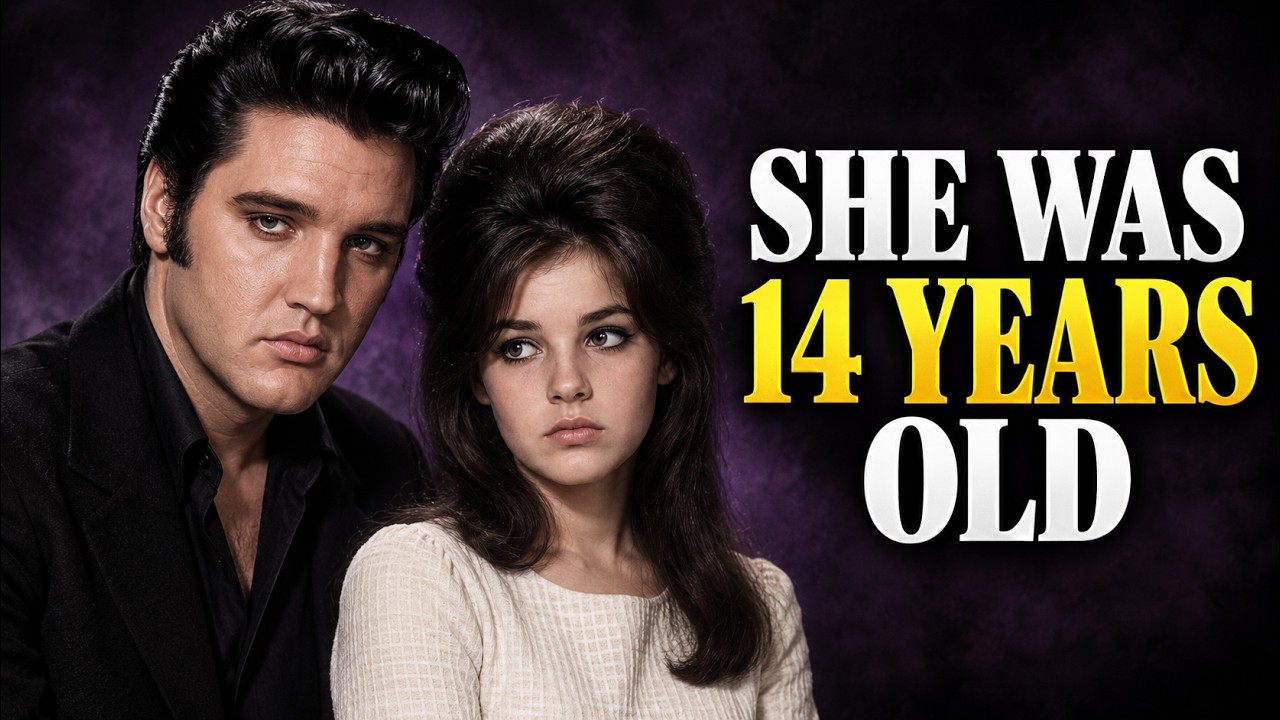
When Elvis and Priscilla were introduced in West Germany in 1959, she was fourteen years old and he was twenty-four. Their early meetings were supervised by her family, who established strict conditions before allowing further contact. The years that followed took her behind the gates of Graceland, where she lived a life that never seemed entirely her own, waiting most evenings for a man who was usually somewhere else. By the time she wore that dress, she had spent so long being shaped into what he wanted that she would later say she did not know who she actually was underneath it.
None of this was hidden. Her family, the American press, and millions of fans watched the public narrative unfold in something close to real time and largely accepted it without question. That is the part that should unsettle more than any secret would. The disturbing thing about Elvis and Priscilla was never hidden.
It was consensus. It started in Germany in 1959. Elvis Aaron Presley was already the most recognizable young man on the planet when the army sent him to Friedberg. He had eleven number one records, a movie career, and a media circus around his drafting that had followed him across the Atlantic.
He was twenty-four. He was lonely. His mother Gladys had died the year before, and he was grieving her hard, filling the house he rented in Bad Nauheim with a rotating cast of friends and hangers-on to avoid being alone with his loss. Priscilla Ann Beaulieu came from a military family.
Her stepfather, Air Force officer Paul Beaulieu, had just been transferred to West Germany, and the family had landed in a new country with few local connections. In November 1959, an acquaintance of Elvis’s approached Priscilla at a coffee shop and offered to introduce them. Her stepfather called the man’s commanding officer to verify the arrangement and required that any meeting be supervised. Those early years taught Priscilla something that mattered later, and it was not charm or beauty, though both are constantly mentioned in retellings.
It was adaptability under supervision. She was a child of a frequently relocating military family, someone who had learned to read a new environment quickly, defer to authority without friction, and make herself agreeable to whoever controlled the circumstances. That learned adaptability defined the years that followed, for better and for considerably worse. By her own account in the 1985 memoir Elvis and Me, the initial relationship developed through conversation and music.
Elvis played records, talked about his mother’s death, and appeared more vulnerable and ordinary than the version of him on television. The meetings took place under family rules, with supervision and a fixed return time. When Elvis returned to the United States in March 1960, direct contact largely gave way to calls and letters. For the next two years, he worked to win the confidence of the Beaulieu family.
In 1962, he asked them to approve a visit to Los Angeles, and the Beaulieus drew up a formal list of conditions before agreeing: supervision, a return date, and clear assurances about accommodation. Elvis accepted every demand. During that visit, Priscilla’s distinctive public appearance began to take shape, according to multiple accounts, largely at his direction. It was an early sign of a pattern that would later dominate their adult life together.
Elvis deciding how he wanted Priscilla to look and encouraging her to conform to that image. The next turning point came when Elvis proposed that Priscilla relocate to Memphis. He presented the arrangement to her family as structured, supervised, and focused on completing her education, with accommodation initially said to be provided by Elvis’s father and stepmother on the Graceland property. According to Priscilla’s later account, the reality gradually became different.
She entered the closed world surrounding Graceland, where daily life revolved around Elvis’s schedule, tastes, friends, and employees, the group known as the Memphis Mafia. The arrangement separated her from her family and familiar surroundings and placed her inside a world controlled by one exceptionally powerful public figure. Her family, Elvis’s management, and eventually the press presented the arrangement as reassuring and respectable. Nobody in this story needs to be reduced to a cartoon villain for the imbalance to remain troubling.
The arrangement was visible, approved, and widely celebrated. After Priscilla completed her education and entered adulthood, the pattern continued. What is well documented from her own writing and from people around the household is that Elvis influenced her clothing, makeup, posture, schedule, and social life. She was expected to be available and unbothered whenever he returned from Hollywood.
She would later describe herself plainly as having been molded. His word for it, by her account, was that he wanted to build her into the perfect wife. That is not devotion. That is ownership dressed as care.
Both of those things were sitting in the same house at the same time. The engagement came in 1966, the wedding in May 1967, the eight-minute Vegas ceremony behind the photograph everyone kept. Lisa Marie was born on February 1, 1968. For a while from the outside, the marriage looked like the fairy tale had simply continued.
The record tells a different story about what those years at Graceland actually were. By Priscilla’s own account, and by reporting that emerged over the following decades, Elvis’s affairs during his film years were widely known within his circle and largely tolerated by an entourage financially and socially dependent on him. She described periods of profound loneliness inside a house full of people. A wife whose social calendar consisted of whatever movie Elvis wanted to see, whatever music he wanted playing, whatever restaurant he wanted to visit, with essentially no independent life of her own carved out anywhere in it.
That is not a marriage souring gradually the way marriages sometimes do. It is the same dynamic from 1963 continuing uninterrupted into the years everyone assumed had fixed itself with a wedding ring. By the early 1970s, the record shows a household under real strain. Elvis’s increasing prescription drug dependency, documented later in detail by biographers with access to medical and household records, along with his continued relationships outside the marriage, and Priscilla’s own growing restlessness after years of having no identity outside Elvis’s wife.
In 1972, she left Graceland for a karate instructor she had met through Elvis’s own entourage. The first real autonomy she claims for herself was an affair conducted using the very household Elvis had built to contain her. Elvis, by multiple accounts, was devastated. The divorce was finalized October 9, 1973, in Santa Monica.
That is not a villain getting what he deserved. It is two people, one of whom had been directing the other’s adult identity from its earliest stages, discovering that the architecture had a structural flaw the whole time. A person underneath it who eventually wanted out. What Priscilla did with the years after is where the story stops being simple.
She did not disappear, and she did not spend the rest of her life litigating Elvis publicly, even though by any modern reading she would have had grounds to. Instead, after his death in August 1977, she became almost immediately the person who saved his financial legacy. As co-executor of his estate, facing a Graceland on the verge of being sold off to cover debts, she made the decision in 1982 to open the mansion to the public. Elvis Presley Enterprises, under her stewardship, turned Graceland into one of the most visited private homes in America and built the machinery that still generates the bulk of the Presley estate’s value today.
The woman who had been shaped into the perfect wife became, after the marriage ended, an unusually shrewd business executive. That is documented in tax filings and corporate history rather than in private letters. She has also, consistently over four decades of interviews, refused to render Elvis as simply a monster. She described real tenderness alongside the control, moments of genuine gentleness, and a grieving man who could appear vulnerable and caring in private.
That complexity is essential to understanding why his influence over her became so complete. Priscilla herself has spent forty years describing him as both the great love of her life and, in the same breath, the person who shaped her identity in his own image. Both of those things appear to be true. The formula wants you to pick one.
The record will not let you. For nearly a decade after the divorce, there was no detailed version beyond tabloid speculation. Then, in 1985, Priscilla published Elvis and Me. Every serious retelling since, including this one, is downstream of that single book.
She is essentially the only person from inside that household who chose to put a first-person account on the record at length. The memoir is sympathetic to Elvis in tone, even as it documents, in plain language, the isolation, imbalance, and control. That combination, affectionate and damning at once, is precisely why the book has been read two completely different ways for forty years. As a love story with some hard edges, or as a documented account of one person’s identity being shaped by someone far more powerful.
Sofia Coppola’s 2023 film Priscilla, adapted directly from that memoir and co-produced with Priscilla’s involvement, is the first major mainstream retelling to lean hard into the second reading. Graceland is filmed as something closer to a beautifully decorated cage than a palace. Priscilla approved that framing. The woman who spent decades protecting Elvis’s commercial legacy also signed off on a film that portrays a person gradually losing her independence inside the world of a man everyone else called a king.
The control of the narrative has not stopped mattering even now. After the death of her daughter, Lisa Marie, in January 2023, Priscilla found herself in a bitter legal dispute with her granddaughter, Riley Keough, over control of the trust that governs Graceland itself. A fight over who gets to be the literal custodian of Elvis’s physical legacy, eventually settled privately. She published a second memoir, Softly as I Leave You, in 2025, extending the story on her own terms yet again.
Every major account of this relationship, seventy years on, still runs through one woman’s decision about what to disclose, when, and how sympathetically. Go back to the photograph from May 1, 1967. It captures the brief ceremony and the carefully presented image of the newly married couple. Everyone kept that photograph because it looks like the end of a fairy tale.
The woman from Germany who married the king. What the photo actually shows, once you know what came before it, is the culmination of years of influence and control. By the time Priscilla entered the marriage, much of her appearance, schedule, environment, and public identity had already been shaped around Elvis’s expectations. He loved her in some real sense and controlled her in an equally real one, with the cooperation of people who interpreted that control as devotion.
People think they remember a love story with an unhappy ending. What they actually remember, once you strip the caption off the photograph, is the wedding portrait of a woman who had been disappearing into someone else’s design long before she was finally able to write her own account of it.
