In early 2020, as COVID-19 lockdowns swept across the United States, interest in amateur radio surged dramatically. Enrollment at Ham Radio Prep, one of the largest online licensing course providers, jumped by more than 700 percent in the second week of March alone compared to the same week the previous year. People stuck at home sought a hobby that required no departure from the house and offered a documented role in emergency communications. Yet by the end of July 2020, new amateur licenses issued had fallen by roughly 12 percent compared to the same period in 2019.
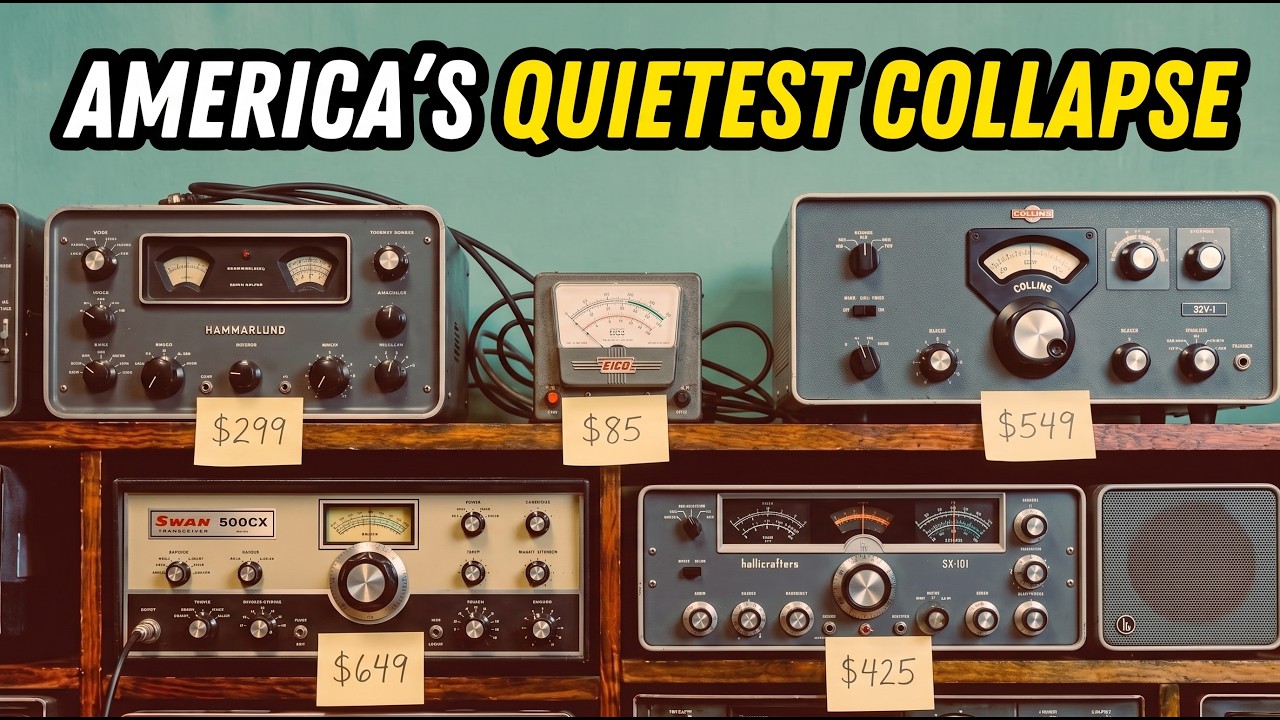
The wave of curiosity never fully became a wave of commitment. The 68-year-old Dayton Hamvention, the hobby’s largest annual gathering, was cancelled that spring for the first time in its history. In-person testing, the traditional gatekeeper for licensing, was widely suspended. Some pandemic newcomers did follow through, bought equipment, often new and at retail prices, then drifted away as restrictions lifted.
That equipment did not disappear. It entered the used market in the following years, barely used and in good condition, adding to a surplus already building from other directions. This was not the first time the amateur radio equipment market had been reshaped by outside forces. The Heathkit company, whose self-assembled radios defined the hobby for a generation, quietly ended its electronics kit line in March 1992 after 47 years.
Commentators at the time cited a familiar mix of reasons: mass-produced foreign electronics had become cheaper than the parts needed to build a kit at home, and fewer people wanted to spend a weekend with a soldering iron when a finished product cost about the same. That pattern had not previously struck the used equipment market in the same way. For most of the postwar era, used amateur radio gear behaved less like consumer electronics and more like a musical instrument or a fine hand tool. Companies such as Collins Radio, R.
L. Drake, and Heathkit produced equipment meant to be repaired, not replaced, and it retained a large share of its value for years. An operator would buy a transceiver, use it for a few contests, then sell it for a significant portion of its original price when upgrading. That resale value funded the next purchase.
The mechanism was simple: scarcity, brand reputation, and a generational upgrade cycle assumed that used equipment still held intrinsic worth. The Dayton Hamvention provided a useful window into this old economy. It began in 1952 when a small committee in Ohio hoped for 300 visitors but received more than 600. The used goods market, starting with about 200 seller spaces, eventually grew to more than 2,000.
In the late 1990s and early 2000s, tables of used Collins and Drake gear sold quickly. Entry-level handhelds from established Japanese manufacturers such as Yaesu, Icom, and Kenwood held a floor price of around 100 dollars even used, simply because no real alternative undercut them. That price floor mattered more than it seemed. It meant used equipment, even worn examples, had a dependable minimum value.
Sellers relied on it, buyers expected it. The entire used equipment economy rested on this quiet assumption. The first blow came from a direction almost nobody in that market was watching. In 2001, a company called Baofeng was founded in Fujian Province, China, manufacturing basic two-way radios for commercial and industrial buyers, the sort of unglamorous equipment used by security firms and construction crews.
In the early 2010s, Baofeng began producing dual-band handheld transceivers aimed directly at the amateur market. In May 2012, its UV-5R model received FCC approval, paving the way for wide sales in the United States. What followed damaged the used handheld market more than any single event before or since. The UV-5R and its long series of variants now typically sell for 20 to 30 dollars, making it by a wide margin one of the best-selling amateur radios in the world.
In 2025, the American Radio Relay League, the hobby’s national association, published an official guide titled Using the Baofeng Radio. When the establishment publishes a manual for the device that changed the game, the victory is complete. Consider what a new 20-dollar radio does to the value of a used one. For years, a well-maintained used handheld from an established manufacturer might sell for 60 or 70 dollars.
Once a new dual-band radio cost less than dinner for two, there was almost no room left for a used price. The price floor that had quietly supported the entry-level tier for decades simply ceased to exist. Other Chinese manufacturers pushed the same price pressure into higher categories. Xiegu began selling software-defined HF radios like the G90, compact 20-watt units with built-in antenna tuners and real-time spectrum displays, at prices far below what a comparable feature set would have cost from an established manufacturer just a few years earlier.
Trackers of used listings describe average resale values for entry-level handheld transceivers declining by high single digit percentages annually since around 2020. A free third-party program called CHIRP, which allowed owners to program these cheap devices from a laptop instead of fiddling with a small keypad menu, removed one of the last real annoyances separating a budget import from a branded handheld. Once Baofeng proved the model, manufacturers like Retevis, TYT, and Radioddity rushed to follow the same approach, and the low-cost handheld market became crowded with cheap options. A second independent force came from within the hobby itself.
Joe Taylor, call sign K1JT, a physicist who shared the 1993 Nobel Prize in Physics for discovering the first binary pulsar, and Steve Franke, K9AN, released a new digital mode called FT8, embedded in their WSJT-X software package. The name abbreviates their two call signs combined with the mode’s eight-tone frequency shift keying system. FT8 was designed to allow operators to make weak-signal contacts using short 15-second transmit cycles, with error correction strong enough to pull an understandable signal from noise about 20 decibels below the level where voice communications fade out entirely. Within about two years, it became the most widely used digital mode on the HF bands, and by 2025 the ARRL described it as the undisputed dominant digital mode in the hobby.
The reason this mattered for the used equipment market was not the technology itself but what it made unnecessary. Before FT8, making reliable long-distance contacts on HF often required a significant investment: a high-power transceiver, a large directional antenna, and sometimes a tower to mount it on. For operators living in apartments or neighborhoods with homeowners association restrictions on visible antennas, this was closer to a radical transformation than a gradual improvement. Serious HF operation no longer required the equipment that had defined the upper tier of the used market for generations.
Fewer operators felt the need for the premium transceiver, the tall antenna, or the power amplifier. When fewer people seek a particular class of used equipment, the price that class can command tends to fall with it. Taylor appeared genuinely surprised by the speed of FT8’s adoption, according to his public comments at the time. He described it as a special-purpose tool, distinct from the general role voice and Morse code still play in the hobby.
It was not an attempt to disrupt the market. Earlier, he had developed JT65 and WSPR, weak-signal modes built for tasks like earth-moon-earth communication and mapping how radio signals propagate around the world. FT8 was the moment this kind of research-oriented weak-signal software moved into ordinary daily use. Around the same period, a separate trend reshaped demand from a different angle, not by changing what equipment could do but by changing where people wanted to use it.
Parks on the Air began in early 2017, growing out of an ARRL special event encouraging operators to activate stations from national parks. When that event ended, a group of volunteers decided to keep the concept alive independently, and by 2018 it became a registered nonprofit. The idea is simple: licensed operators travel to a park or public land, set up a portable station, and try to make at least 10 contacts in a day to activate that location. Other operators, working from home or wherever they are, try to contact these activators and log the contact themselves.
By mid-2025, the program had attracted more than 49,000 active hunters and about 29,000 activators worldwide, with total contacts growing by nearly 40 percent between 2023 and 2025 alone. The significance lies not just in the growth but in the shift in the kind of equipment this growth requires. A Parks on the Air activator is not looking for a heavy base station or a tower-mounted directional antenna. They want something light enough to carry to a park, a compact low-power transceiver, a simple wire antenna that can be set up and taken down quickly, and a battery pack instead of a wall socket.
This created an almost paradoxical effect in the used market: it strengthened resale prices for one narrow category, small portable battery-powered radios, while prices for the heavy traditional equipment that once filled ham shacks continued to fall. Operators did not stop wanting equipment. They began wanting a different kind of equipment, and the used market was slow to catch up. The year 2020 brought a wave of interest that briefly seemed as if it might reverse the trend, before mostly failing to do so.
Dayton Hamvention, held annually since 1952, cancelled its 2020 event entirely. The pandemic disrupted the one thing that converts interest into licensing: in-person testing. Amateur radio tests in the United States were still typically administered in person by volunteer examiners, and when gathering restrictions swept the country, test sessions were cancelled or postponed on a wide scale. According to ARRL data from that period, new amateur licenses issued by the end of July 2020 fell about 12 percent compared to the same period in 2019, and overall FCC license application activity for the year fell by nearly 15 percent.
Then, starting in April 2022, the FCC imposed a 35-dollar application fee, mandated by Congress, covering new applications, renewals, and vanity call sign changes. It is a modest fee in absolute terms, but it arrived just as the pandemic wave of interest was already cooling. No single factor broke the used market, but together they reshaped its entire economy. On April 25, 2024, Martin Jue, the 80-year-old founder of MFJ Enterprises, announced in a letter to the amateur radio community that his company would cease production at its facility in Starkville, Mississippi.
MFJ was founded in 1972, starting with a small set of CW filters sold for under 10 dollars, and grew by 2014 into the world’s largest producer of amateur radio accessories, expanding by acquiring other well-known brands: Ameritron, Hy-Gain, Cushcraft, Mirage, and Vectronics. They all fell together. In his letter, Jue pointed directly to the effects of the COVID-19 pandemic, writing that it was the strongest blow the company had ever received and that it never fully recovered. Production officially ended on May 17, 2024.
The closure of MFJ attracted the most attention given the company’s size, but it was part of a longer pattern rather than an isolated event. Ham Radio Electronics Supply, a retail operation for 59 years, closed all four of its stores in Milwaukee, Las Vegas, Cleveland, and Orlando in the summer of 2016. Ham Radio Outlet, the last major national retail chain still standing in the hobby, has trimmed its presence over the years since. Beneath every other force lies a demographic reality the amateur radio community has long been aware of.
According to a 2019 editorial by then-ARRL CEO Howard Michel, published in QST magazine, the average age of an ARRL member at that time was 68. Surveys from national radio associations in several European countries put the average age of licensed operators higher, often approaching 70. In Germany, statistics collected by the national amateur radio association DARC show operators peaking at about 80,000 in 2002. When licensed operators pass away, the community has a special term for them: they become silent keys.
Their families are often left with a complete station of equipment they do not understand, cannot easily value, and usually just want to dispose of. Companies have formed specifically to serve this need. Ham Estate, for example, offers inventory, valuation, and liquidation of an entire silent key station, including towers and antennas, for a commission of 30 percent of net proceeds. The steady flow of estate equipment adds another stream pressuring prices.
Yet the hobby itself is not declining. Dayton Hamvention has actually posted record attendance in recent years: over 33,000 attendees in 2023, nearly 36,000 in 2024, and close to 37,000 in 2025, its highest figure ever. The hobby’s appeal, the community, the tinkering with equipment, the shared knowledge, has not weakened at all. What changed is something narrower and more specific.
The old economy of used equipment, built on the assumption that each new generation of operators would fund upgrades by reselling old gear at near-purchase prices, and that serious HF operation required expensive transceivers and towering antennas, collapsed within a single ten-year period. In 2025, a series of tariffs affecting electronics imported from Japan and China began appearing directly in invoices for new amateur radio equipment. Dealers and manufacturers described cost increases of 24 percent or more on some products, sometimes higher depending on country of origin and specific tariff classification.
For the first time, a force is pushing used prices upward.
